Hearing
 Call Kai
 Learn
Learn Practice Test
 Spaced Repetition
 Match
Match Flashcards
 Knowt Play
1/57

Earn XP
Description and Tags
Final Exam
Name | Mastery | Learn | Test | Matching | Spaced | Call with Kai |
|---|
No analytics yet
Send a link to your students to track their progress
58 Terms
Amplitude/Intensity
The magnitude of displacement (increase or decrease) of a sound pressure wave. Perceived as loudness.
Frequency
For sound, the number of times per second that a pattern of pressure change repeats. Perceived as pitch.
Pressure fluctuation of a sound in relation to distance
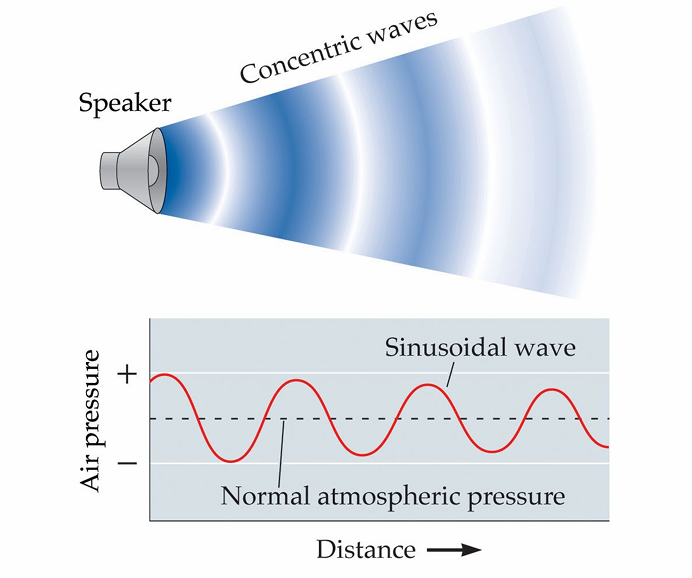
Sound waves are described by the frequency and amplitude of pressure fluctuations
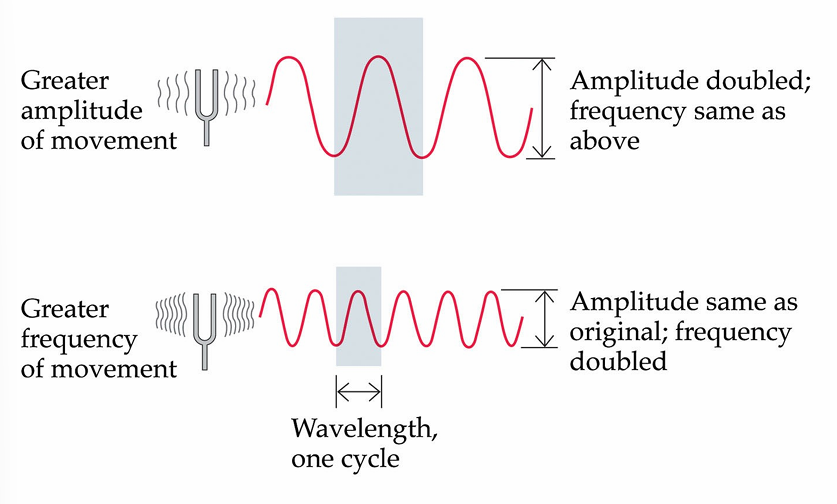
Hertz (Hz)
A unit of measure for frequency (equals one cycle per second)
Loudness
The psychological aspect of sound related to perceived intensity (amplitude)
Pitch
The psychological aspect of sound related mainly to the fundamental frequency
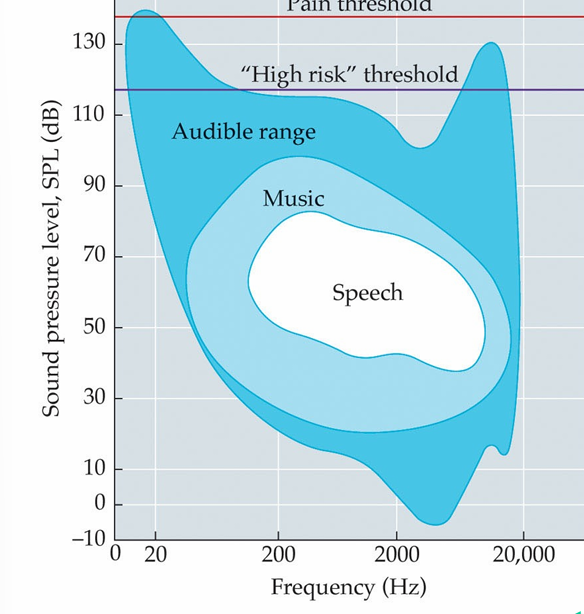
Decibel (dB)
A unit of measure for the physical intensity of sound. Defines the difference between 2 sounds as the ration between 2 sound pressures (Ex: 10:1 sound pressure = 20dB, and a 100:1 ratio = 40dB) ((ON A LOG SCALE))
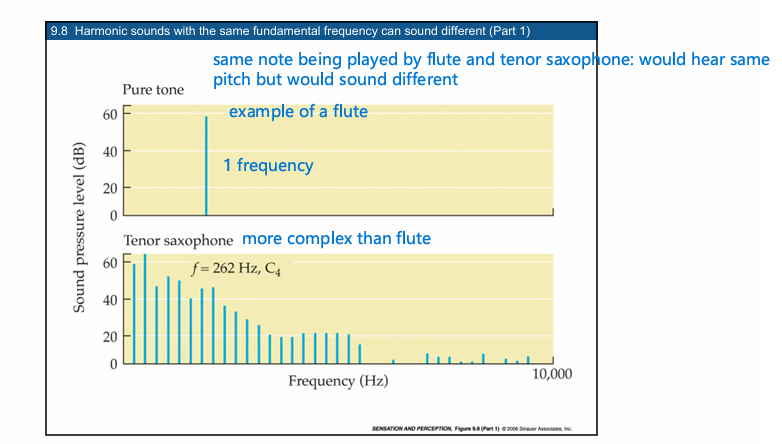
Sine wave/Pure tone
The waveform for which variation as a function of time is a sine function
Spectrum
A representation of the relative energy (intensity) present at each frequency.
Fundamental Frequency
The lowest-frequency component of a complex periodic sound (go from Low A 27.5 Hz to High C 4.2 kHz) ((middle C is 261 Hz)
Acoustic Energy
Disturbance in the density of particles which comprise an elastic medium
Phase
Position of a sound wave within its cycle at a specific point in time (measured in degrees)
Transmission
Process by which sound waves are collected, amplified and converted into electrical nerve impulses for the brain to interpret as sound.
Absorption
Process by which sound energy is taken in by a material when sound waves encounter it rather than being reflected back into the environment
Reflection
Occurs when sound waves travel through the air and when these waves encounter a surface they don’t simply stop, they bounce off creating echoes.
Sound Vs. Light
In vision amplitude and phase is irrelevant (never changes)
Light is significantly faster than sound
Concentric Waves
Circular waves that emanate outward from a certain point
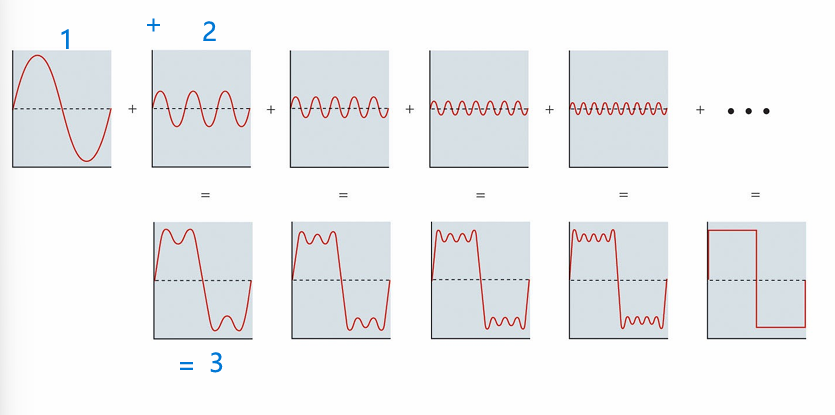
A sine wave is a circular motion extended over time
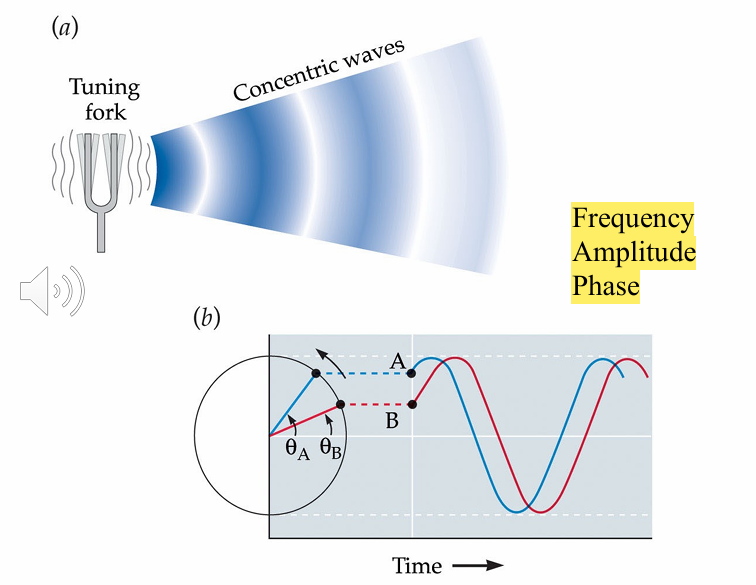
Every complex sound wave can be analyzed as a combination of sine waves
Harmonic sounds with the same fundamental frequency can sound different
Pinna
The outer, funnel-like part of the ear
Ear Canal
Conducts sound vibrations from the pinna to the tympanic membrane and prevents damage to the tympanic membrane
Tympanic Membrane
The ear drum; a thin sheet of skin at the end of the outer ear canal. Vibrates in response to sound.
Outer Ear
The external sound gathering portion of the ear, consisting of the pinna and the ear canal
Middle Ear
An air-filled chamber containing the middle bones (ossicles). Conveys and amplifies vibration from the tympanic membrane to the oval window
Ossicle
Any of three tiny bones of the middle ear: malleus, incus, and stapes
Malleus
Receives vibration from the tympanic membrane and is attached to the incus
Incus
Middle of the three ossicles, connecting the malleus and the stapes
Stapes
Connected to the incus on one end, it presses against the oval window of the cochlea on the other end.
Oval Window
The flexible opening to the cochlea through which the stapes transmits vibration to the fluid inside
Inner Ear
A hollow cavity in the temporal bone of the skull and the structure within its cavity: the cochlea and the semicircular canals of the vestibular system canals
Tensor Tympani
The muscle attached to the malleus; tensing it decreases vibration
Stapedius
The muscle attached to the stapes; tensing it decreases vibration
Acoustic Reflex
Protects the ear from intense sounds via contraction of the stapedius and tensor tympani muscles
Cochlea
A spiral structure of the inner ear containing the organ of Corti
Tympanic Canal
One of three fluid-filled passages in the cochlea. Extends from the round window at the base of the cochlea to the helicotrema at the apex
Vestibular Canal
One of three fluid-filled passages in the cochlea. Extends from the oval window at the base of the cochlea to the helicotrema at the apex
Middle Canal
One of three fluid-filled passages in the cochlea. Sandwiched between the tympanic and vestibular canals and contains the cochlear partition
Helicotrema
The opening that connects the tympanic and vestibular canals at the apex of the cochlea
Reissner’s Membrane
A thin sheath of tissue separating the vestibular and middle canals in the cochlea
Basilar Membrane
A plate of fibers that form the base of the cochlear partition and separates the middle and tympanic canals in the cochlea
Cochlear Partition
The combined basilar membrane, tectorial membrane and organ of Corti, together responsible for the transduction of sound waves into neural signals.
Round Window
A soft area of tissue at the base of the tympanic canal that releases excess pressure remaining from extremely intense sounds.
Organ of Corti
A structure on the basilar membrane of the cochlea that is composed of hair cells and dendrites of auditory nerve fibers
Hair Cell
Any cell that has stereocilia for transducing mechanical movement in the inner ear into neural activity sent to the brain; some receive inputs from the brain
Auditory Nerve
A collection of neurons that convey information from hair cells in the cochlea to (afferent) and from (efferent) the brain stem
Stereocilium
Any of the hairlike extensions on the tips of hair cells in the cochlea that, when flexed, initiate the release of neurotransmitters
Tectorial Membrane
A gelatinous structure, attached on one end, that extends into the middle canal of the ear, floating above inner hair cells and touching outer hair cells
Tip Link
A tiny filament that stretches from the tip of a stereocilium to the side of its neighbor
Place Code
Tuning of different parts of the cochlea to different frequencies in which information about the particular frequency of an incoming sound wave is coded by the place along the cochlear partition that has the greatest mechanical displacement
Afferent Fiber
A neuron that carries sensory information to the central nervous system
Efferent Fiber
A neuron that carries information from the central nervous system to the periphery.
Threshold Tuning Curve
A graph plotting the thresholds of a neuron on fiber in response to sine waves with varying frequencies at the lowest intensity that will give rise to a response
Characteristic Frequency (CF)
The frequency to which a particular auditory nerve fibers is most sensitive
Eustachian Tube
A narrow passage leading from the pharynx to the cavity of the middle ear, permitting the equalization of pressure on each side of the eardrum.
Vestibular Nerve
A component of the inner ear, plays a fundamental role in maintaining balance and spatial orientation. It relays information about head position and movement to the brain.
Tunnel of Corti
Spiral passage located in the cochlea that plays a crucial role in the transmission of sound waves to the hair cells.