p1 predictions
 Call Kai
 Learn
Learn Practice Test
 Spaced Repetition
 Match
Match Flashcards
 Knowt Play
1/54

There's no tags or description
Looks like no tags are added yet.
Name | Mastery | Learn | Test | Matching | Spaced | Call with Kai |
|---|
No analytics yet
Send a link to your students to track their progress
55 Terms
3 ways to prevent mosquito bites
• wear long(er) sleeves / clothes
allow reduce bare skin exposure
• use insect repellent or insecticide
• mosquito nets
why does the plant cell contains mitochondria but the bacterial cell does not contain mitochondria.
bacterial cell is too small
stages of the cell cycle
stage 1: DNA / chromosomes replicate and sub-cellular structures increase in number
stage 2: one set of chromosomes is pulled to each end of the cell
stage 3: cytoplasm and cell membrane divide to form 2 identical daughter cells
does a RBC have nucleus
no
what shape is a plant cell
rectangular
Explain why the red blood cell bursts but the plant cell does not burst.
water enters (the cells) by osmosis
plant cell has a cell wall (which prevents it from bursting)
function of haemoglobin
carries oxygen
from lungs to tissues
what to always say when talking about respiration
if its aerobic or anaerobic
why do many of the cells in a plant root store starch.
starch is energy source / store (for active transport)
how to convert 1 mm into micrometre
multiply by 1000
Give two advantages of using an electron microscope instead of a light microscope.
high(er) magnification
high(er) resolution
Give two ways onion cells would look different when seen using an electron microscope.
(would) look more magnified / bigger
(cell would) have more detail
or
(would) be at a higher resolution
or
(could) see more sub-cellular structures
or
sub-cellular structures seen in detail
3 reasons why a womens 3 children r not genetically identicak
• different egg / sperm each time
• genes from two parents
• each gamete / egg / sperm has different alleles / genes / DNA / genetic information
Which two factors can cause cancer?
antibiotics and viruses
Give two advantages of using an electron microscope instead of a light microscope.
high(er) magnification
high(er) resolution
What is the function of mitochondria?
to transfer energy for use
by (aerobic) respiration
Describe the function of muscle cells in the wall of the stomach.
contract
to churn / move / mix food
why does anaerobic respiration release less energy than aerobic
less energy released / transferred (per molecule of glucose)
(due to) incomplete breakdown / oxidation of glucose
why is having more rbcs good for an athete
there is) more haemoglobin so more oxygen (carried / bound
(athlete can do) more aerobic respiration to transfer / release (more) energy
Explain the advantages of red blood cells passing through a capillary one at a time.
more oxygen released (to tissues)
• slows flow
• shorter distance (for exchange)
• more surface area exposed
conversion of mm to nm
x 100 000 000!!!!!!!
4 aspectic techniques for investigating effectiveness of antibiotics
• sterilise equipment / surfaces (before use)
• (use) sterilised agar
• secure lid of the Petri dish with (adhesive) tape
• only lift lid of Petri dish a little (when setting up plate)
Name 2 medical conditions that could be treated using heart cells created from an embryo.
CHD and cardiovascular disease
1 good thing about using stem cells for donar organs
can be done immediately and no need to wait
why is using a stent in a trachea good
stent opens up the trachea
allowing air to flow through
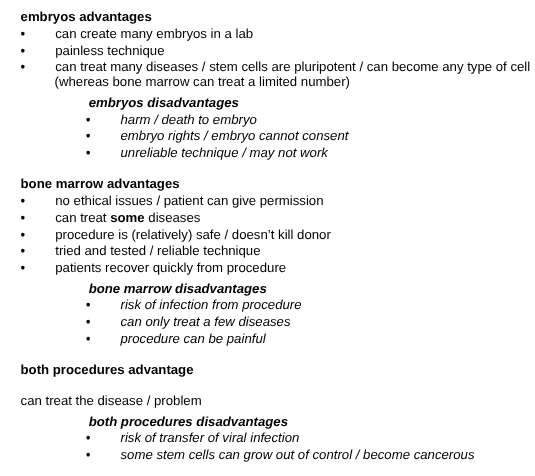
Evaluate the use of stem cells from a patient’s own bone marrow instead of stem cells from an embryo.
what type of cell division causes the change in number of E. coli cells
binary fission
what will happen if bacteria have no nutrients
die
Describe how water moves from roots to the leaves.
by transpiration stream / pull
in xylem
why is it good to have most stomata on lower side of leaf
less water lost
so it does not wilt
Describe, as fully as you can, how urine is produced by the kidneys.
• filtration of blood
• reabsorption / substances taken back into blood
• (reabsorption) of all of the sugar / glucose
• (reabsorption) of some of ions / of ions as needed by body
• (reabsorption) of some of water / of water as needed by the body
• urea present in urine / urea not reabsorbed
• reabsorption of water by osmosis / diffusion
or reabsorption of sugar / ions by active transport
what does activ transport happen across
membrane
formula for respiration in plants
C6H12O6 + 6O2 → 6CO2 + 6H2O
Describe the process of active transport in the root hair cells of plants.
take up of (soluble) substances / ions against the concentration gradient
through the (semi-permeable) (cell) membrane
energy from mitochondria
Explain why putting pressure on the heart helps the person.
pushes / moves blood
to get oxygen around the body
Describe how forcing air into the person’s lungs helps the person.
provides oxygen (for respiration)
Explain the effect of a partly blocked coronary artery on the human body.
reduced blood flow to heart (muscle / tissue / cells)
• (so) less oxygen to heart (muscle / tissue / cells)
• (so) less (aerobic) respiration (in heart / body cells)
(more) anaerobic respiration
• (so) less energy (released)
• (so) less blood / oxygen / glucose around the body (from heart)
less carbon dioxide removed from body (muscle / tissue / cells)
• (resulting in) breathlessness
• (resulting in) tiredness
(anaerobic respiration causes) production of lactic acid
• (build-up of lactic acid) causes muscle fatigue / pain or chest pain
Other than heart disease, name two conditions which are linked to obesity.
• arthritis
• diabetes
• high blood pressure
• strokes
Give the three main stages in testing a new drug before it is sold to the public.
laboratory tests / tests on tissues
tests for side effects on volunteers / healthy people / small numbers
test on patients / sick people
Describe what happens during blood clotting.
involvement of platelets / eg platelets ‘trigger’ clotting process
meshwork formed (which traps blood cells)
Describe how the structure of an artery is different from the structure of a vein.
doesn’t have valves
has a thicker wall or thicker layer of muscle doesn’t have valves
Give 4 differences in the composition of the blood in an artery and vein
• (artery has) more oxygen
• (artery has) more glucose
• (artery has) less carbon dioxide
• (artery has) less lactic acid
Suggest 4 possible advantages of using the new artificial blood, instead of using human blood for a transfusion in humans.
• no rejection
• abundant supply
• low risk of infection
• longer shelf life
what can happen w a leaking heart valves
backflow can occur or some blood flows backwards
what do u have to take alongside mechanical heart valves
statins/blood thinners
do mechanical or biological valves last longer
mechanical
role of white blood cells
defence against or destroy pathogens / bacteria / viruses / microorganisms
what factors must be checked on an artificial heart valve before insertion
• that it doesn’t cause an immune response or isn’t rejected / damaged by white blood cells
• whether it is a long lasting material / doesn’t decompose / corrode / inert
• if it is strong (to withstand pressure)
• it will open at the right pressure
• that it doesn’t cause clotting
• that it doesn’t leak or it prevents backflow
• non toxic
what is a drug
(substance / chemical) that affects body chemistry / chemical reactions in the body
what is starch broken down into
sugars
Benedict colour change upon what ..
blue to green, yellow, orange, or brick-red upon heating, depending on concentration
colour change biuret solution
from blue to violet
Describe a method to investigate the effect of pH on the rate of starch breakdown by amylase.
• add iodine solution to spotting tile
• use measuring cylinder
• (to) add amylase (solution), pH solution and starch (solution) together
• start the timer
• use pipette
• (to) remove a drop of mixture at regular intervals (e.g. every 30 seconds)
• add drop of mixture to iodine (solution)
• if starch is present, mixture and iodine (solution) turns blue / black
• continue until the iodine (solution) and the mixture remain yellow / orange / brown
• record the time taken for the mixture to remain orange
• repeat at different pH
• compare times at each pH
(control variables):
• volume of starch (solution) / amylase (solution) / pH solution / iodine (solution)
• concentration of starch (solution) / amylase (solution) / pH solution / iodine (solution)
• temperature
Suggest what happens to the breakdown of starch when it reaches the stomach.
breakdown stops
because stomach produces / contains acid / has low pH
and amylase cannot work in acid / low pH
what is a enzyme
a catalyst / speeds up a reaction1
it is a protein or it is specific or it has an active site