Class 14: Public Goods
 Call Kai
 Learn
Learn Practice Test
 Spaced Repetition
 Match
Match Flashcards
 Knowt Play
1/25

There's no tags or description
Looks like no tags are added yet.
Name | Mastery | Learn | Test | Matching | Spaced | Call with Kai |
|---|
No analytics yet
Send a link to your students to track their progress
26 Terms
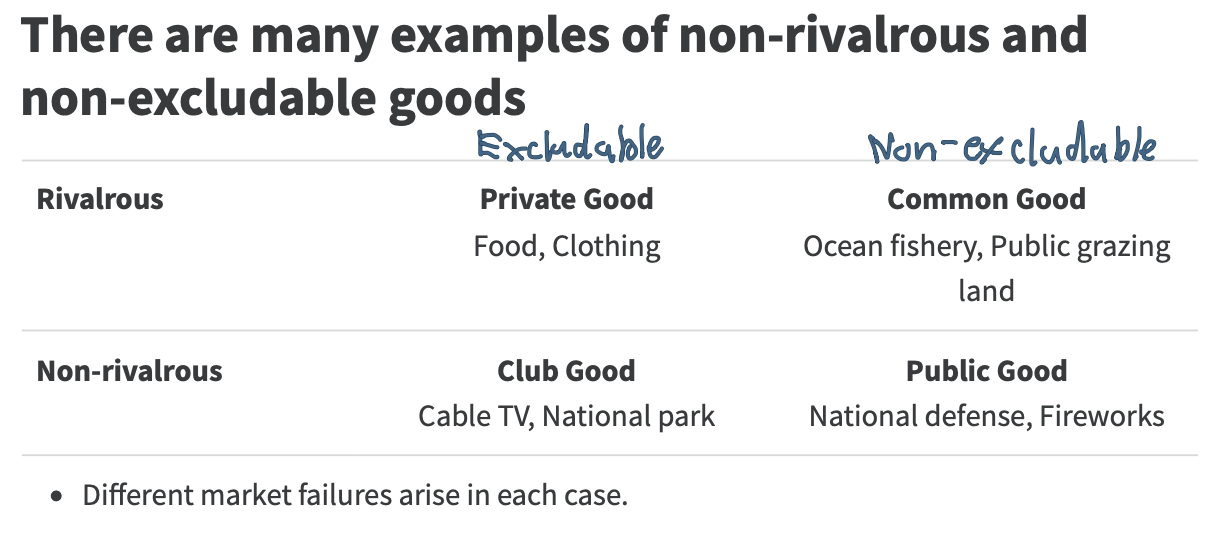
What are private goods?
Most goods we think about in economics are private goods
1. If I have something, I can prevent you from using it
2. If I consume it, you don’t get to consume it
What are some goods that not private goods? Non-rivalrous
Non-rivalrous good is if one person consumption does not reduce another person utility from consuming it
What are some goods that not private goods? Non-excludable
Non-excludable goos is if people can’t be prevented from consuming it
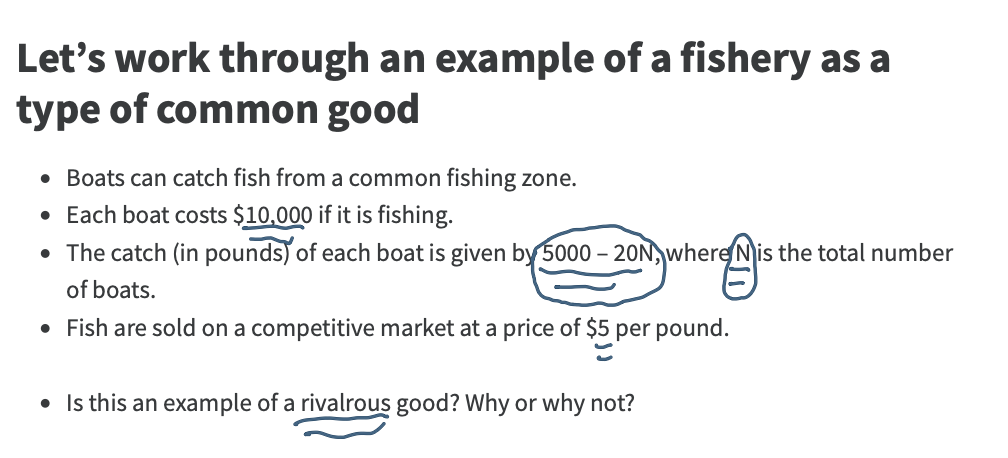
What type of good are ocean fishery and why?
They are rivalrous and non-excludable, because they are rivalrous over fishing reduces the utility of the next fishermen, and non-excludable, because you can’t really enforce, or exclude people from the oceans
What type of good are fireworks display?
Non-rivalrous and non-exludable, because anyone can watch a firework blow up in the sky without ruining it for other people, and it impossible to exlude people from watching if your nearby
What are some examples of non-rivalrous and non-excludable goods
Noted
What is tragedy of the commons?
It occurs when common goods (rivalrous and non-excludable) become overused by people, leading to the degradation of a resource by a user imposes a negative externality on other users. Left unregulated, users will overuse the resource relative to the socially optimal level
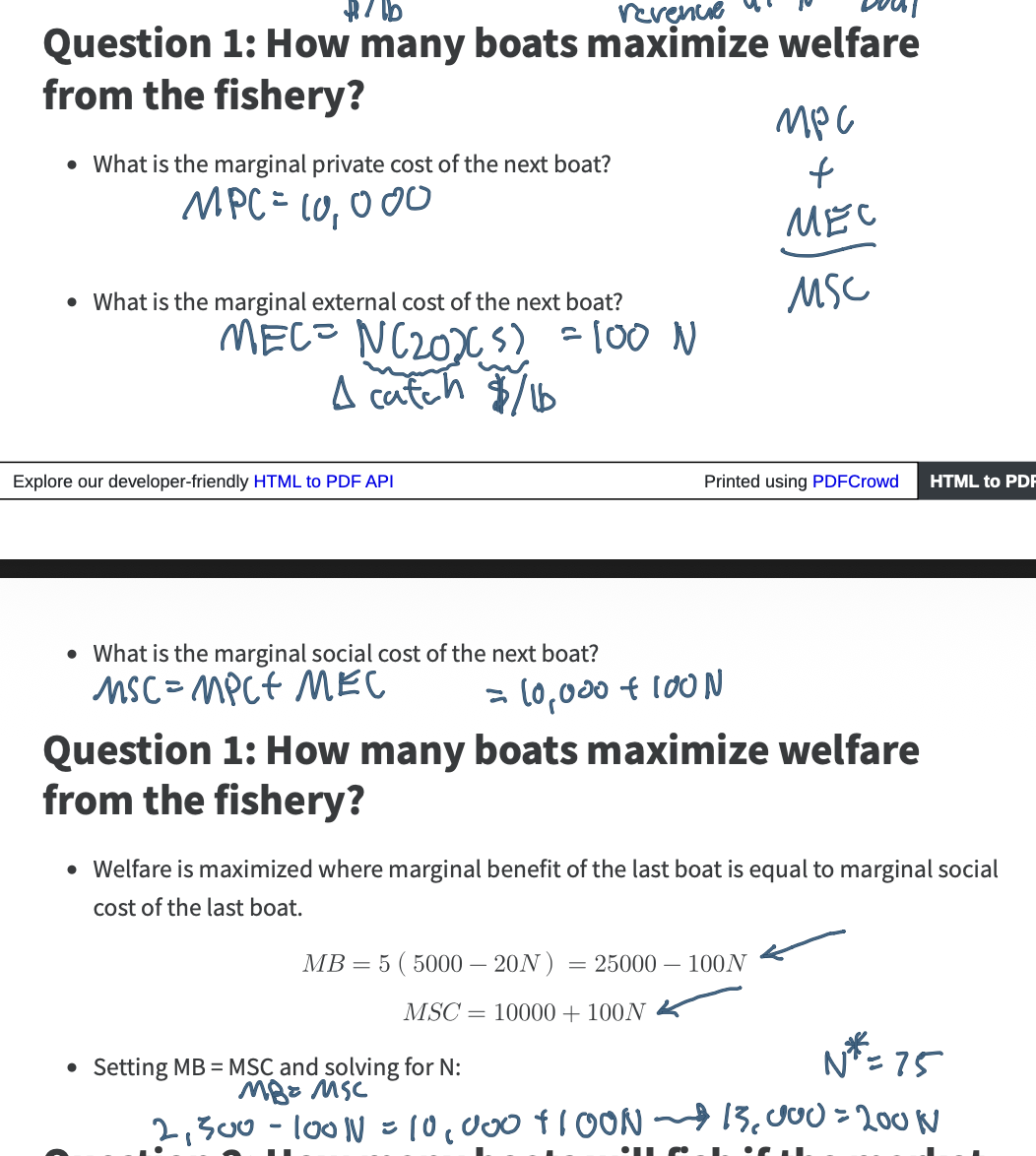
How many boats maximize welfare from the fishery?
Set marginal benefit (MB) = Marginal Social Cost (MSC)
MB = MSC
MB = P x Q
MB = 5 (5000 - 20N) = 25,000 - 100N
MPC = 10,000
MEC = N(20 (Change in catch) 5 ($/lb)) = 100N
MSC = 10,000 + 100N
MSC = MB
10,000 + 100N = 25,000 - 100N
200N = 15,000
How many boats will if the market is perfectly competitive?
Profit = TR - TC = MB - MPC
MB = 25,000 - 100N - MPC = 10,000
-100N = -15,000
N = 150
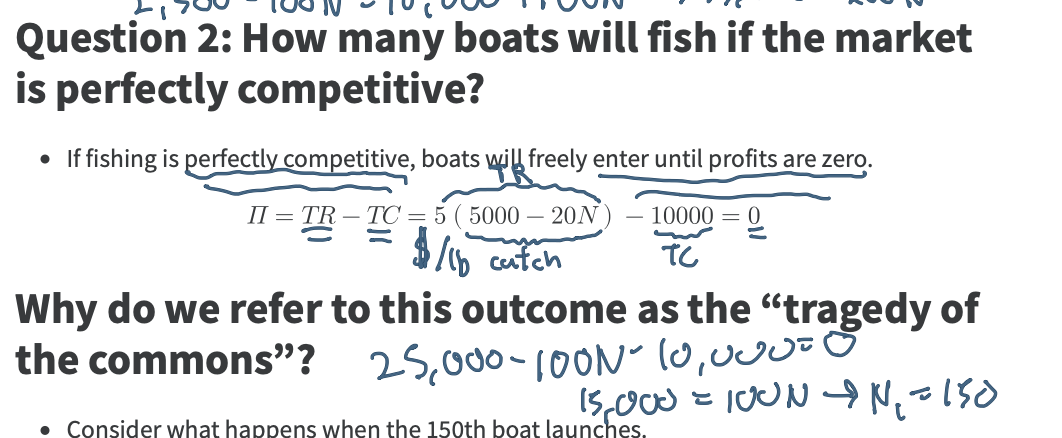
Why do we refer to this outcome as the “tragedy of
the commons”?
This is tragedy of the commons, because each boat owners cares about the profits there own, and don’t care about the externality they impose on others fishers. Resulting in private action overusing or deplete common resources
How can we solve the tragedy of the commons?
Governments could levy a Pigouivan tax each boat, and thus providing a barrier of entry into the market and reducing the amount of fishery entering the market
An alternative approach is to encourage firms to jointly manage the resource as a cooperative
How can a Pigouvian tax solve the tragedy of the commons?
Previous problem: N^* = 75
MEC = 100N
Recall that the optimal pigouvian tax is set equal to Marginal External Cost (MEC) at socially optimal quantity
t (pigouvian tax) = MEC(socially optimal quantity)
t = 100(75)
t = $7,500
How does the tax impact the size of the competitive fishing fleet?
Profit = TR - TC
N^* = 75
25,000 - 100N - 10,000 (MPC) - 7,500 (Externality) = 0
7,500 = 100N
N = 75
How can a cooperative solve the tragedy of the commons?
Working progreress
Public goods and market failure
Public goods are non-excludable and rivalrous
Mnay people can use and enjoy them without reducing their value
Ex - National defense, fireworks, lighthouses
What market failure occurs under public goods
Under public goods each person that contributes to the public goods generates a large positive externality that many people can enjoy regardless of contributions
This leads too little of the public good being provided, and economists refer to this as free-rider problem
Note - Look at the image
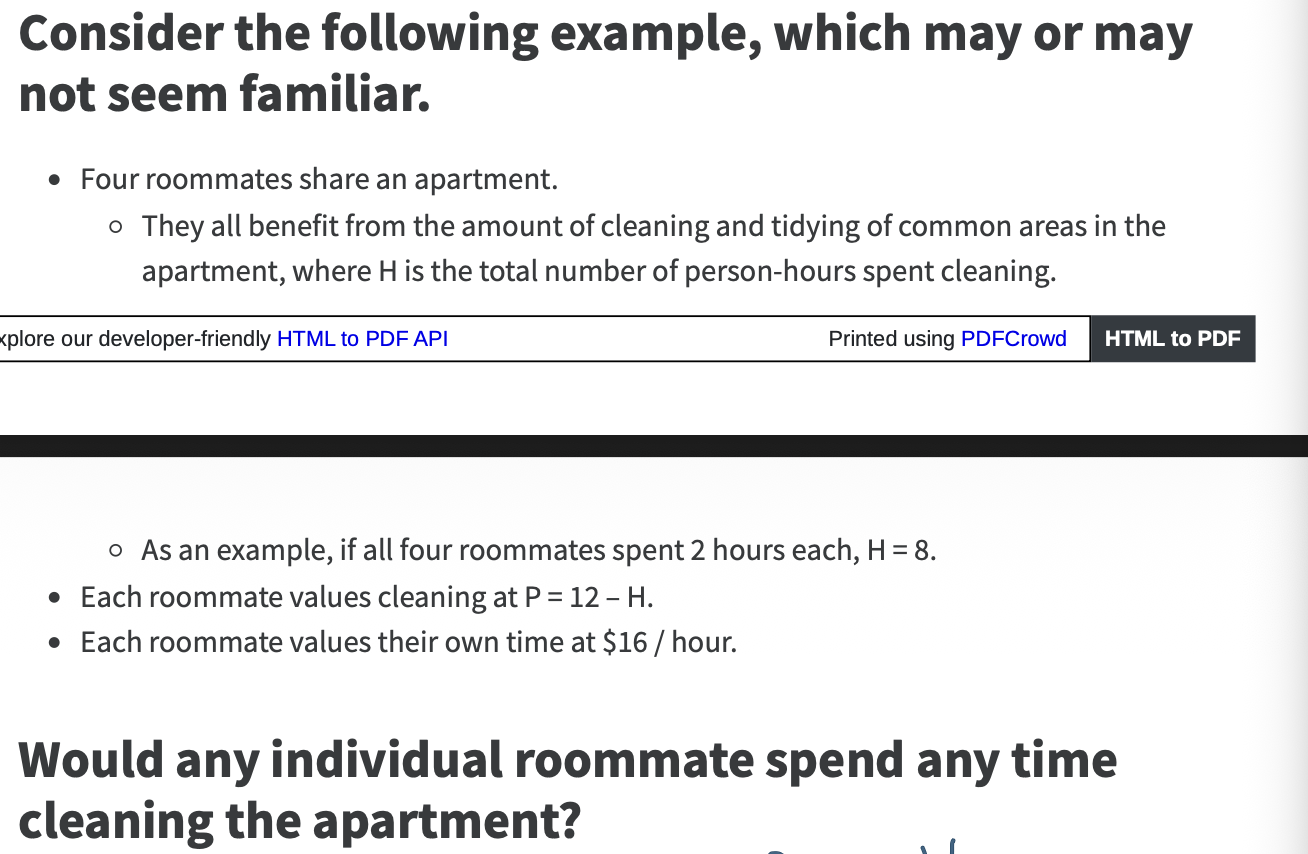
No, because each roommate values there time at $16 / hour and individual value of cleaning is P = 12 - H
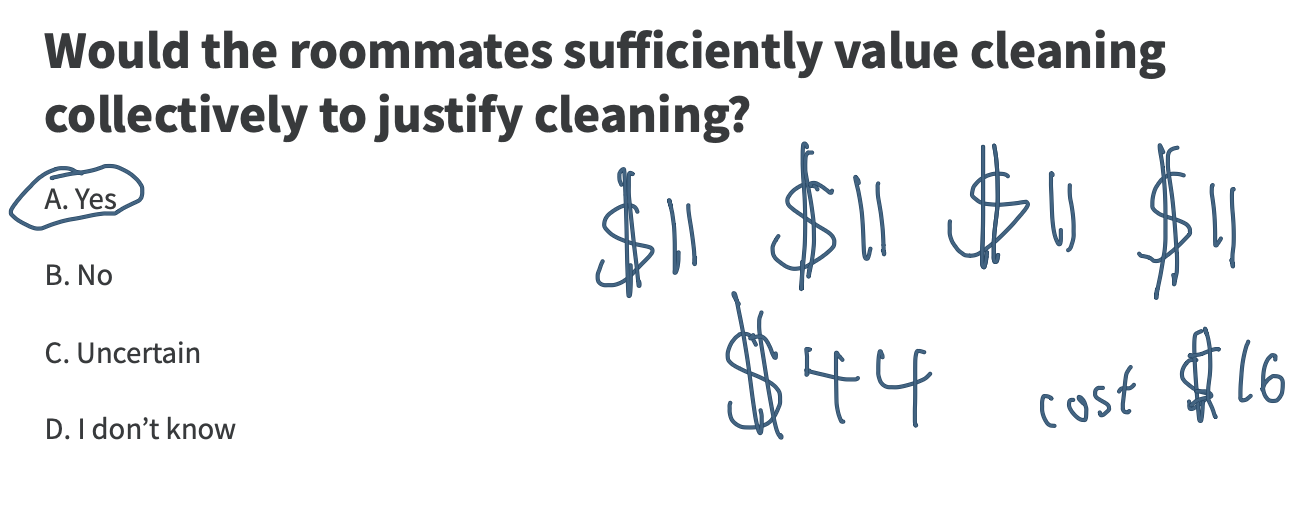
Would the roommates sufficiently value cleaning collectively to justify cleaning?
Yes, because if you combine the 4 roommates to clean for one hour.
4 P(1) = 12 - 1 = 11(4) = $44 of values vs $16
MPB = 12 - H
MSB = 4 (12 - H)
The $44 value collectively makes sense instead of $11 for each roommate, because they all collectively benefits from clean apartment and which is $44 value
How many hours of cleaning maximize welfare?
MSB = MC
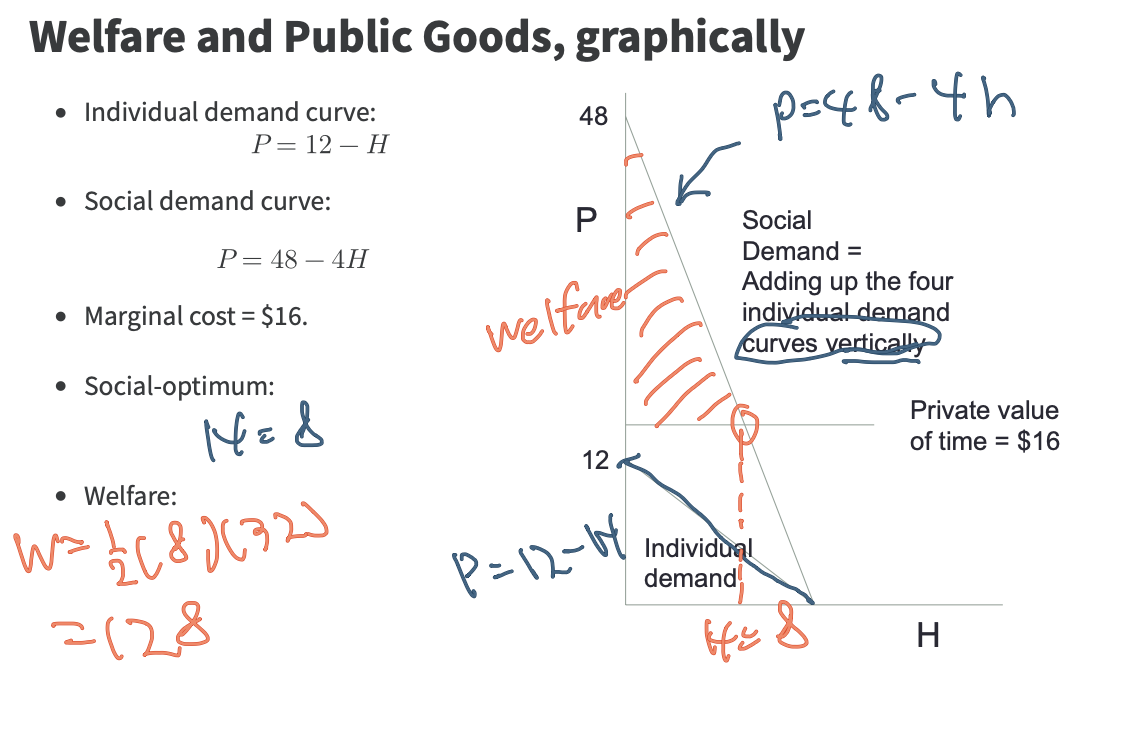
MSB = 48 - 4H
MC = 16
48 - 4H = 16
32 = 4H
H = 8
Just like a rivalrous good, welfare is maximized where the marginal benefits to society are equal to marginal cost
Why is welfare at that point?
The welfare is ½(8)(32), because welfare is any point at, or below Social Demand Curve, and private value of time
How do policymakers solve the free-rider problem
for public goods? Here, there are two sources of market failure.
1. Because the good is non-rivalrous, contributions create a positive externality.
2. Because the good is non-excludable, you canʼt force a person to pay for it.
So how might we solve the free-rider problem?
1. Public provision - some goods are provided by the government and paid for by
taxes (e.g., City of Davis firework displays, national defense).
2. Private provision - some firms provide public goods and fund them through
advertising or donations (e.g., Wikipedia, NPR, etc.), compelling contributions
through exclusive content or by increasing the social pressure to contribute.