FAH287 Final exam Flashcards
 Call Kai
 Learn
Learn Practice Test
 Spaced Repetition
 Match
Match Flashcards
 Knowt Play
1/64

There's no tags or description
Looks like no tags are added yet.
Name | Mastery | Learn | Test | Matching | Spaced | Call with Kai |
|---|
No analytics yet
Send a link to your students to track their progress
65 Terms
Political and Social Context of 19th-Century France
France experienced major political instability after the defeat of Napoleon in 1815.
The July Revolution of 1830 resulted in the overthrow of King Charles X and the rise of Louis-Philippe as the new ruler.
Louis-Philippe was initially seen as a “people’s king,” but over time he failed to represent the interests of the lower classes.
In 1848, widespread dissatisfaction led to another الثورة (revolution), forcing Louis-Philippe to step down.
During this same period, industrialization was rapidly changing society by increasing factory work and urban populations.
These changes created overcrowded cities, poor working conditions, and visible inequality between social classes.
This unstable environment strongly influenced artists, who began focusing on real social and political issues in their work
Causes of Social Anger and Revolution in France
Many people were frustrated by the growing gap between the rich and the poor during the 19th century.
Industrialization created difficult working conditions, long hours, and low wages for laborers.
Workers and peasants struggled to survive while the upper classes continued to benefit economically.
Political leaders often promised reform but failed to improve conditions for ordinary people.
Louis-Philippe, in particular, lost public trust because he began to rule more like a traditional monarch.
Government violence against civilians and restrictions on freedoms increased public anger.
These frustrations led to revolutions and encouraged artists to represent social injustice in their work
Realism (Art Movement)
Realism developed in France in the 1840s and 1850s following periods of political unrest and revolution.
Realist artists rejected traditional subjects such as mythology, religion, and heroic history painting.
Instead, they focused on depicting everyday life, especially the experiences of workers and peasants.
Realism emphasized truthful representation rather than idealized or romanticized imagery.
The movement was considered controversial because it forced viewers to confront poverty and inequality.
Realism was not just a style but a shift in subject matter toward modern life and social reality
Why Realism Was Considered Radical
Before Realism, large-scale paintings were typically reserved for important historical, religious, or mythological subjects.
Realist artists began using these large formats to depict ordinary people and everyday scenes.
This challenged traditional artistic hierarchies and expectations about what subjects were “worthy” of art.
Many viewers were uncomfortable seeing poor and working-class individuals represented so prominently.
Realism forced the upper classes to confront social inequalities that they often ignored.
Because of this, Realism was seen as both politically and socially provocative.
Industrialization and Its Impact on Art
Industrialization introduced factories, machines, and new forms of labor into society.
Many people moved from rural areas to cities in search of work, leading to overcrowding and poverty.
Working conditions in factories were often harsh, unsafe, and poorly paid.
Artists responded to these changes by focusing on modern life and its challenges.
Some artists highlighted the struggles of workers, while others explored the visual effects of speed, motion, and new technology.
Industrialization became an important background influence for both Realist and Romantic artists
Art and Politics in the 19th Century
Art became closely connected to political events and social movements during this period.
Many artists used their work to respond to revolutions, government actions, and social inequality.
Some artists, like Daumier, directly criticized political leaders and government policies.
Other artists focused on social conditions rather than direct political messages, showing the lives of workers and peasants.
Art was no longer only decorative but became a tool for commentary and critique.
This shift reflects a broader change in how artists saw their role in society.
Orientalism
Orientalism refers to the depiction of Middle Eastern, North African, and Asian cultures by Western artists.
These artworks were often based on imagination rather than accurate observation.
The East was frequently portrayed as exotic, sensual, timeless, and different from modern Europe.
Women in these scenes were often shown as passive, sexualized, and confined to interior spaces.
These representations reflected Western fantasies and colonial attitudes rather than real cultural understanding.
Orientalism reveals how art can shape and reinforce stereotypes about other cultures
The Male Gaze
The male gaze refers to the way women are depicted in art for the pleasure of a presumed male viewer.
Female figures are often shown as passive, sexualized, or objectified.
In many Orientalist paintings, women are presented as objects to be observed rather than individuals with agency.
The viewer is placed in a position of control, looking into private or intimate spaces.
This concept helps explain how power and gender influence visual representation in art.
Romanticism (Art Movement)
Romanticism developed in the early 19th century as a reaction against strict rules and rational thinking.
It emphasized emotion, drama, and individual experience.
Romantic artists often focused on powerful events such as revolutions, natural disasters, and human struggle.
Their works frequently include strong contrasts, movement, and expressive compositions.
Romanticism can also include elements of imagination and symbolism.
Artists like Delacroix and Turner used Romanticism to explore both political events and the power of nature
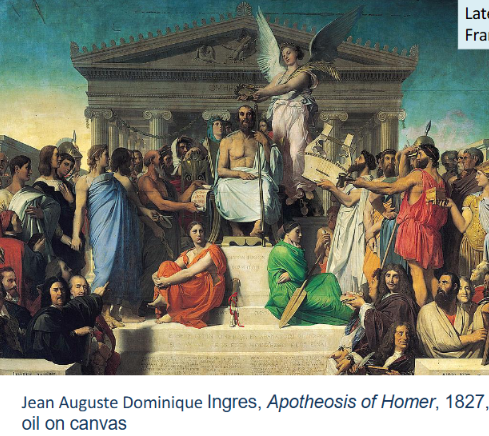
Ingres — Apotheosis of Homer (1827)
Identification:
Artist: Ingres
Title: Apotheosis of Homer
Date: 1827
Movement: Neoclassicism
Historical Context:
This work was created during a period when academic art strongly valued classical Greek and Roman traditions.
European institutions believed that ancient culture represented the highest standard of artistic and intellectual achievement.
The painting reflects the continued dominance of academic ideals before movements like Realism challenged them.
Style:
The composition is highly ordered and symmetrical, emphasizing clarity and balance.
Figures are idealized with perfect proportions rather than realistic imperfections.
The use of clean lines and controlled forms reflects the influence of classical sculpture.
Themes:
The painting celebrates intellectual and artistic greatness by placing Homer at the center as a god-like figure.
Surrounding figures represent important contributors to Western culture, reinforcing a hierarchy of knowledge.
The work emphasizes admiration for tradition, authority, and the legacy of classical antiquity.
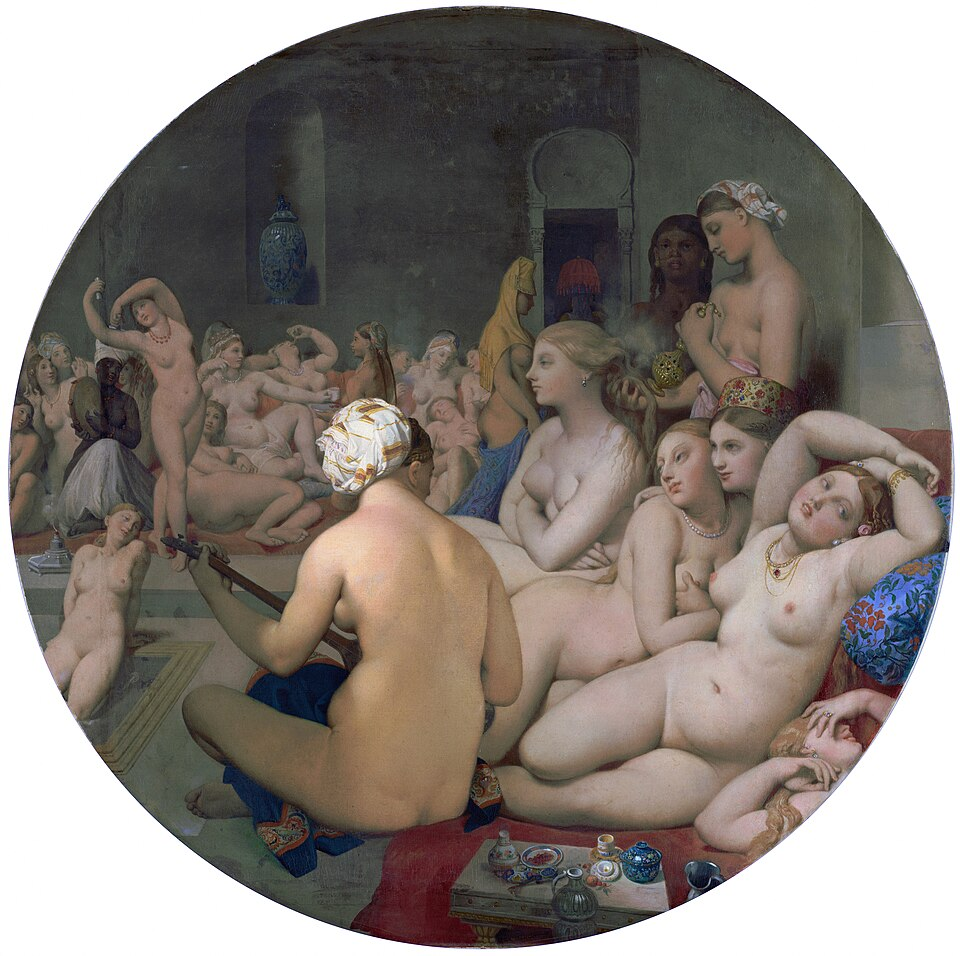
Ingres — The Turkish Bath (1862)
Identification:
Artist: Ingres
Title: The Turkish Bath
Date: 1862
Movement: Neoclassicism / Orientalism
Historical Context:
The painting was created during a period of strong European fascination with Eastern cultures and customs.
Artists often relied on secondhand accounts, travel writings, and imagination rather than direct observation.
The work reflects broader colonial attitudes that portrayed non-European societies as sensual, primitive, and timeless.
Style:
The composition is circular, creating the effect of looking through a peephole into a private, forbidden space.
The figures are arranged in interlacing, curved forms that emphasize fluidity and unity.
Bodies are highly idealized and often anatomically distorted to create graceful, decorative shapes.
The soft lighting and smooth surfaces create a dreamy, sensual atmosphere.
Themes:
The painting strongly reflects the male gaze, positioning the viewer as a voyeur observing nude women in a private setting.
The scene is highly eroticized, with overlapping bodies and intimate poses emphasizing sensuality.
The circular composition reinforces the idea of secret observation, increasing the sense of forbidden access.
The work presents an imagined version of Eastern life, shaped by fantasy rather than reality.
Women are depicted as passive and available, reinforcing Western stereotypes about Eastern cultures.
The painting reflects a broader tendency to exoticize and sexualize the “other,” revealing more about European desires than actual cultural practices.
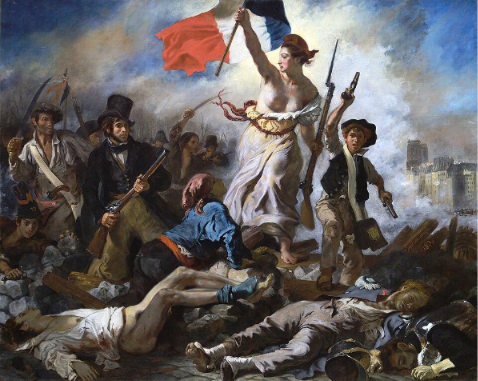
Delacroix — Liberty Leading the People (1830)
Identification:
Artist: Delacroix
Title: Women of Algiers in their Apartment
Date: 1834
Movement: Romanticism / Orientalism
Historical Context:
The painting was inspired by Delacroix’s 1832 trip to North Africa during a diplomatic mission under Louis-Philippe.
Although he briefly observed similar interiors, much of the scene was reconstructed from memory and imagination.
The work reflects European fascination with the “exotic East” during a period of colonial expansion.
It presents the East as timeless, sensual, and different from modern Europe, reinforcing Orientalist ideas
Style:
The composition is intimate and enclosed, focusing on an interior domestic space.
Rich colors, fabrics, and decorative elements create a sense of luxury and exoticism.
Light and shadow are used strategically, with deeper shadows in the background drawing attention to the figures.
The figures are relaxed and loosely arranged, contributing to a calm, atmospheric mood.
Themes:
The painting reflects the male gaze, as the women are presented as objects to be observed within a private, intimate space.
The women are barefoot and remain indoors, reinforcing their confinement to the domestic sphere.
Their relaxed poses and activities, such as smoking, suggest leisure and passivity.
The contrast between light-skinned and dark-skinned figures emphasizes racial difference and reinforces European ideas of hierarchy.
The inclusion of different ethnicities, particularly Black figures, functions to highlight the perceived “exoticism” of the scene.
Elements such as clothing, setting, and decorative details are partially imagined, making the space a constructed fantasy rather than an accurate depiction.
The work ultimately reflects Western curiosity and desire, rather than a true understanding of the culture.
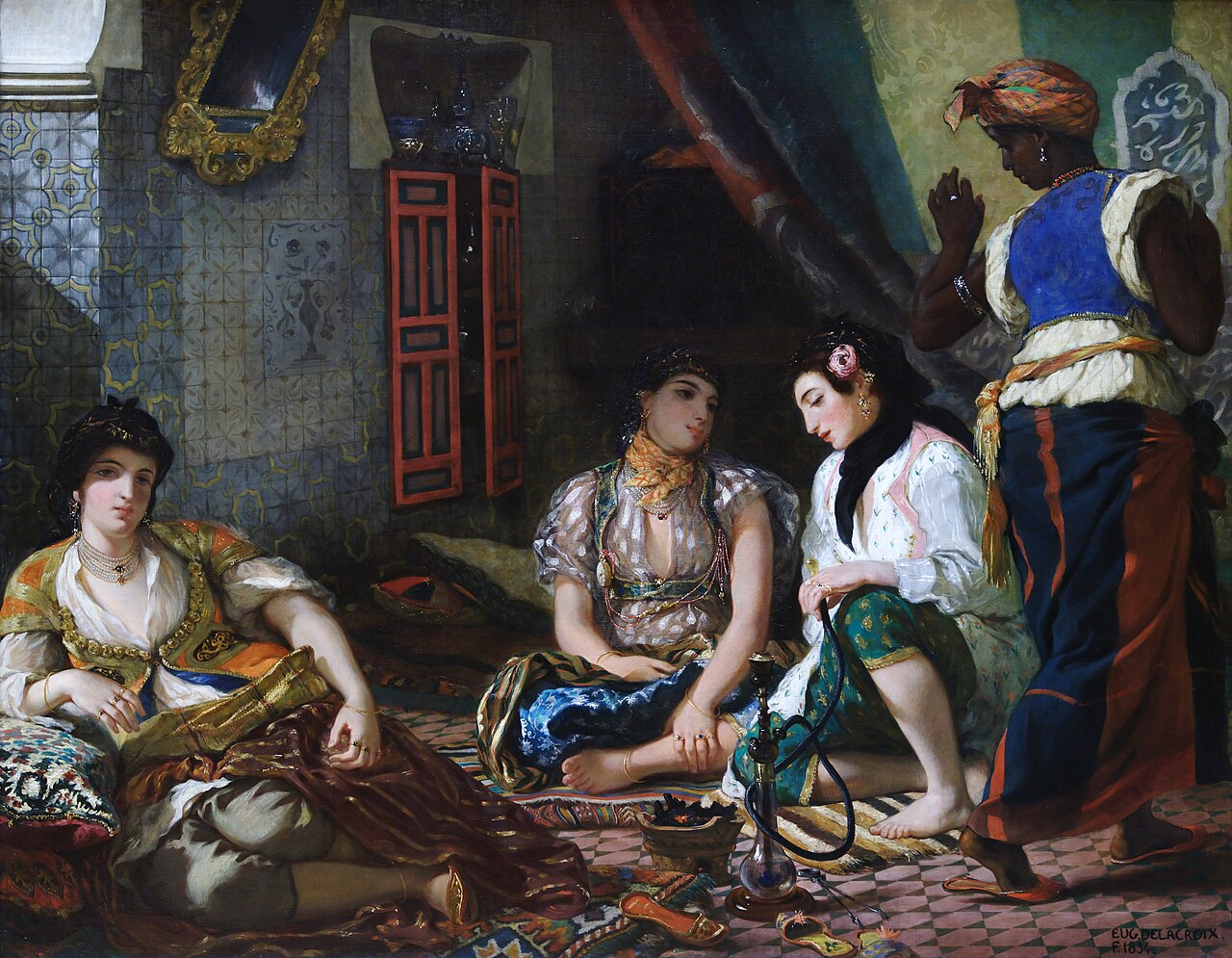
Delacroix — Women of Algiers in their Apartment (1834)
Identification:
Artist: Delacroix
Title: Women of Algiers in their Apartment
Date: 1834
Movement: Romanticism / Orientalism
Historical Context:
The painting was inspired by Delacroix’s travels to North Africa, although much of the scene is constructed from memory and imagination.
It reflects European curiosity and fascination with non-European cultures during a period of colonial expansion
Style:
The work features rich colors, detailed patterns, and carefully rendered textures that emphasize luxury.
The composition is relaxed and intimate, focusing on a quiet interior space.
Light is used to draw attention to the figures and create a soft, atmospheric mood.
Themes:
The painting reflects Orientalism by presenting a romanticized and exotic view of Eastern life.
Women are shown in a private domestic space, reinforcing ideas of confinement and passivity.
The contrast between light and dark skin tones highlights racial and cultural differences.
The scene is not an accurate representation but rather a constructed fantasy shaped by Western perspectives.
Delacroix vs Ingres — Orientalism Comparison
(Women of Algiers vs The Turkish Bath)
Similarities:
Both paintings are examples of Orientalism, presenting Western interpretations of Eastern cultures.
Both depict women in private, domestic interiors, emphasizing separation from public life.
Both reflect the male gaze, as the viewer is positioned as an observer of intimate female spaces.
Both portray the East as timeless, sensual, and exotic, rather than modern and realistic.
Neither painting is fully accurate, as both rely on imagination and constructed details rather than direct observation.
Differences — Approach to Reality:
Delacroix’s work is partially based on real observation from his travels, although it is still idealized.
Ingres’ painting is almost entirely imagined, with little concern for cultural accuracy.
Differences — Style:
Delacroix uses rich colors, naturalistic textures, and a more grounded composition.
Ingres uses smooth, idealized forms, distorted anatomy, and a circular composition that creates a more artificial effect.
Delacroix’s lighting creates depth and atmosphere, while Ingres’ softer tones create a more dreamlike, unified space.
Differences — Representation of Women:
In Delacroix’s painting, the women are clothed and appear more relaxed and passive, with subtle sensuality.
In Ingres’ painting, the women are nude and highly sexualized, with exaggerated poses and intimacy.
Ingres’ work more strongly emphasizes eroticism and objectification.
Differences — Viewer Experience:
Delacroix invites the viewer into a quiet, observational moment.
Ingres places the viewer in a voyeuristic position, as if secretly looking into a forbidden space (peephole effect).
Overall Interpretation:
Both works reveal more about Western fantasies and desires than about actual Eastern cultures.
Delacroix presents a more subtle and observational version of Orientalism.
Ingres presents a more extreme, eroticized, and openly fantastical version.
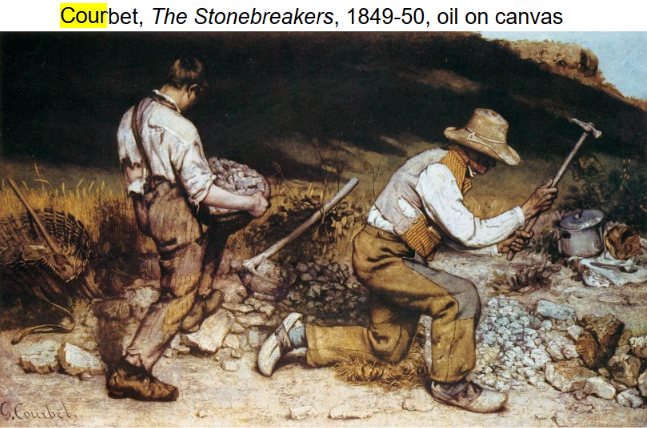
Courbet — The Stonebreakers (1849–50)
Identification:
Artist: Courbet
Title: The Stonebreakers
Date: 1849–50
Movement: Realism
Historical Context:
The painting was created after the 1848 revolutions, during a time of heightened awareness of social inequality.
It reflects growing concern about the conditions of the working class in industrializing France.
Style:
Courbet uses a rough, direct painting style that avoids idealization.
The figures are presented in a straightforward manner, without heroic exaggeration.
The focus is on the physical strain of labor rather than aesthetic beauty.
Themes:
The painting emphasizes the harsh realities of manual labor and poverty.
The workers are anonymous, representing the broader working class rather than individuals.
The work rejects traditional heroic subjects and instead elevates everyday life.
It forces viewers to confront the social realities of modern society.
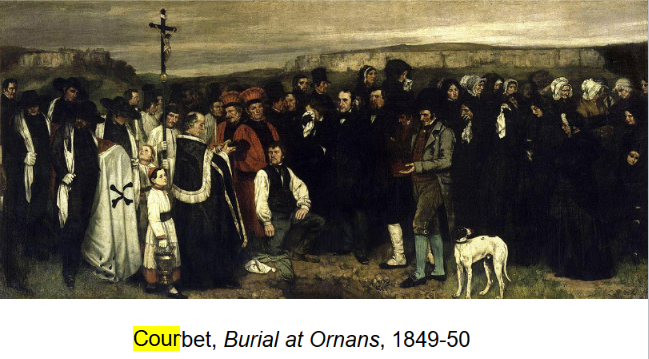
Courbet — Burial at Ornans (1849–50)
Identification:
Artist: Courbet
Title: Burial at Ornans
Date: 1849–50
Movement: Realism
Historical Context:
The painting shows a funeral in Ornans, which is Courbet’s hometown in France.
It was created after the 1848 revolutions, during a time of political and social change.
Instead of painting a heroic or historical event, Courbet chose to depict a local, everyday scene.
This reflects the Realist goal of representing modern life and ordinary people.
Style:
The painting is very large, a scale traditionally used for important history paintings.
The composition is horizontal and lacks a central heroic focus, making the scene feel more natural and unstructured.
The figures are individualized but not idealized, and many appear stiff or emotionally distant.
There is no dramatic lighting or emphasis, which reinforces the ordinary nature of the event.
Themes:
The painting emphasizes that everyday life, including death and community rituals, is worthy of serious artistic attention.
It challenges traditional art hierarchies by treating a provincial funeral as equal to grand historical subjects.
The work reflects social equality by giving importance to ordinary people rather than elites or heroes.
It presents reality without idealization, showing how people actually behave rather than how they “should” behave.
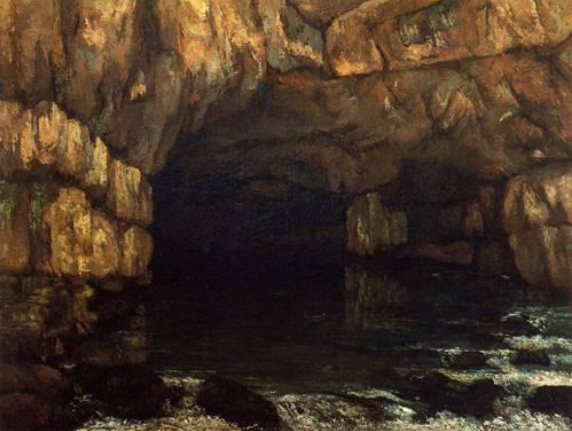
Courbet — The Source of the Loue (1864)
Identification:
Artist: Courbet
Title: The Source of the Loue
Date: 1864
Movement: Realism
Historical Context:
This painting belongs to a later stage in Courbet’s career, where he began experimenting more with form and abstraction.
It reflects a broader artistic shift toward focusing on natural processes rather than narrative subjects.
This work reflects a later stage in Courbet’s career, where he expands Realism beyond social subjects and begins focusing on nature and material processes.
Rather than abandoning Realism, he shifts his attention from human experience to the physical reality of the natural world.
Style:
The composition focuses closely on natural elements such as rock and flowing water.
The brushwork becomes looser and more expressive, moving away from strict realism.
The forms are less clearly defined, emphasizing texture and movement rather than detail.
The painting demonstrates how Realism can move beyond social commentary to explore texture, movement, and the raw presence of nature.
It suggests a transition toward more modern approaches, where visual experience becomes as important as subject matter.
Themes:
The painting explores nature as a raw, physical force rather than a symbolic or narrative subject.
It reflects an interest in origins, particularly the source of water.
The work suggests a transition toward abstraction by prioritizing material and visual experience over storytelling.
It connects to broader artistic trends that move toward modern and experimental approaches
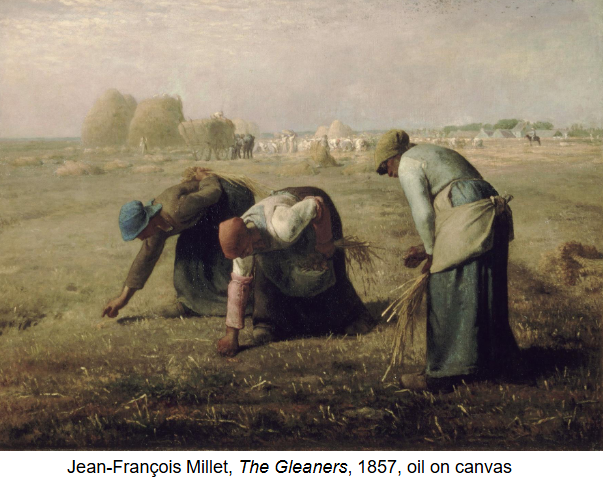
Millet — The Gleaners (1857)
Identification:
Artist: Millet
Title: The Gleaners
Date: 1857
Movement: Realism
Historical Context:
The painting depicts gleaning, a practice where the poorest members of society collected leftover crops after the harvest.
These figures represent rural workers in France, particularly women and children who relied on this labor to survive.
Millet returned to his own community to paint these subjects, emphasizing a direct connection to real life.
At the time, images of peasants were politically sensitive, as there were fears of social unrest and revolution.
The decision to depict such a low-status subject on a large scale was controversial and challenged traditional artistic expectations.
Style:
The figures are shown with naturalistic detail, bent over in repetitive motions that emphasize the physical strain of their labor.
The composition places the gleaners prominently in the foreground, making their work the central focus of the painting.
A soft, golden light washes over the scene, giving it a calm and almost spiritual atmosphere.
The large scale of the painting gives the subject a sense of gravity and importance, similar to history painting.
Themes:
The painting emphasizes the hardship and physical demands of manual labor, particularly for the rural poor.
At the same time, the figures are not depicted as weak, but rather as strong and enduring, highlighting their resilience.
The golden light and calm tone introduce a Christian association, linking their suffering to the suffering of Christ and suggesting moral value in humility.
The work brings attention to the continued presence and importance of peasant labor in French society.
By elevating a humble subject, Millet challenges what was traditionally considered worthy of art and forces viewers to acknowledge social inequality.
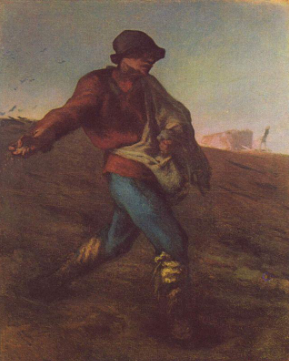
Millet — The Sower (1850)
Identification:
Artist: Millet
Title: The Sower
Date: 1850
Movement: Realism
Historical Context:
The painting was created during a time of political instability and fear of peasant uprisings in France.
Images of strong rural workers could be interpreted as both admirable and potentially threatening.
Style:
The figure is large and dynamic, with exaggerated movement that emphasizes physical strength.
The background is simplified, keeping focus on the action of sowing seeds.
The dramatic lighting enhances the figure’s presence and importance.
Themes:
The painting represents labor, growth, and the cycle of life.
It emphasizes the strength and importance of the working class.
The figure can also be interpreted as a symbol of potential change or unrest.
The work reflects both admiration and anxiety toward peasant laborers.
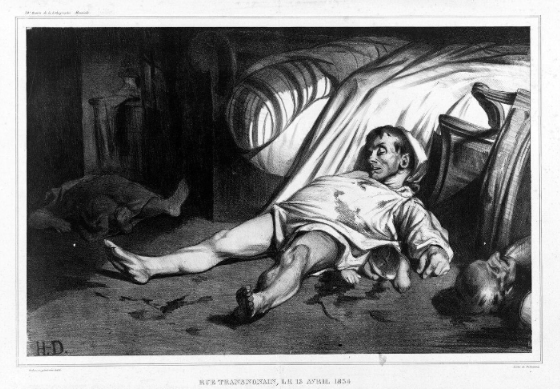
Daumier — Rue Transnonain, April 15, 1834
Identification:
Artist: Daumier
Title: Rue Transnonain, April 15, 1834
Date: 1834
Movement: Realism / Political Art
Historical Context:
The image is based on a real event in which government troops killed civilians during a political crackdown in Paris.
A working-class family was shot in their home, and the event became a symbol of government violence and injustice.
The officer responsible was reportedly rewarded, which increased public outrage and distrust of authority.
The incident contributed to further unrest and rioting among the population.
Daumier, known for his political criticism, used this work to expose corruption and injustice under the July Monarchy
Style:
The work is a lithograph, allowing it to be widely distributed and seen by a large audience.
The composition focuses on the aftermath of the event rather than the moment of violence itself.
The scene is presented in a stark and unembellished manner, emphasizing realism and immediacy.
The figures are depicted with heavy, grounded forms that give a sense of physical weight and finality.
The image has a journalistic quality, resembling a visual report of a real crime scene.
Themes:
The work exposes government violence, corruption, and the abuse of power.
It functions as a form of political protest, criticizing authority without the need for written explanation.
The lack of dramatization or heroic elements makes the tragedy feel more real and disturbing.
The image highlights the vulnerability of ordinary people, particularly the working class.
It demonstrates how art can serve as a powerful tool for social commentary and public awareness.
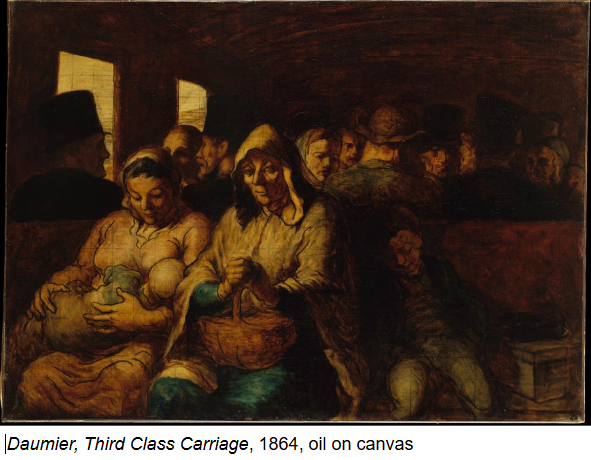
Daumier — Third Class Carriage (1864)
Identification:
Artist: Daumier
Title: Third Class Carriage
Date: 1864
Movement: Realism
Historical Context:
The painting reflects life during the industrial era, when railways became a major form of transportation.
Train cars were divided by class, with “third class” reserved for the poorest passengers.
This division made social inequality highly visible in everyday life.
The work responds to industrialization by showing how modern systems reinforce class differences.
It also connects to broader artistic trends that focused on ordinary people and regional life during this period
Style:
The composition is tightly focused on the figures, minimizing background detail to emphasize human presence.
The lighting is soft and subdued, with a gentle glow that gives the scene emotional weight and seriousness.
The figures are rendered with quiet realism, avoiding dramatic gestures or exaggeration.
The central grouping creates a sense of stillness and reflection rather than action.
Themes:
The painting highlights the realities of class division in modern industrial society.
The elderly woman holding a child becomes a central symbol of endurance, suggesting a lifetime of hardship.
The soft, almost golden light gives the figures a sense of dignity and gravitas despite their poverty.
The work elevates the lives of the poor, presenting them as worthy of attention and respect.
It reflects the idea that modern progress (like trains) does not benefit all people equally.
The painting invites empathy by showing the quiet, everyday experience of those often ignored in society.
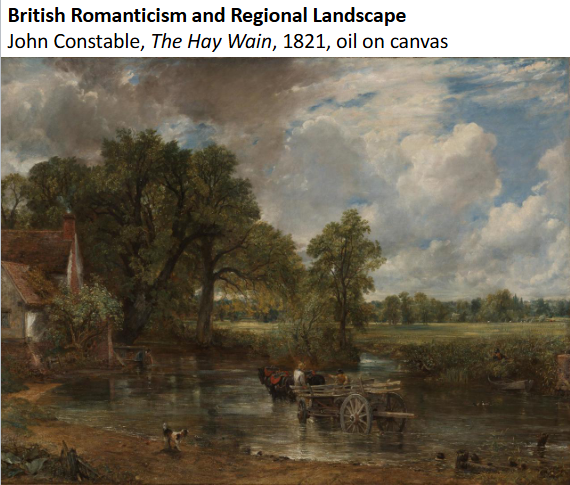
Constable — The Hay Wain (1821)
Identification:
Artist: Constable
Title: The Hay Wain
Date: 1821
Movement: Romanticism (Landscape)
Historical Context:
The painting depicts a rural scene from the region in England where Constable grew up, reflecting his personal connection to the landscape.
It was created during a period of increasing industrialization, when many people were leaving rural areas for cities.
Constable’s focus on the countryside reflects a broader sense of nostalgia for traditional rural life.
Although the subject appears calm and apolitical, presenting such a scene on a large scale was considered somewhat controversial because it challenged academic expectations.
Style:
The painting is highly detailed, with careful observation of natural elements such as trees, water, and sky.
Constable aims for accuracy, attempting to capture the specific look and atmosphere of the landscape.
The composition is calm and balanced, with a naturalistic arrangement rather than dramatic emphasis.
His style is often described as “picturesque,” meaning it presents an idealized yet believable version of rural life, including cottages and everyday scenery.
Themes:
The painting emphasizes a deep connection to nature and the importance of rural life.
It reflects nostalgia for a simpler, pre-industrial world that was beginning to disappear.
By depicting an ordinary rural scene on a large scale, Constable elevates the everyday landscape to a subject worthy of serious art.
The work can be seen as a subtle challenge to academic standards, which traditionally prioritized historical or mythological subjects.
It contrasts with artists like Turner, whose landscapes are more dramatic and focused on the power and chaos of nature.
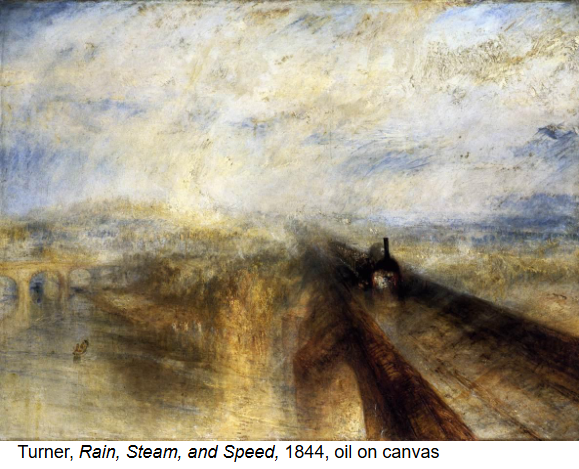
Turner — Rain, Steam, and Speed (1844)
Identification:
Artist: Turner
Title: Rain, Steam, and Speed
Date: 1844
Movement: Romanticism (toward Impressionism)
Historical Context:
The painting reflects the rapid expansion of industrialization in 19th-century England, particularly the development of the railway system.
It depicts the Great Western Railway, a symbol of modern technological progress.
Turner shifts attention away from traditional subjects to focus on a modern machine, showing how industrialization was transforming everyday life.
His approach influenced later movements like Impressionism, especially in the emphasis on atmosphere and perception
Style:
Turner uses loose, expressive brushwork that blurs forms and reduces clear detail.
The composition is driven by a strong diagonal thrust, emphasizing the speed and force of the train moving through the landscape.
Light, steam, and rain merge together, creating an almost abstract effect where forms dissolve into atmosphere.
The painting prioritizes how the eye experiences motion and light rather than precise representation.
Themes:
The painting explores the tension between nature and technology, as the train cuts through the natural landscape.
It reflects the power and speed of modern progress, suggesting both excitement and disruption.
The presence of a small rabbit on the tracks highlights the contrast between the natural world and industrial forces.
The image can be read as a commentary on how modern life is accelerating and reshaping human experience.
The work emphasizes perception and atmosphere, showing how reality is experienced rather than simply observed.
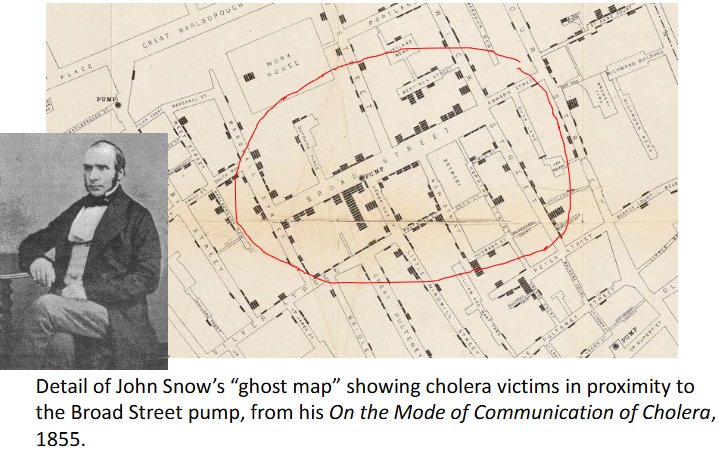
Miasma Theory vs Germ Theory (“Ghost Map”)
In the early 19th century, many people believed in the miasma theory, which claimed that diseases were caused by “bad air” or foul smells.
This belief was based on the idea that dirty environments produced harmful vapors that made people sick.
In the 1850s, Dr. John Snow challenged this theory by studying cholera outbreaks in London.
He demonstrated that cholera was spread through contaminated water, not air.
His research, often called the “Ghost Map,” traced disease outbreaks to specific water sources.
This marked a major shift toward modern scientific understanding of disease.
Urban Conditions in 19th-Century Cities & Industrialization
Rapid urban growth led to overcrowded cities with poor living conditions.
Streets were narrow, tightly packed, and lacked proper ventilation.
Human waste was often collected and dumped in open pits, creating strong odors and unsanitary environments.
Cemeteries became overcrowded, with bodies sometimes exposed or poorly buried.
These conditions contributed to frequent outbreaks of disease, especially cholera.
Cities were seen as unhealthy, chaotic, and difficult to control.
Industrialization caused rapid population growth in cities, leading to overcrowding and poor living conditions.
Issues such as pollution, human waste, and disease (like cholera) became major concerns.
New systems like sewers, lighting, and public parks were introduced to improve urban life.
Despite these improvements, poverty and class divisions remained strong.
The modernization of Paris created new social spaces, including cafés, theaters, and entertainment venues.
Haussmannization of Paris (Urban Reform)
Under Napoleon III, Baron Haussmann led a major reconstruction of Paris in the mid-19th century.
Narrow streets were replaced with wide, straight boulevards to improve movement and airflow.
Sewer systems and clean water infrastructure were developed to improve public health.
Cemeteries were reorganized, with remains moved to spaces like the catacombs.
Parks and green spaces were added to provide fresh air, often described as giving the city “lungs.”
New lighting and infrastructure made the city more organized and visually appealing.
Political Control and Urban Design
The redesign of Paris was not only about health, but also about control and surveillance.
Wide boulevards made it more difficult for revolutionaries to build barricades.
The military could more easily move through the city and suppress uprisings.
The working class was increasingly seen as a “dangerous class” capable of revolt.
Urban design became a tool to prevent future revolutions.
Social Consequences of Urban Reform
The reconstruction of Paris displaced many poor residents, forcing them to move to the outskirts (banlieues).
These areas became associated with poverty and social marginalization.
Although the city became cleaner and more modern, inequality remained and in some cases worsened.
Displacement created further frustration and instability among the lower classes.
These tensions contributed to ongoing fears of social unrest and revolution.
Prostitution and Modern Paris
During this period, prostitution became highly visible and regulated in Paris.
Women were required to register and undergo health checks due to concerns about disease.
Prostitution was closely linked to urban spaces such as cafés and entertainment venues.
Many artworks from this period subtly reference prostitution through clothing, posture, and setting.
These depictions reflect anxieties about morality, class, and the role of women in modern society.
The Flâneur
BACK:
The flâneur is a figure associated with modern urban life, particularly in 19th-century Paris.
He is typically a middle- or upper-class man who walks through the city without a specific purpose.
Unlike workers, he has the leisure time to observe his surroundings rather than participate in them.
His role is to watch, study, and reflect on the people, spaces, and social interactions of the city.
The concept is closely associated with the writer Baudelaire, who described the flâneur as a detached observer of modern life.
The flâneur represents curiosity, observation, and the experience of living in a rapidly changing urban environment.
Connection to Manet:
Manet is closely associated with the flâneur because his paintings reflect this act of observation.
He often depicts modern urban scenes such as cafés, bars, and public spaces.
His works capture moments that feel spontaneous, as if the viewer has just encountered the scene.
In paintings like A Bar at the Folies-Bergère, the viewer is placed in the position of a flâneur, observing social interactions.
Manet can be understood as both a flâneur himself and an artist who represents this perspective in his work.
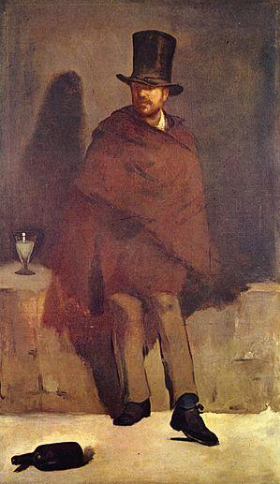
Manet — The Absinthe Drinker (1859)
Identification:
Artist: Manet
Title: The Absinthe Drinker (The Ragpicker)
Date: 1859
Movement: Realism / Early Modernism
Historical Context:
The figure is based on a real Parisian eccentric, a ragpicker who lived on the margins of society.
Ragpickers collected discarded materials and were seen as social outsiders, but also as figures connected to hidden truths of urban life.
The painting reflects growing interest in modern city life and marginalized individuals.
Absinthe was a popular drink among artists and the lower classes, known for its high alcohol content and supposed hallucinatory effects.
It was sometimes associated with creativity, decadence, and moral concern in modern Paris
Style:
The figure is painted on a large scale, traditionally reserved for important or elite subjects, making this a deliberate and rebellious choice.
The composition references Spanish painting, particularly Velázquez’s portrait of Menippus, a philosopher associated with truth-telling and satire.
The figure stands alone, giving him a sense of presence and dignity despite his social status.
The brushwork appears loose and somewhat unfinished compared to academic standards, contributing to a modern aesthetic.
Themes:
The painting explores the figure of the outsider as both marginalized and significant.
The ragpicker represents a person who engages with what society discards, suggesting a connection to truth and reality.
Because the ragpicker deals with what society throws away, he can be seen as someone who confronts aspects of life that others ignore, suggesting a connection to truth.
There is a strong sense of ambiguity, as the figure is dressed like a gentleman but is actually homeless.
The work challenges traditional ideas of class and respectability by giving a low-status figure dignity and importance.
The reference to Menippus suggests that outsiders may hold a deeper understanding of society and authority.
The painting reflects modern urban life, where identities are unstable and difficult to define.
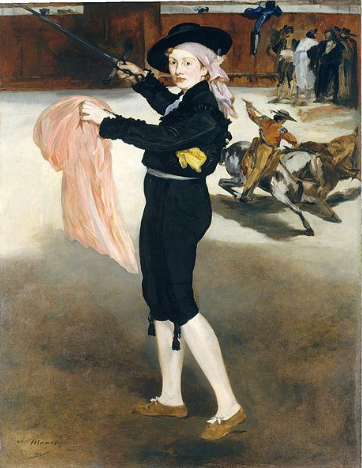
Manet — Victorine Meurent in the Costume of an Espada (1862)
Identification:
Artist: Manet
Title: Victorine Meurent in the Costume of an Espada
Date: 1862
Movement: Realism / Early Modernism
Historical Context:
Victorine Meurent was one of Manet’s most important models and appears in many of his works.
The painting reflects modern Parisian interest in performance, spectacle, and public entertainment, such as bullfighting.
It may subtly reference prostitution, as women in public or performative roles were often associated with sexuality.
The work was rejected from the Salon, showing how controversial Manet’s modern subjects and style were
Style:
The space is flattened and awkward, with unclear depth and spatial relationships.
The figure appears pushed close to the viewer, creating a slightly uncomfortable and confrontational effect.
The pose is twisted and difficult to read, making her movement ambiguous.
The background elements, such as the bull, feel disconnected, adding to the sense of instability.
The painting captures a moment like a “snapshot,” rather than a carefully staged, idealized scene.
Themes:
The painting explores performance and identity, as Victorine is dressed as a bullfighter rather than herself.
The cross-dressing introduces ambiguity, challenging traditional gender roles.
The figure embodies tension, as a bullfighter both attracts and confronts danger, raising the question of whether she is in control or at risk.
This dynamic can be linked to the idea of the modern woman as both object and agent, particularly in relation to prostitution.
The painting reflects how modern life can feel confusing and unclear.
The awkward composition makes the scene feel disconnected rather than smooth and balanced.
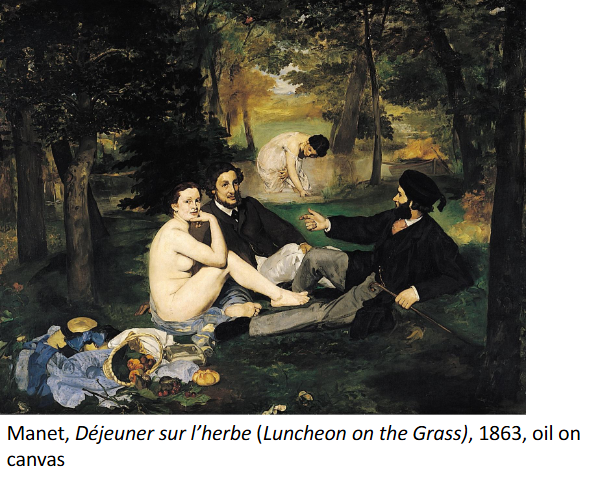
Manet — Déjeuner sur l’herbe (1863)
Identification:
Artist: Manet
Title: Déjeuner sur l’herbe
Date: 1863
Movement: Realism / Early Modernism
Historical Context:
The painting was rejected from the official Salon and exhibited in the Salon des Refusés, where controversial works were shown.
It references classical paintings such as Giorgione’s Pastoral Concert, but reworks them in a modern setting.
Manet replaces mythological figures with ordinary, contemporary people, which shocked viewers.
Style:
The composition is flattened and spatially inconsistent, making the scene feel unnatural.
The figures do not blend smoothly into the environment, creating a sense of awkwardness.
The brushwork appears loose and unfinished compared to academic standards.
The scene feels like a captured moment rather than a carefully staged composition.
Themes:
The painting contrasts classical tradition with modern life, especially through the use of a nude figure in a contemporary setting.
It plays with the tradition of the “surprised nude,” where a woman is seen bathing and reacts modestly.
However, Victorine Meurent does not appear embarrassed or surprised, and instead looks calmly and directly at the viewer.
This direct gaze challenges the viewer and removes the usual sense of modesty or innocence.
The painting mixes ideas from classical art with a modern, everyday scene, creating a contrast between idealized tradition and ordinary life.
By showing a real woman nude in a modern setting, the painting removes the usual “mythological excuse” for nudity, making the scene feel more direct and uncomfortable for viewers.
Manet challenges traditional representations of the nude by placing a real, modern woman in a setting that removes the protective context of mythology, making the scene feel direct and unsettling.
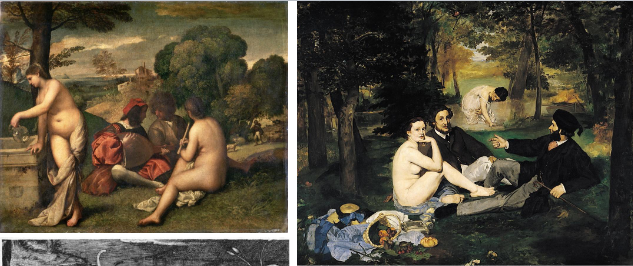
Giorgione, Pastoral Concert — Relation to Manet’s Déjeuner sur l’herbe
Manet’s Déjeuner sur l’herbe is directly inspired by Giorgione’s Pastoral Concert, a Renaissance painting.
In Giorgione’s work, nude female figures appear alongside clothed men in a natural setting.
However, in the Renaissance context, the nude women are understood as mythological or symbolic figures, which makes the scene acceptable.
Manet borrows this composition but replaces the mythological figures with real, modern people.
Unlike Giorgione’s figures, Manet’s nude woman does not represent a goddess and instead appears as a real person.
This removes the “artistic excuse” for nudity and makes the scene feel more direct and uncomfortable.
The comparison highlights how Manet challenges traditional art by turning a classical composition into a modern, controversial image.
🧠 Easy way to remember:
👉 Giorgione = myth → acceptable nude
👉 Manet = real life → awkward nude
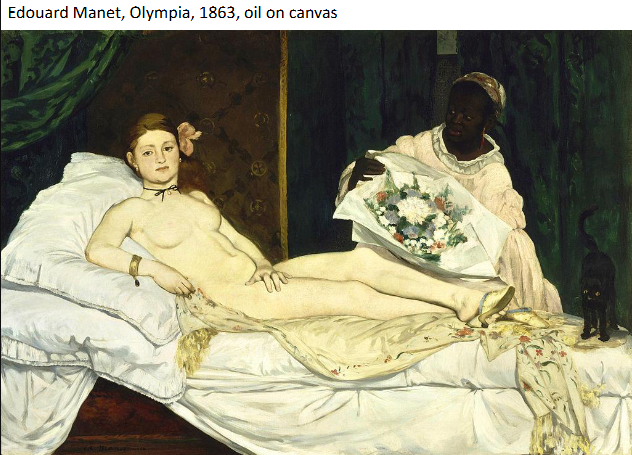
Manet — Olympia (1863)
Identification:
Artist: Manet
Title: Olympia
Date: 1863
Movement: Realism / Early Modernism
Historical Context:
The painting caused a major scandal when it was exhibited, with viewers reacting angrily and even needing guards to protect it.
Many critics described it as ugly, unfinished, and offensive.
It reflects widespread anxiety in Paris about prostitution and modern urban life.
Manet directly references Titian’s Venus of Urbino (1538), but transforms the idealized goddess into a modern woman.
Unlike traditional nudes, this figure represents a working woman (likely a prostitute) rather than a mythological figure
Style:
The lighting is harsh and flat, with a yellow tone that removes the soft, glowing beauty seen in classical paintings.
The figure appears sharply outlined, with areas that look patchy or unfinished by traditional standards.
The painting lacks the smooth blending and idealization expected in academic art.
This makes the image feel more direct, real, and even uncomfortable.
Themes:
Olympia looks directly at the viewer with a calm, self-aware expression, making the viewer feel like a client rather than a distant observer.
The painting presents the nude as a real, working woman instead of an idealized goddess, removing the usual “artistic excuse” for nudity.
Details such as the black cat (replacing the loyal dog in Titian), jewelry, ribbon choker, and flowers all reference sexuality and the sex trade.
Her hand placement is firm and deliberate, suggesting control rather than modesty.
The work challenges traditional ideas of beauty and femininity by showing a body that is not softened or idealized.
It exposes the reality of modern life, particularly the visibility of prostitution in Paris.
By reworking a classical image into a modern scene, Manet undermines traditional art and forces viewers to confront uncomfortable social realities.
Manet transforms the traditional idealized nude into a modern, confrontational figure, forcing viewers to confront the realities of prostitution and their own role as observers.
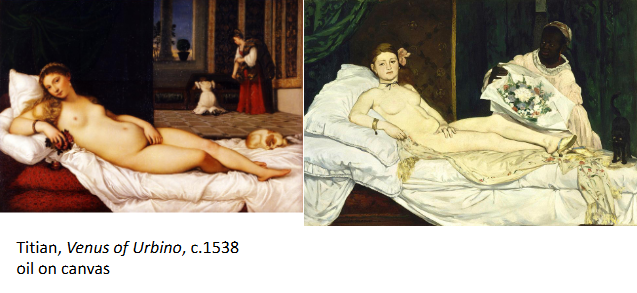
Manet — Olympia vs Titian — Venus of Urbino
Similarities:
Both paintings show a reclining nude woman lying on a bed.
Both figures look outward toward the viewer, creating a direct visual connection.
Both include details like jewelry, flowers, and a servant figure, suggesting themes of love and sexuality.
Manet’s painting is intentionally based on Titian’s composition.
Differences — Identity of the Woman:
In Titian’s painting, the figure represents Venus, a goddess, making the nudity acceptable and idealized.
In Manet’s painting, Olympia is a real, modern woman, likely a prostitute.
This removes the “mythological excuse” and makes the nudity feel more direct and uncomfortable.
Differences — Style and Appearance:
Titian uses soft lighting and smooth transitions, creating an idealized and beautiful body.
Manet uses harsh lighting and flat tones, making the body appear more real and less idealized.
Olympia’s body looks more stark and confrontational, rather than softly sensual.
Differences — Meaning and Symbolism:
In Venus of Urbino, the dog symbolizes loyalty and marriage, suggesting a domestic, acceptable context.
In Olympia, the black cat replaces the dog, symbolizing sexuality and independence.
Titian’s painting suggests a private, intimate setting, while Manet’s feels more like a transactional encounter.
Differences — Relationship to the Viewer:
Venus’s gaze is softer and more inviting, fitting traditional ideas of beauty and femininity.
Olympia’s gaze is direct and self-aware, making the viewer feel like a client rather than a passive observer.
Overall Meaning:
Titian presents an idealized, acceptable nude within a classical tradition.
Manet reworks this into a modern, confrontational image that exposes social realities like prostitution.
The comparison shows how Manet challenges traditional art by making the familiar subject feel uncomfortable and real.
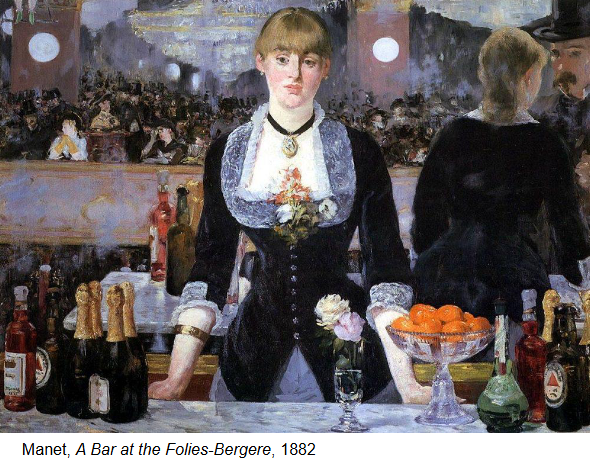
Manet — A Bar at the Folies-Bergère (1882)
Identification:
Artist: Manet
Title: A Bar at the Folies-Bergère
Date: 1882
Movement: Realism / Early Modernism
Historical Context:
The painting is set in a popular Parisian entertainment venue that combined a bar, theater, and social gathering space.
It reflects modern urban life, where people gathered to drink, socialize, and watch performances.
Women working in these environments were often expected to flirt with customers and were sometimes associated with prostitution.
The scene captures the social dynamics and consumer culture of late 19th-century Paris
Style:
The composition includes a large mirror behind the barmaid, which creates confusion about space and perspective.
The reflection does not perfectly align with what we see, making the scene feel slightly off and difficult to read.
The viewer’s position is unclear, as we seem to stand where the customer would be.
The brushwork is loose, helping the painting feel like a quick, observed moment rather than a staged scene.
Themes:
The painting explores modern social interactions, especially between men and women in public spaces.
The barmaid appears tired and emotionally distant, even though she is surrounded by activity.
Her direct gaze suggests awareness of being watched, while her expression feels indifferent or detached.
The interaction with the male customer (seen in the mirror) suggests a moment of service mixed with possible flirtation.
The work reflects the commodification of women, as she is not only selling drinks but also presenting herself as part of the experience.
The painting highlights a sense of disconnection, where people are physically close but emotionally distant.
The mirror creates ambiguity, making it unclear how people relate to each other and emphasizing the complexity of modern life.
The mirror creates confusion, as the reflection does not align perfectly with the figure in front of us.
This makes it unclear whether we are seeing a true reflection or a separate scene.
The male figure in the reflection may represent the viewer, placing us in the role of the customer.
This ambiguity makes the viewer part of the interaction while also creating uncertainty about what is actually happening.
Impressionism (Core Idea)
Impressionism focuses on capturing how things look in a specific moment, especially light and atmosphere.
Artists were interested in how the eye perceives a scene, rather than precise detail.
Paintings often look loose or unfinished compared to traditional art.
Subjects include modern life, landscapes, and everyday scenes.
Light, color, and movement are more important than clear outlines.
Realism vs Impressionism
Realism:
Focuses on accurate depictions of everyday life, especially workers and the lower class.
Often includes social or political meaning.
Figures are clearly defined and solid.
Artists aim to show reality in a direct and honest way.
Impressionism:
Focuses on light, color, and atmosphere, capturing a specific moment in time.
Paintings often look loose, blurry, or unfinished.
Less concerned with social issues, more focused on visual experience.
Emphasizes how the eye perceives a scene rather than detailed accuracy.
Key Difference:
Realism = what is happening in the world
Impressionism = how the world looks in a moment
Monet’s Working Method (Series Painting)
Monet often worked on multiple canvases at once, sometimes 10–15 paintings simultaneously.
He switched between them to capture different lighting conditions throughout the day.
His approach was almost scientific and methodical, studying how light changes a subject.
He became less focused on the object itself and more on how it appears visually.
Monet — Light, Atmosphere, and Perception
Monet focused on moments where light and atmosphere become visible, such as fog, steam, or mist.
His paintings often blur the line between object and environment.
The goal was to capture the experience of seeing, not just the subject.
This approach leads to increasingly abstract-looking works over time.
Monet — Later Work (Water Lilies & Spirituality)
In his later years, Monet focused on water lilies in his garden at Giverny.
These paintings explore reflection, depth, and surface, making it hard to tell what is real.
The works become more meditative and immersive, especially large installations.
Some later paintings are connected to ideas of spiritual reflection and contemplation.
His final works were donated as a symbol of peace after World War I.
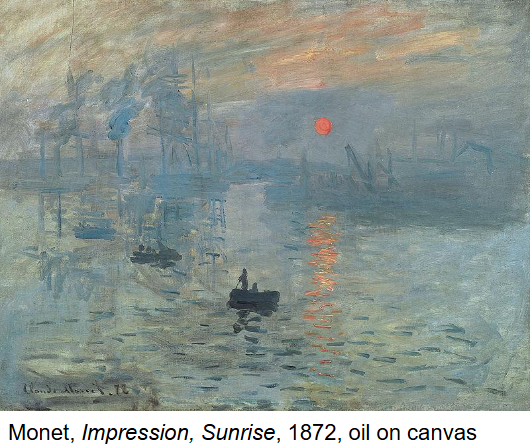
Monet — Impression, Sunrise (1872)
Identification:
Artist: Monet
Title: Impression, Sunrise
Date: 1872
Movement: Impressionism
Historical Context:
The painting was exhibited in the first independent exhibition of a group of artists later known as the Impressionists.
These artists formed a society independent from the official Academic Salon, which often rejected their work.
The group was centered around places like Argenteuil and held several exhibitions between 1874–1876.
The name “Impressionism” comes from a critic, Louis Leroy, who mocked Monet’s painting for looking unfinished.
Critics saw the work as careless and unskilled, showing how controversial this new style was.
The painting gave Impressionism its name, originally used as a criticism.
It reflects modern industrial life, including ships and a harbor.
Style:
Painted en plein air (outdoors), capturing a real moment directly from observation.
Loose, visible brushstrokes with minimal detail.
Forms are not clearly defined and seem to dissolve into light and atmosphere.
The sun is suggested through color rather than precise shape.
Themes:
The painting captures a fleeting moment, especially the effects of light, fog, and atmosphere.
It emphasizes how the eye perceives a scene rather than showing exact detail.
The work reflects modern life, including industrial elements like ships and smoke.
It challenges traditional expectations of art by prioritizing impression over finished detail.
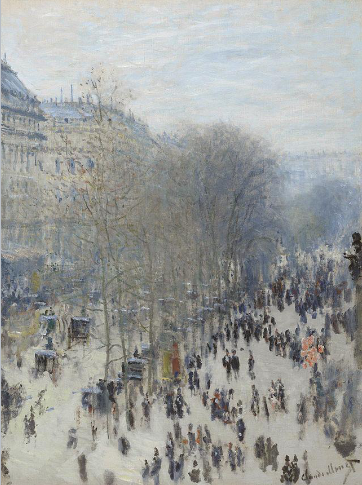
Monet — Boulevard des Capucines (1873)
Identification:
Artist: Monet
Title: Boulevard des Capucines
Date: 1873
Movement: Impressionism
Historical Context:
Depicts a newly modernized Paris after Haussmann’s renovations, with wide boulevards and increased public activity.
Reflects the rise of urban life, crowds, and leisure in the modern city.
Painted from an elevated viewpoint, linking to the perspective of the flâneur as an observer of city life.
Style:
Loose, quick brushstrokes reduce figures to small, indistinct forms.
Emphasis on movement, light, and atmosphere rather than clear detail.
The high viewpoint creates distance, making the scene feel like a passing visual impression.
Themes:
Captures the experience of modern city life and crowded public spaces.
Suggests the anonymity of individuals within large urban crowds.
Reflects the act of observing rather than participating, aligning the viewer with the flâneur.
Focuses on how the scene is perceived in a moment rather than telling a story.
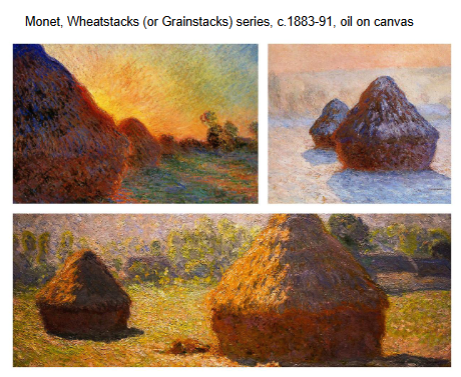
Monet — Grainstack in Sunshine (1891)
Identification:
Artist: Monet
Title: Grainstack in Sunshine
Date: 1891
Movement: Impressionism
Historical Context:
Part of Monet’s haystack (grainstack) series, where he painted the same subject under different lighting conditions.
The haystacks represent rural agricultural life in France.
At a time of increasing industrialization, these images reflect a sense of nostalgia for the countryside, which was gradually changing or disappearing
Style:
Thick application of paint with bold, visible color (blues, yellows, golds).
The form of the haystack is simplified and begins to feel slightly abstract.
Light and atmosphere dominate the image, making the surface appear to shift and “pulse.”
The focus is less on detail and more on how the eye perceives the subject in changing light.
Themes:
The painting is a study of how light transforms a single object over time.
The haystack itself becomes secondary to the visual experience of color and atmosphere.
The simple, almost house-like form gives the subject a strong visual presence.
It reflects a quiet appreciation and nostalgia for rural life and agricultural labor.
The repeated focus on the same subject suggests a more meditative and observational process.
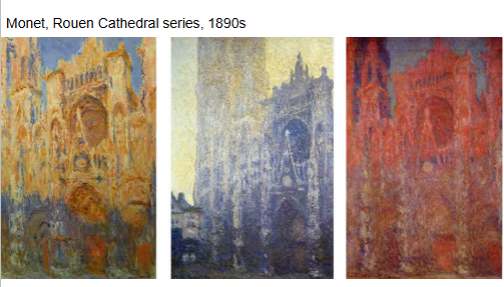
Monet — Rouen Cathedral Series (c. 1890s)
Identification:
Artist: Monet
Title: Rouen Cathedral Series
Date: c. 1890s
Movement: Impressionism
Historical Context:
Monet painted the cathedral repeatedly over about six years, working methodically across different times of day.
The focus shifts away from the building itself to how it appears under changing light and atmospheric conditions.
This reflects his ongoing interest in perception and the effects of environment on what we see
Style:
The surface of the cathedral is broken into patches of color rather than clear architectural detail.
Light, mist, and atmosphere soften and partially dissolve the structure.
Different materials (stone, glass) are shown through how they reflect and absorb light.
The brushwork emphasizes visual sensation over precise form.
Themes:
The series explores how light and atmosphere transform a single subject over time.
The cathedral becomes a surface for studying color, reflection, and perception.
There is a subtle spiritual quality, as the shifting light gives the structure an almost immaterial presence.
The work reflects a move toward focusing on seeing itself, rather than the object being seen.
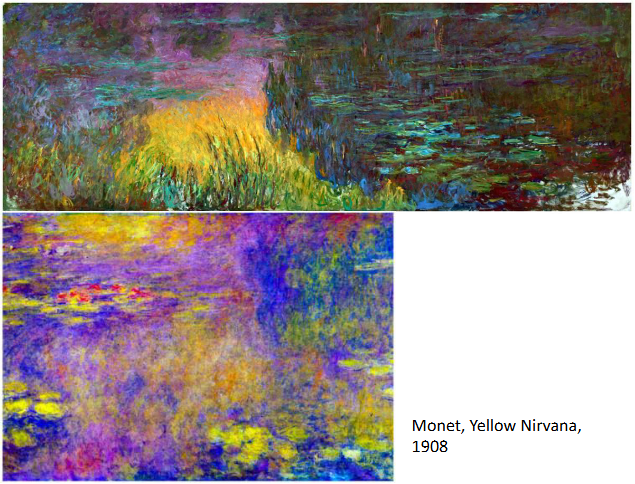
Monet — Yellow Nirvana (1908)
Identification:
Artist: Monet
Title: Yellow Nirvana
Date: 1908
Movement: Late Impressionism
Historical Context:
The painting belongs to Monet’s later period, when his work became more focused on personal experience and perception.
His eyesight was beginning to decline, which may have influenced the stronger, more intense use of color.
The title “Nirvana” suggests an interest in ideas of spiritual transcendence and inner reflection
Style:
The painting uses vivid, dominant color, especially yellow tones.
Forms are less clearly defined, moving toward abstraction.
The image becomes more immersive, focusing on overall visual sensation rather than distinct objects.
Themes:
The work reflects a sense of spiritual contemplation, suggested by the idea of “nirvana.”
It emphasizes the experience of looking rather than the subject itself.
The painting can be seen as a personal, meditative space for the artist.
It shows a shift toward abstraction, where color and perception become more important than form.
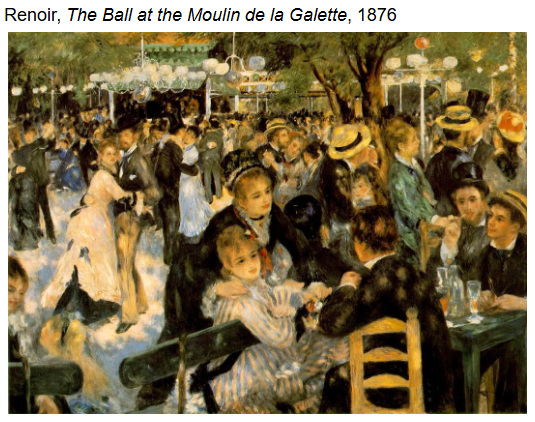
Renoir — The Ball at the Moulin de la Galette (1876)
Identification:
Artist: Renoir
Title: The Ball at the Moulin de la Galette
Date: 1876
Movement: Impressionism
Themes:
Social life and leisure
A sense of joy and relaxation and reimagining of harmonious mingling after political unrest
People enjoying modern urban life
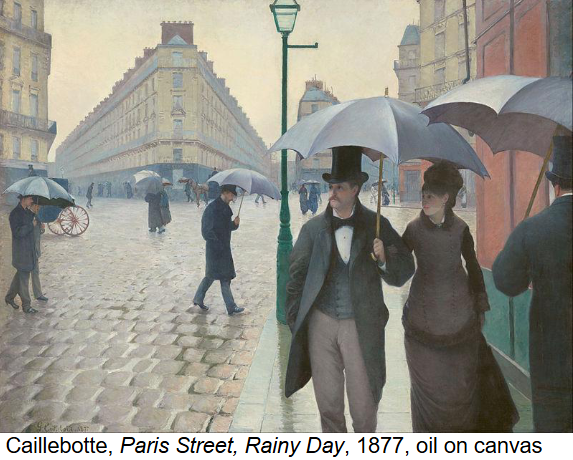
Caillebotte — Paris Street, Rainy Day (1877)
Identification:
Artist: Caillebotte
Title: Paris Street, Rainy Day
Date: 1877
Movement: Impressionism / Realism
Historical Context:
The painting shows modern Paris after Haussmann’s renovations, with wide boulevards and open urban space.
It reflects new social environments where people move through the city and observe one another.
Caillebotte was both a painter and a collector who supported Impressionist exhibitions.
The scene emphasizes visibility and the experience of being in public space
Style:
The composition is highly structured and controlled, unlike the looser style of many Impressionists.
Figures are more clearly defined, showing Caillebotte’s more observational and restrained approach.
Strong perspective lines guide the viewer’s eye down the boulevard.
The wet street and atmosphere are carefully rendered, adding realism to the scene.
Themes:
Focus on modern city life and public space.
Suggests class differences through clothing and distance between people.
Emphasizes looking and being seen, with figures gazing in different directions.
Shows how people can be close together but still feel separate.
Caillebotte — Young Man at His Window (1875)
Identification:
Artist: Caillebotte
Title: Young Man at His Window
Date: 1875
Movement: Impressionism / Realism
Historical Context:
Reflects modern Paris after Haussmann’s renovations, with open streets and increased visibility.
Balconies and windows became important spaces for observing the city.
Style:
The figure is shown from behind, focusing attention on what he is looking at rather than who he is.
Strong contrast between the interior space and the outside street.
The composition feels still and controlled, with a sense of distance.
Themes:
The painting focuses on the act of looking, rather than action or narrative.
It shows a liminal space between inside and outside, private and public.
The figure appears detached, creating a sense of isolation or emptiness.
The viewer is unsure how to interpret the scene, including the man’s relationship to the woman in the street.
This ambiguity reflects modern life, where people observe each other without clear connection.
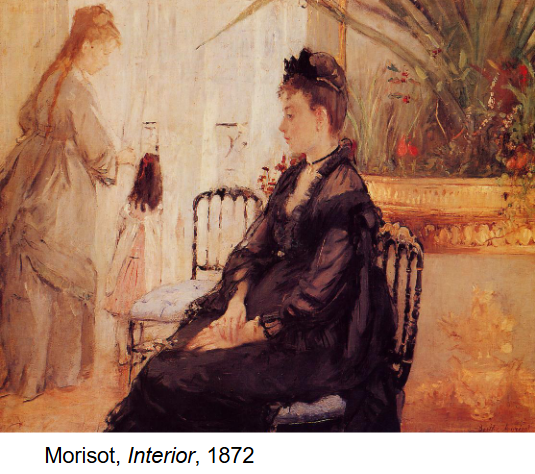
Morisot — Interior (1872)
Identification:
Artist: Morisot
Title: Interior
Date: 1872
Movement: Impressionism
Historical Context:
Morisot was part of the Impressionist group and one of the few prominent female artists of the time.
As a woman, she was often limited to painting domestic and interior spaces, rather than public scenes like cafés.
Her work reflects the experiences and restrictions placed on upper-class women in 19th-century society.
Style:
Light, loose brushwork with attention to fabric, texture, and light, especially whites and sheer materials.
Soft use of color and light creates an atmospheric, intimate scene.
The composition emphasizes the interior space while still hinting at the outside world through windows and light.
Themes:
The painting focuses on women in domestic space, particularly upper-class women.
There is a strong sense of boundaries between inside and outside, with figures looking out but remaining confined.
The woman’s downcast gaze creates emotional ambiguity, making it unclear if she is reflective, bored, or constrained.
The work suggests confinement and limitation, as women are positioned within the home but aware of the world beyond it.
It reflects a specifically female perspective, capturing everyday moments and inner emotional states rather than public action.
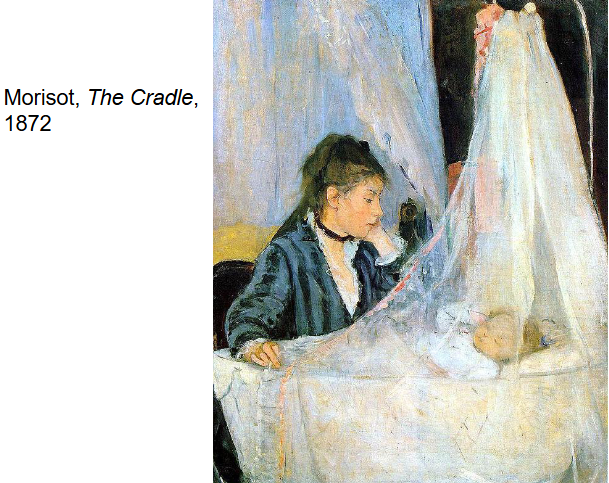
Morisot — The Cradle (1872)
Identification:
Artist: Morisot
Title: The Cradle
Date: 1872
Movement: Impressionism
Historical Context:
The painting depicts Morisot’s sister as a new mother with her child.
Reflects the kinds of subjects available to female artists, focusing on domestic life and motherhood.
Shows a more intimate, personal side of modern life compared to public urban scenes.
Style:
Soft, loose brushwork typical of Impressionism.
Strong attention to light and material, especially the sheer white fabric of the cradle.
The veil-like fabric partially obscures the child, emphasizing perception and the act of looking.
Subtle use of color and light creates a calm, quiet atmosphere.
Themes:
The painting centers on motherhood and care, showing a private, intimate moment.
The mother’s expression is ambiguous, possibly showing fatigue, calm, or quiet reflection.
The sheer fabric creates a sense of distance and protection, separating mother and child slightly.
The work captures a moment of stillness and pause, rather than action.
It reflects an Impressionist interest in how we see, but through a female and maternal perspective.
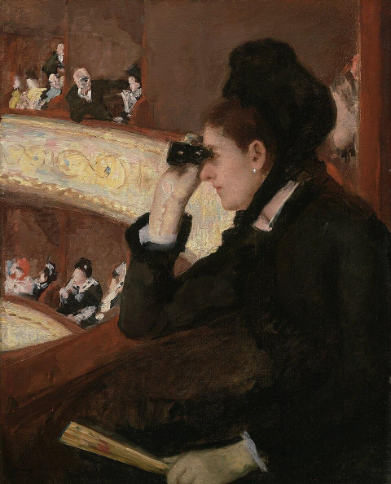
Cassatt — In the Loge (At the Opera) (1878)
Identification:
Artist: Cassatt
Title: In the Loge (At the Opera)
Date: 1878
Movement: Impressionism
Historical Context:
The painting is set in an opera house, a key social and entertainment space in modern Paris.
These spaces were not just for watching performances, but also for being seen and observing others.
Women could attend, but their behavior and appearance were closely watched and judged.
Style:
Clear focus on the female figure in the foreground, with softer, less defined background elements.
Use of light and contrast draws attention to her face and dress.
The composition creates a layered scene, showing both the woman and the man observing her.
Themes:
The painting explores looking and being looked at.
The woman is actively watching the performance, but she is also being watched by a man in the background.
This creates a sense of the male gaze, where women are observed and judged in public spaces.
The woman appears aware and composed, suggesting she understands she is being seen.
The work highlights the tension between public appearance and inner experience, as women had to carefully manage how they presented themselves.
It reflects the complexities of being a woman in modern urban society, where visibility brings both freedom and pressure.
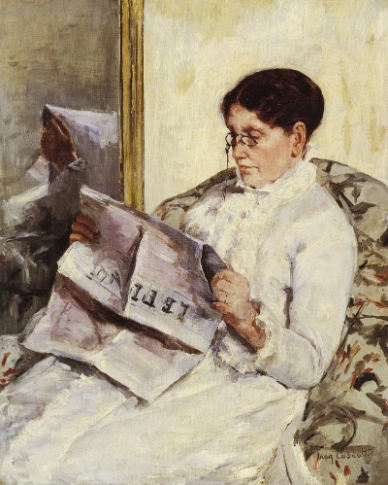
Cassatt — Reading Le Figaro (1878)
Identification:
Artist: Cassatt
Title: Reading Le Figaro
Date: 1878
Movement: Impressionism
Historical Context:
The painting shows a woman (Cassatt’s mother) reading a newspaper, which was associated with public life and politics.
At the time, reading the news was more commonly linked to men, making this a subtle but important shift.
The work reflects growing ideas around women’s education and early feminist thinking.
Style:
Focus on a single figure in a quiet interior setting.
Soft, controlled brushwork with attention to posture and gesture.
The composition emphasizes the act of reading rather than dramatic action.
Themes:
The painting presents a woman as intelligent, engaged, and aware of the world.
It challenges traditional gender roles by showing a woman participating in what was seen as a more “masculine” activity.
The newspaper connects the domestic interior to the outside world, allowing access to public life from within the home.
There is a sense of dual space, where the woman is physically inside but mentally engaged with the wider world.
The work reflects a more modern image of women as thoughtful and independent individuals.
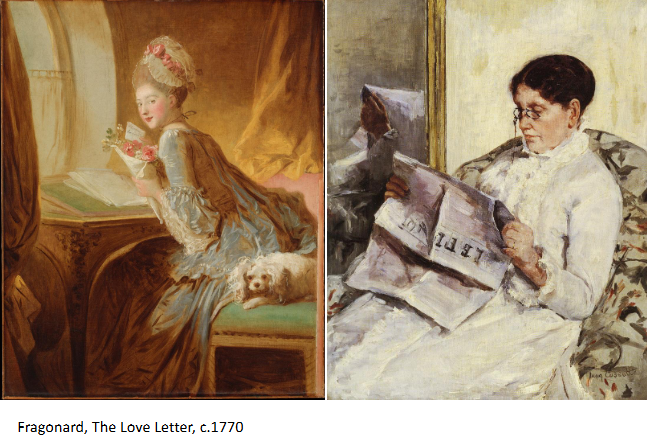
Cassatt — Reading Le Figaro vs Fragonard — The Love Letter
Similarities:
Both paintings show a woman reading in a private, domestic setting.
Both focus on quiet, intimate moments rather than public action.
Differences — Purpose of Reading:
In Fragonard’s The Love Letter, the woman reads a romantic letter, emphasizing flirtation and romance.
In Cassatt’s Reading Le Figaro, the woman reads a newspaper, showing intellectual engagement and awareness of the world.
Differences — Representation of Women:
Fragonard presents the woman as playful and flirtatious, designed to appeal to a male viewer.
Cassatt presents the woman as serious, focused, and independent, emphasizing her intelligence.
Differences — Meaning:
Fragonard’s work reflects Rococo ideals, where women are associated with romance and pleasure.
Cassatt’s work reflects modern and feminist ideas, showing women as thoughtful and socially aware.
Overall Idea:
Fragonard = woman as an object of romance
Cassatt = woman as an independent thinker
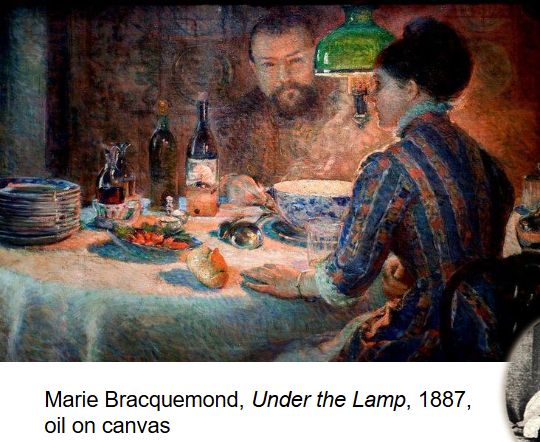
Bracquemond — Under the Lamp (1887)
Identification:
Artist: Bracquemond
Title: Under the Lamp
Date: 1887
Movement: Impressionism
Historical Context:
Bracquemond was associated with the Impressionists but is less well-known.
Later accounts (from her son) revealed that her husband was controlling and discouraged her artistic career.
This background adds deeper meaning to the domestic scene and the dynamics between the figures.
Style:
Focus on an interior domestic setting, with careful attention to light from the lamp.
Details such as steam rising from the bowl and objects on the table create a sense of everyday realism.
The lighting creates a warm but slightly tense atmosphere.
Themes:
The painting shows a quiet domestic moment between a husband and wife.
The man’s strong gaze creates a sense of tension and control within the scene.
The woman’s presence suggests a more restrained or defined role within the household.
The work reflects gender roles and power dynamics within the home.
There is an underlying sense of psychological strain, even within an ordinary setting.
The painting captures how everyday domestic life can contain subtle emotional tension.
Degas — Approach to Impressionism
Key Ideas:
Degas was trained in a classical academic style, unlike many Impressionists.
His work looks spontaneous but is actually carefully planned and constructed.
He was interested in modern life, especially working women.
His compositions often include cropping, unusual angles, and diagonal views.
He focuses on moments behind the scenes, rather than polished final performances.
Inspired greatly by Manet
Degas — Working Women and “Behind the Scenes”
Key Ideas:
Degas often painted ballerinas, laundresses, and women in labor-intensive jobs.
He shows the reality behind beauty, including exhaustion, strain, and awkward moments.
His work reveals the hidden labor behind entertainment and fashion.
There is often ambiguity, making it unclear whether he is sympathetic or critical.
Neo-Impressionism (Seurat & Signac)
What it is:
An art movement that developed after Impressionism in the 1880s.
Focuses on a more scientific and controlled approach to painting.
Key Characteristics:
Uses pointillism (small dots of color) instead of blended brushstrokes.
Colors are placed side by side so the eye mixes them.
Paintings look more structured, still, and planned.
How it’s different from Impressionism:
Impressionism = loose, fast, capturing a moment
Neo-Impressionism = careful, slow, based on color theory
Neo-Impressionism builds on Impressionist interests in light and perception, but replaces spontaneity with a controlled, scientific approach to color.
Themes:
Often shows modern life, but in a more rigid and artificial way.
Can include subtle ideas about class and social behavior.
Post-Impressionism (Cézanne & Van Gogh)
What it is:
A group of artists working after Impressionism who wanted to go beyond just capturing appearance.
Key Ideas:
Focus on structure (Cézanne) and emotion (Van Gogh).
Artists begin to distort color, space, and form on purpose.
Less about copying reality, more about interpreting it.
How it’s different from Impressionism:
Impressionism = capturing what the eye sees
Post-Impressionism = expressing how the artist thinks or feels
Why it matters:
Leads to modern art movements like Cubism and Expressionism
Realism → Impressionism → Neo-Impressionism → Post-Impressionism
Realism:
Focus on everyday life and social reality
Impressionism:
Focus on light, atmosphere, and perception
Neo-Impressionism:
Scientific approach using dots of color (pointillism)
Post-Impressionism:
Focus on emotion, structure, and personal expression
Overall Shift:
From showing reality → to capturing perception → to analyzing vision → to expressing meaning
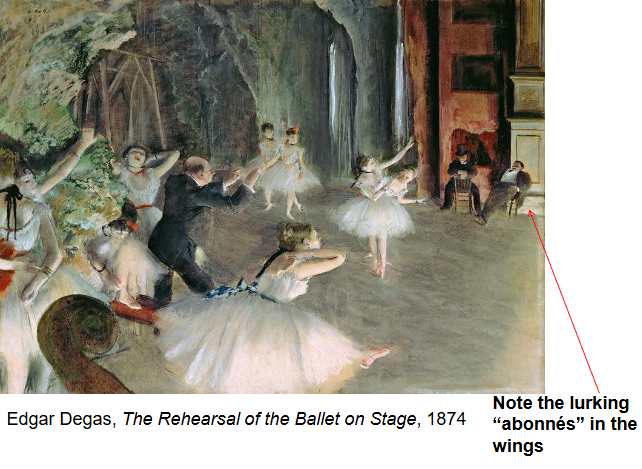
Degas — The Rehearsal of the Ballet on Stage (1874)
Identification:
Artist: Degas
Title: The Rehearsal of the Ballet on Stage
Date: 1874
Movement: Impressionism
Historical Context:
Ballet was a popular form of modern entertainment in Paris, but the dancers were often young, working-class women who were poorly paid.
Wealthy male subscribers (“abonnés”) had special access to rehearsals, creating unequal power dynamics and uncomfortable relationships.
The ballet world had an underlying connection to exploitation and, at times, sex work, which Degas subtly references
Style:
The scene is shown from a side-stage, diagonal viewpoint, making it feel like we are part of the rehearsal.
The composition is carefully constructed but appears spontaneous.
Figures are cropped and arranged in awkward, natural poses, emphasizing realism.
The central figure (likely the instructor) interrupts the scene, adding to the sense of a paused moment.
Themes:
The painting reveals the reality behind the illusion of ballet, showing rehearsal instead of performance.
It emphasizes labor, strain, and imperfection, rather than beauty and grace.
Small details (scratching, stretching, yawning) highlight the physical demands on the dancers.
The presence of male spectators in the background introduces a sense of surveillance and unease.
Degas explores the idea that both dance and painting are constructed illusions, built through repeated effort.
Overall, the work presents a more honest and layered view of modern life, exposing what is usually hidden.
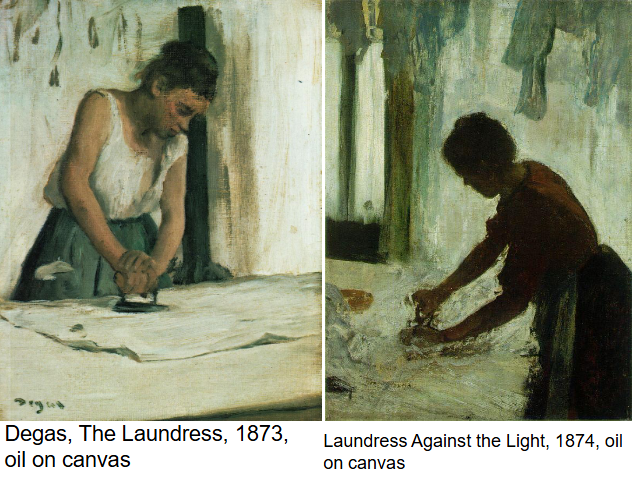
Degas — Laundress Against the Light (1874)
Identification:
Artist: Degas
Title: Laundress Against the Light
Date: 1874
Movement: Impressionism
Historical Context:
Laundresses worked in harsh, exhausting conditions for low pay.
Their work was often discussed in relation to morality and social concerns
Style:
Light creates a glowing or halo-like effect around the figure.
Focus on gesture and posture rather than detail.
Themes:
Emphasizes physical strain and exhaustion.
Gives dignity and presence to working women.
Blurs line between realism and subtle idealization.
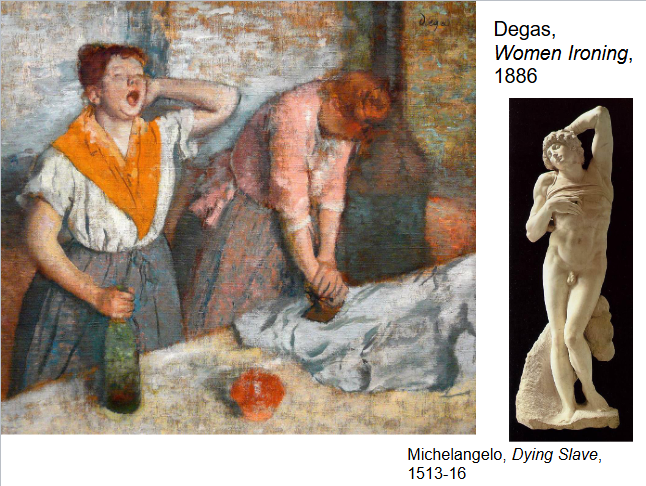
Degas — Women Ironing (1886)
Identification:
Artist: Degas
Title: Women Ironing
Date: 1886
Movement: Impressionism
Historical Context:
Laundresses were working-class women doing physically demanding labor for low wages.
Their work environments were hot, exhausting, and often associated with social concerns about morality and behavior.
Style:
The composition uses repeated poses (one woman leaning forward, one leaning back) to create balance and rhythm.
Figures are shown in awkward, unidealized positions, emphasizing realism over beauty.
The gestures feel natural and unpolished, reinforcing the sense of a captured moment.
Themes:
The painting highlights exhaustion and physical strain, shown through yawning, slouching, and repetitive movement.
The repeated labor suggests a cycle of work that feels endless and almost enslaving.
The poses may reference classical sculpture (like Michelangelo’s Dying Slave), linking modern labor to ideas of constraint and lack of freedom.
The bottle introduces ambiguity, possibly suggesting drinking or reflecting negative assumptions about working-class women.
Degas presents a more honest and unglamorous view of labor, exposing the reality behind everyday life.
Seurat — Bathers at Asnières (1883–84)