Pharm Ch 24 - Natural/Herbal Products and Dietary Supplements, Pharm Chapter 24: Natural/Herbal Products and Dietary Supplements, Chapter 24: natural/ herbal products and dietary supplements, Chapter 24 Natural/Herbal Products and Dietary Supplement…
 Call Kai
 Learn
Learn Practice Test
 Spaced Repetition
 Match
Match Flashcards
 Knowt Play
1/194

There's no tags or description
Looks like no tags are added yet.
Name | Mastery | Learn | Test | Matching | Spaced | Call with Kai |
|---|
No analytics yet
Send a link to your students to track their progress
195 Terms
Which statements are true about natural or herbal substances in the United States?
a. Herbal products marketed as dietary supplements are not required to comply with safety and efficacy regulations imposed on drug products.
b. Manufacturers cannot claim to cure conditions, but they can claim to improve structure or function.
c. The Food and Drug Administration (FDA) can allow a qualified health claim if scientific evidence exists to support the claim.
d. Because a prescription is not necessary for their use, most patients do not consider natural products or dietary supplements to be medicine.
e. All of the Above
f. Only A & C
e. All of the Above
Why do people take Natural/Herbal Products and Dietary Supplements (Slide 2 of 2)?
Why do people turn to herbal substances?
Marketing practices
Available without a prescription
Cultural influences
Sense of taking control of one's health
Distrust of physicians
Lack of health insurance
Improvements in analysis and quality control
Advances in clinical research
The FDA has performed much of the research and advanced the knowledge about herbal products and supplements. The German Federal Health Agency established the German Commission E to review and analyze world literature on plant-based products.
a. Both statements are true.
b. Both statements are false.
c. The first statement is true, the second is false.
d. The first statement is false, the second is true
The first statement is false, the second is true
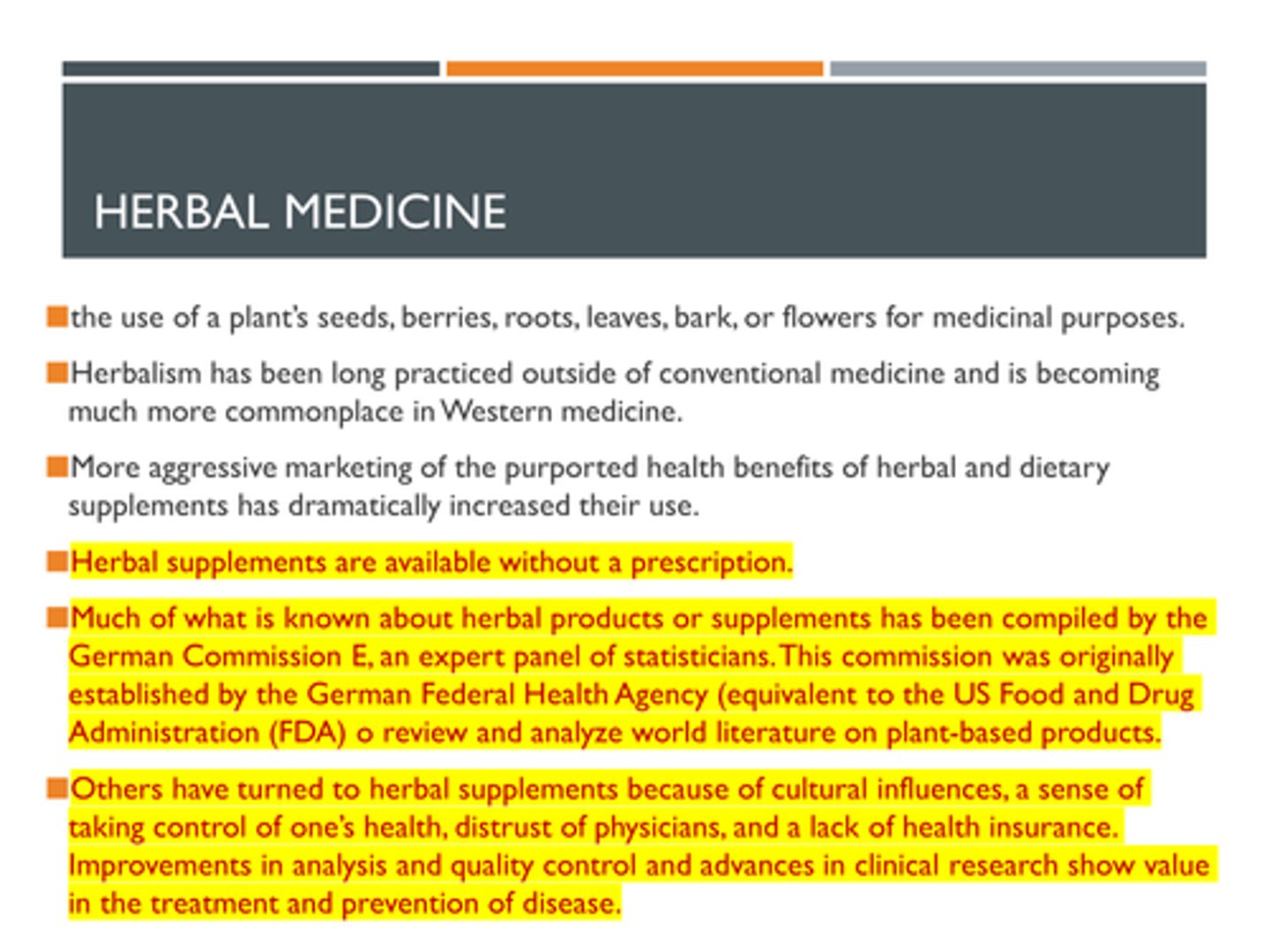
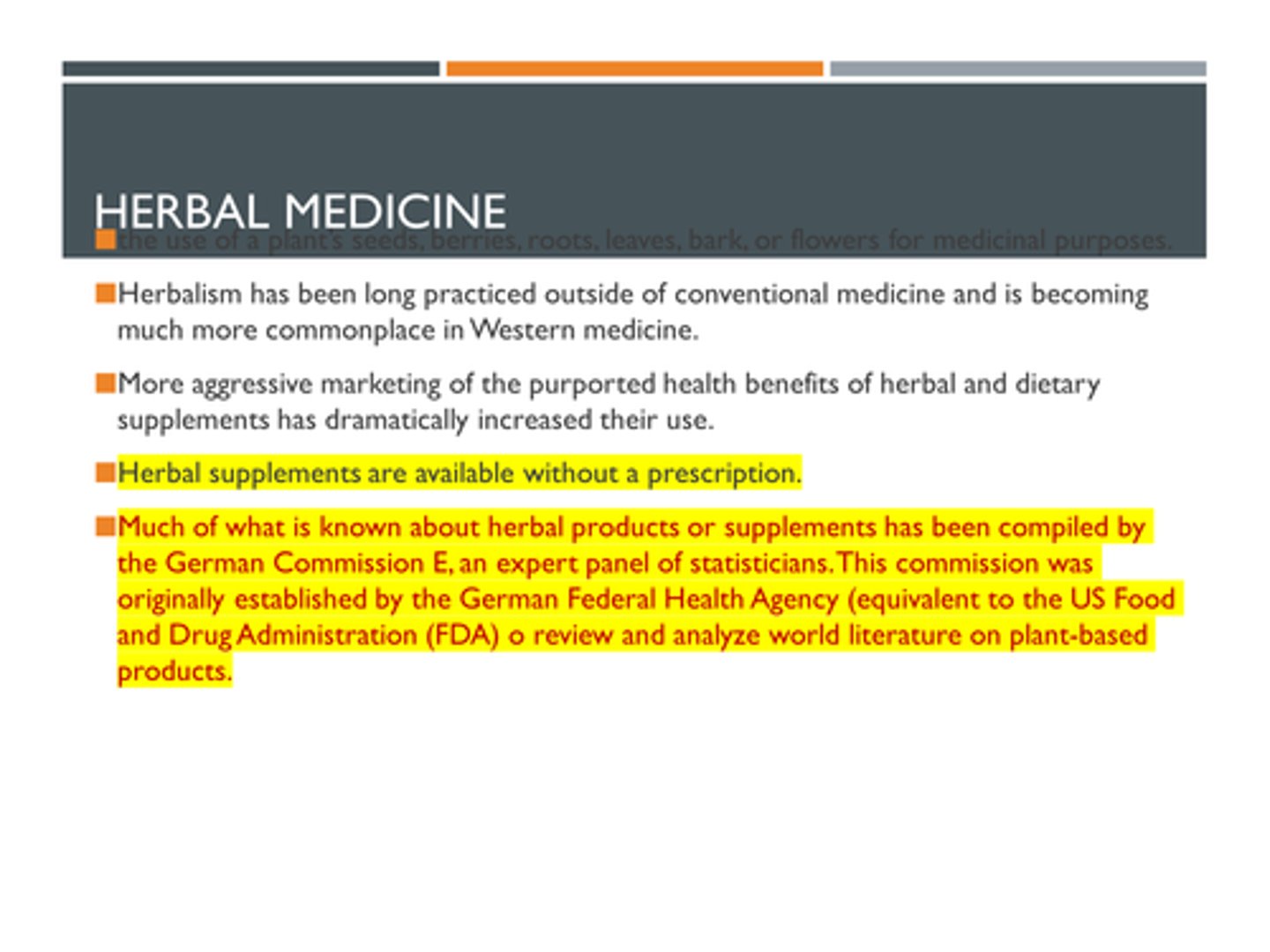
Much of what is known about herbal products or supplements has been compiled by the German Commission E, an expert panel of statisticians. This commission was originally established by the German Federal Health Agency (equivalent to the US Food and Drug Administration (FDA) to review and analyze world literature on plant-based products.
Herbal products in the United States are regulated by which governmental agency?
a. Federal Trade Commission
b. Food and Drug Administration (FDA)
c. Environmental Protection Agency
d. Dietary Supplement and Education Act
e. U.S. Pharmacopeia
Dietary Supplement and Education Act
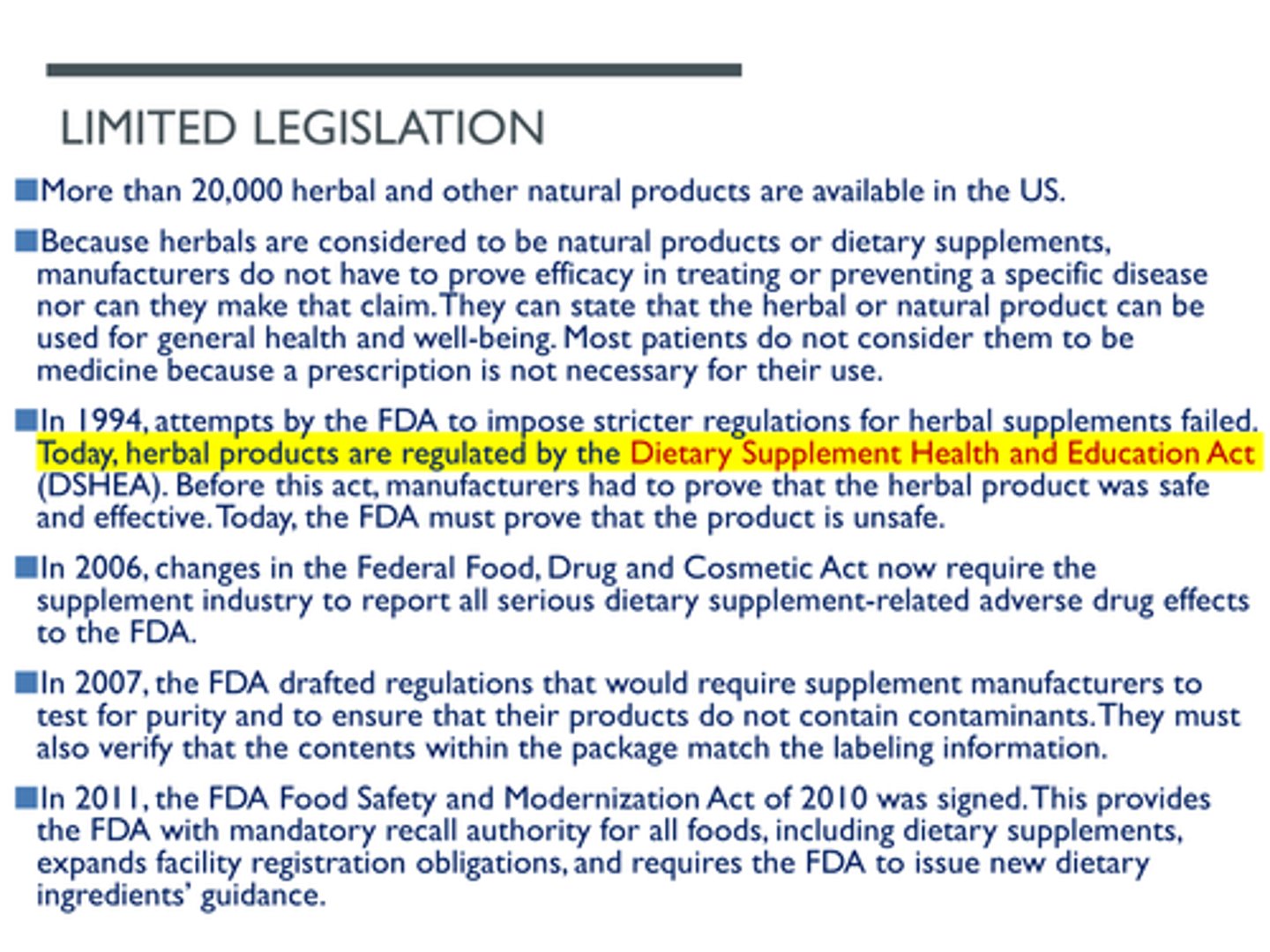
In 1994, attempts by the FDA to impose stricter regulations for herbal supplements failed. Today, herbal products are regulated by the Dietary Supplement Health and Education Act (DSHEA). Before this act, manufacturers had to prove that the herbal product was safe and effective. Today, the FDA must prove that the product is unsafe.
Many consumers consider herbal products to be nontoxic or side-effect-free because they are often called "natural" remedies. Most herbal products cause no adverse effects and drug interactions.
a. Both statements are true.
b. Both statements are false.
c. The first statement is true, the second is false.
d. The first statement is false, the second is true.
The first statement is true, the second is false.
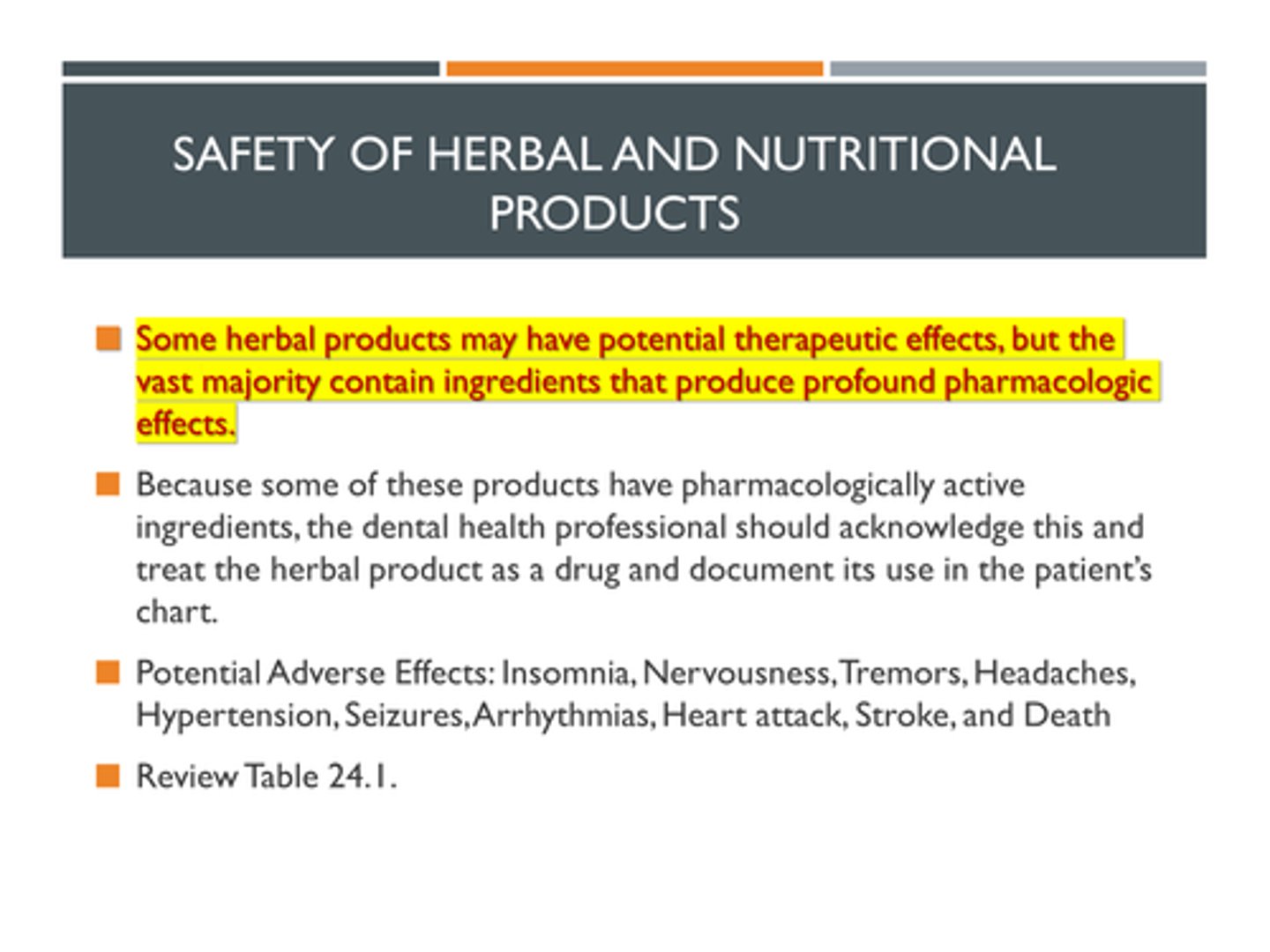
Some herbal products may have potential therapeutic effects, but the vast majority contain ingredients that produce profound pharmacologic effects.
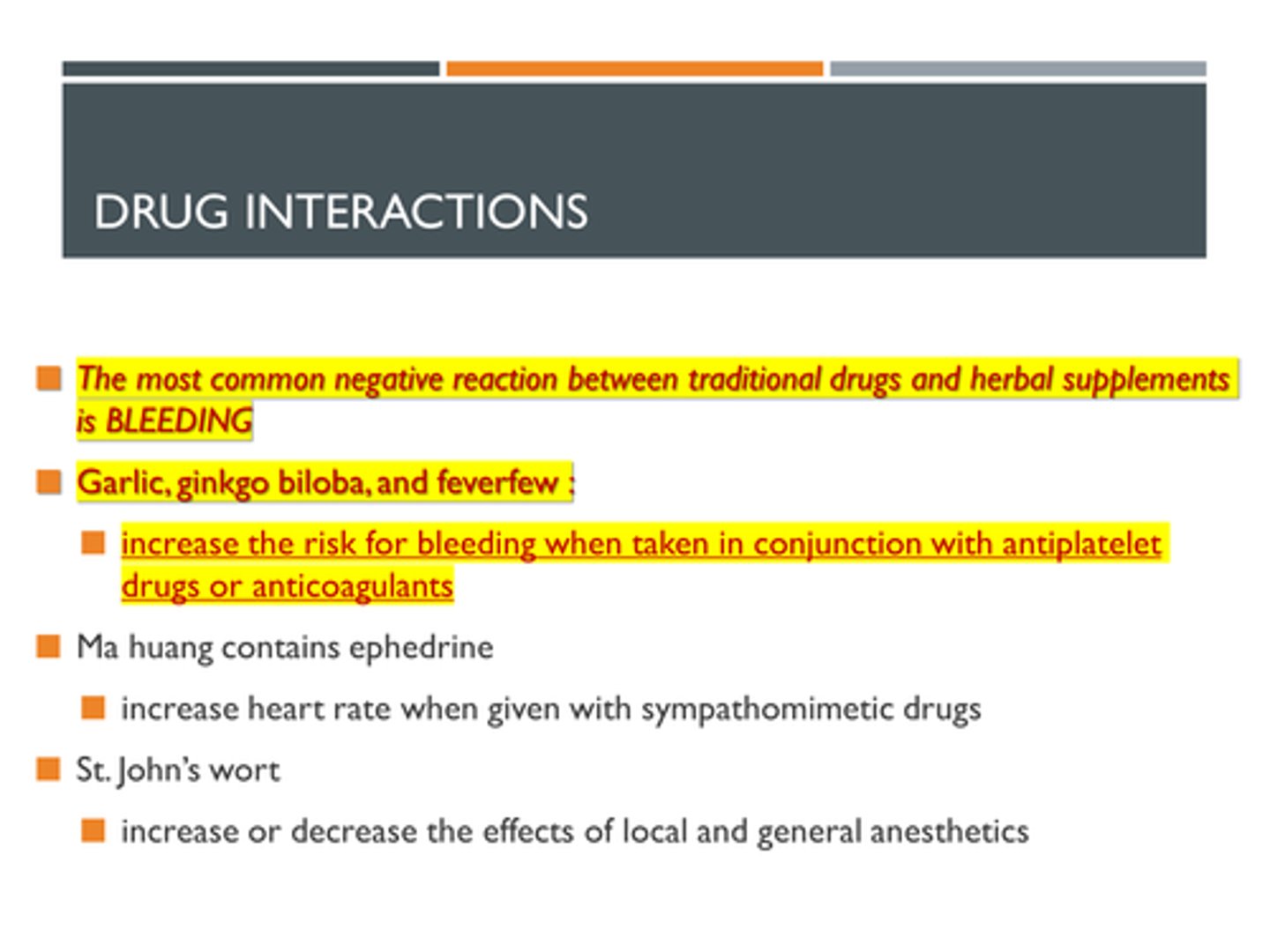
What is the most common adverse dental result from drug interactions between traditional drugs and herbal supplements?
Bleeding during dental procedures
An increased risk of bleeding can occur when __________ is taken in conjunction with antiplatelet drugs or anticoagulants.
Garlic, Gingko biloba, Feverfew
The FDA introduced Good Manufacturing Practice standards to ensure that dietary supplements are free of adulterants, contaminants, and impurities and that the labels accurately depict the contents of the package. This testing is mandatory and is enforced by the FDA.
a. Both statements are true.
b. Both statements are false.
c. The first statement is true, the second is false.
d. The first statement is false, the second is true.
The first statement is true, the second is false.
False = Testing is left to the manufacturer.
Natural/Herbal Products and Dietary Supplements (Slide 1 of 2)
Limited regulation
Safety of herbal and nutritional products
Drug interactions
Standardization of herbal products
Good manufacturing practice
Herbal supplements used in oral health care
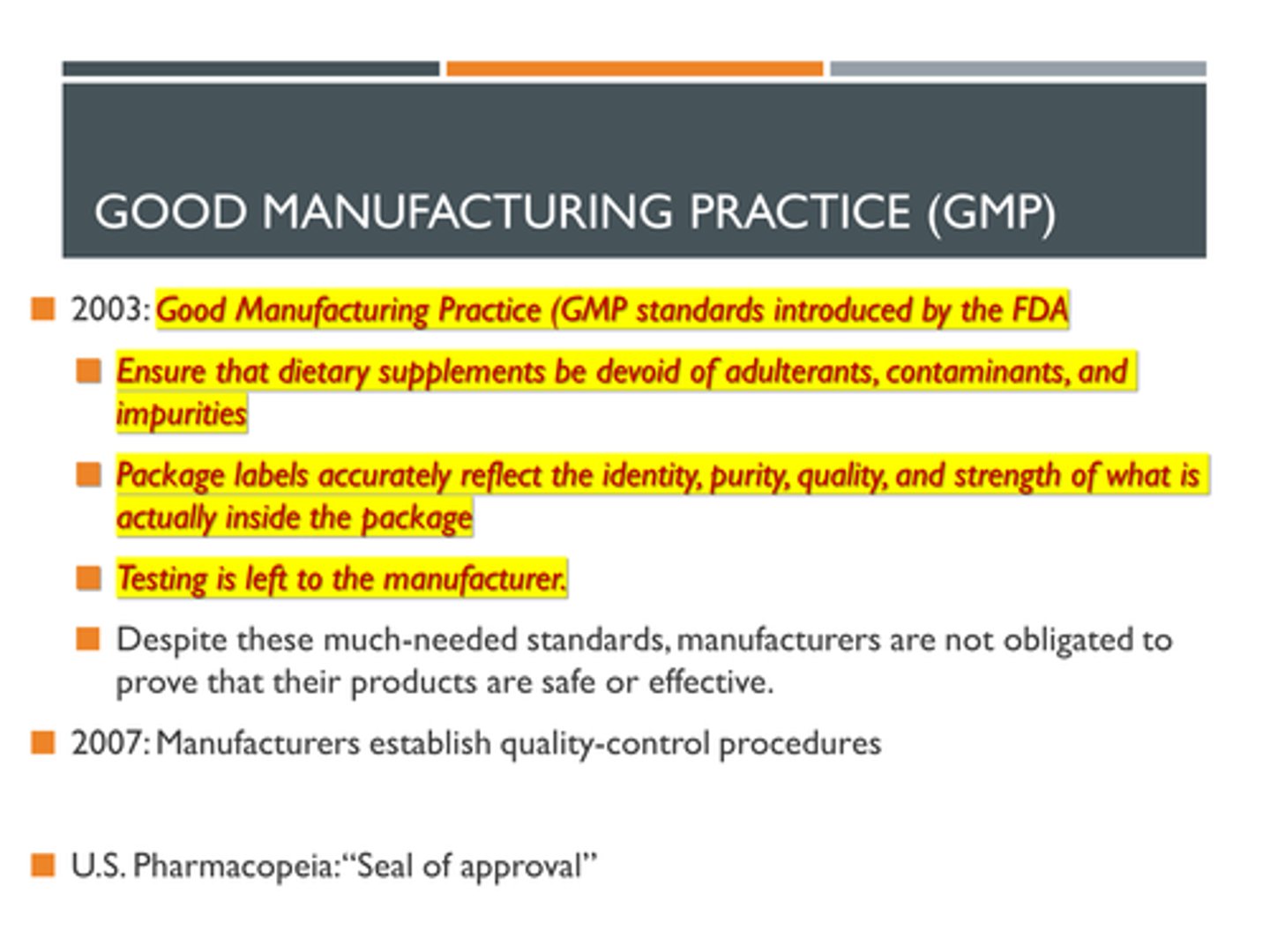
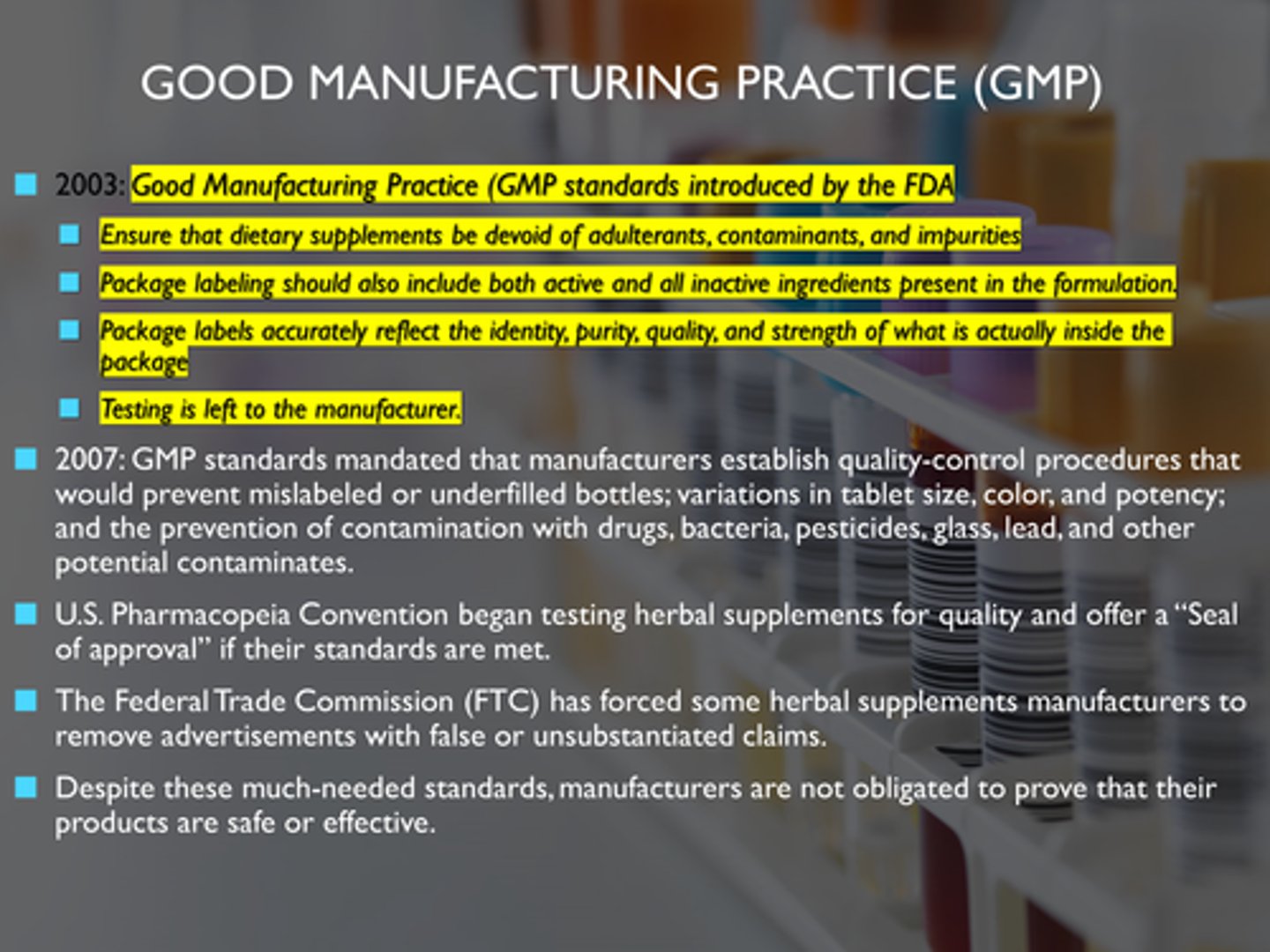
2003: GMP standards introduced by the FDA
Ø
Ensure that dietary supplements be devoid of adulterants, contaminants, and impurities
Ø
Package labels accurately reflect the identity, purity, quality, and strength of what is actually inside the package
Ø
2007: Manufacturers establish quality-control procedures
U.S. Pharmacopeia: "Seal of approval"
Name this act:
- Now manufactures must test for purity ensure that dietary supplements be devoid of adulterants, contaminants
- Provide accurate labeling information to consumers
- Package labels accurately reflect the identity, purity, quality, and strength of what is actually inside the package
- No therapeutic claims on the label
- Must be labeled as a dietary supplement
- No false or misleading information
- "This product is not intended to diagnose, treat, cure, or prevent any disease"
Good manufacturing practice (GMP)
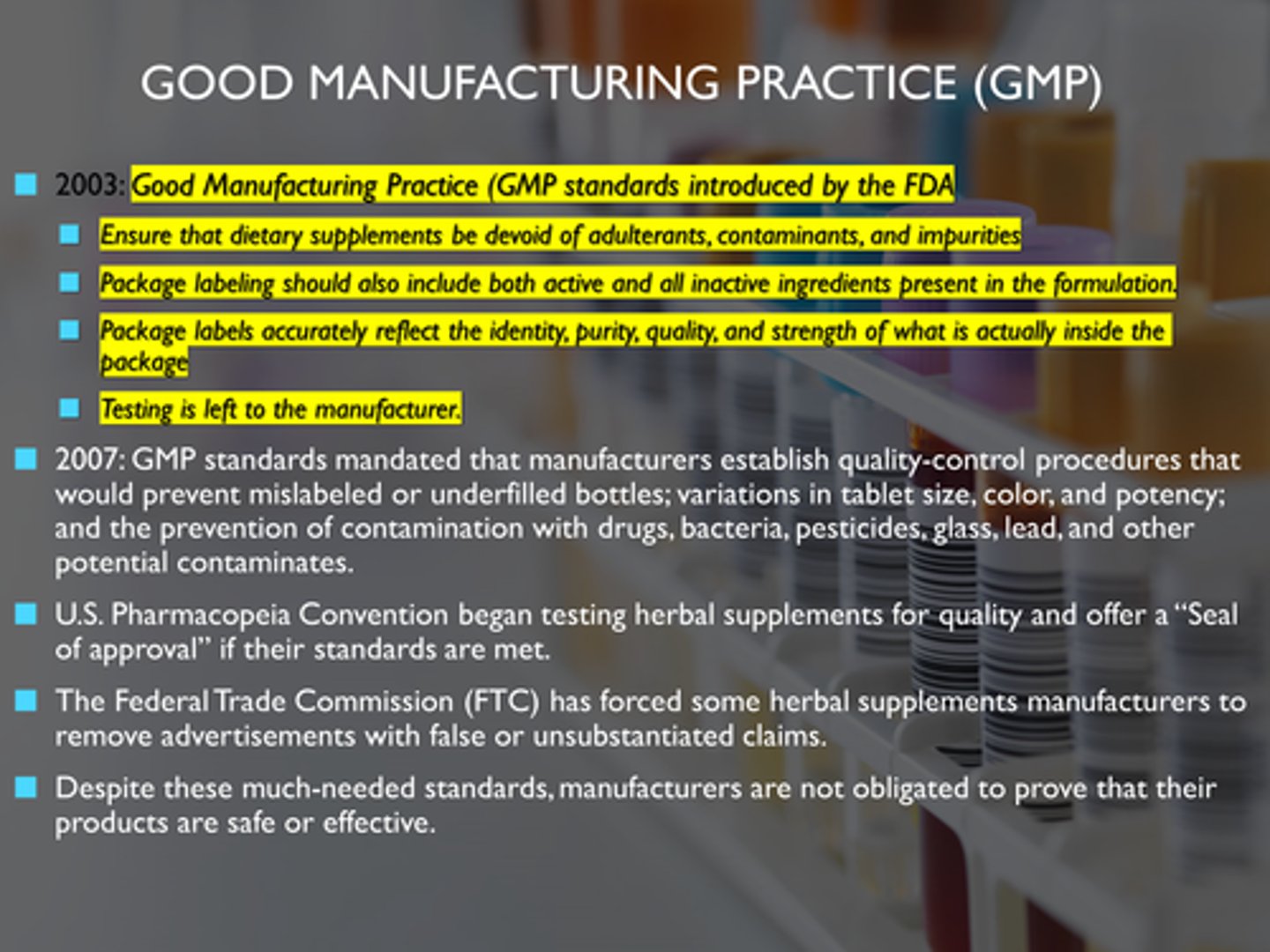
____________ standards were introduced by the FDA to ensure that dietary supplements are devoid of adulterants, contaminants and impurities and that package labels accurately.
Good manufacturing practice (GMP)
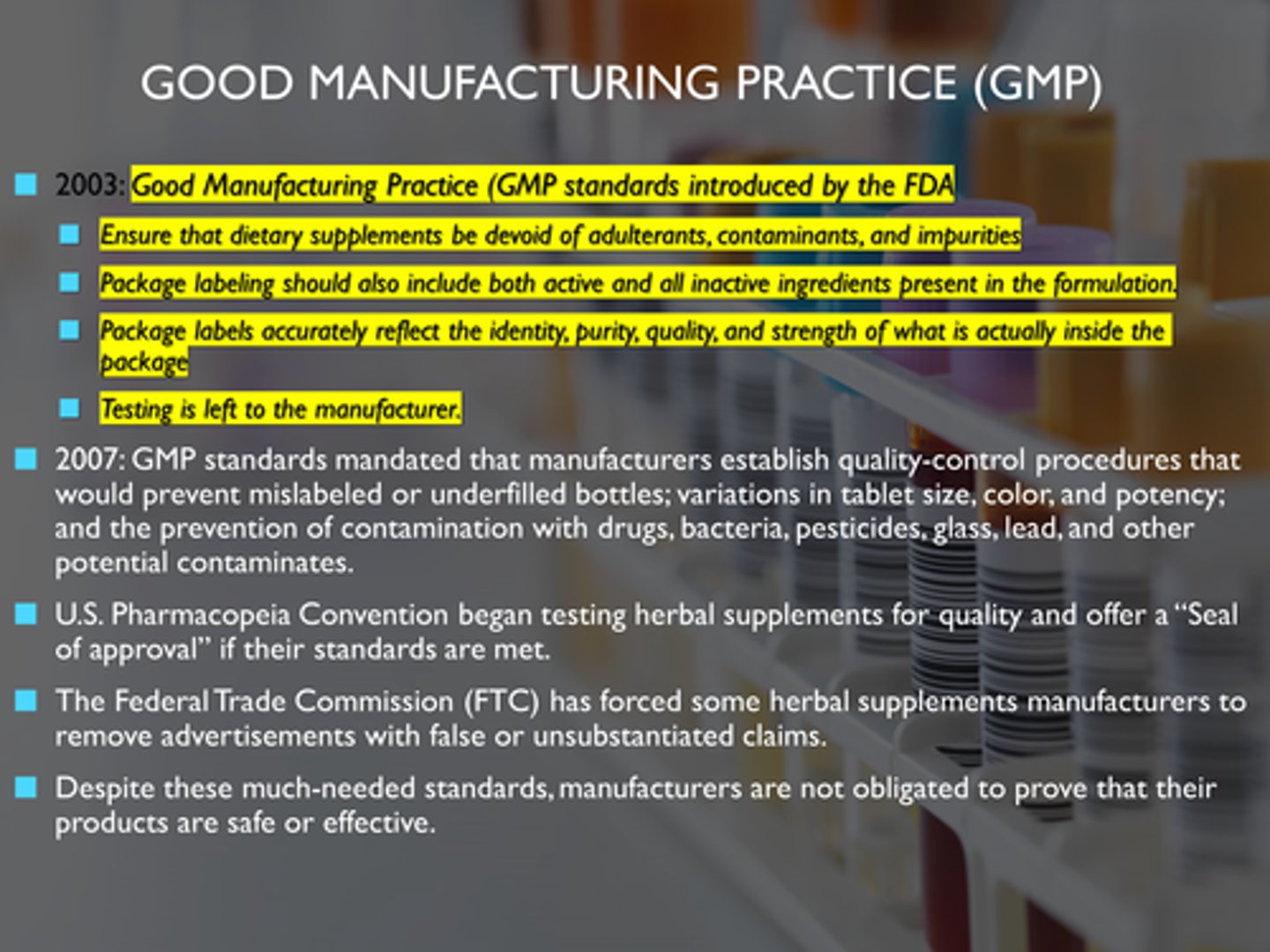
All are problems with herbal supplements except which of the following?
a. Information about drug interactions with herbal supplements is lacking.
b. The purity and potency of these products are closely regulated.
c. Dosage is not standardized.
d. Package labeling is often incomplete or inaccurate.
e. The product may contain more than one active ingredient.
b. The purity and potency of these products are closely regulated.
Which herbal supplement products have been proven effective in protecting against plaque and gingivitis?
a. Acemannan hydrogel (extract of aloe vera)
b. Essential oil mouth rinse
c. Oil of cloves (eugenol)
d. Triclosan
e. Xylitol
f. b and d only
b and d only
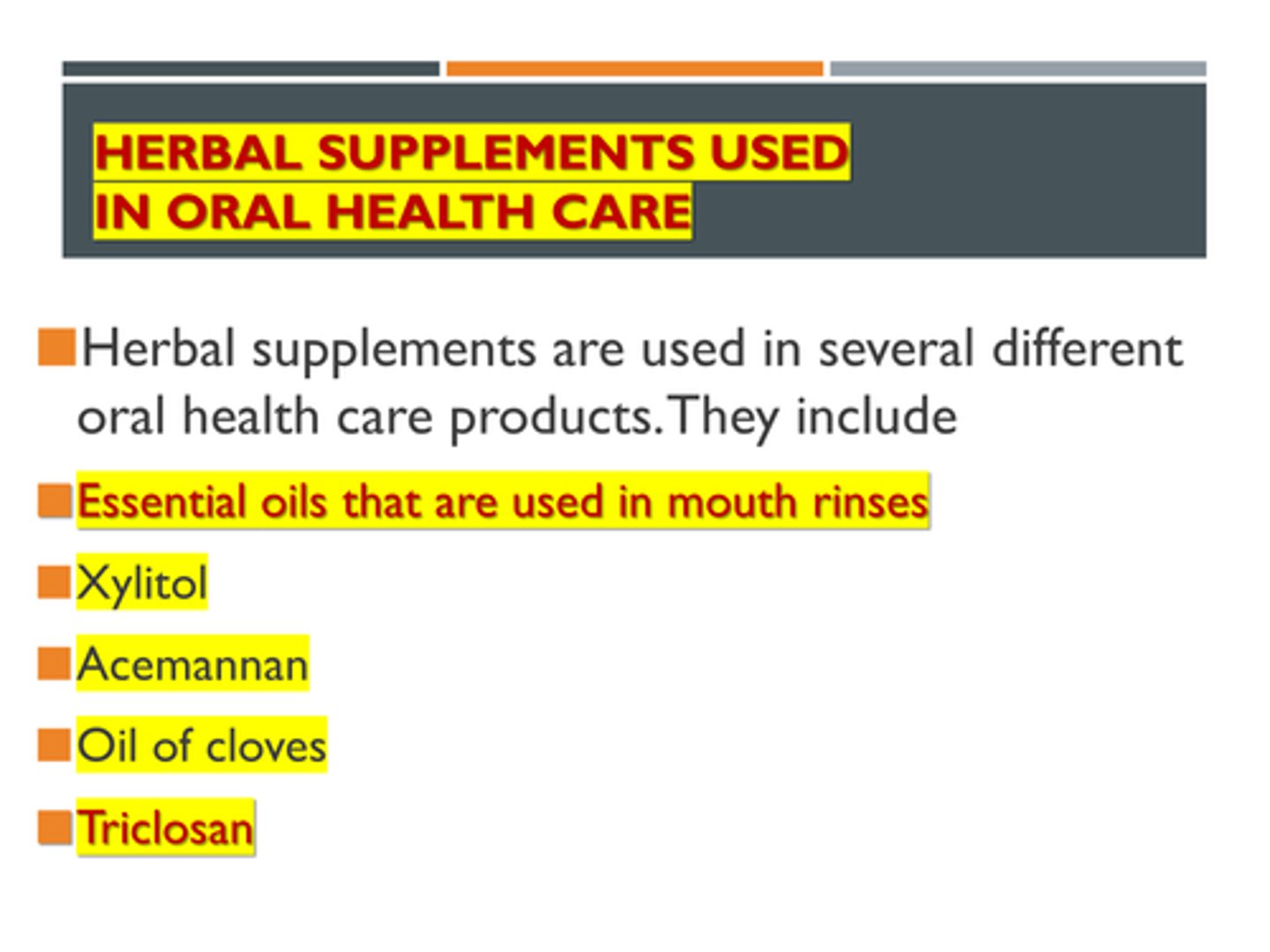
Herbal Supplements Used in Oral Health Care
> Essential oils that are used in mouth rinses
> Xylitol
> Acemannan
> Oil of cloves
> Triclosan
Which herbal supplement has cariostatic effects?
Xylitol
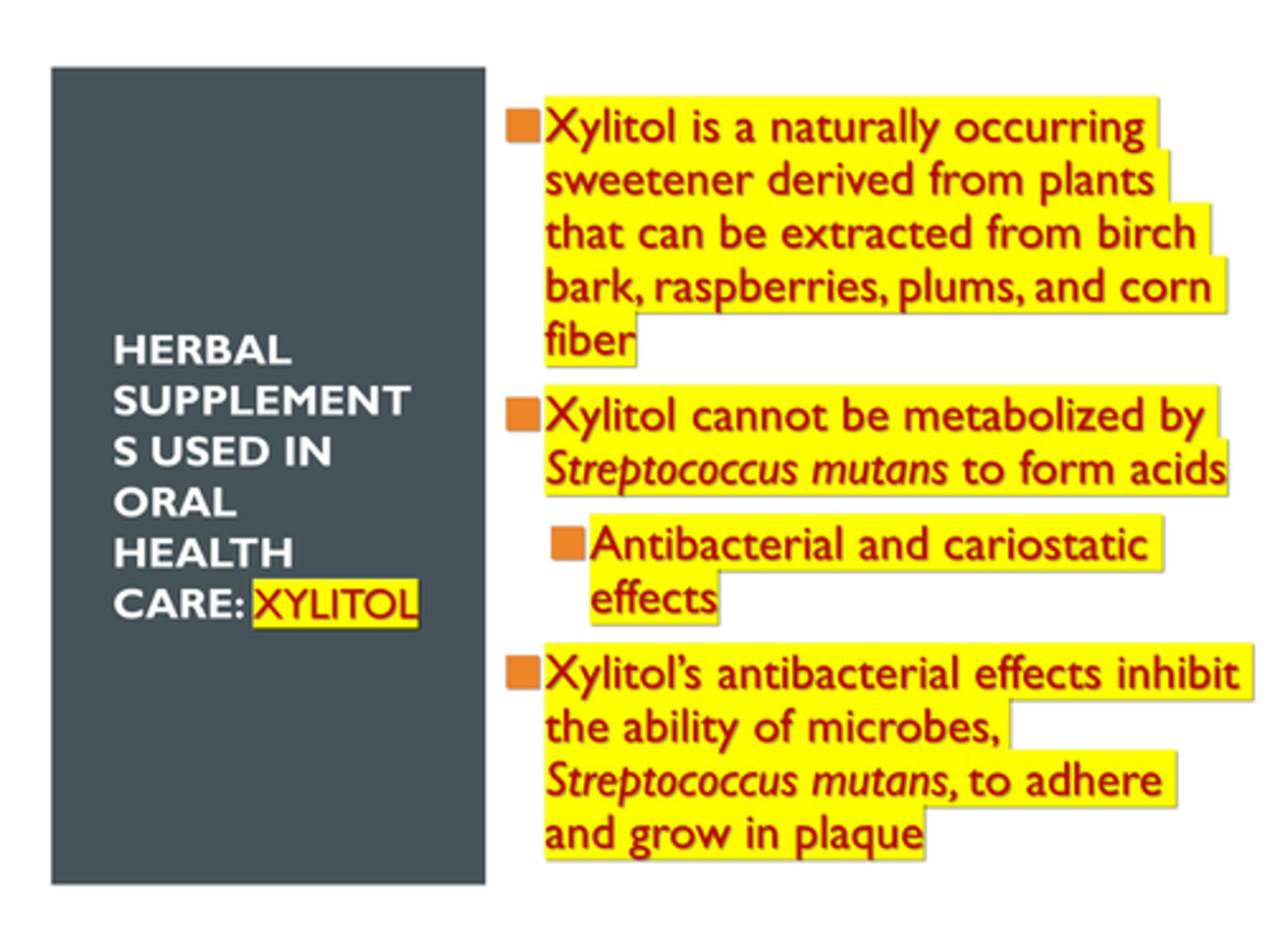
Herbal Supplements Used in Oral Health Care: Xylitol
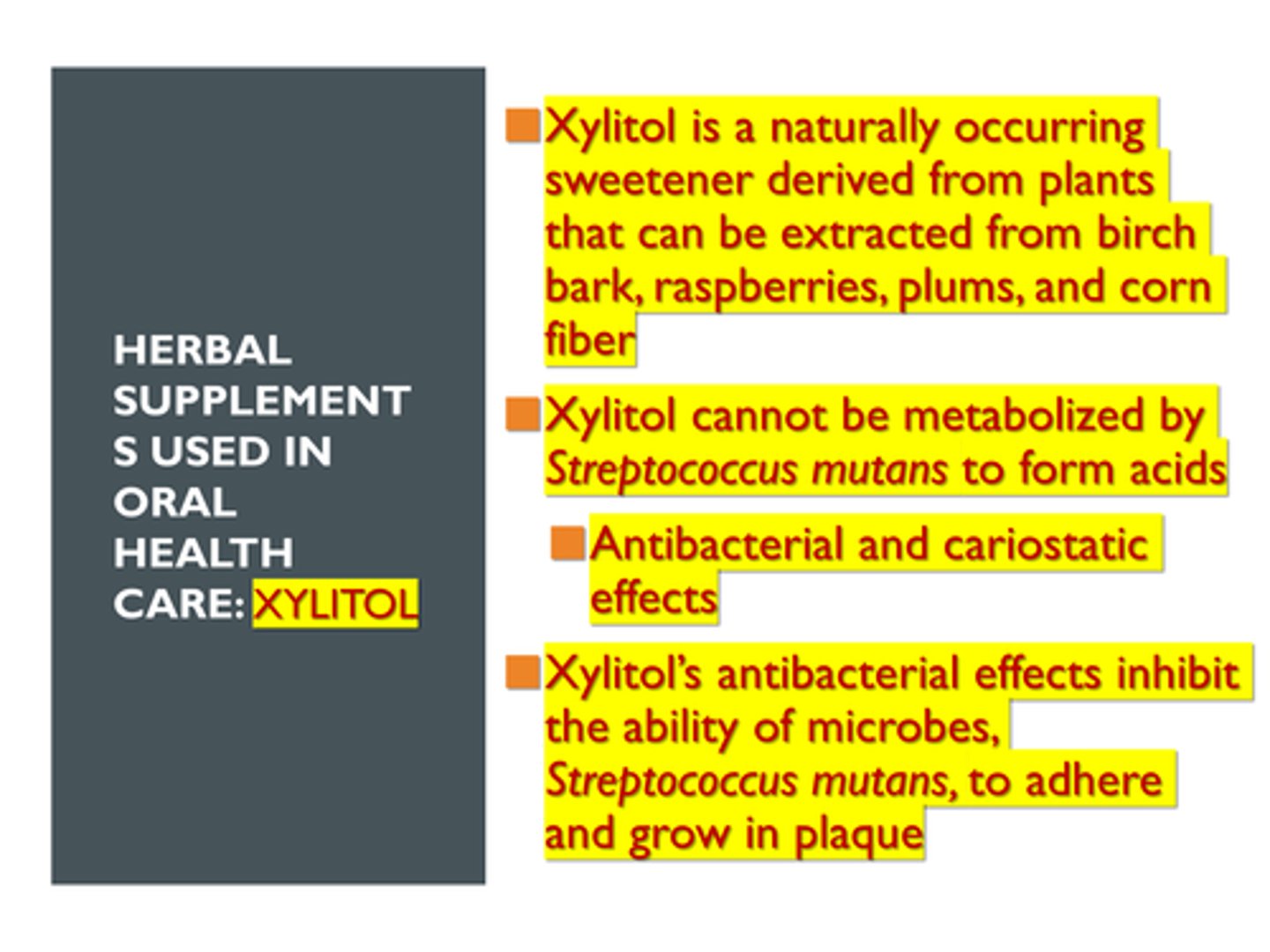
>> Xylitol is a naturally occurring sweetener derived from plants that can be extracted from birch bark, raspberries, plums, and corn fiber
>> Xylitol cannot be metabolized by Streptococcus mutans to form acids
>> Xylitol’s antibacterial effects inhibit the ability of microbes to adhere and grow in plaque
Which supplement cannot be metabolized by Streptococcus mutans to form acids?
Xylitol
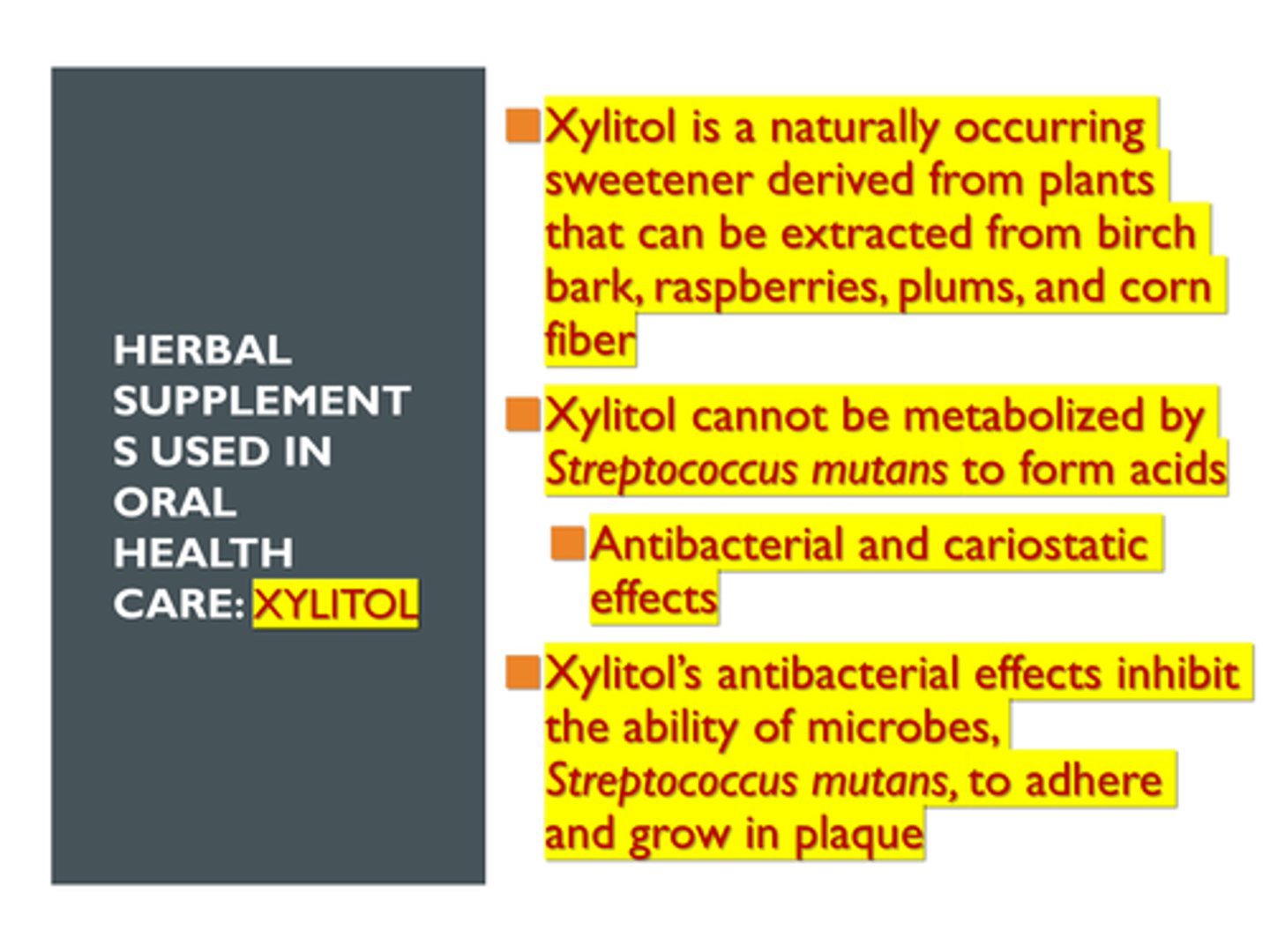
Herbal Supplements Used in Oral Health Care: Xylitol
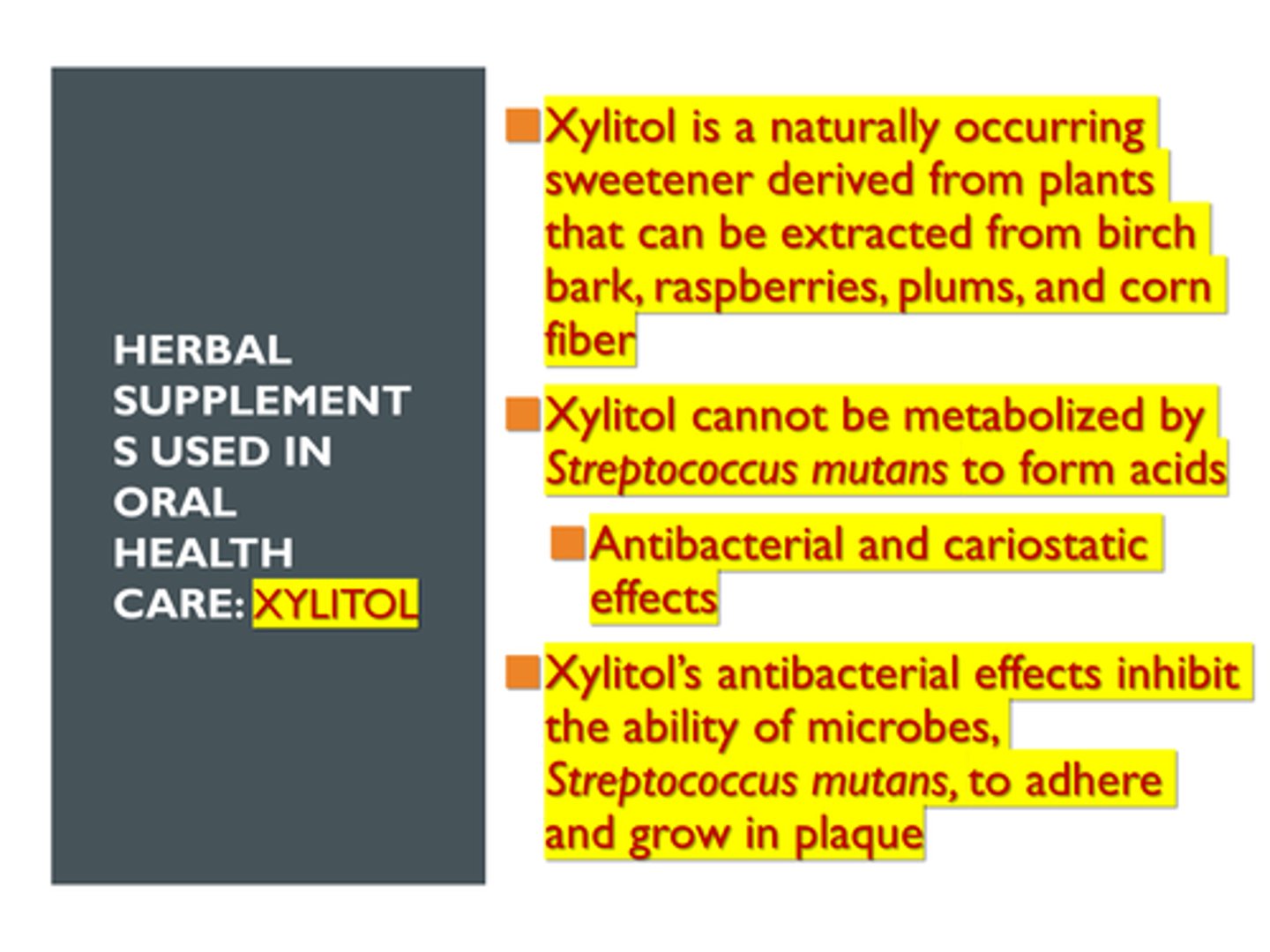
>> Xylitol is a naturally occurring sweetener derived from plants that can be extracted from birch bark, raspberries, plums, and corn fiber
>> Xylitol cannot be metabolized by Streptococcus mutans to form acids
>> Xylitol’s antibacterial effects inhibit the ability of microbes to adhere and grow in plaque
______ is a naturally occurring sweetener derived from plants that can be extracted from birch bark, raspberries, plums, and corn fiber.
xylitol
Xylitol antibacterial effects inhibit the ability of microbes to adhere to and grow in plaque.
TRUE
Which supplement has a naturally occurring sweetener derived from plants that can be extracted from birch bark, raspberries, plums, and corn fiber. Sweetness is comparable to sucrose?
xylitol
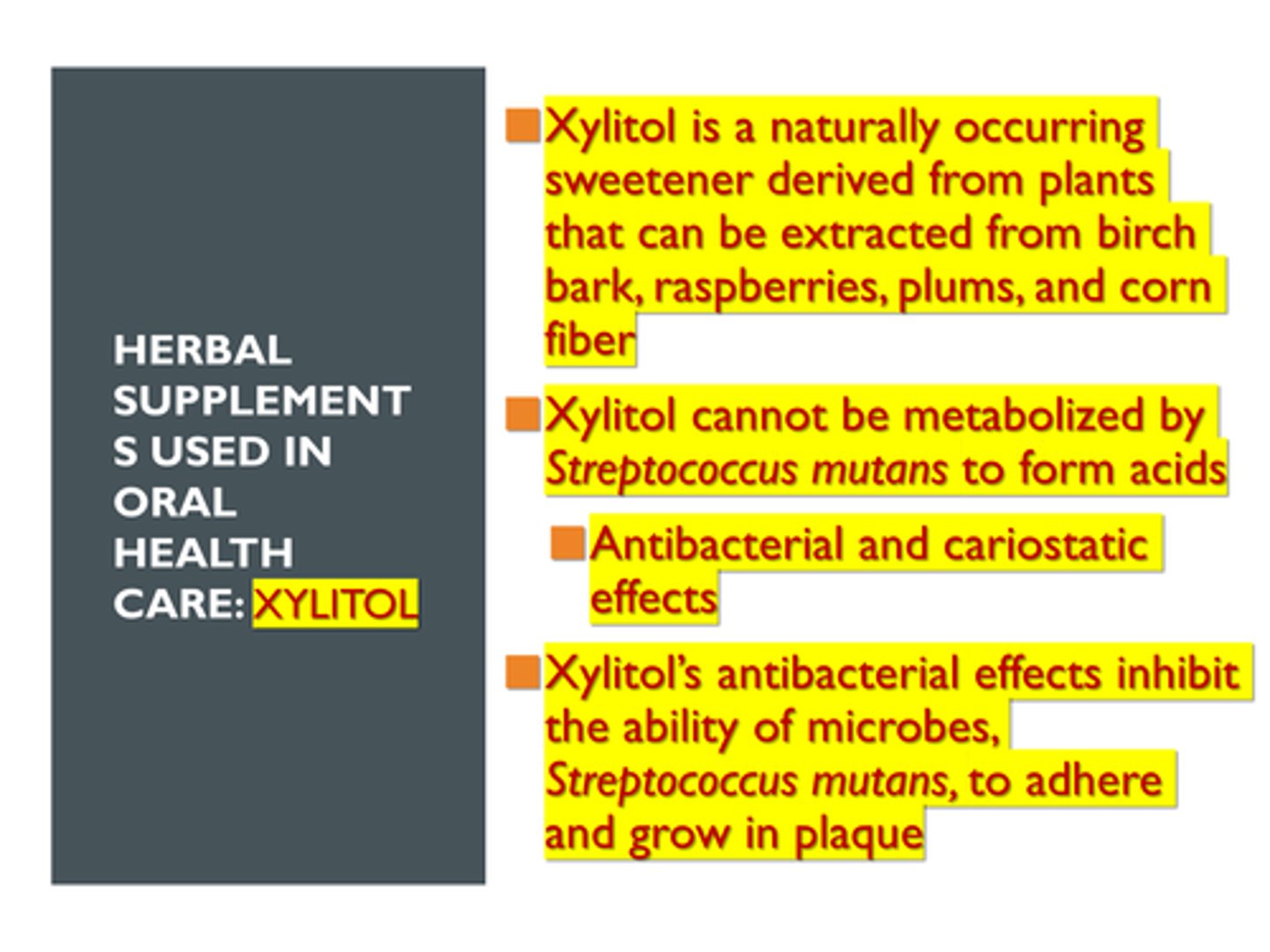
Herbal Supplements Used in Oral Health Care: Xylitol
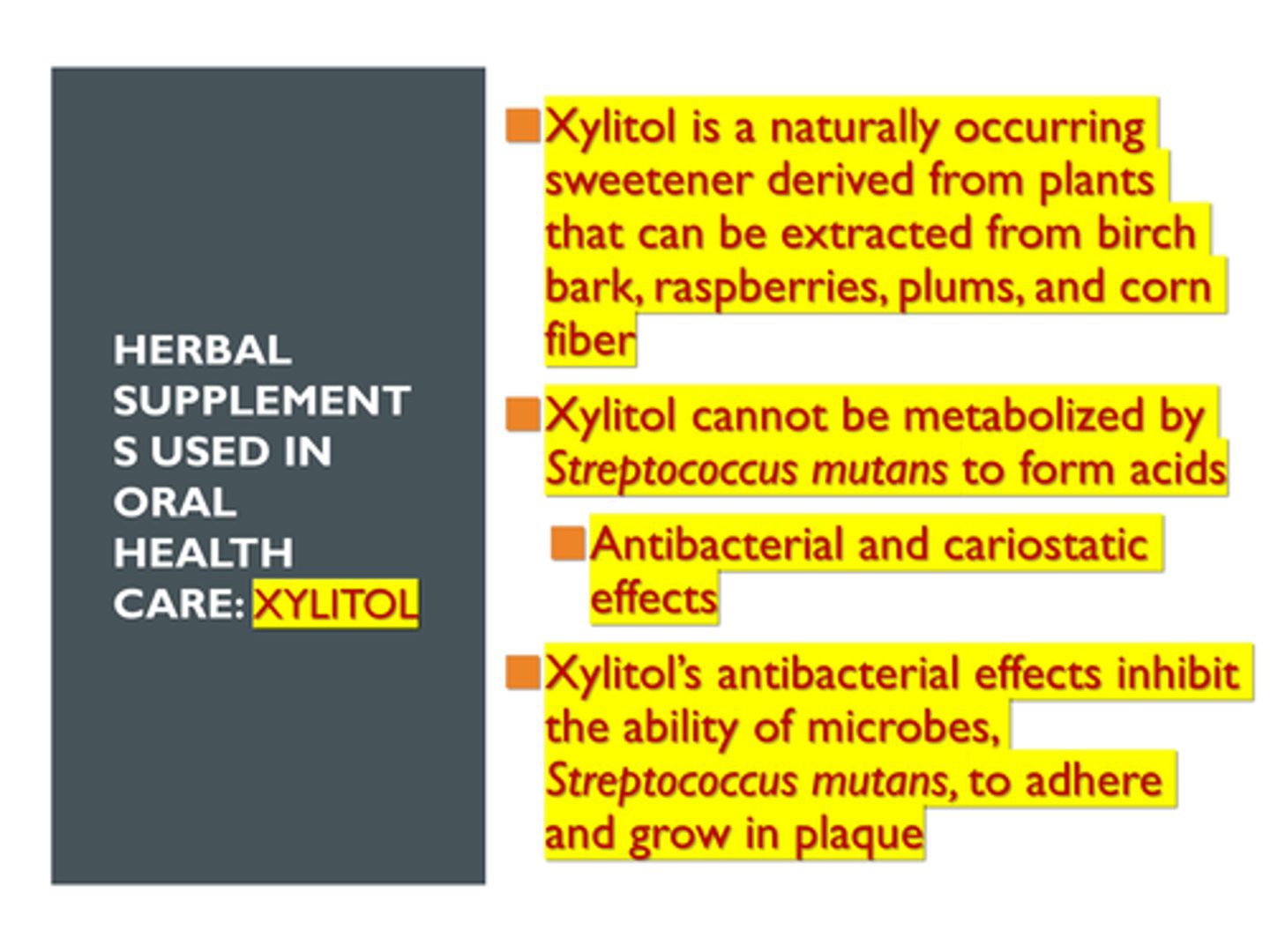
>> Xylitol is a naturally occurring sweetener derived from plants that can be extracted from birch bark, raspberries, plums, and corn fiber
>> Xylitol cannot be metabolized by Streptococcus mutans to form acids
>> Xylitol’s antibacterial effects inhibit the ability of microbes to adhere and grow in plaque
Cannot be metabolized by Streptococcus mutans. Reduces S. mutans levels, yielding antibacterial and cariostatic effects.
xylitol
Does xylitol have antibacterial effects that inhibit the ability of microbes to adhere and grow in the plaque?
True
False
True
Which is the mechanism of action of xylitol for its antibacterial and cariostatic effects?
a. Direct bacteriocidal effect on Streptococcus mutant
b. Inhibition of the ability of S. mutans to adhere and multiply in plaque
c. Inability to be metabolized by S. mutans as a nutrient source
d. b and c only
e. All of the above.
d. b and c only
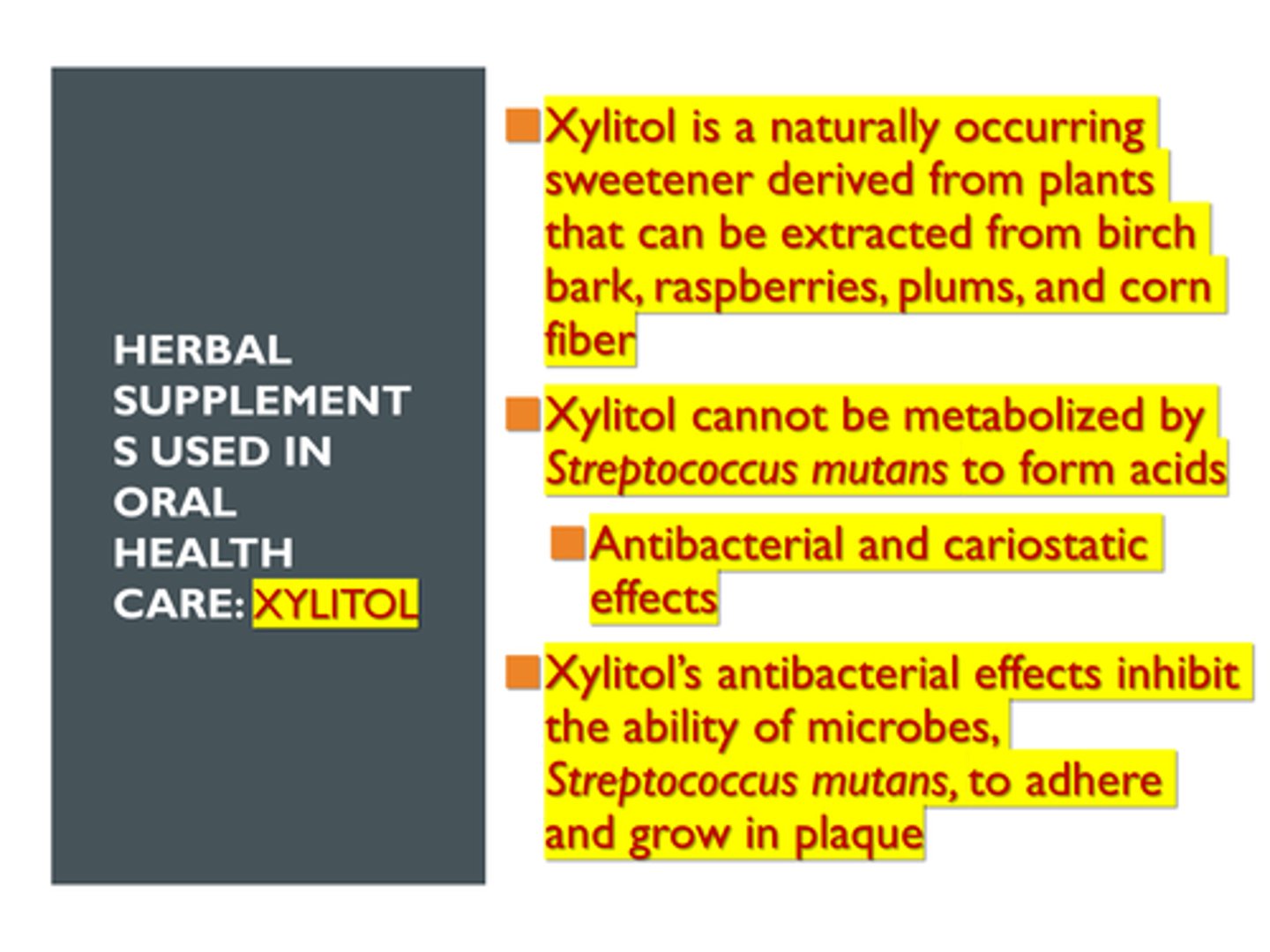
Herbal Supplements Used in Oral Health Care: Xylitol
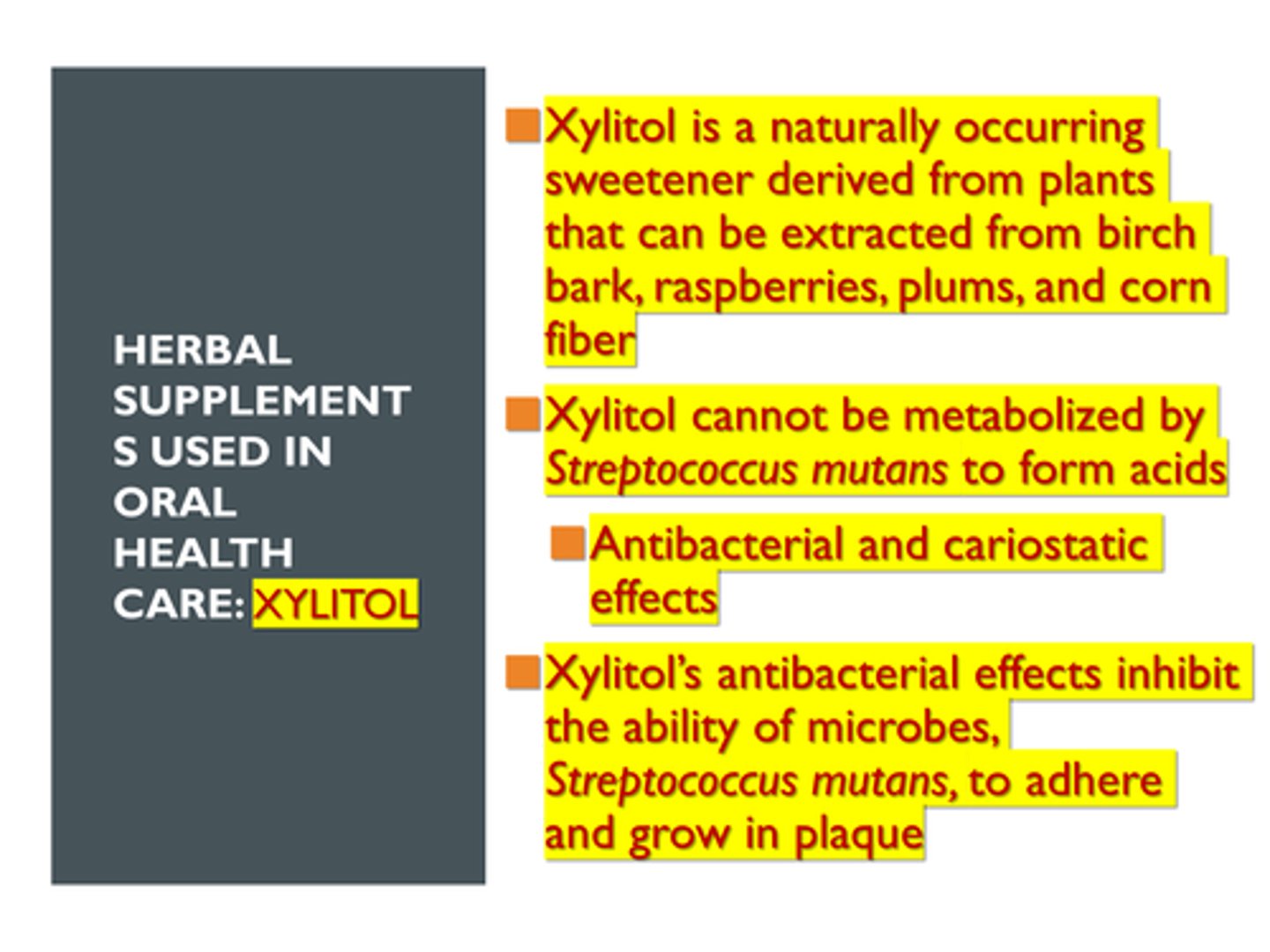
>> Xylitol is a naturally occurring sweetener derived from plants that can be extracted from birch bark, raspberries, plums, and corn fiber
>> Xylitol cannot be metabolized by Streptococcus mutans to form acids
>> Xylitol’s antibacterial effects inhibit the ability of microbes to adhere and grow in plaque
Oil of cloves has been used in dentistry for many years as a topical analgesic for dental pain. Extensive clinical trials have confirmed its efficacy.
a. Both statements are true.
b. Both statements are false.
c. The first statement is true, the second is false.
d. The first statement is false, the second is true
The first statement is true, the second is false.
FALSE - No published clinical trials that confirm its efficacy
Which is true of eugenol?
Naturally occurring sweetener with an anticariogenic effect.
Herbal-based product that significantly reduces plaque and gingivitis.
Used in mouth rinses containing thymol, eucalyptol, and menthol.
Extract of aloe vera plant leaf used to treat aphthous ulcers
Historically used in dentistry as a topical analgesic for dental pain.
Historically used in dentistry as a topical analgesic for dental pain.
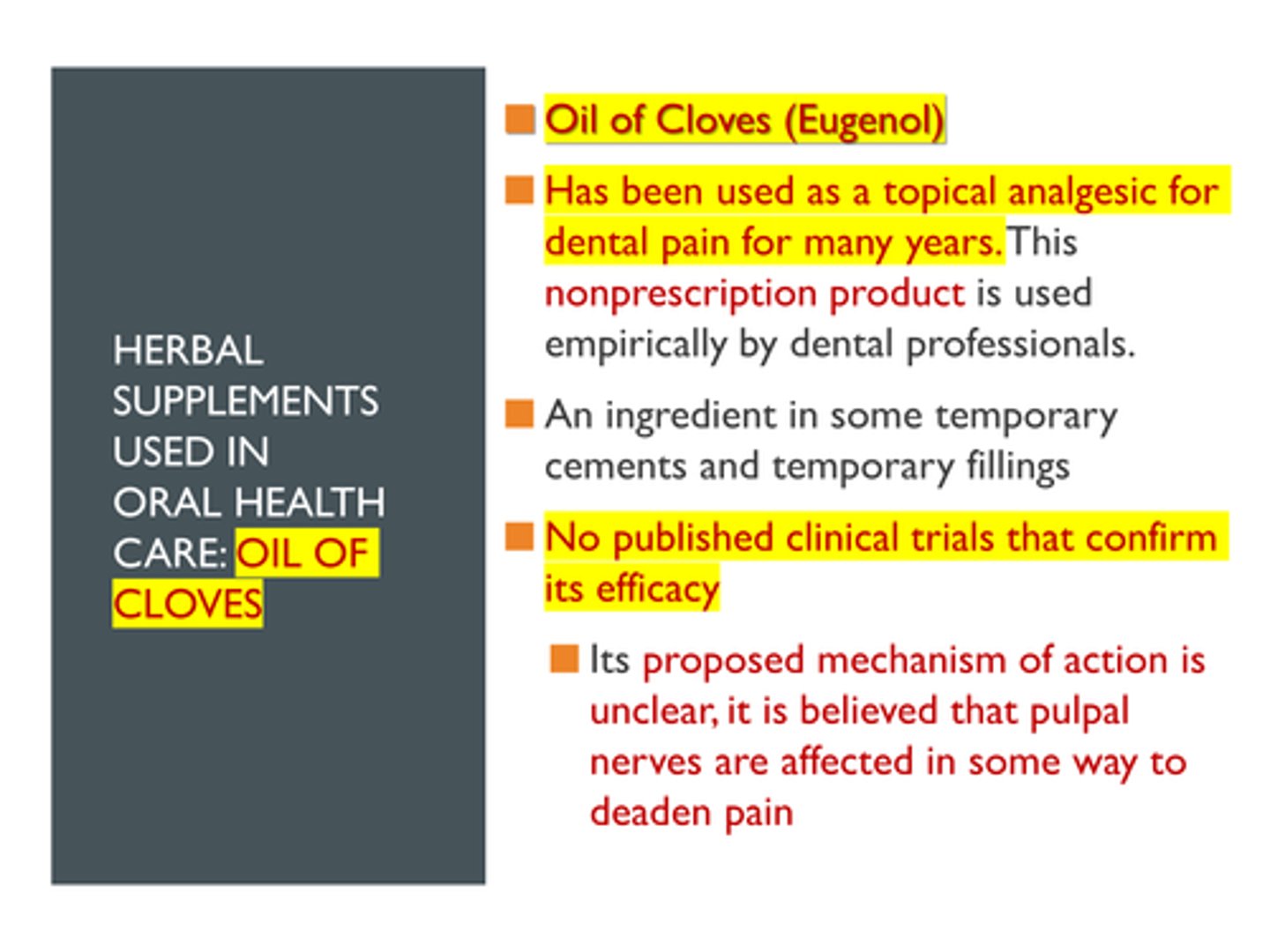
Herbal Supplements Used in Oral Health Care: Oil of Cloves (Eugenol):
>> Has been used as a topical analgesic for dental pain for many years. MOA is unknown. This nonprescription product is used empirically by dental professionals.
>> An ingredient in some temporary cements and temporary fillings
>> No published clinical trials that confirm its efficacy
>> Its proposed mechanism of action is unclear, it is believed that pulpal nerves are affected in some way to deaden pain
Which supplement is a topical analgesic for dental pain; thought to affect pulpal nerves?
Topical analgesic for dental pain. MOA is unknown. Deaden pain.
Oil of Cloves (Eugenol)
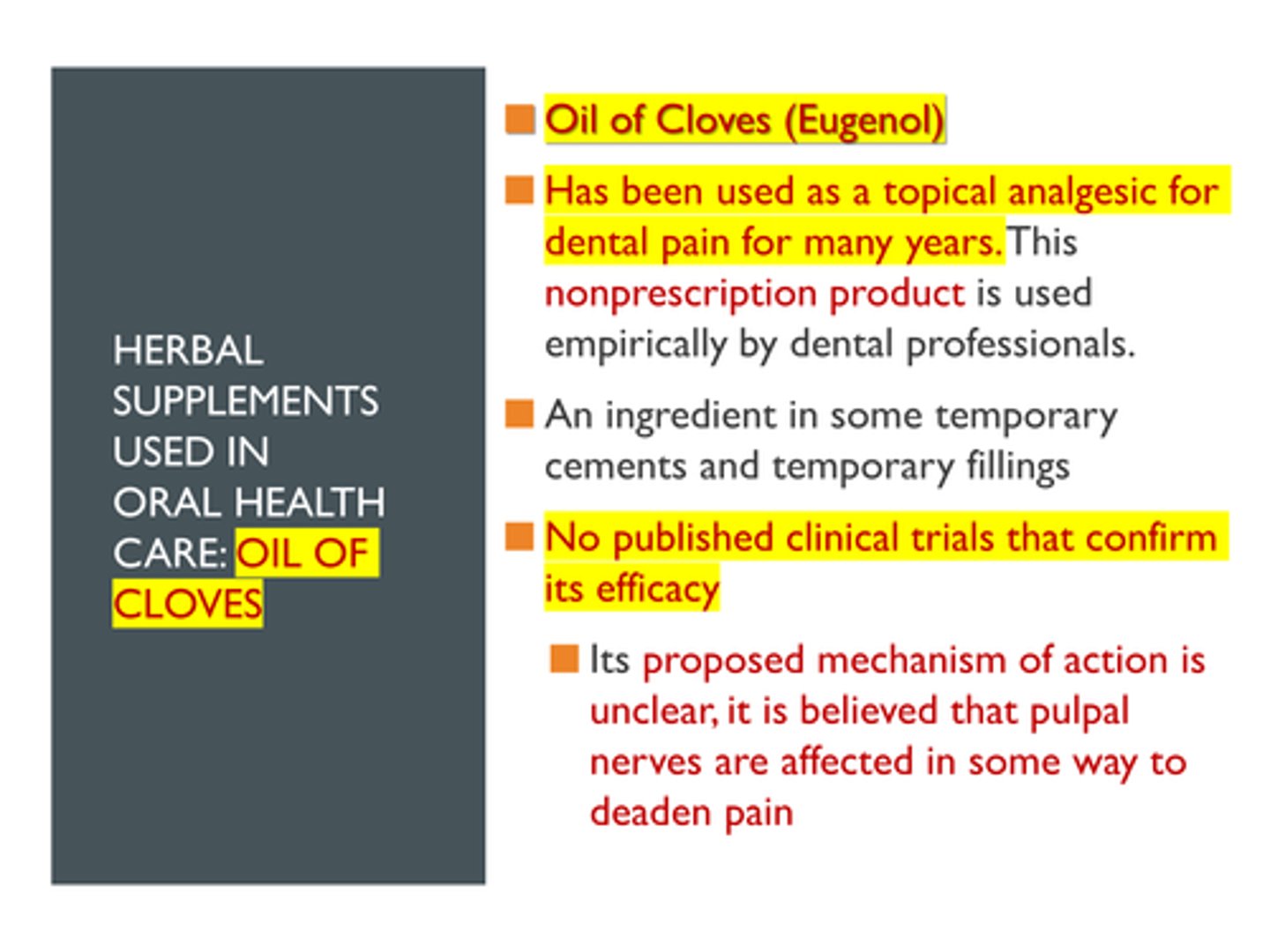
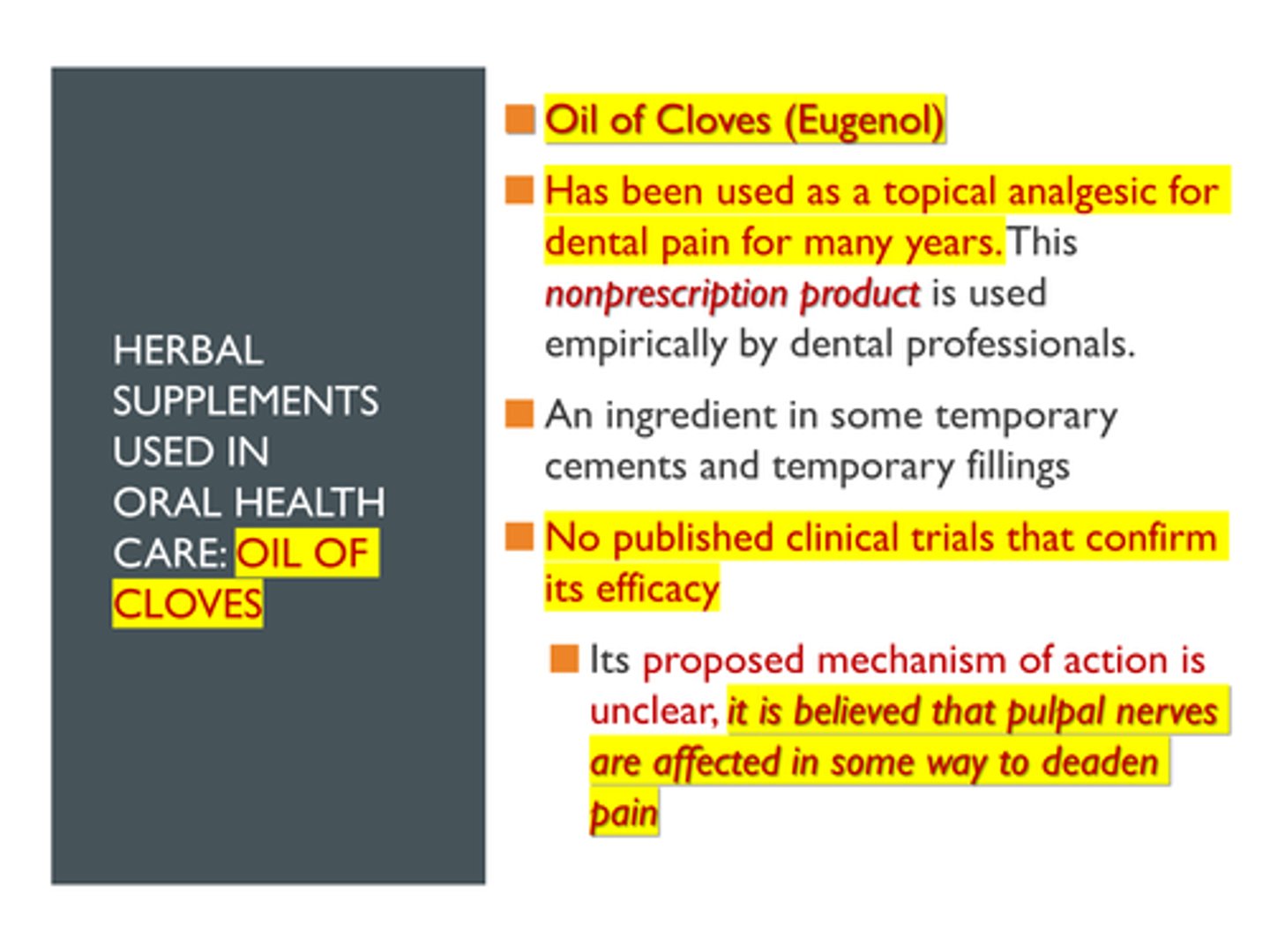
Herbal Supplements Used in Oral Health Care: Oil of Cloves (Eugenol):
>> Has been used as a topical analgesic for dental pain for many years. MOA is unknown. This nonprescription product is used empirically by dental professionals.
>> An ingredient in some temporary cements and temporary fillings
>> No published clinical trials that confirm its efficacy
>> Its proposed mechanism of action is unclear, it is believed that pulpal nerves are affected in some way to deaden pain
Each of the following is true of the FDA Food Safety and Modernization Act of 2010 EXCEPT one. Which is the EXCEPTION?
a. It provides the FDA with mandatory recall authority for all foods.
b. It requires the manufacturer to prove that an herbal product is safe and effective.
c. It expands the facility registration obligations.
d. It requires the FDA to issue New Dietary Ingredients guidance.
It requires the manufacturer to prove that an herbal product is safe and effective.
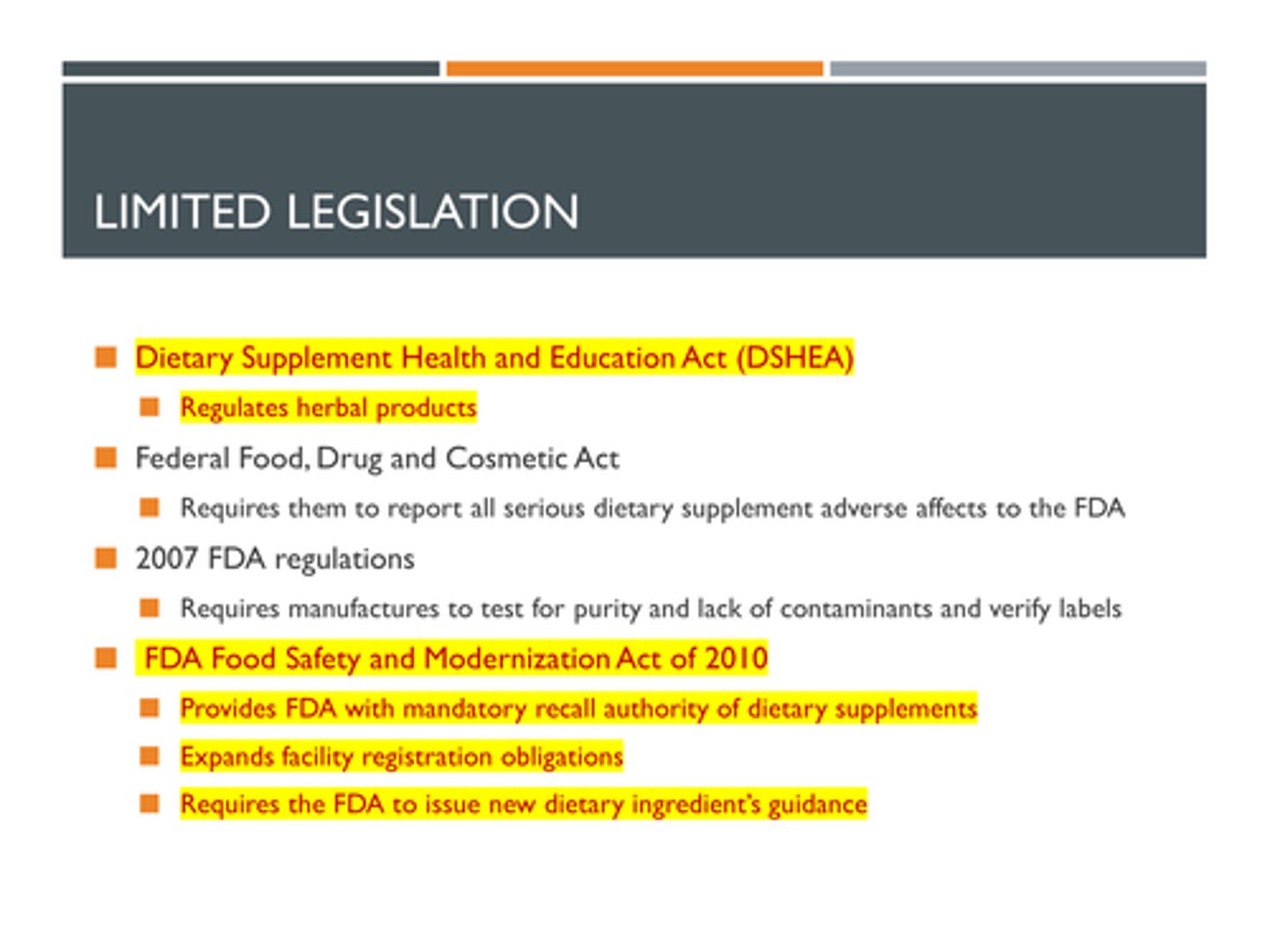
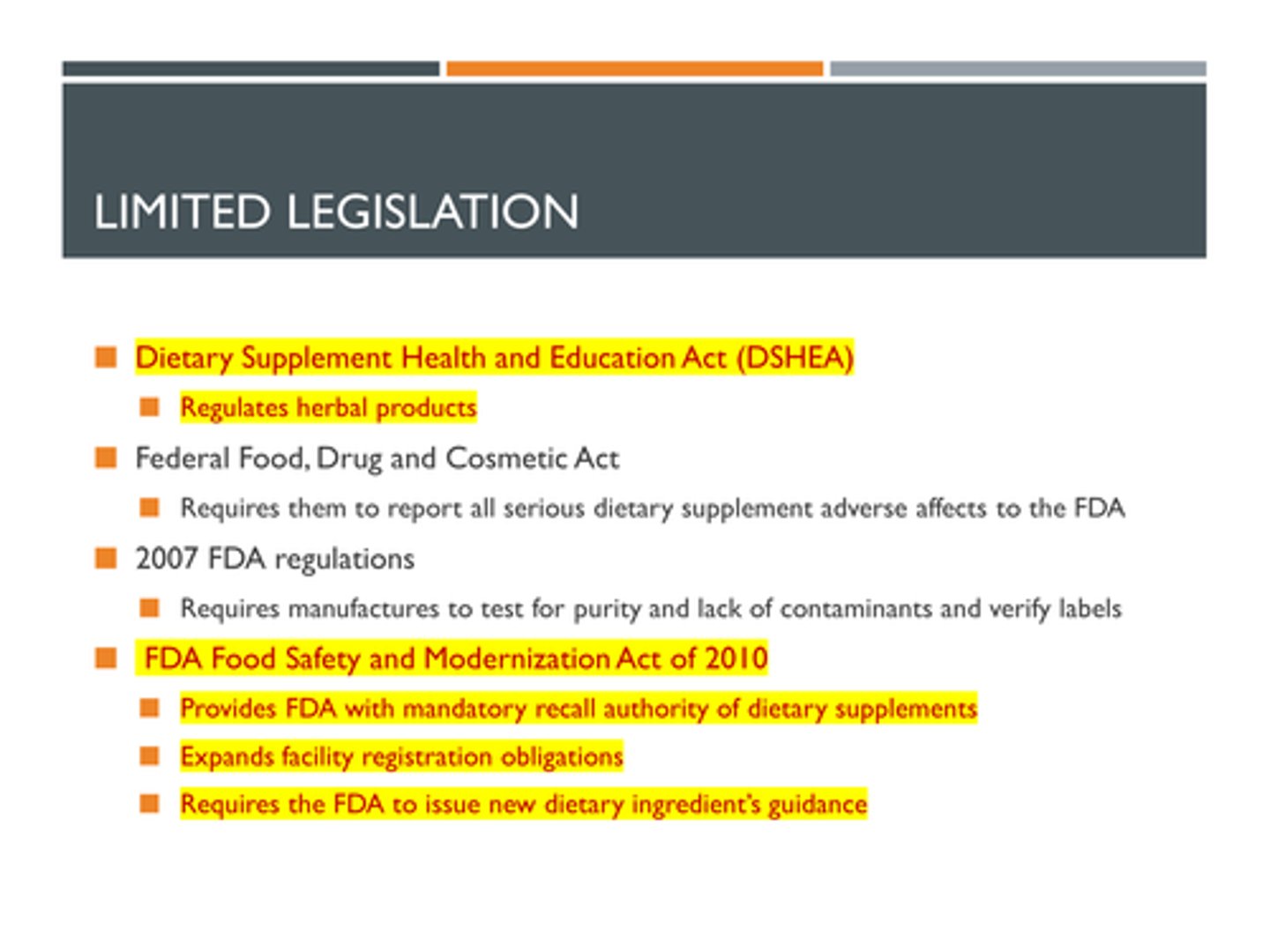
Limited Legislation:
> Dietary Supplement Health and Education Act (DSHEA) - regulates herbal products
> Federal Food, Drug and Cosmetic Act - Requires them to report all serious dietary supplement adverse affects to the FDA
> 2007 FDA regulations - Requires manufactures to test for purity and lack of contaminants and verify labels
> 2011 FDA Food Safety and Modernization Act of 2010 -
- Provides FDA with mandatory recall authority of dietary supplements
- Expands facility registration obligations
- Requires the FDA to issue new dietary ingredient’s guidance
Herbal products are regulated by the
Dietary Supplement Health and Education Act (DSHEA)
The Adverse Events Reporting law requires reporting of "serious" adverse events for
both over-the-counter drugs and dietary supplements.
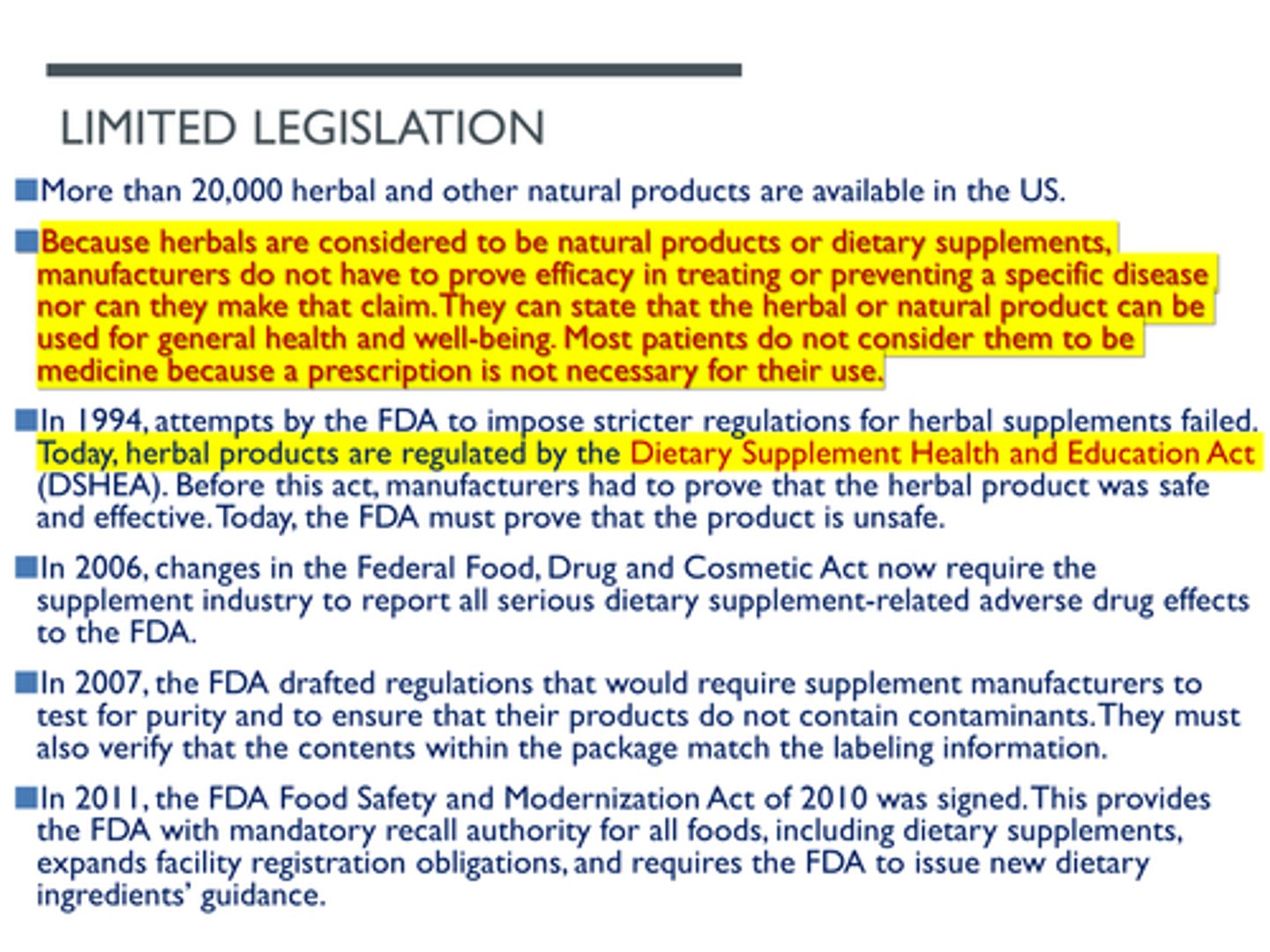
Manufacturers have to prove efficacy in treating or preventing a specific disease. Manufacturers can state that herbal or natural products can be used for general health and well-being.
first statement is true, second statement is false
both statements are true
first statement is false, second statement is true
Both statements are false
first statement is false, second statement is true
T/F
When patients take herbal/ natural medications they often do not report their use.
true
Herbal products are marketed as dietary supplements in the US and are not required to comply with safety and efficacy regulations imposed on drug products. Manufacturers cannot make claims of curing conditions, but they can make claims of improving structure or function.
first statement is true, second statement is false
both statements are true
first statement is false, second statement is true
Both statements are false
both statements are true
Manufacturers cannot make claims of curing conditions, but they can make claims of
Improving structure or function
what should all herbal products must be labeled as?
a dietary supplement
T/F
Therapeutic claims on the label are allowed
False
No false or misleading information; however information is not necessarily scientific. This phrase must be included: "This product is not intended to diagnose, treat, cure, or prevent any disease"
first statement is true, second statement is false
both statements are true
first statement is false, second statement is true
Both statements are false
both statements are true
what is the misconception about the safety of Herbal and Nutritional Products?
products are nontoxic and free of side effects because they are "natural"
what is the reality for safety of Herbal and Nutritional Products?
products have potential therapeutic effects as well as adverse effects and drug interactions
yes or no
herbal products should be listed in the medical history
yes
T/F
In 2007 The Adverse Events Reporting Law amended the federal Food, Drug and Cosmetic Act to require the reporting of "serious" adverse events for both OTC drugs and dietary supplements
true
In Dec 2007, the Adverse Events Reporting Law required the reporting of “serious” adverse events for both OTC drugs and dietary supplements
Which supplement significantly reduces plaque and gingivitis?
triclosan
T/F
one triclosan-containing product has received the
ADA's Seal of Acceptance for its antigingivitis effect
true
Essential oils are not approved by the ADA.
True
False
False
Over 20 mouth rinses that contain EOs have been approved by the ADA
What are the three essential oil mouth rinses that are used in dentistry?
Thymol, Eucalyptol, Menthol
Essential oils mouth rinses are Bacteriostatic effect on oral pathogens known to cause plaque and gingivitis?
True
False
True
What is the name of the herbal supplement extracted from the aloe vera plant leaf that has immunomodulating properties and is available as an OTC patch?
Acemannan hydrogel
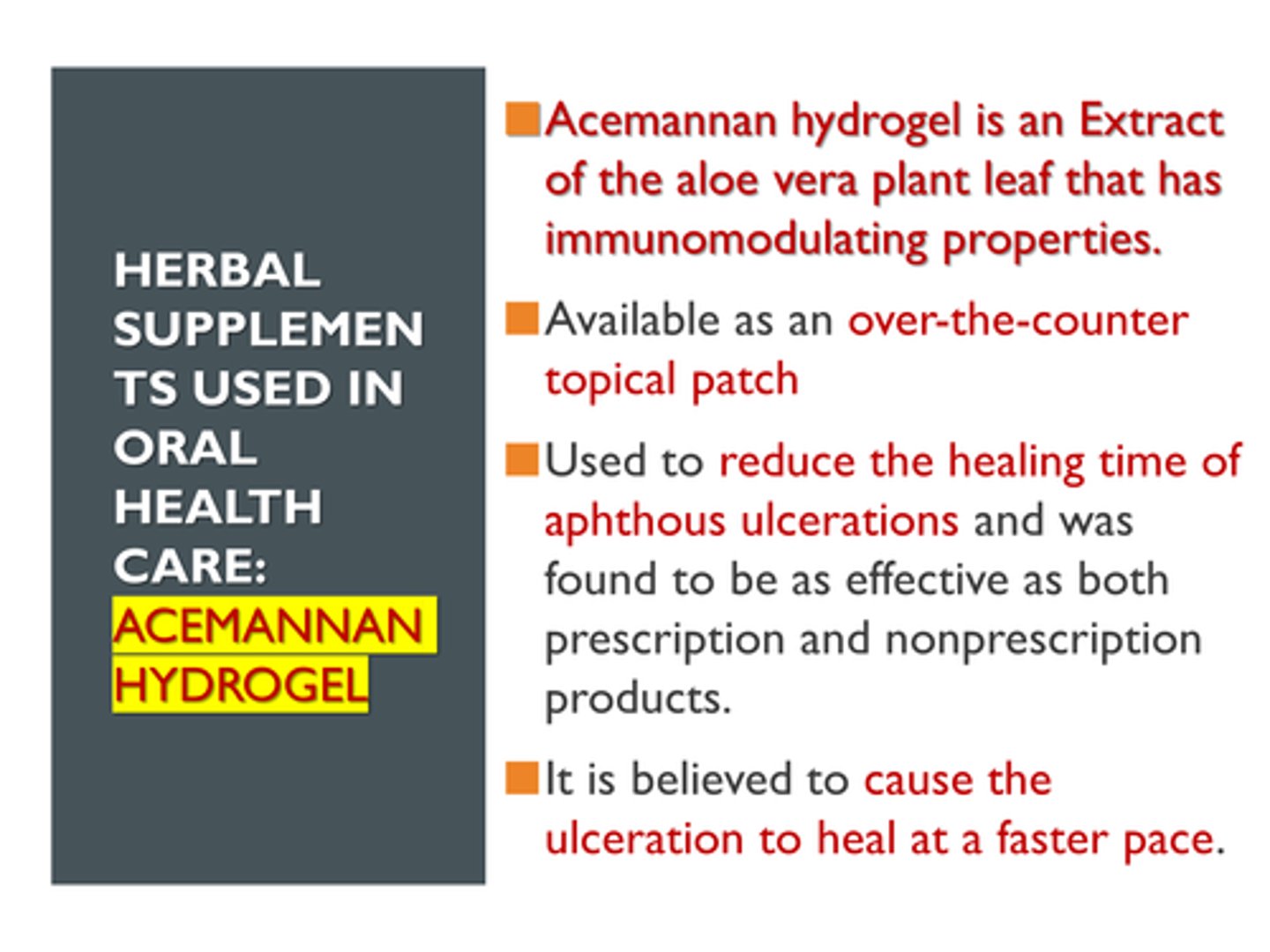
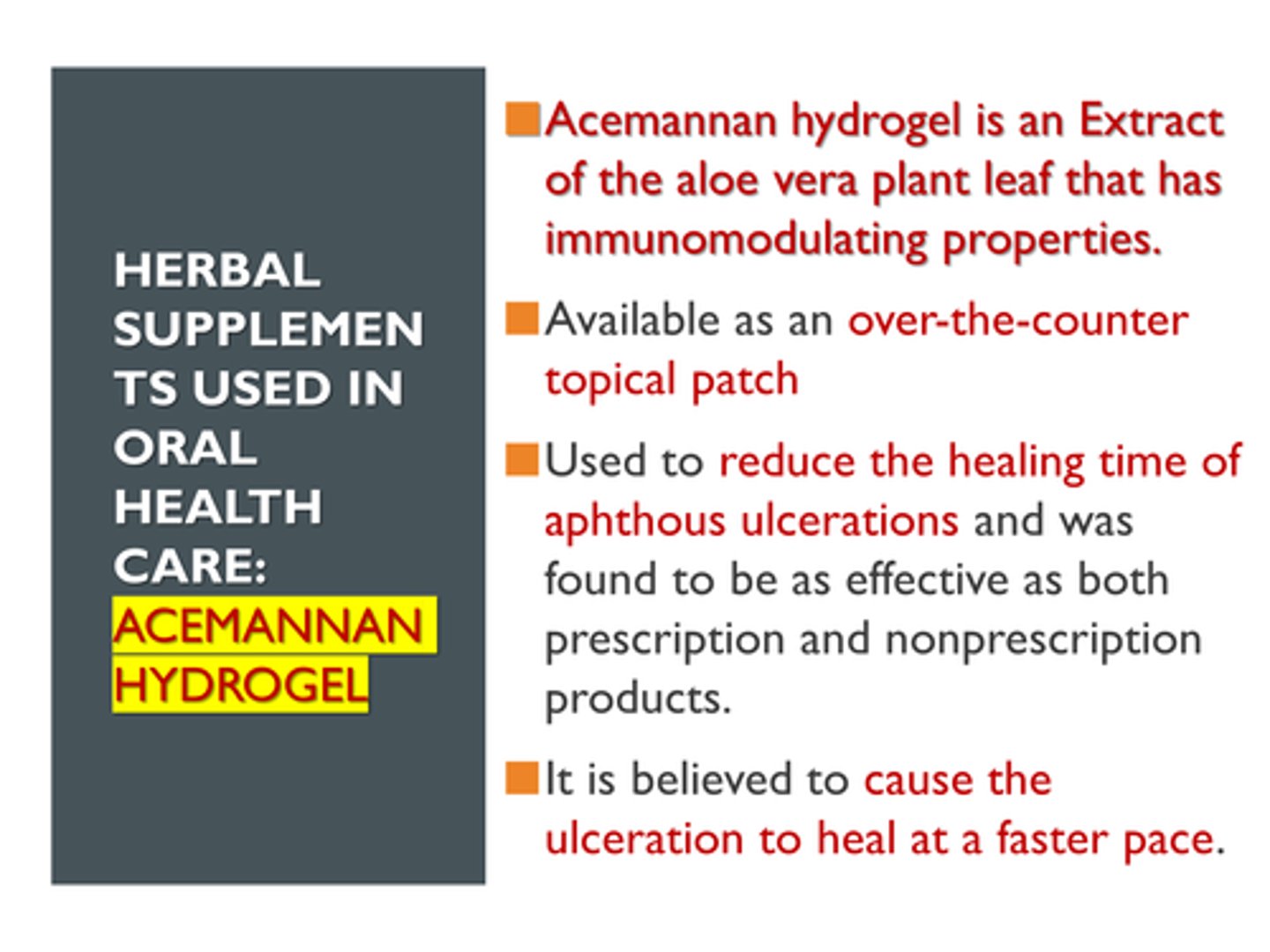
Which herbal supplement is used to reduce the healing time of aphthous ulcerations and found as effective as Rx and non-Rx products?
acemannan Hydrogel
There is a no lack of standardization with many herbal products
True
False
False
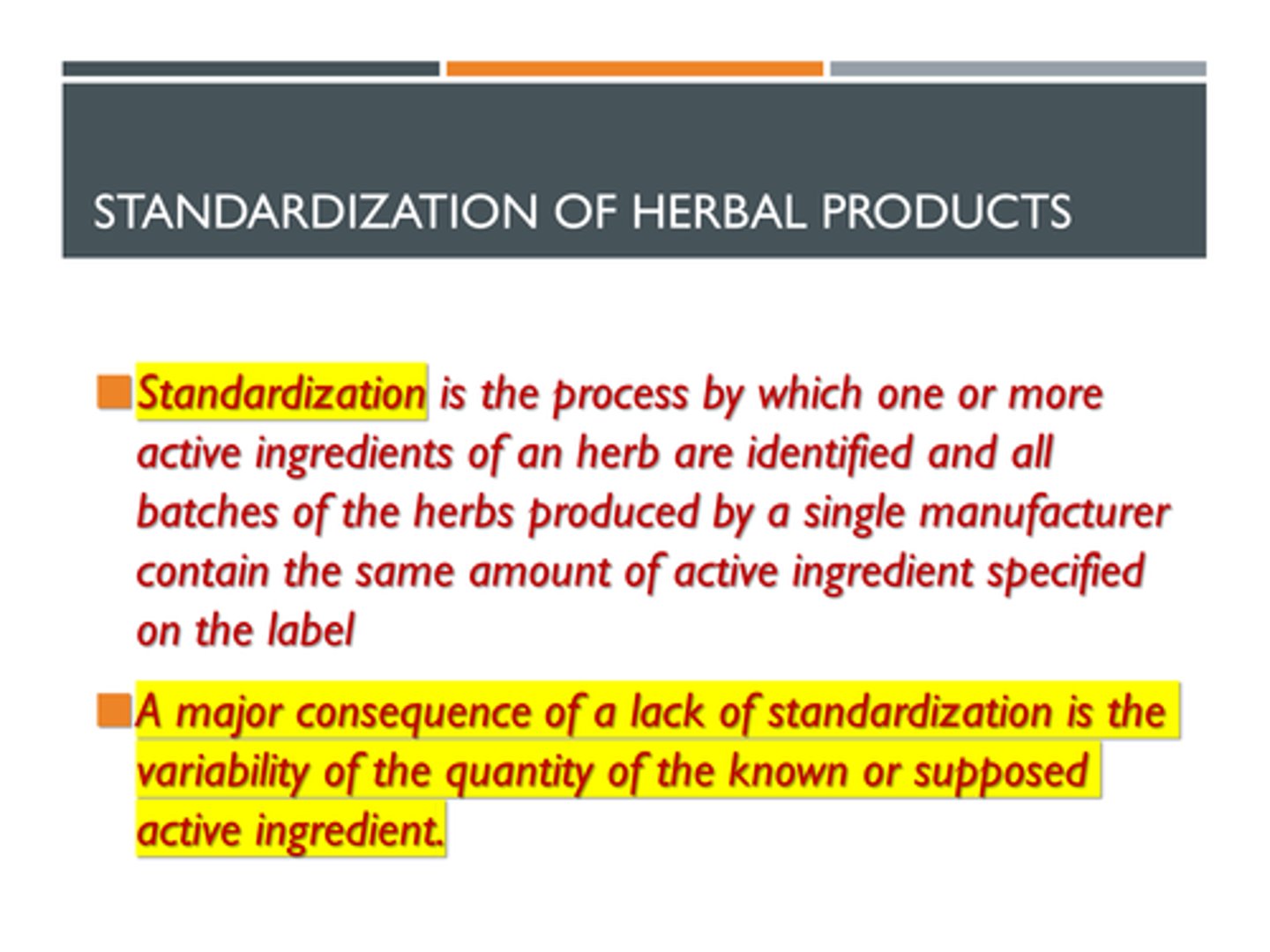
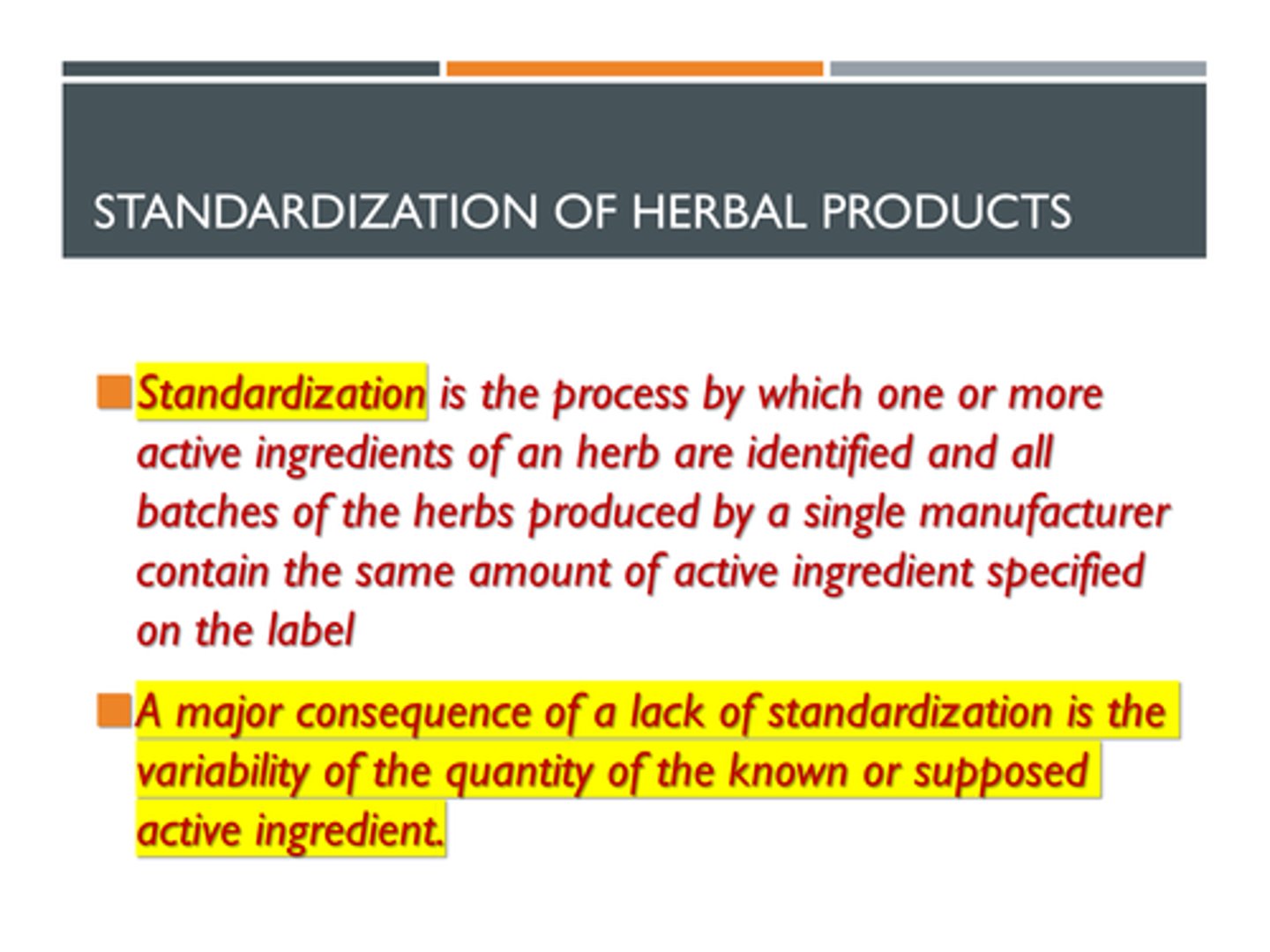
A process by which one or more active ingredients of an herb are identified and all batches of the herbs produced by a single manufacturer contain the same amount of active ingredient specified on the label
Standardization (of Herbal Products)
what are the oral adverse effects from herbal supplements?
Dysgeusia, gingival hyperplasia, intraoral hemorrhage, necrosis, oral candidiasis, oral ulceration, stomatitis, tooth discoloration, xerostomia
what are the side effect from St.johns wort?
xerostomia, bleeding
what are the side effect from feverfew?
oral mucosal irritation, ulcerations, lip irritation, swelling, gingival bleeding
what are the side effect from ephedra (ma-huang)?
tachycardia, hypertension, bleeding, FDA tried to prohibit ephedrine containing products but was overturned
What are the side effect from niacin, yohimbe?
postural hypotension
what are the side effect from chaparral, comfrey?
hepatotoxicity, bleeding
what are the side effect from kava?
hepatotoxicity, bleeding, oral and lingual dyskinesia
what are the side effect from echinacea?
tongue numbness and taste changes, allergic reactions
what is the side effect from Angelica, clove, garlic, ginkgo, ginseng, red clover, high doses of vitamin E?
Bleeding
what are the side effect from Coenzyme Q10, milk thistle, pomegranate, wormwood?
allergic reactions
T/F
Herbal products can't interact with conventional drugs leading to an increased risk for toxicity and reduced therapeutic effects
False
what is the most common negative result from a drug interaction?
bleeding
what happens when Bilberry fruit, bromelain, chamomile, Cordyceps, coenzyme Q10, evening primrose, garlic, ginger, ginseng, ginkgo, Guggul, horsechestnut, kava, licorice, oil of clove, turmeric, and feverfew interacts with antiplatelet drugs or anticoagulants?
bleeding
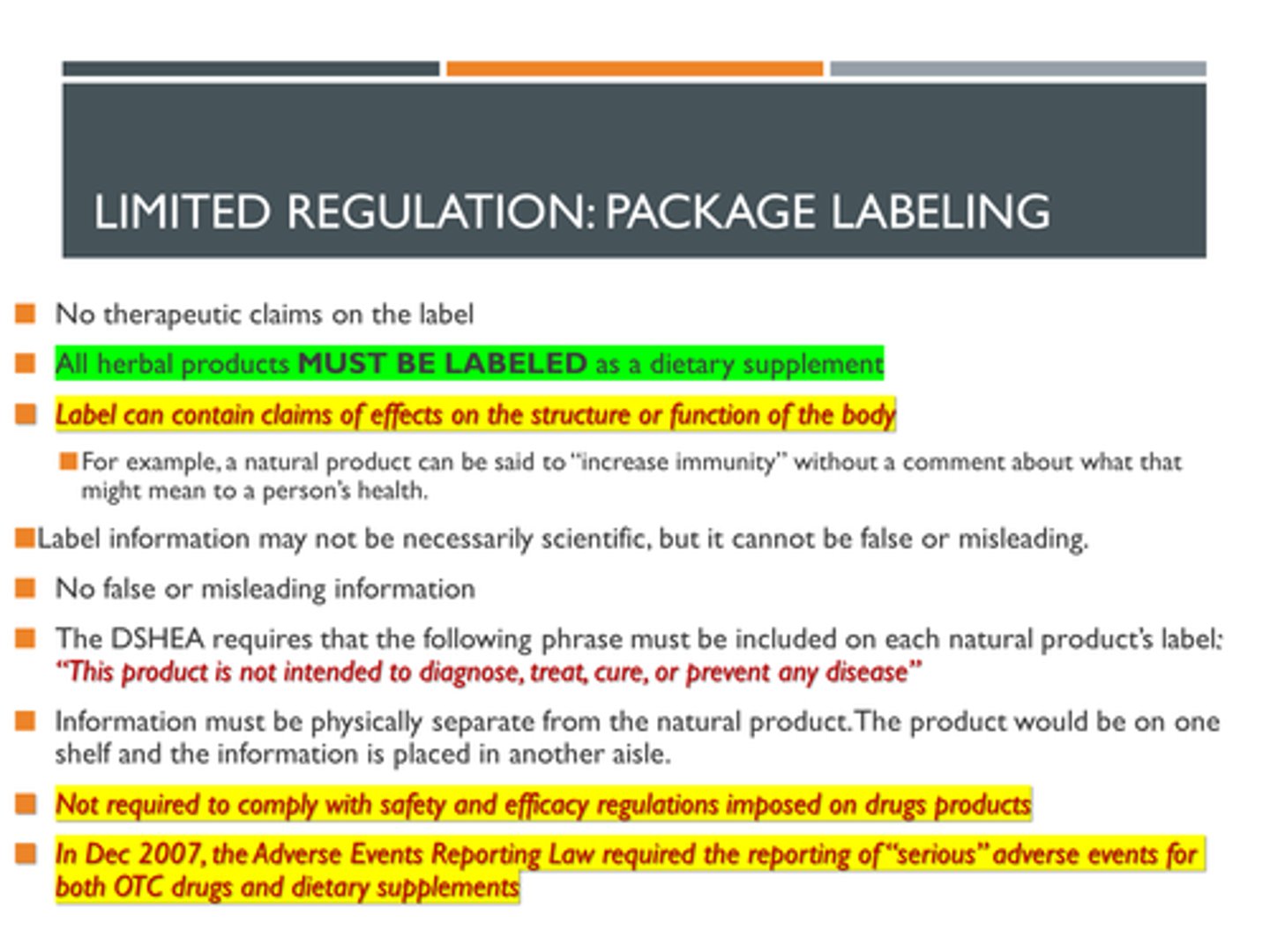
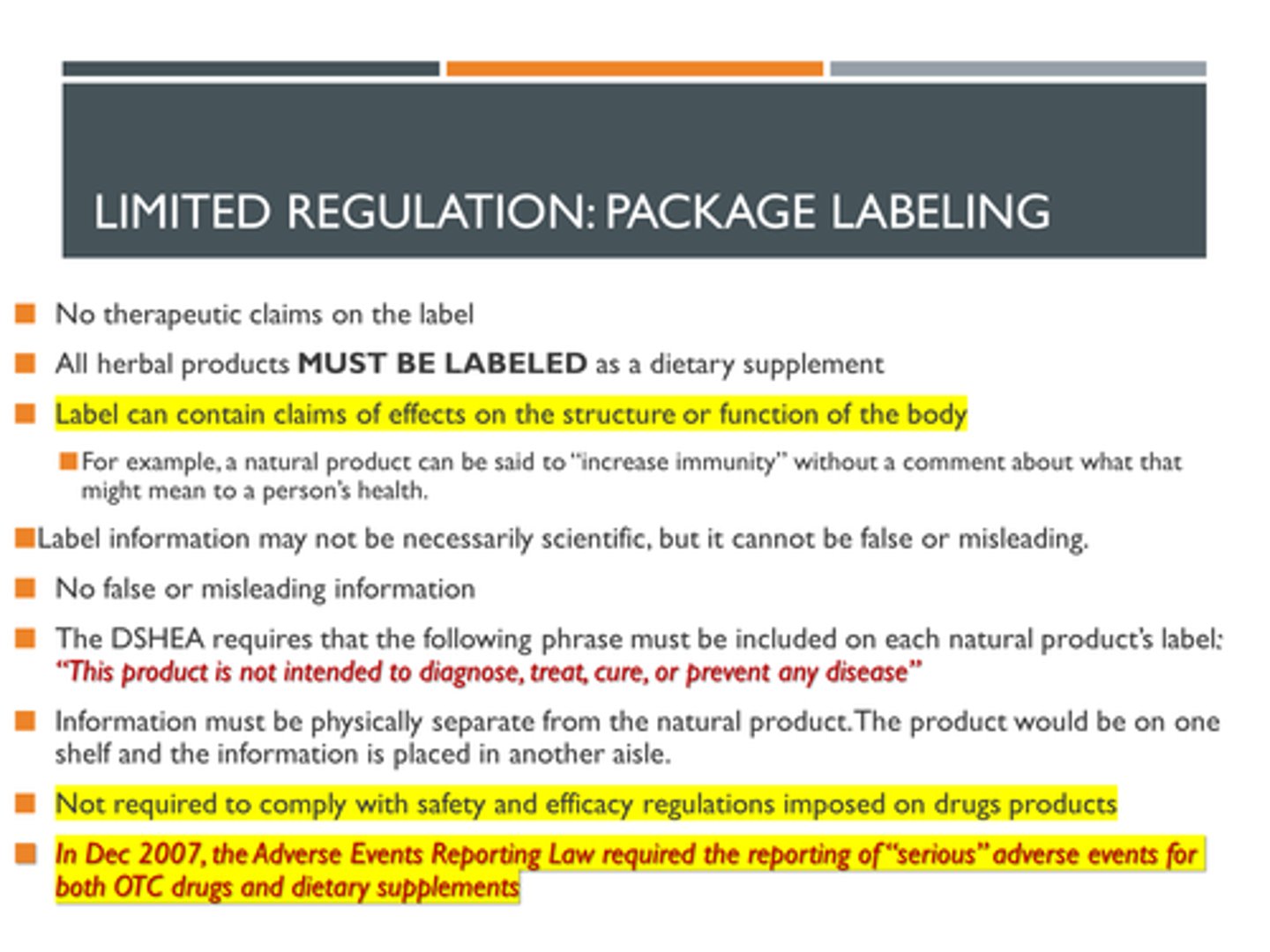
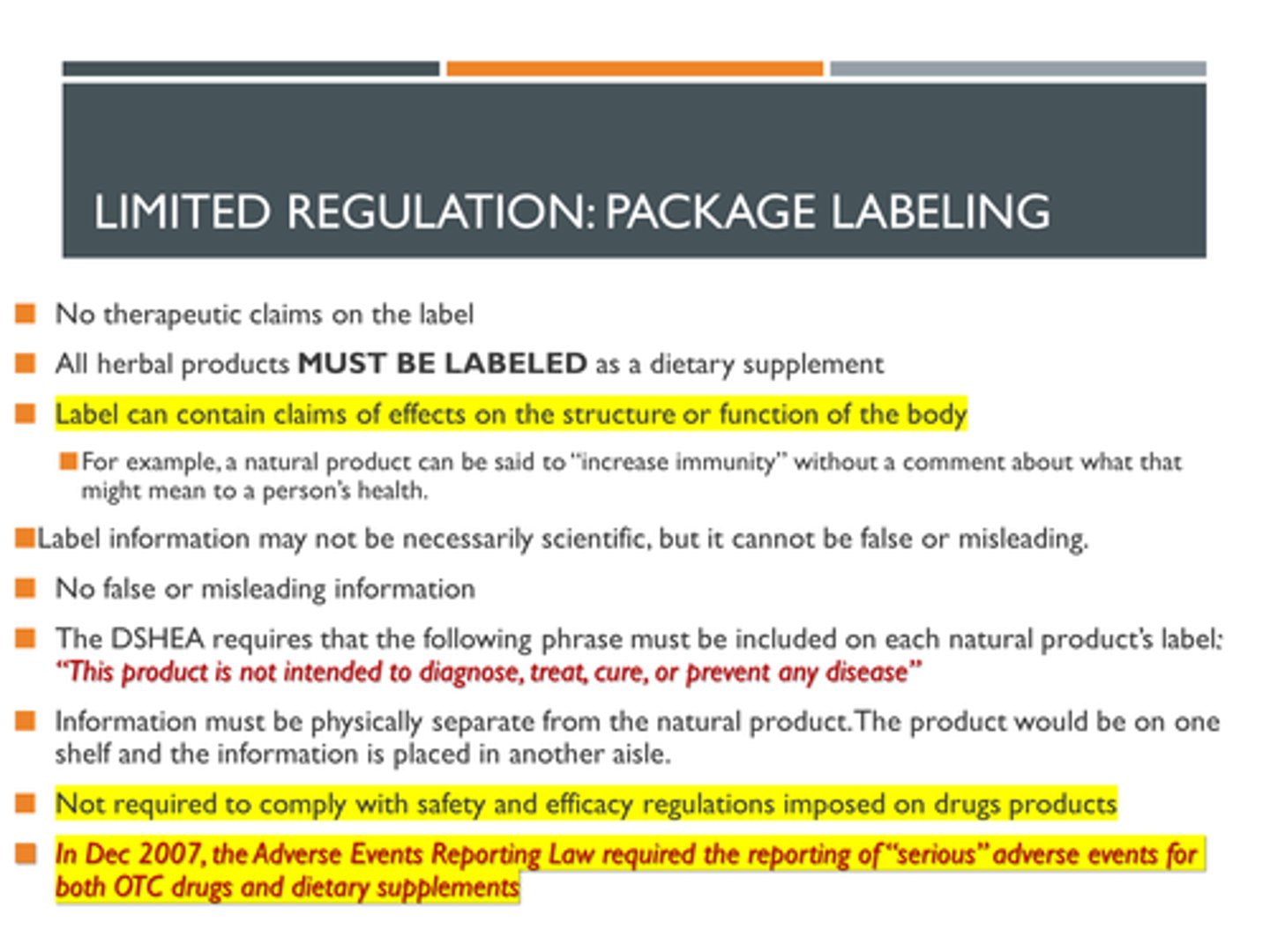
Limited Regulation: Package Labeling
No therapeutic claims on the label
Must be labeled as a dietary supplement
No false or misleading information
"This product is not intended to diagnose, treat, cure, or prevent any disease"
Physically separate information
Safety of Herbal and Nutritional Products
Insomnia
Nervousness
Tremor
Headaches
Hypertension
Seizures
Arrhythmias
Heart attack
Stroke
Death
Oral Adverse Effects
Dysgeusia
Gingival hyperplasia
Intraoral hemorrhage
Necrosis
Oral candidiasis
Oral ulceration
Stomatitis
Tooth discoloration
Xerostomia
Drug Interactions
Garlic, ginkgo biloba, and feverfew can increase the risk for bleeding when taken in conjunction with antiplatelet drugs or anticoagulants
Ma huang contains ephedrine and can increase heart rate when given with sympathomimetic drugs
St. John's wort can increase or decrease the effects of local and general anesthetics
Herbal Supplements Used in Oral Health Care: Acemannan Hydrogel
Extract of the aloe vera plant leaf
Immunomodulating properties
Available as an over-the-counter topical patch
Used to reduce the healing time of aphthous ulcerations
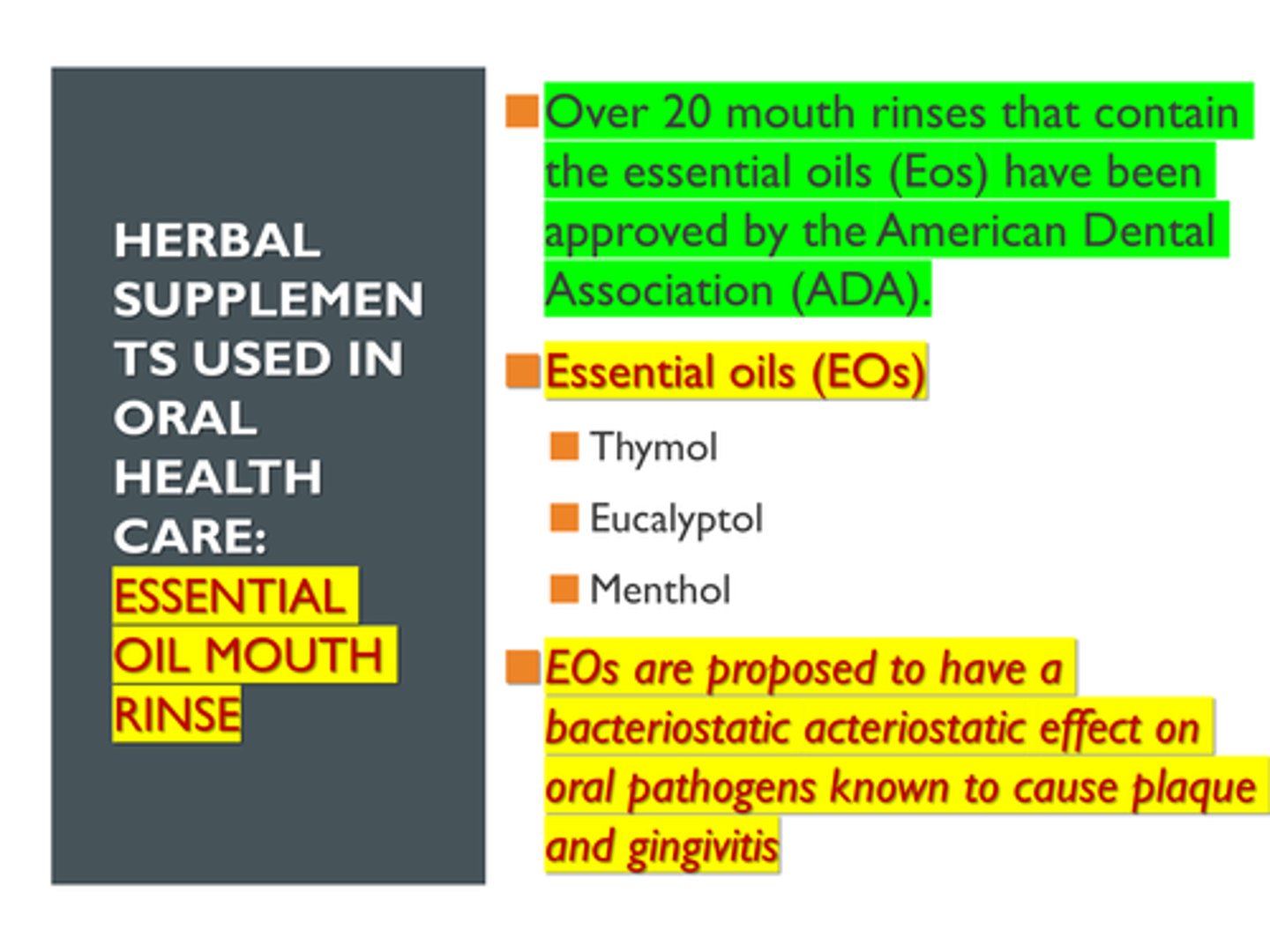
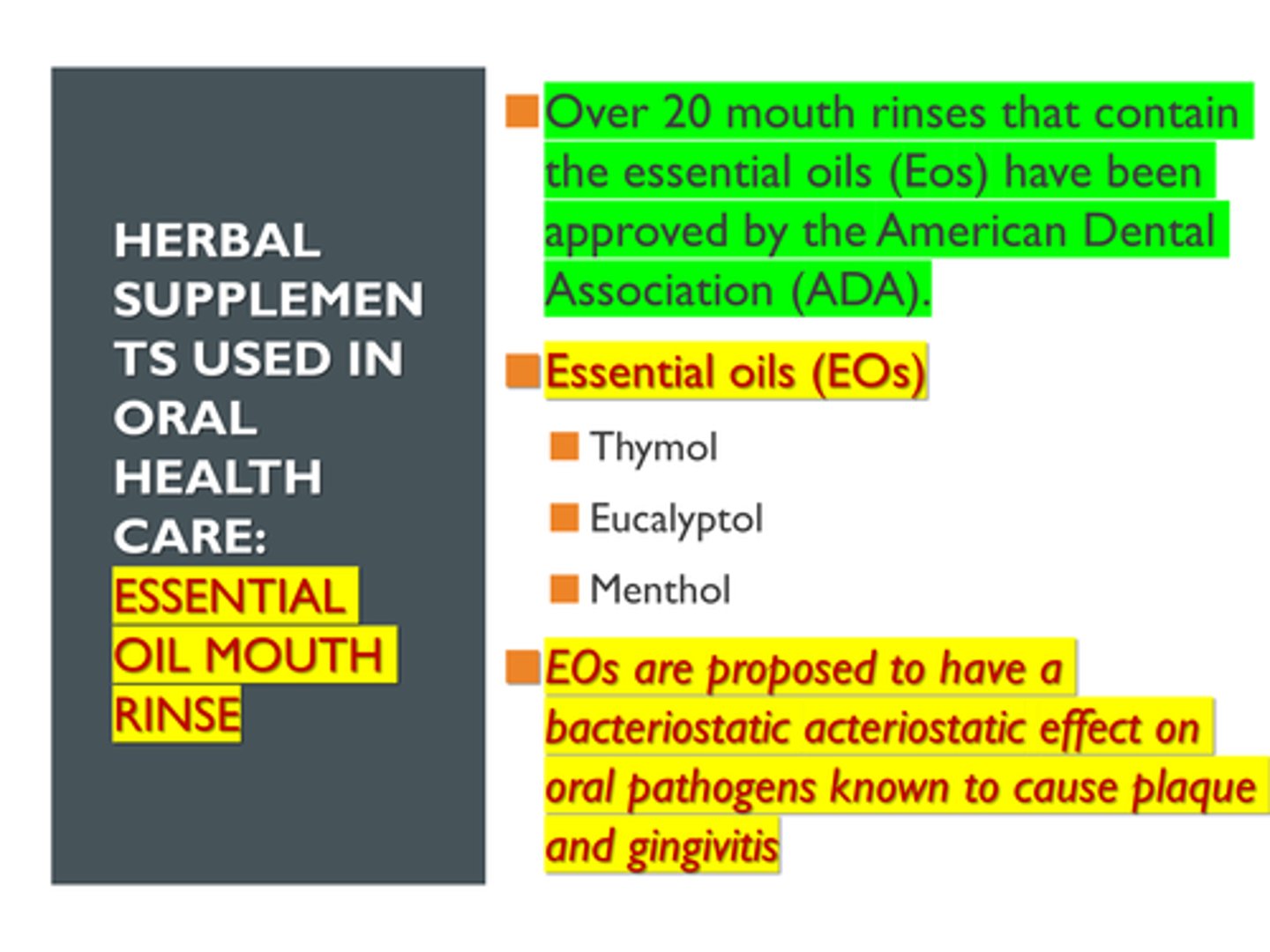
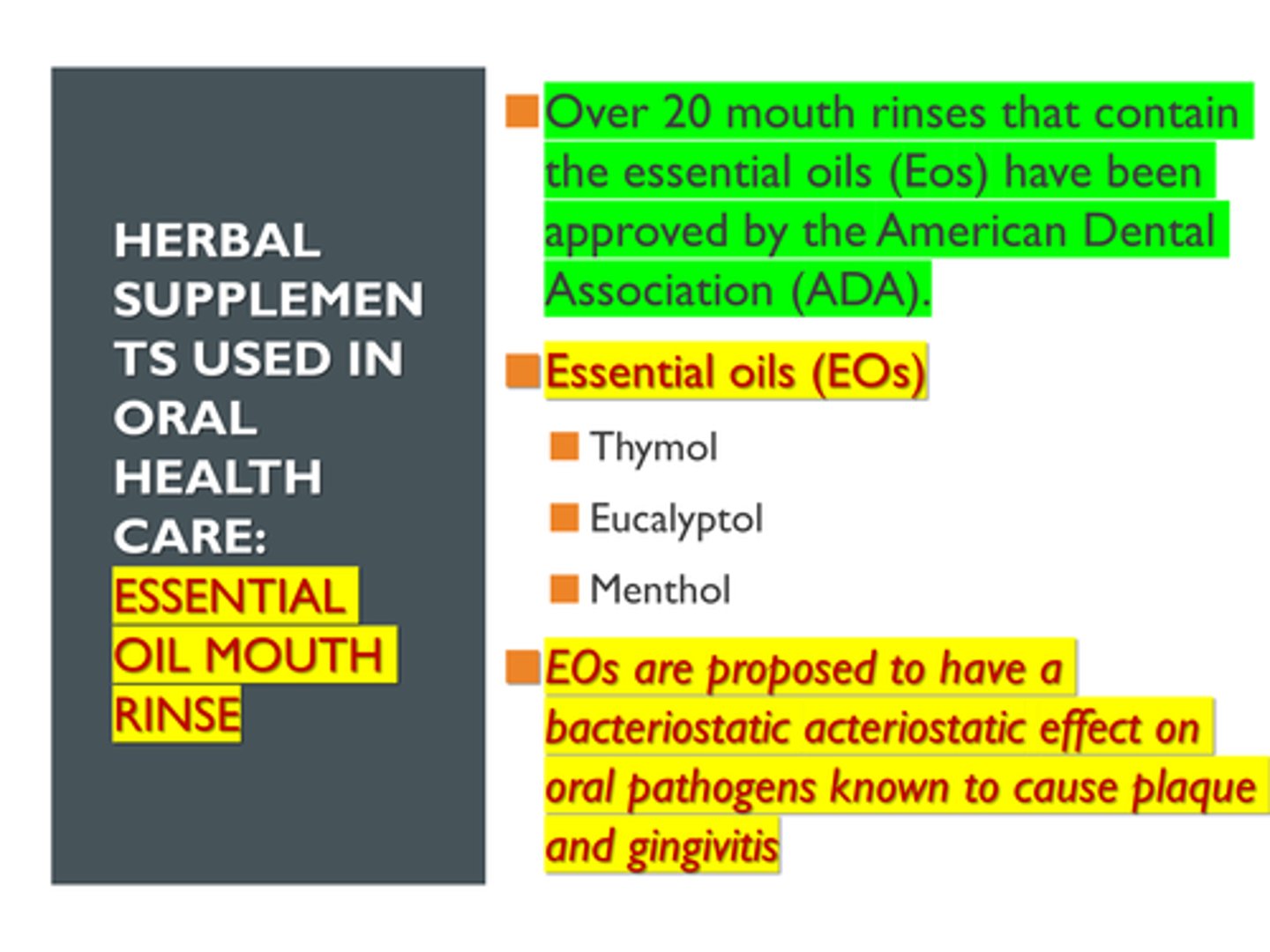
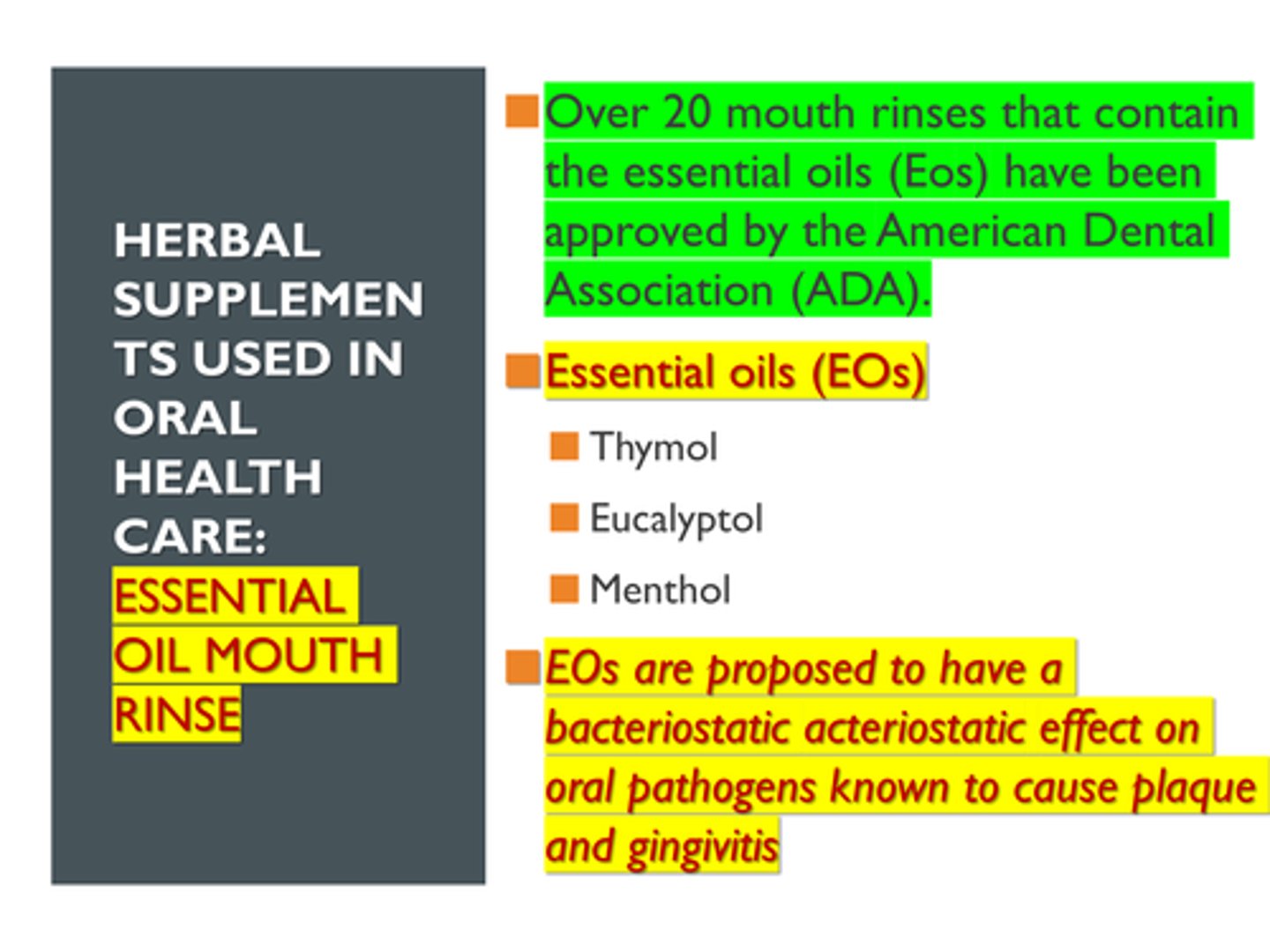
Herbal Supplements Used in Oral Health Care: Essential Oil Mouth Rinse
Essential oils (EOs)
ØThymol
ØEucalyptol
ØMenthol
Bacteriostatic effect on oral pathogens known to cause plaque and gingivitis
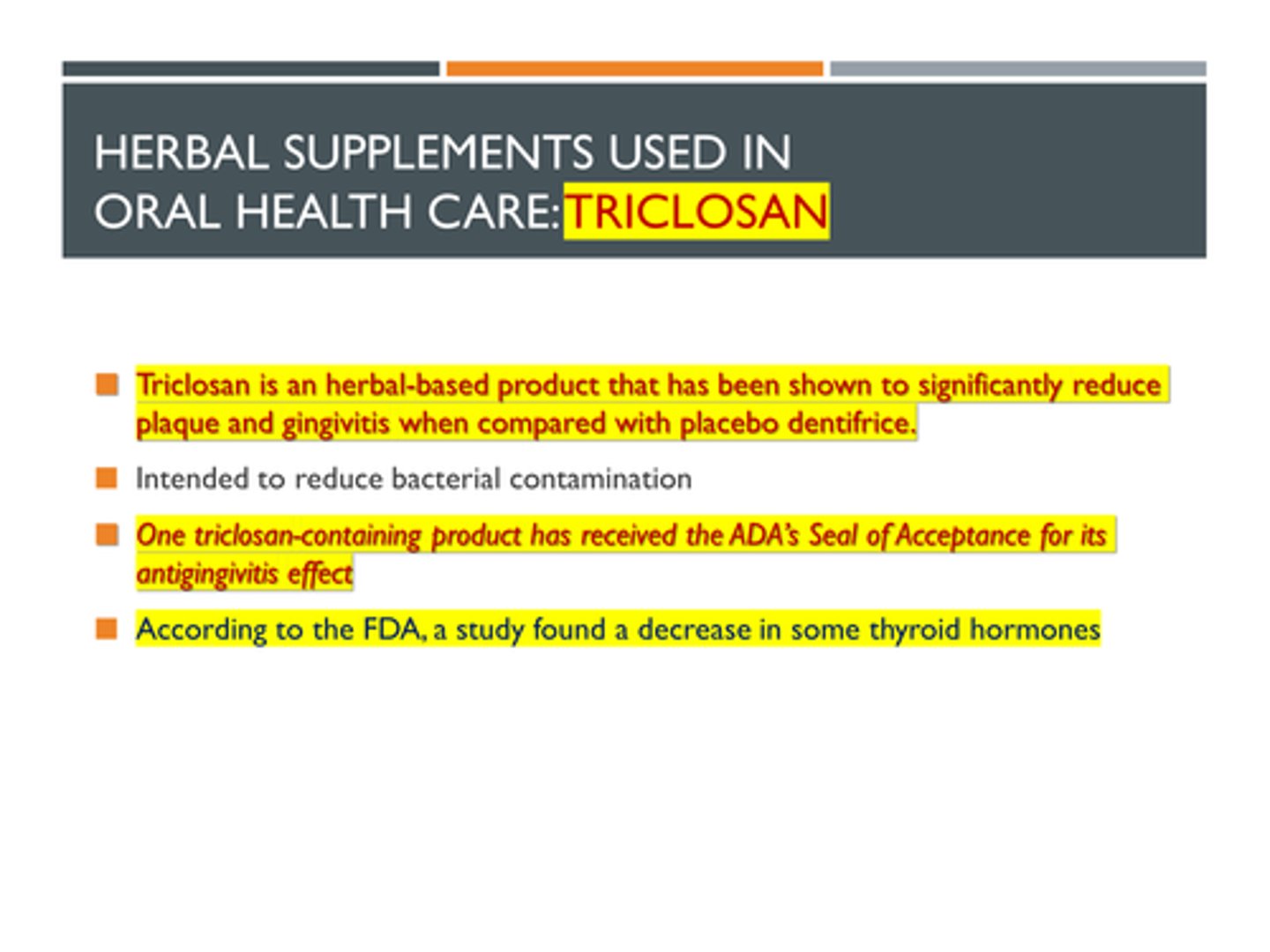
Herbal Supplements Used in Oral Health Care: Triclosan
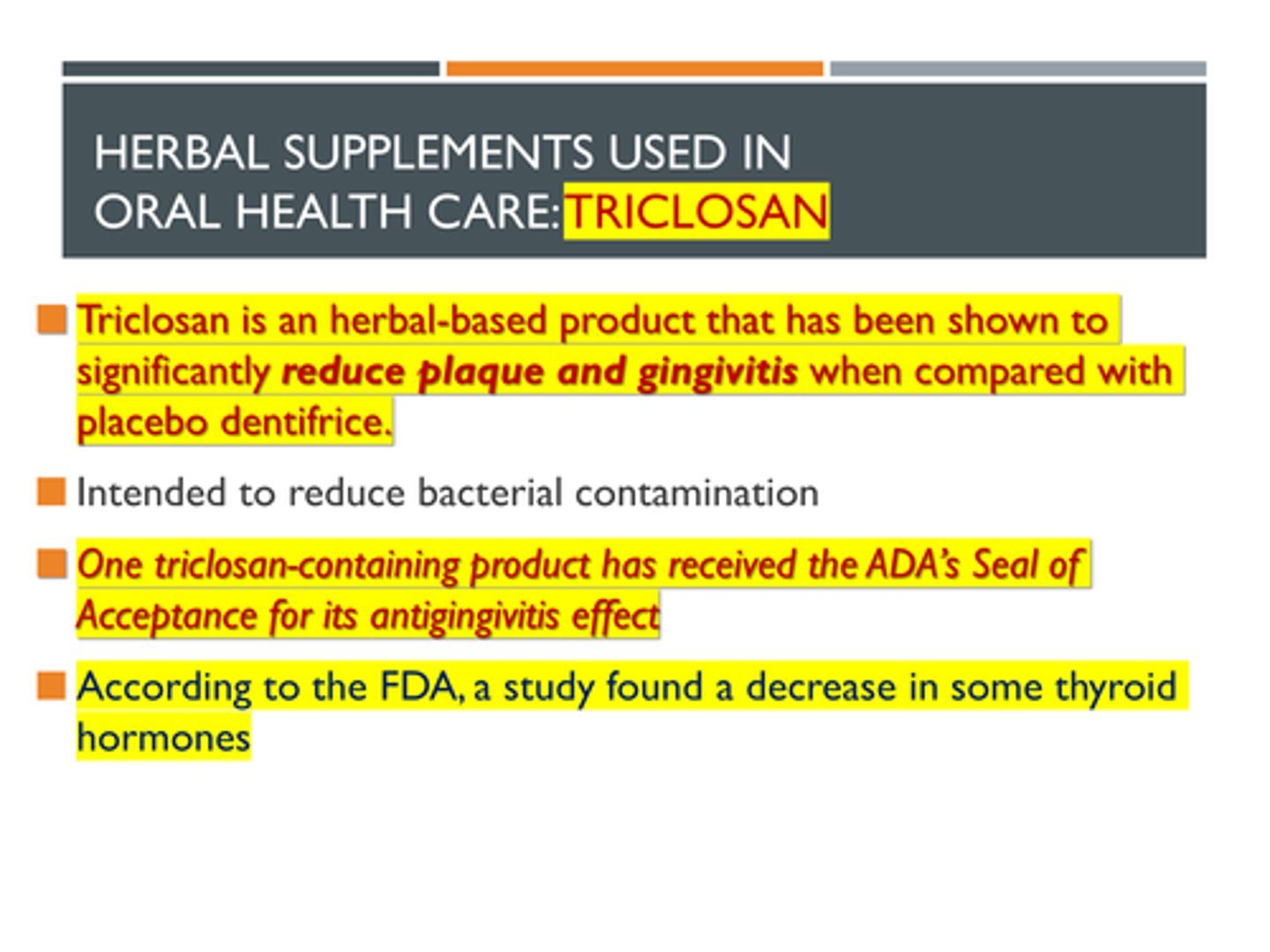
Herbal Supplements Used in Oral Health Care: Triclosan
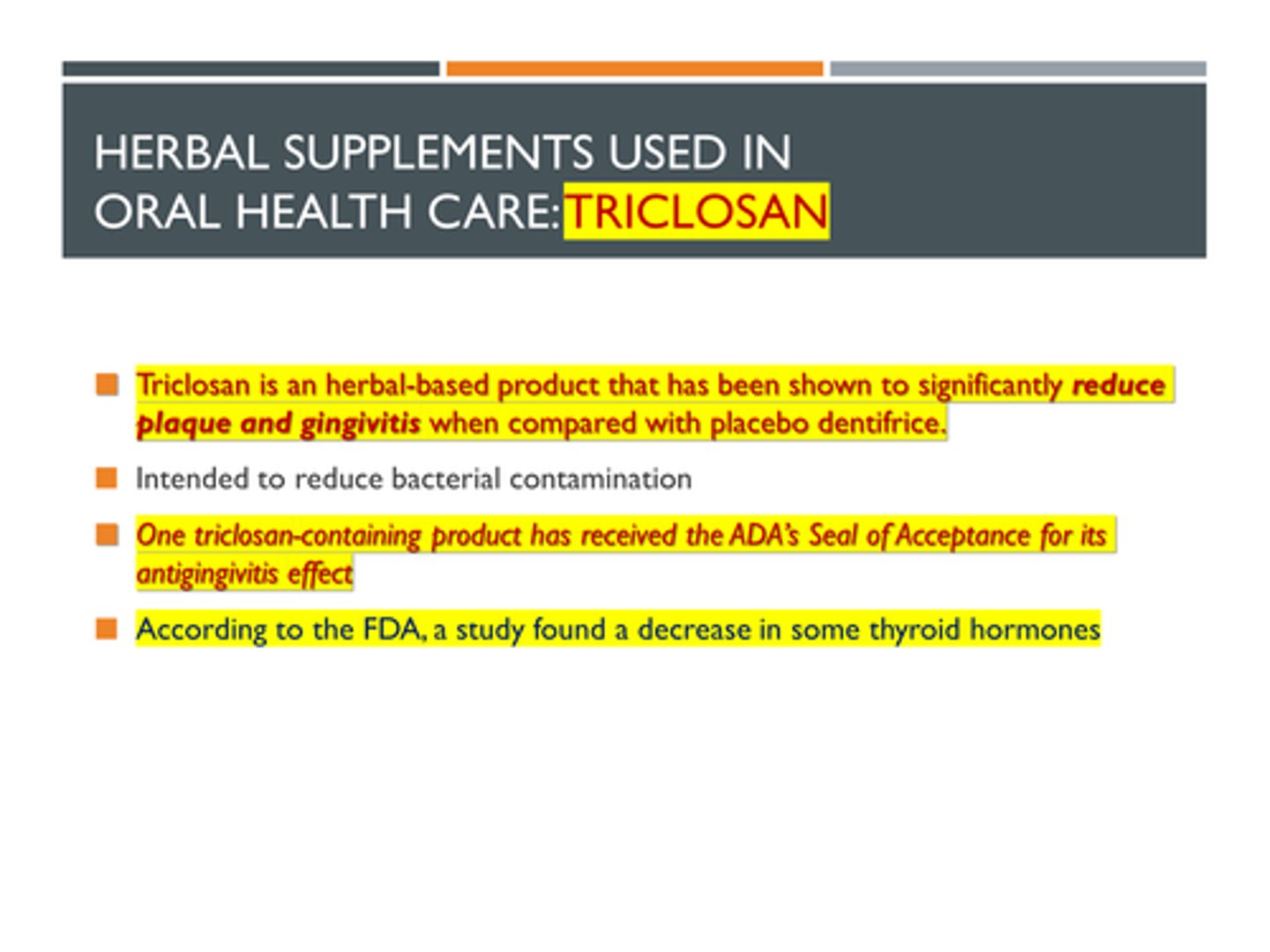
Triclosan is an herbal-based product that has been shown to significantly reduce plaque and gingivitis when compared with placebo dentifrice.
> Intended to reduce bacterial contamination
> One triclosan-containing product has received the ADA’s Seal of Acceptance for its antigingivitis effect
> According to the FDA, a study found a decrease in some thyroid hormones
Manufactures DO or DO NOT have to prove efficacy in treating or preventing a specific disease?
DO NOT
Which act regulates herbal products nowadays and manufactures must prove if it is unsafe?
Dietary Supplement Health & Education Act (DSHEA)
Which act provides the FDA ability to recall all foods, including dietary supplements?
FDA Food Safety and Modernization Act
What is a potential problem of taking Shankhpushpi herbal supplement with Phenytoin?
Reduced drug levels (inhibition of drug effect)
Additive sedative effects and coma is a potential problem when taking Kava kava and ___ together
Benzodiazepines
Antagonistic effects is a potential problem when taking Echinacea, zinc and ___ together
Immunosuppressants (corticosteroids, cyclosporin)
Which 3 supplements can increase the risk for bleeding when taken in conjunction with antiplatelet drugs or anticoagulants?
1. Garlic
2. Ginkgo biloba
3. Feverfew
Lowered seizure threshold is a potential problem when taking Evening primrose oil, borage and ___ together
Anticonvulsants
What are adverse effect(s) of Feverfew? (2)
1) Oral mucosa irritation
2) Ulcerations
What are adverse effect(s) of Ephedra
(ma-huang)? (2)
1) Tachycardia
2) Hypertension
___ contains ephedrine and can increase heart rate when given with sympathomimetic drugs
Ephedra (ma-huang)
Which 2 supplements when taking may cause postural hypotension?
1) Niacin
2) Yohimbe
Which 3 supplements when taking together cause hepatotoxicity and bleeding?
1) Chaparral
2) Comfrey
3) Kava
Angelica, clove, feverfew, garlic, ginkgo, ginseng, red clover, and high doses of vitamin E have an adverse effect of ___
Bleeding
Pomegranate, coenzyme Q10, echinacea, milk thistle, and wormwood adverse effect:
Allergic reactions
Which herbal supplement can induce the 3A3/4 isoenzyme of the cytochrome P-450 system and can increase the metabolism of many different drugs, including an increase or decrease effect of local and general anesthetics?
St. John's wort
Which 2 supplements can cause intraoral hemorrhage?
Feverfew and ginkgo
___ can cause change in taste
Echinacea
Name 5 Herbal supplements used in oral health care:
1. Acemannan
2. Essential Oil Mouth Rinse
3. Oil of Cloves (Eugenol)
4. Triclosan
5. Xylitol
Which herbal supplement used in oral health care has immunomodulating properties to reduce the healing time of aphthous ulcerations?
Acemannan
___ have bacteriostatic effect on oral pathogens known to cause plaque and gingivitis
Essential oils in mouth rinse
What are the three essential oils in Listerine?
1) Thymol
2) Eucalyptol
3) Menthol
What are Oil cloves products used for?
Topical analgesic for dental pain, used for dry socket relieve
Which herbal supplement has an antigingivitis effect (but is NO longer used)?
Triclosan
Which herbal supplement has a cariostatic effect (inhibit the formation of dental caries)?
Xylitol
What dental products have herbal supplements as the active ingredient?
Essential oils - listerine
Oil of cloves - eugenol
What adverse affect can herbal supplements have on the oral cavity? (7)
- Xerostomia
- Gingival bleeding
- Oral ulcerations
- Gingival hyperplasia
- Necrosis
- Oral candidiasis
- Tooth discoloration
True of false: Patients always report supplement use
FALSE!
Do manufacturers have to prove efficiency in treating or preventing a specific disease?
No & they can't make that claim!
The term ______ has been associated with herbal products because they are primarily derived from plant sources.
Natural
Herbal products are marketed as ______ ________ in the US and are not required to comply with the safety and efficacy regulations imposed on drug products.
Dietary supplements
The US FDA must prove a product is
Unsafe
Other aspects of the DSHEA prevent the use of _______ claims on the label
Therapeutic