Biology 150 exam 1
 Call Kai
 Learn
Learn Practice Test
 Spaced Repetition
 Match
Match Flashcards
 Knowt Play
1/74

There's no tags or description
Looks like no tags are added yet.
Name | Mastery | Learn | Test | Matching | Spaced | Call with Kai |
|---|
No analytics yet
Send a link to your students to track their progress
75 Terms
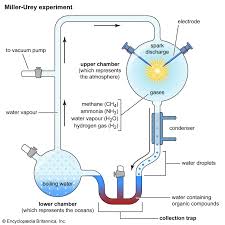
reducing atmosphere hypothesis
miller urey experiment; an experiment conducted to test pre life conditions and see if organic molecules could have spontaneously appeared. They found that in an environment with NH3 O2 N2 and H2O organic molecules could have formed
deep sea vent hypothesis
supposes organic molecules could have formed inside hydrothermal deep sea vents that could have provided energy, heat, and mineral catalysts
extraterrestrial hypothesis
supposes organic molecules could have arrived on a meteor or from outer space
step 2 - origins of life
simple into complex molecules. these organic molecules would have polyermerized into more complex compounds, likely aided by mineral surfaces such as clay
Step 3 - origins of life
becoming cell structures. the complex molecules began distinguishing the external from internal by producing boundaries
protobiont
prebiotically produced molecules that acquired a boundary like a lipid bilayer
Step 4 - origins of life
the cell structures gain chemical activity. RNA is thought to be the first macromolecule in protobionts bc it can store info, catalyze (using its ribosomes), and can self replicate.
How did RNA evolve
it had 2 traits it needed to develope: ability to make new RNA (1) and ability to speed up ribonecleotide synthesis (2).
1A: a mutation that coded for replication occured in the RNA
1B: that mutation made the RNA with that gene multiply quicker and eventually beat out the rest of the RNA
2A: a mutation that let RNA catalyze a step in ribonucleoside sequencing production
2B: same thing occured where those RNAs were more fit to reproduce more and outlast the other RNA
whats the origin of eukaryotic cells?
2 methods:
Endosymbiosis - one structure “lives” inside another for a mutually beneficial relationship
Invagination: membrane of a cell folds inward and traps outer material and bacteria (lead to nuclear envelope)
Fossil dating
technique used to determine specimen age
what are the factors of fossil dating
tissue, location,size, species abundance, human bias
how is fossil dating done
by measuring percentage of radioisotope decay
when was the first prokaryote, cyanobacteria, eukaryote, multicellular eukaryote, invertebrate, and when was the Cambrian explosion
3.5 -3.8, 3.5, 2.5, 1.5, 0.6, 0.5 (Billion years ago)
traits used for phylogenetic trees and define
morphological - organisms physical attributes
molecular - DNA sequences
embryonic - developemental similarities
what is phylogeny/ phylogenetic tree
a representation of evolutionary history, visually represented in a tree
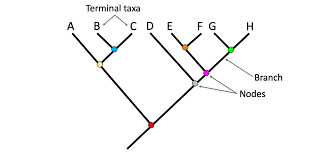
define each parts of this phylogenetic tree
Node: where lineage splits
Branch: evolving lineage
clade
an organism and all its decendents
paraphyletic clade
ancestor+group but some decendents are missing
homologs
features in different species that share a common ancestor
paralogs
genes in same species evolved through duplications
orthologs
genes in different species evolved from a common ancestors gene through speciation
evolution
heritable change in 1 or more characteristics of a population or species from 1 generation to another
6 pieces of evidence for evolution
fossils
selective breeding
vestigial structures
convergent evolution
homologies
biogeography
processes of evolution - gene duplication
Gene duplication is a process where a segment of DNA is copied and results in the presence of additional copies of that gene in the genome. This can lead to new functions and greater variability among species.
processes of evolution - mutations
random changes in gene sequences that increase variation
processes of evolution - exon shuffling
process in evolution where genes coding regions (Exons) are mixed through recombination events leading to new proteins and functions
processes of evolution - horizontal shuffling
Horizontal gene transfer is a process where genetic material is transferred between organisms in a manner other than traditional reproduction, allowing for the acquisition of new traits and increased diversity
what can alter allele frequency
natural selection
genetic drift
migration
genetic drift
random shifts in alleles based on random events, usually occurs in small populations
types of genetic drift
founder effect - a few individuals from a population start a new population
bottleneck effect - individuals that survive an event (I.e tornado) have different allele frequencies that the og population
microevolution
changes in gene patterns in a population resulting in character changes
macroevolution
microevolution but over a long period of time resulting in a new species
biolological species concept
that a group of individuals can breed
ecological species concept
species occupying specific ecological niches
evolutionary species concept
each species has its own evolutionary lineage
what does it mean to be a species
organisms share common characteristics, interbreed succesfully, and share evolutionary history.
cryptic species
look similar and have been classifies as one species but are different
anagenesis
process where species goes through gradual change over time leading to new traits, transformation of single lineage
cladogenesis
species evolves into 2 or more distinct lineages or species, occurs when a single ancestor lineage splits into multiple decendants
what are the processes of speciation
genetic changes / microevolution
adaptive changes
reproductive isolation
types of reproductive isolation
pre-zygotic and post-zygotic
types of pre-zygotic reproductive isolation
temporal isolation - organisms aren’t awake at the same time so they can’t reproduce
geographical isolation - organisms are in different locations so they can’t reproduce
behavioral isolation - having different mating calls for ex
gametic - can have intercourse but not reproduce
mechanical isolation - physically cannot reproduce (I.e different genetalia)
types of post-zygotic reproductive isolation
hybrid sterility - can reproduce but the result is infertile (mules)
hybrid inviability - zygote becomes unviable post fertilization
allopatric speciation
physical separation of 1 species that diverge into 2 species
hybrid zones
if there is overlap between the 2 species
adaptive radiation
when species break off into ecological niches
sympatric speciation
adaption to environment and different behaviors
polyploidy
common in plants, change in chromosome number
sexual selection
traits one gender finds more attractive, helps with mate selection
evo-devo (evolutionary development)
different gene expression can lead to developmental differences
what does gremlin do and what does BMP4 do
gremlin inhibits BMP4 and BMP4 causes apotosis
what is apotosis
cellular suicide, method of removing cells
give an example of gremlin and BMP4 being used
both a chicken and a duck had BMP4 but only the duck had gremlin which is why they look different
archea
single celled microorganisms, extremophiles (can live in extreme conditions)
what type of archea likes high salt conditions
halophiles
connections between archea and eukaryotes
histones associated with DNA, 30 or more ribosomal proteins