Ch 2 - Free Trade & Protection
 Call Kai
 Learn
Learn Practice Test
 Spaced Repetition
 Match
Match Flashcards
 Knowt Play
1/31

There's no tags or description
Looks like no tags are added yet.
Name | Mastery | Learn | Test | Matching | Spaced | Call with Kai | Chat |
|---|
No analytics yet
Send a link to your students to track their progress
32 Terms
What do countries choose to specialise in?
Countries specialise in the production of certain goods and services to which they are best suited
What makes specialisation and trade possible?
Made possible because of the uneven distribution and quality of resources between countries. If production costs differ, more countries will benefit by specialising in their most efficient production form, and then to trade with one another.
Which G&S should countries export?
G&S for which they have a comparative advantage in producing
Which G&S should countries import?
G&S for which they have a comparative disadvantage in producing
Absolute Advantage
A country is said to have an absolute advantage over another country if it can produce a greater quantity of that good with the same amount of resources
Assumptions of the Absolute Advantage Model
Only 2 countries
Only 2 goods produced and consumed
Resources are perfectly mobile
Transport costs not considered
Comparative Advantage
A country is said to have a comparative advantage in producing a good or service if it can produce that good or service at a lower opportunity cost than another country
Opportunity Cost Formula - Production
Opportunity Cost (A) = Quantity of B/ Quantity of A
Opportunity Cost Formula - Inputs
Opportunity Cost (A) = Hours Taken to Produce A / Hours Taken to Produce B
Exports D/ S Model + Explanation
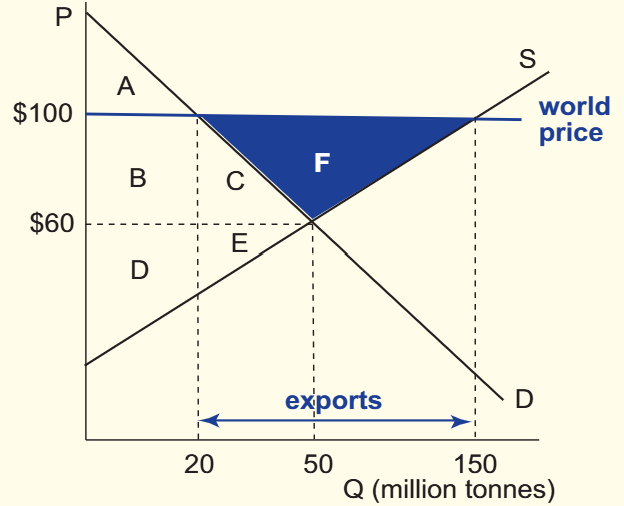
The equilibrium price for iron ore in Australia is $60 per tonne, and the equilibrium quantity is 50 million tonnes are produced. The world price for iron ore is $100 which is much higher than the Australian domestic price, meaning that Australia has a comparative advantage in iron ore production.
If Australian producers sell at the higher world price, quantity supplied increases to 150 million tonnes while quantity consumed falls to just 20 million tonnes. Exports will equal the difference between quantity demanded and quantity supplied - 130 million
tonnes.
After the trade, iron ore producers gain by selling more iron ore and receiving a higher price. Iron ore consumers in Australia however will lose because they consume less iron ore and pay a higher price.
However, the gains always of exports will always exceed the losses. Australian producers will gain more than Australian consumers lose by – thus causing an increase in economic welfare will increase as a result of exports.
Before trade, consumer surplus equals the area A + B + C, while producer surplus equals the area D + E. After trade, consumer surplus decreases to area A - consumers lose areas B and C, due to the higher price, which is transferred to domestic producers. But not only do producers gain areas B and C, but they also gain area F. Area F represents the net gain from exports. Exports therefore result in a net increase in economic welfare.
Imports D / S Model + Explanation
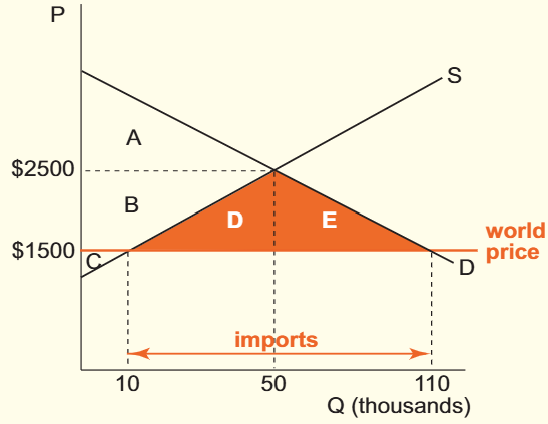
In the domestic Australian market, equilibrium price of a laptop is $2500, and equilibrium quantity is 50 thousand laptops produced. The world price for laptops is $1500 which is much lower than the Australian domestic price. This means that Australia has a comparative disadvantage in laptop production.
If Australian consumer import computers at the lower world price of $1500, quantity demanded increases to 110 thousand while quantity supplied falls to just 10thousand. Imports will equal the difference between quantity demanded and quantity supplied - 100 thousand.
After trade, laptop consumers gain by buying more laptops at a lower price. However, laptop producers in Australia will lose because they sell a lower quantity and receive a lower price. Gains always exceed the losses. Australian consumers of laptops gain more than laptop producers lose – thus resulting in an increase in net economic welfare
Before trade, consumer surplus equals area A, while producer surplus equals the area B + C. After trade, consumer surplus increases to the area A + B + D + E - consumers gain areas B, D and E due to the lower price. But after trade, producer surplus falls to area C - domestic producers lose area B to consumers. Area D + E represents the net increase in economic welfare from imports
Define ‘Protection’
Protection refers to any action by the government designed to give the domestic producer an artificial advantage over a foreign producer
How does protective practises ‘hurt’ countries?
Protective practises can cause a lower level of national income and a lower standard of living - hence, it is better economically in the long run to pursue policies that promote free trade
What are the 3 classified types of protection?
Tarrifs
Subsidies
Quotas
What is the goal of protection?
The goal of protection is to increase domestic production in the protected industry and to decrease the consumption of imported goods and services
Who benefits from protection?
The owners and workers in the protected industries and sometimes the government (tarriff revenue)
Who loses from protection?
Consumers always ‘pay more and get less’
All forms of protection result in a net welfare loss for the economy
The losses from protection always outweigh the gains
Define a ‘Tariff’
A tax placed on an import
What does a tarriff aim to do?
It is designed to increase the price of a foreign good or service so that the competing domestic good or service receives a price benefit
Tariff D / S Model + Explanation
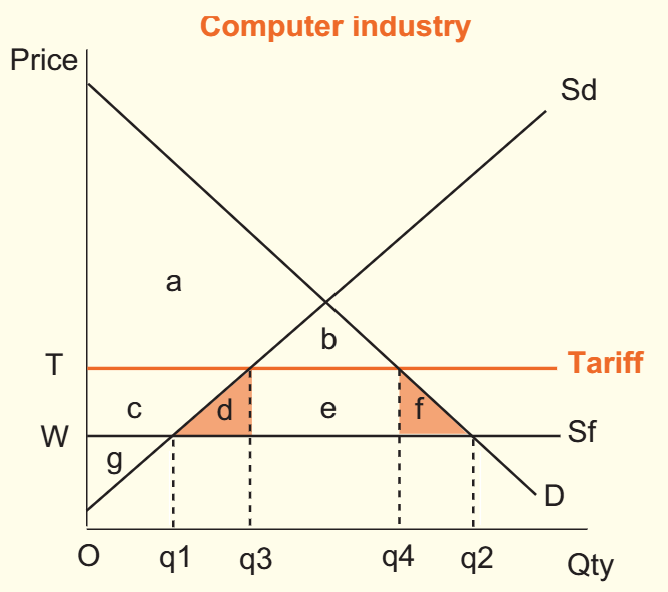
The world price of computers (W) is lower than the domestic equilibrium price. This means that Australian consumers will import computers from overseas at the world price, demanding a quantity of q2, while domestic supply is only at q1. The difference between q1 and q2 represents imports.
If the government imposes a tariff (tax) on imports, then the price of the good will increase from W to T. At this price, consumers will consume less at q2, and will pay more at T. On the other hand, producers will produce more at q3 at a higher price. Imports have contracted from q1 and q2 to q3 and q4 - decreasing imports.
Domestic producers gain because they sell a greater quantity of computers at a higher price - meaning they gain area C.
The government also gains by collecting the taxation revenue generated from the tariff - gaining area G.
Consumers are losing because they are consuming less of the product and are having to pay a higher price. Consumer surplus falls from areas a + b + c + d + e + f to just areas a + b.
The loss to consumers (c + d + e + f) exceeds the gains to producers (c) and the gains to the government (g). Because the losses exceed the gains - the tarrif results in a decrease in net economic welfare.
Define ‘Subsidies’
Grants or payments made by the government to producers. They are paid for out of general tax revenue and directly lower a producer’s costs of production.
What does a subsidy enable producers to do?
Enables a domestic producer to sell their product at a lower price to compete against imports
Subsidy D / S Model + Explanation
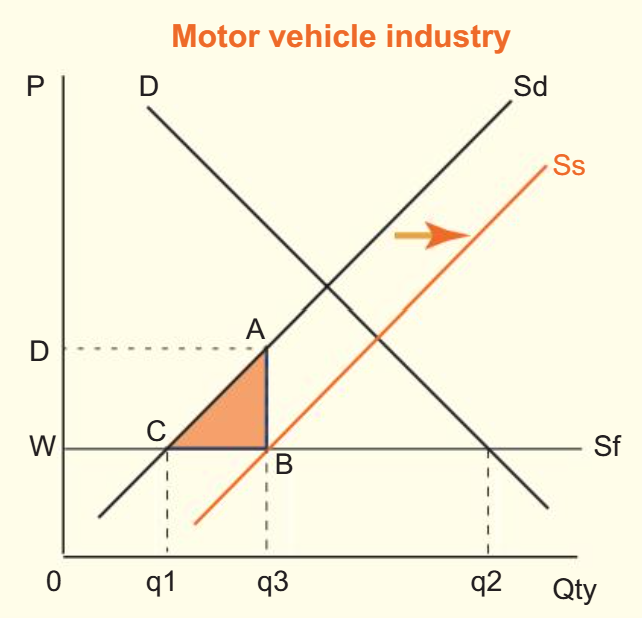
Initially, the world price for the good is at W. At this price, domestic consumers demand at a quantity of Q2, and domestic producers supply at a quantity of Q1. The difference between Q1 and Q2 represents imports.
When the government pays a subsidy to domestic producers (provides them with money to lower their production costs), then their supply curve increases – it shifts to the right.
Domestic producers can now supply at a greater quantity at Q3 at the same price of W. This reduces imports from area Q1 to Q2 to areas Q3 to Q2.
Domestic producers gain as they can supply a greater quantity at the same price.
A subsidy also has no direct adverse effects on consumers. Consumers pay
the same price and purchase the same quantity of the good. Consumers do
however, bear an indirect burden in that the cost of the subsidy has to be paid for
from government taxation revenue. There is an opportunity cost here because
this revenue could have been used to spend on other goods and services, such
as education or health.
The cost of the subsidy is equal to area DABW but the increase in producer
surplus is equal to area DACW. The cost of the subsidy exceeds the gains to producers. Losses exceed gains - resulting in a deadweight loss.
Area ABC represents the deadweight loss – thus, the subsidy results in a decrease in net economic welfare.
Define a “Quota”
A limit on the quantity of a particular good that can be imported into a country
What are the arguments for protection?
Anti - Dumping
Infant Industry
Diversification
National Security (Defence)
Increased Employment
Cheap Foreign Labour
Favourable Balance of Trade
Anti - Dumping
The use of protection in a situation whereby a “company exports a product at a cheaper price than the price it normally charges at its own home market”
Foreign firms may use lower prices to drive out domestic competitors, gain control of the market and then increase prices, etc
It is difficult to prove dumping, as lower prices for foreign products may just reflect more efficient production
Infant Industry
The use of protection for newly established industries until they have time to grow and develop economies of scale
Allows industry to; gain experience, become efficient, and develop a comparative advantage
Protection often becomes permanent, firms lose incentive to innovate, and industry becomes dependent on protection
Diversification
The use of protection based on the idea that countries shouldn’t specialise too narrowly
Reduces risk from changes in world demand and price shocks, helps build a broader industrial base
Economies are dynamic anyway, government may pick wrong industries, most countries are diversified anyway
National Security (Defence)
The use of protection based on the idea that some industries are vital in wartime, and they need domestic production for emergencies
Hard to define '“vital industries”, can be used as an excuse for protection, and trade promoted cooperation
Cheap Foreign Labour
Protection based on the idea that countries with lower wages have an unfair advantage
Wages reflect productivity, low wage countries specialise in labour - intensive goods, high wage countries specialise in skill / capital intensive goods
Favourable Balance Trade
Protection to reduce imports to fix a trade deficit, on the basis that a "trade surplus is good”
Imports are not bad - they give benefits too; protection reduces exports too - leading to higher production costs and retaliation from other countries
Trade Liberalisation
The process of reducing or removing trade barriers between countries