PMLS Lesson 5: Ethics
 Call Kai
 Learn
Learn Practice Test
 Spaced Repetition
 Match
Match Flashcards
 Knowt Play
1/55

There's no tags or description
Looks like no tags are added yet.
Name | Mastery | Learn | Test | Matching | Spaced | Call with Kai |
|---|
No analytics yet
Send a link to your students to track their progress
56 Terms
Ethics
is a moral code that guides how an individual should behave.
A branch of knowledge that deals with moral principles.
Is also about the individual’s search for meaning while dealing with human problems.
Logical, Epistemological, Cosmological, Ethical, Aesthetical, and Scientific
Kinds of Problems
Logical
Problem of reasoning
Epistemological
Problem of the truth
Cosmological
Problem of the universe
Ethical
Problem of morality
Aesthetical
Problem of art and beauty
Scientific
Problem of science
Moral beliefs
Ethics deals with a diverse prescription of universal concepts and principles that serve as a foundation of this.
Donal Harrington
For him, morality can be viewed in different perspectives — as a law, inner conviction, love, personal growth, and as social transformation.
Morality
It can be viewed in different perspectives — as a law, as an inner conviction, as love, as personal growth, and as social transformation (Donald Harrington)
James Gustafson (1974) Illustration of Ethics vs Morality
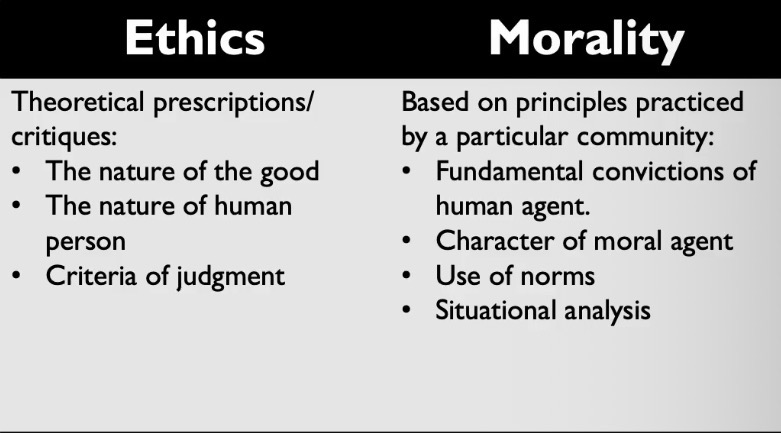
Fundamental conviction of human agent
Character of moral agent
Use of norms
Situational analysis
Morality based on principles practices by a particular community
Nature of the good
Nature of human person
Criteria of judgement
Ethics in Theoretical prescriptions/ critiques
Ethos
Greek word where ethics is derived from, which means “character”
Decision making
Ethics serves as a guide for this — based on one’s belief. (School of ethics)
Ethical Relativism, Ethical Pragmatism, and, Ethical Utilitarianism
Theories of Ethics
Ethical Relativism
“What is right for you, may not be right for someone else.”
Also known as the moral relativism
School of ethics anchored on the principle that morality depends on the culture, what is right for one group may not be right for another.
Theory based on norms relative to a particular culture or society.
Challenge: The preservations o its cultural uniqueness and acknowledgement of cultural differences.
Social Diversity
Ethical Relativism acknowledges this, that every society has a unique moral design and culture; and people’s beliefs are greatly influenced by culture.
Ethical Relativism
According to this, neither culture is absolutely right or wrong. What is “moral” depends of the cultural norms, tradition, and beliefs of the society practicing it.
Ethical Pragmatism
“What is right is what works best in practice and brings the best results.”
Dealing with things realistically in a ways that is based on practical rather than theoretical considerations.
Charles Sanders Pierce (1870) and further developed by William James.
America’s most distinctive and major contribution to the field of philosophy
More of a theory of knowledge, truth, and meaning rather than morality.
Instead of asking what’s right or wrong, it asks “Will this decision be useful, beneficial, or practical?”
Pragmatic
Dealing with thing sensibly and realistically in a way that is based on practical rather than theoretical considerations.
Charles Sanders Peirce, William James
Ethical Pragmatism was discovered by him in 1870 and further developed by him.
Ethical Utilitarianism
“Right is what brings the greatest happiness/ benefit for the greatest number.”
Determines right from wrong by focusing on outcomes.
If the end justify the means
School of ethics states that the rightness and wrongness of actions is determined by their consequences.
Jeremy Bentham and John Stuart Mill
Ethical Utilitarianism was developed by them.
John Stuart Mill
Stated by him — “actions are good insofar as they tend to promote happiness, bad as they tend to produce unhappiness. The utility or usefulness of an action is determined by the extend to which it promotes happiness rather than its reverse”
Abortion, Euthanasia, and Genetic Engineering
Most Common Ethical Issues
Abortion
Is considered illegal in the Philippines. Article II, Section 12 of 1987 Philippine Constitution states that:
“The state recognizes the sanctity of life and shall protect and strengthen the family as a basic autonomous social institution. It shall equally protect the life of the mother and the life of the unborn from conception.”
Pro-life and Pro-choice
The two positions regarding abortion
Pro-life
Anti-abortion, believes abortion is murder and should be stopped.
Pro-choice
Beliefs that the decision to abort is one of personal liberty and thus should be legal.
DNR (Do not Resuscitate)
This initiation is best performed after an understanding by physicians, patients, family, staff has been reached.
No code
CPR and ACLs
Interventions that can be offered to all patients within the hospital.
CODE
A call from cardiopulmonary resuscitation efforts.
Code Blue, No Code, Slow Code, Chemical Code
Types of CODES
Code Blue
Signal to the emergency team of the need to respond (oxygenation, ventilation, cardiac message, electroshock, emergency drugs)
No code
Do not resuscitate
Slow code
The team slows down the resuscitation so as to appear to be providing care but it is only an illusion.
Chemical code
Similar intent to slow code. The team provides drugs but not other forms of resuscitation.
Euthanasia
Is the practice of ending life intentionally, usually in situations when the individual is terminally ill, to relieve them of pain and suffering. Also known as “mercy killing”, euthanasia is regarded as a merciful release of an individual form an incurable sickness.
dignified death
Mercy killing
Euthanasia is also known as this.
Voluntary, Non-voluntary, Involuntary
3 types of Euthanasia
Herbert Hendin
He describes euthanasia as the process of inducing the painless death of a person who is severely debilitated for reasons assumes to be merciful, either through voluntary, non-voluntary, or involuntary means.
Genetic Engineering
Is a controversial ethical sue because it involves genetic manipulations that are perceived to be against moral standards set by society.
Humans are seen to be acting as their own gods.
Genetic screening
Is a procedure whose main purpose is to screen, choose, and select the gene for proper detection of any genetic disease and other chromosomal malformations. This is usually done for the early diagnosis of disease.
Genetic intervention
Are techniques such as genetic control, therapy, and surgery. People can now “intervene” in biological process and “control’ bad or defective genes.
Stem-cell therapy
Is a form of genetic engineering that makes use of stem cells to treat r prevent diseases, It has been the subject of controversy because of how stem cells are sourced.
In vitro fertilization (IVF)
Is popularly known as laboratory fertilization. In the past, this technology became the subject of controversies because many religious group opposing the procedure as they perceive it to be a deviation from the natural process of fertilization.
Research Ethics
Refers to the set of principles and standards that guide how scientific investigations should be conducted to ensure honesty, integrity, fairness, and respect for human and animal subjects.
Respect for Persons
Beneficence
Non-Maleficence
Justice
Confidentiality and Privacy
Core Principles of Research Ethics
Respect for Person (Autonomy)
treat participants as individuals with the right to make their own decisions.
Requires informed consent and respects for the right to withdraw att any time.
Beneficence
Researchers must act in ways regarding maximize possible benefits of the study.
Strive to improve health, knowledge, or society through the research.
Non-Maleficence
“Do no harm”
Minimize risks and avoid unnecessary harm to participants, whether physical, psychological, o social.
Justice
Ensure fairness in selecting participant and distributing both the burdens and benefits of research.
Avoid exploiting vulnerable groups.
Confidentiality and Privacy
protect personal data and information gathered during research.
Avoid fabrication, and plagiarism
Maintain anonymity when required
Professional Ethics
Ethics cover the philosophy of doing what is right.
The civil code of behaviors considered correct by members of the profession for the good of both the patients and the professionals.