Clinical Notes (11, 13, 15) + Eye
 Call Kai
 Learn
Learn Practice Test
 Spaced Repetition
 Match
Match Flashcards
 Knowt Play
1/77

There's no tags or description
Looks like no tags are added yet.
Name | Mastery | Learn | Test | Matching | Spaced | Call with Kai |
|---|
No analytics yet
Send a link to your students to track their progress
78 Terms
Clinical note - Tracheal Blockage… what is it called?
Aspiration = breathing in foreign objects (usually can be coughed out)
Clinical note - Tracheal Blockage… How to remove/stop this?
If normal coughing doesn’t work…
Heimlich Maneuver/Abdominal Thrusts - forcefully pushes object out (allows airflow)
Intubation
Tracheostomy
What is intubation?
when epiglottis (tissue around the glottis) swells
insert a curved tube through the pharynx and glottis (allows airflow)
What is Tracheostomy?
Incision through the anterior tracheal wall
Tube insterted, bypasses the larynx = airflow directly to the trachea
Clinical note - What is artificial Repiration?
A technique to provide air to peeps with unworkable respiratory muscles
Mouth-mouth
An Endotracheal tube = tube into the glottis and trachea
Attached to this = Mechanical Ventilators
CPR (Cardiopulmonary resuscitation) - if cadiovascular system does not work
Clinical Note - What are Pulmonary fuction tests?
it monitors vairous respiratory functions
** very simple but delivers very credible/useful results
Spirometer = measures parameters (vital capacity, expiratory reserve volume, inspiratory reserve volume)
Peak flow meter = measurs max rate of forced expiration (exhale)
Clinical note - What is Decompression Sickness?
Aka “THE BENDS”
very painful : from a sudden drop in atmospheric pressure (NITROGEN BUBBLES FORM)
Nitrogen affects joint/blood stream/cerebrospinal fluid
Clinical note - What is Carbon Monoxide Poisoning?
Whecn CO binds with hemoglobin and O2 can bond with the heme anymore
the hemoglobin/RBC is useless for respiratory fuctions now
** very likely to die if medical assistance happens
Treatment
prevent more CO exposure
Administer pure O2 (bump out CO on Hemoglobin)
Transfusion of RBC
Clinical note - What is Emphysema?
A Chronic progressive condition
Produces shortness of breath and th einability to tolerate physical exhertion
Form the eleimation of bronchioles/alveoli
Clinical note - What is Lung Cancer?
An agressive class of malignancies originating inthe bronchial passageways/alveoli
Affects epithelia cells that lines conduting passageways, mucoous glands, alveoli
Most common cancer to get
Treatment
surgery, radiation therapy, chemotherapy
Clinical note - What is Hypercapnia?
Increase of Pco2 in arterial blood
stimulates chemoreceptors in the carotid and aortic bodies and chemoreceptive neurons of the medulla obongata
Stimulates Hyperventilation = increased rate of respiration (rapid breathing)
Co2 diffusion increases
Hyperventilation leads to Hypocapnia = abnormally low Pco2
leads to hypoventilation = till Pco2 reaches og amount
Clinical note - What is Sudden Infant death syndrome (SIDS)?
child just stops breathing
usual ocurances…
midnight to 9AM
Late fall/winter
infant (2-4 months old)
Risk factors
sleeping on belly
genetic factor (controversial)
proposed cause
respiratory process problem that disrupts the relfexive respiratory pattern
** people say that the age this commonly happens correlates to when the respi. centers are going through a period of connecting with the brain
What is Cystic Fibrosis?
A defect of respiratory muscosa (inherited) = makes it more dense/viscous
mucus transport stops and blocks small respiratory passageways
Normal respi. defences stop = more bacteiral infections
leads to a lot of deaths
Could lead to heart failure
** defected Chromosome 7 gene
What is Respiratory Distress Syndrome?
when it is hard ot open the alveoli/inhaling is hard
peopel die exhuasted, trying to keep lungs inflated
Clinical Note- What is Pneumonia?
the inflammtion of the pulmonary lobules
usually from infection (when respiratory defenses are down)
restricts airways/fluid leak into alveoli
Clinical notes - What is Pneumocystis carnii?
a Fungus (escaped from the alveoli)
Common Pneumonia in peeps with AIDS
Clinical Notes - What is Tuberculosis?
Bacterial infecitons of th elungs
bactirium : Mycobacterium tuberculosis
Sings/symptoms : chest pain, fever, night sweats, fatigue, wieght loss
trasmit thtough casual contact (couhging, sneezing, speaking)
Chap 11… What are two best known inherited disorders that comes from th eproduction of Abnormal Hemoglobin
Thalassemia
Sickle Cell Anemia (SCA)
Chap 11… What is Thalassemia?
An inherited disease which is from the inadequate production of the globular protiens compotnents of hemoglobin
RBC production slows
Matured RBC are fragile and short lived
Scare number of healthy RBC = reduces O2 carrying capacity of the blood + leads to growth and developement problems
TREATMENT
transfusions = administraction of blood components to Maintain RBC #s normal count
Chap 11… What is Sickle Cell Anemia (SCA)?
A mutation that effects the amino acid sqeuence of one pair of the globular protiens of hemoglobin
when blood has an abundance of O2 = doesn’t show problem
when defective hemogloobin gives up a lot of stored O2 = surrounding hemoglobin molecules interact
RBC change shape + turn stiff + curves = “Sickle shaped”
Doesn’t affect O2 carrying
**makes RBC more fragile and easily damaged
**gets stuck in capillaries (can’t fold very well)
Chap 11… What is Hemolytic Anemia?
the untimely breakdown of “sickled” RBC as a result of Sickle cell anemia
Chapter 11… What is the Hemolytic Disease of the Newborn (HDN)?
AKA Erythroblastosis Fetalis
During pregnancy (fetal and mom’s circulaitory systems are closelt intertwined) = Antibodies from the mom cross the placenta and destroy the fetal’s RBC
Usually during delivery : Rh(-) mom and Rh(+) baby’s antigens = mom’s antibodies (anti Rh) are produced
the amount doesn’t effect the 1st child a lot (usually)
massive amounts of anti-Rh antibodies ar eproduced for the 2nd child
hemolyzes the fetal’s RBC = procduces anemia
fetal demand for RBC increases = RBC leave the bone marrow and into circulation before maturing fully
Chapter 11… What is HDN in shorter terms? Why is it also called Erythroblastosis Fetalis?
When the Hemolytic disease of the Newborn infleunces the mom’s anti Rh antibodies to destroy the fetal’s RBC = fetal needs more RBC
the fetal RBC leave the bone marrow before fully developing
It’s also called Erythroblastosis Fetalis ….
immature RBC are called erythroblasts
Chapter 11… Testing for blood compatibility : what are the two steps?
Determining the blood type of the recipient
doing a cross match test
Chapter 11… How to test/determine a recpipiant’s blood type?
A blood smaple mixed with 3 RBC’s ANITGENS to see if it produces a negative cross reactions
anti - B/A/Rh antibodies with blood
clumping of anti-A and anti-B - the person has AB Blood
No clumping of anti-A and anti-B - the person is type O
Chapter 11… What happens during Cross-match testing?
Recipient’s PLASMA (RBC) gets mixed with a donor’s RBC = see if cross reaciotns happen
it doesn’t work that good the other way around
Chapter 11- What Blood type is used for all types (doesnt create cross reactions)? Which one can recieve all?
Donate/“Used” → Type O - aka universal donors
Cross reactions still can occur
Receive → Type AB - aka universal recipiants
Chapter 11…. what are ways to avoid compatibility problems?
Use synthetic blood substitutes - dont have surface antigens to trigger cross reactions
cross-match test
Chapter 11 - What other things can blood compatibility test be used for?
paternity testing
Crime detection
can prove if the person in question is NOT involved
CANT prove if we was
Chapter 11…Abnormal Hemostasis, what are the two types?
** any disorder that affects a person’s clotting factor can disrupt the entire hemostasis process
Excessive Coagulation
Embolus, Embolism, Thrombus
Inadequate Coagulation
Hemophilia
Chapter 11… What is an Embolus?
an abnormal mass in the bloodstream
one type of an embolus → A drifting blood clot : clot formed in the circulation rather than injury site
Don’t stick on vessel walls
drifts till plasmin (enzyme in blood that breaks down fibrin—protein that forms blood clots) digests it OR it lodges a small vessel
other EX: air bubbles, fat globules
Chapter 11 … what is embolism?
a condition when an embolus blocks circulation to an artery/vein (a vascular blockage)
2 popular types of conditions where an embolus blocks a vessel
Strokes
Pulmonary embolism
Chapter 11… What is a Stroke?
Embolus in the arterial system + plugged capillaries in the brain
Chapter 11… What is a Pulmonary Embolism?
Embolus in the Venous system + Plugged capillaries in lungs
Chapter 11… What is a Thrombus?
A blood clot attched to a vessel wall + platelets attch to a healthy/not injured vessel wall
Platelets are attracted to roughened areas (“Plaques”) with lotta lipids
clot enlarges = pojects into the vesel’s channel (“lumen”) = reduces its diamter
could completely block it or create an embolus
Chapter 11… How to treat conditions realting to embolus?
Surgically remove
Administer anticoagulants = attacks clots
Ex: enzymes… streptokinase and urokinase (change plasminogen to plasmin)
Administer tissue plasminogen activator = stimulates plasmin formation
Chapter 11.. What is Hemophilia?
Inadequate Coagulation/production of clotting factors - inherited
clotting factor usually inadequate = Factor V||| (essential component of the clotting pathway)
Severity depends on the degree of under production
Severe cases = extensive bleeding from slight mechnaical stress or hemorrages that happen spontaneously at joints and muscles
Chapter 11.. What is treatment for Hemophilia?
Transfusions… BUY plasma samples must be pooled (“combined”) to get enough clotting factors
PRICEY and increases risk of blood-borne infections (Ex: Hepatitis and AIDS)
Gene splicing techniques = make factor V|||
Chap 13… What is Arteriosclerosis?
thickening/toughening of arterial walls
Could lead to Coronary artery disease in coronary vessels OR strokes (ateriosclerosis in brain)
Chap 13… What are the 2 types of Arteriosclerosis?
Focal calcification
Atherosclerosis
Chap 13… What is Focal calcification?
degenerating smooth muscle in the tunica media is replaced by calcium deposits
part of aging
a complication of diabetes mellitus (an endocrine disorder)
Chap 13… What is Atherosclerosis?
a form of Ateriosclerosis
lipid deposites form in th etunica media from endothelial lining damage
*most common form of arteriosclerosis
Chap 13… What factors contribute to the development of Atherosclerosis?
lipid levels in bloop → people with elevate dlevels of plasma lipids
Specifically cholesterol
Lipoproteins - protein-lipid complexes in tissue that cholesterol gets transported to
when the lipoproteins stay in circulation for a long time - monocytes remove them and attach to the endothelia of blood vessels
the monocytes release growth factors that stimulate smooth muscle cell division near the tunica interna
*vessel wall thickens and stiffens
More monocytes take part → monocytes, smoothe muscl fibers, and endothelial cells start phagocytizing lipids
Atherosclerotic plaque happens (can be removed by chngaing diet)
cant be changed if the problem isn’t dealt early and the plaque grows … the endothelial cells swell with lipids→ gaps appea rin the cells
platelets stick to the exposed collagen fibers, and aggregation happens
forms a blood clot → clogs blood vessel
** can halt the plaque BUT CANT FIX STUCUTRAL CHANGES
Chap 13… What is a Atherosclerosis Plaque?
a fatty mass of tissue that projects into th elumen of the vessel
simple problem if dealt early
BAD problem if left unchecked
USUALLY EFFECTS»» Elderly peeps (specifically men)
RISK FACTORS », age, gender, and high blood cholesterol levels
monocytes and more of them go into endothelial cells… and with the helps of smooth muscle fibers, and endothelial cells … they start phagocytizing lipids
Chap 13… What is Capillary Dynamics And Blood Volume? What 2 processes can happen?
Andy condition that affect hydrostatic/osmotic pressures int he blood/tissue will shift the direciton fo fluid movement
Recall of fluids
Edema
Chap 13… What is the process, Recall of fluids?
A net movement of water from interstitial fluids to the bloodstream
Chap 13… What is the process, Edema?
opposite process of the recall of fluids
it’s an abnormal accumilation of interstitual fluid in tissue
usually happens around brusies (Damge to capillaries = plasma protiens leak into the interstitial fluid → decreases osmotic pressure of the blood + elevates osmotic pressure in tissue)
**Serious cases : result from increase pressures in aterial/venous/both systems → usually during Congestive Heart Failure (CHF)
Chap 13… What is Congestive Heart Failure?
Heart failure = When cardiac output doesnt meet demands of the body
Congestive Heart Failure = L ventricle cant keep up with R ventricle
blood flow backs up int he pulmonary circuit
R ventricle works harder = pulmonary arterial pressures increase… leads to pulmonary edema
Chap 13… What is Pulmonary Edema?
Buildup of fluids in th elungs (chnage is osmotic pressure in lungs)
from the increased blood pressure of the pulmonary vessels
Chap 13… How to Check Pulse and Blood pressure?
Feel pulse in large/medium arteries
Procedure = use finger to compress an artery against a solid mass (Ex: bone) = compression leads to feelign a pulse
Inside of the wrist is usually used → radial artery (pressed against th edistal portion of the radius)
Other arteries = temporal, facial, external, carotid, brachial, femoral, popliteal, posterior tibial, and dorsalis pedis arteries
Chapter 13… What are pressure points?
Firm presure on artieries near limb bases that reduces/stops arterial bleeding in more distal portions of the limb
Chapter 13… How is Blood pressure measured?
Sphygmomanometer
Cuff on arm + Stethoscope + pressure gauge
inflate till approx 30mm Hg pressure (enough to stop flow of blood in brachial artery… eliminating the sound of the pulse)
** pressure when the pusle is heard = peak systolic pressure
***Pressure when pusle fades = diastolic pressure
Chapter 13… What is “Korotkoff”?
DistinctiveSounds heard during the blood pressure test with the sphygmomanometer
Bloss pressure is recorded with a slash …
Systolic pressure / diastolic pressure
120/80 → pulse pressure of 40 mm Hg
Chap 13… What does Exercise, Cardiovascular Fitness, and Health do?
Cardiovascular performance improves with trainging
Atheltes = bigger hearts and stoke volumes then non atheletes
EQUATION → Cardiac output = stroke volume (heart rate)
Larger stroke volume = lower heart rate
Regilar excersise benefits + healthy diet +wieght control + no smoking:
lower total blood cholesterol levels, reduces stress, slows plaque formation
** High cholestorol is 1 major risk of getting atherosclerosis (leads to cardiavascular disease and strokes)
Chap 13… What is Shock?
An acute circulatory crisis marked by low blood pressure (hypotension) and inadequate blood flow
Chap 13… What are common causes of Shock?
A fall in cardiac output after hemorrhage/fluid losses
heart damage
external pressure ont he heart
extensive peripheral vasodilation
Chapter 13… what is Circulatory shock?
an importan tform of shock
Cause : reduction in total blood volume of about 30%
Chapter 13 … What are 6 common signs/symptopms of shock?
Hypotension (systolic pressure beloww 90 mm Hg)
Pale/”clammy” skin
vasoconstriction
sympathic activation of sweat glands
Confusion/disorientation
fall of blood pressure in brain
Rapid heart rate - weak pulse
Urination slows/stops
reduced blood flow to kidneys
Blood pH (acidosis) drops
lactic acid generated in O2 - deprived tissues
Chapter 13 … What are immediate treatments of shock?
prevent further fluid losses
Transfusions - increase blood volume
Chapter 13 … What are other forms of shock?
Cardiogenic shock + obstuctive shock
** because … heart cant maintain normal cardiac output
Septic shock, Toxic Shock Symdrome, Anaphylactic shock
** beacuse…. of widespread uncontrolled vasodilation
Harvesting the Blood of America’s Poor: Big Pharma's Blood Plasma Business
it is more valuable than oil..
Plasma is rich in proteins that are essential for manufacturing expensive medications for patients with immune deficiencies and other chronic or genetic conditions
Causes long term health problems
The Industrialization of Plasma: The film details how pharmaceutical giants (such as CSL, Octapharma, and Baxter) treat human plasma as a highly lucrative raw material for life-saving, yet expensive, medications (0:06:25 - 0:07:12).
Exploitation of the Poor: The documentary highlights that many collection centers are located in economically disadvantaged neighborhoods in the U.S. Impoverished donors often rely on these payments as a primary source of income, which creates health risks as they may donate more frequently than recommended to make ends meet (0:13:00 - 0:19:54).
Lack of Transparency and Oversight: The investigators reveal that donors are often subjected to minimal physical checks and that the industry hides behind "trade secrets" to avoid scrutiny regarding the origin of their plasma and the conditions under which it is collected (0:26:17 - 0:27:00, 0:34:26 - 0:34:30).
Health and Safety Concerns: The film raises questions about the long-term impact on donors' health and the potential risks of new, undetected viruses entering the global medical supply chain, especially given the rapid, industrial-scale processing of blood products (0:36:03 - 0:38:06).
What is Congential Heart disease?
Structural heart abnormalities that a baby is born with
These defects develop in the womb during the first two months of pregnancy and range from mild issues (like a small hole in the heart) to complex, life-threatening conditions
What is Bacterial Endocarditis?
bacteria entering your bloodstream and attaching to the inner lining or valves of your heart
destory your heart…
What is used to help treat Congential heart disease?
Collapsible PULMONARY valve
BERLIN HEART
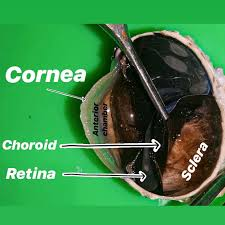
Cornea
Tough clear covering over the iris and pupil
protects the eye
1st stop that light goes through the eye (last stop = retina)
Pupil
drak circle in the center of the iris
lets light into the inner eye
Humans = round
Cows = oval
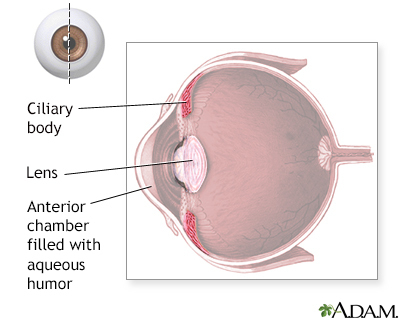
Aqueous Humor
clear fluid
stabalizes the cornea’s round shape
Iris
a Muscle + control how much light enters the eye
between the cornea and lens
cows = brown
Humans = many colors (brown, blue, green, grey)
Lens
Clear, flexible + makes images on the retina
helps with focusing
adds more layers year after year = more cloudy
Vitreous Humor
Thick, clear jelly
Gives eyeballs its shape
Sclera
Thick, tough, white outer covering of the eyeball
Tapetum Lucidum
Colorful, shiny material behind the retina
**FOUND IN ANIMALS
reflects light back through the retina
optic nerve
bundle of nerve fibers
carreis info to the brain from the retina
Blind spot
Where the optic nerve leaves the retina
there’s no light sensitive cells
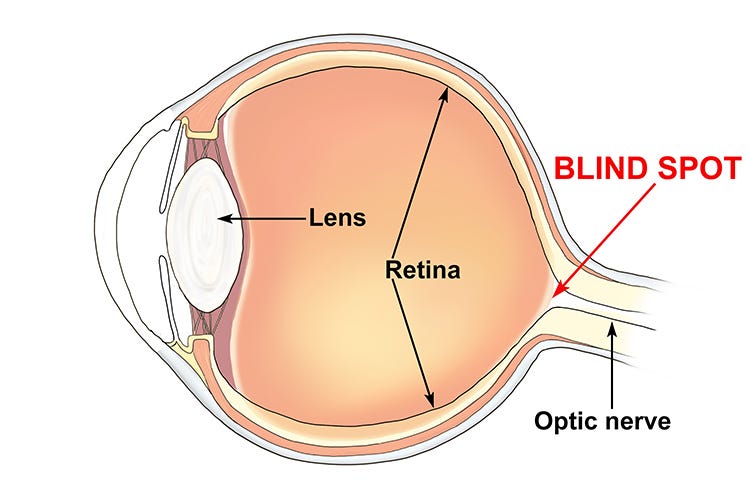
Retina
Layer fo light sensitive cells = back f eye
it detects images focused by the cornea and lens
connects to the brain through an optic nerve
Choroid
dark, highly vascular tissue + between sclera and inner retina
supply blood and nutrients to the outer retina and to absorb excess light
#in cows = has the tapetum lucidium
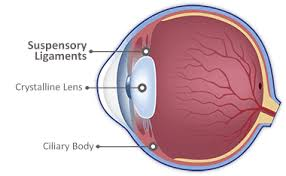
ciliary body (muscle)
smooth muscle and connective tissue responsible for controlling lens shape and making aqueous humor
Acts like a drawstring.
contract = loosens the suspensory ligaments attached to the lens (makes lense rounder and focus on close-up
eelaxes = flattens the lens for distant vision.
a circular ring of tissue located in the middle layer of the eye (the uvea), directly behind the iris
Contains ciliary muscle
suspensory ligament
delicate, fibrous strands = hold lens in place
connects lens to the ciliary muscles
** critical for accommodation (focusing)