People in Groups
 Call Kai
 Learn
Learn Practice Test
 Spaced Repetition
 Match
Match Flashcards
 Knowt Play
1/52

Earn XP
Description and Tags
What is a group, the effect others have on task performance, productivity and decision making in a group vs independently
Name | Mastery | Learn | Test | Matching | Spaced | Call with Kai |
|---|
No analytics yet
Send a link to your students to track their progress
53 Terms
What is a group?
“2 or more people who interact with + influence 1 another + perceive 1 another as ‘us’” (Myers, 2010)
In practice → groups range from mere presence of others to groups whose members interact together
What are Johnson and Johnson’s (1987) 7 major emphases of a social group?
The group is
A collection of individuals who are interacting with one another
A social unit consisting of 2 or more individuals who perceive themselves as belonging to a group
A collection of individuals who are interdependent
A collection of individuals who join together to achieve a goal
A collection of individuals who are trying to satisfy a need through their joint association
A collection of individuals whose interactions are structured by a set of roles + norms
A collection of individuals who influence each other
BUT cannot encompass large groups and/or don't distinguish between interpersonal + group relationships
How did Triplett (1898) study how we’re affected by the presence of others?
Asked 40 children (9-15 yos) to wind string on a fishing reel → presence of another child doing the same task (in pairs; co-actors) OR alone over 6 trials
Children were quicker when working in the presence of another child
Allport (1920, 1954) → social facilitation (in presence of co-actors or passive audience)
Effect can be observed with animals too (Bayer, 1929; Chen, 1937)
According to research, which tasks are improved by the presence of others?
Speed of doing simple multiplication problems
Accuracy of motor tasks
Production of word associations (Allport, 1920
According to research, which tasks are negatively affected by the presence of others?
People are slower at learning nonsense syllables
Completing a maze
Same effect observed in animals (Allee + Masure, 1936)
Doing complex multiplication (Dashiell, 1930; Pessin, 1933)
What are the weaknesses of research into social facilitation?
Social inhibition → decrease in task performance
Imprecision in defining the degree of social presence
Early research focused on coaction whereas later research focused on passive audience effects = impact on individual task performance of the presence of others → led to the near demise of social facilitation research by around 1940s
Until 1930s there was lots of research on SF (much of it conducted on an exotic array of animals)
What is Zajonc’s (1965) drive theory of social facilitation?
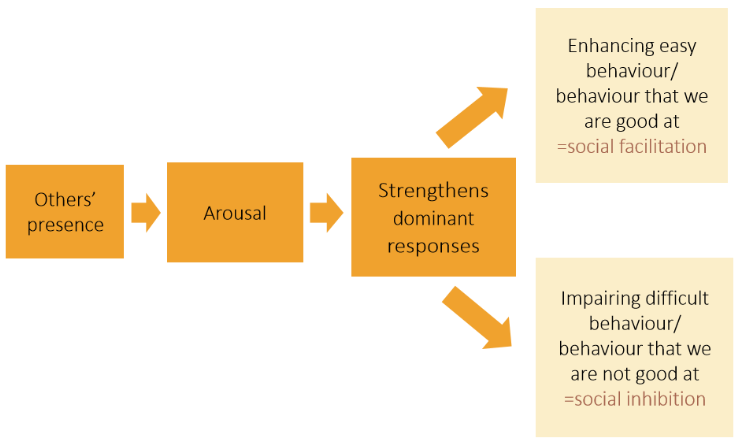
The physical presence of members of the same species instinctively causes arousal that motivates performance of habitual behaviour patterns
Because people are relatively unpredictable behaviour-wise, there is a clear advantage to the species for people's presence to cause us to be in a state of alertness + readiness
Arousal functions as a drive that energises/causes us to enact that behaviour which is our dominant response
If the dom response is correct (we feel the task is easy) -> improved performance
If dom response is incorrect (task is difficult) -> impaired performance
Supported (Green + Gange, 1977; Guerin + Innes, 1982)
What is the evidence for Zajonc’s (1965) drive theory?
Hunt + Hillery (1973)
Studied time taken for students to learn simple + complex mazes (alone vs 2 co-actors)
Fewer errors in learning simple mazes + more errors in learning difficult mazes in presence of others
Michaels (1982)
Observed pool players in a student union
When 4 observers watched them play:
Good players did better → succeeding in 80% of shots vs 71% when alone
Poor players did worse → succeeding in 25% of shots vs 36% when alone
Why are we aroused in the presence of others (explanation of social facilitation effects)?
Arousal due to instinct so mere presence of others cause arousal (Zajonc, 1965)
Evaluation apprehension (Cottrell, 1972)
Distraction + attentional conflict (Sanders, 1981 + 82)
What is Cottrell’s (1968, 1972) evaluation apprehension?
Others make us apprehensive/aroused because we expect that + wonder how they are evaluating us
We quickly learn that the social rewards + punishments we receive are based on others' evaluations of us -> social presence produces an acquired arousal/drive based on evaluation apprehension
Compared the effects on performing well-learned tasks (recognition tasks of nonsense words) of PPTs working alone or in front of an inattentive (2 blindfolded confederates) audience + an attentive audience (2 confederates interested in watching the task)
Performance was boosted only with the attentive audience
Same results by Schmitt (1986)
Worringham + Messick (1983) → joggers sped up when a woman sat facing the path compared with facing away from it
What are the weaknesses of Cottrell’s evaluation apprehension?
Markus (1978) supported EAT on the relatively easy task of dressing in familiar clothing but the more difficult task (unfamiliar clothing), mere presence was sufficient to slow performance down → supports drive theory
Schmitt, Gilovich, Goore + Joseph (1986) → mere presence accelerated performance of the easy task + slowed performance of the difficult task (EA had little additional impact)
Mere presence appears to be a sufficient cause of + EA not necessary for social facilitation effects
Guerin + Innes (1982) -> SFE may occur only when people are unable to monitor the audience -> uncertain about the audience's evaluative reactions to their performance
Guerin (1989) -> SFE on a simple letter-copying task only among PPTs who were being watched by a confederate who they couldn't see
What is Sanders’ (1983) distraction-conflict theory?
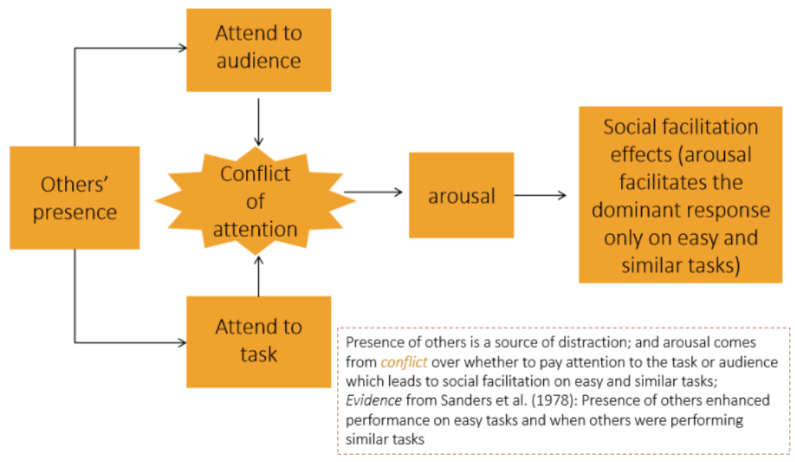
The physical presence of members of the same species is distracting + produces conflict between attending to the task + attending to the audience
Distraction alone impairs task performance but attentional conflict also produces drive that facilitates dom responses → impair performance of difficult tasks + (because drive usually overcomes distraction) improves the performance of easy tasks
Sanders, Baron, Moore (1978) → PPTs in the distraction condition made more mistakes on the difficult task + copied more digits correctly on the simple task than in the other conditions
Groff, Baron + Moore (1983) → PPTs were more aroused (squeezed bottle more) when closely scrutinised by a confederate
What are the strengths of distraction-conflict theory?
Any form of distraction (noise, movement, flashing lights) can produce social facilitation effects
Can accommodate results from studies of social facilitation in animals (unlike EAM)
What is self-awareness theory?
When people focus their attention on themselves as an object, they make comparisons between their actual self (actual task performance) + their ideal self (how they'd like to perform)
What is Higgins’ (1987 + 98) self-discrepancy theory?
Discrepancy between actual + ideal self-increases motivation + effort to bring actual into line with ideal (easy task performance improves)
What did Bond and Titus (1983) discover about the effect of others on our performance?
Meta-analysis of 241 studies
Presence of others only accounts forr 0.3 - 3% variation in performance
What did Bond (1982) discover about the effect of others on our performance?
People are concerned with self-presentation → achievable on easy tasks, social presence produces an improved performance BUT on more difficult tasks, people make/anticipate making errors → embarrassment → impaired task performance
When may the presence of others have more impact? What is the evidence of this?
When people interact with each other → non-drive explanation BUT depends on our interactions with others
Herman (2015) → eat more in the presence of friends + family who are eating than alone BUT follow norm when eating with strangers (may eat less)
Due to evaluation apprehension
What are the attentional consequences of social pressure?
Easterbrook (1959) → people narrow the focus of their attention when they experience attentional overload
Baron (1986) → people have a finite attention capacity → can be overloaded by the presence of an audience
Attention overload makes people narrow their attention, give priority too attentional demands + focus on a small number of social cues
Difficult tasks are those that require attention to a large number of cues → attentional narrowing is likely to divert attention from cues that we really ought to attend to → social presence impairs performance
Simple tasks are ones that require attention to only a small number of cues, so attentional narrowing actually eliminates distraction caused by attending to extraneous cues + focuses attention onto central cues → social presence improves performance
Monteil + Huguet (1999) → latencies on the difficult tasks were significantly lower in the social presence condition → social presence had narrowed attention on to the colour of ink, so that semantic interference from the word itself was reduced
Manstead + Semin (1980)
Emphasis placed on automatic vs controlled task performance
Difficult tasks require a great deal of attention because they're highly controlled
An audience distracts vital attention from task performance → suffers
Easy tasks require little attention because they're fairly automation
An audience causes more attention to be paid to the task → becomes more controlled + better performed
Are we more or less productive when working in a group?
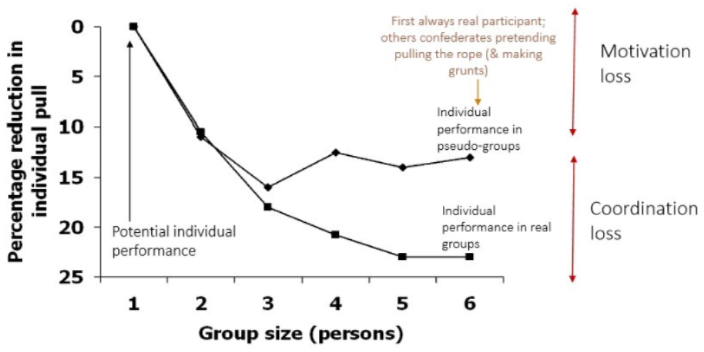
Ringelmann (1913) → young men alone or in groups (2, 3, 8) pull a rope
Force exerted per person decreased as a function of group size (Ringelmann effect)
Individuals are more effective
What is Steiner’s (1972 + 76) task taxonomy?
Group tasks can be classified according to whether a division of labour is possible; whether there is a predetermined standard to be met + how an individual's inputs can contribute
What is the effect of group performance for additive tasks?
The group's performance is better than the best individual's performance
What is the effect of group performance for compensatory tasks?
The group's performance is better than that of most individuals because the average is most likely to be correct
What is the effect of group performance for disjunctive tasks?
The group's performance is equal to or worse than the best individual (the group can't do better than the best idea proposed)
What is the effect of group performance for conjunctive tasks?
The group's performance is equal to the worst individual's performance (unless the tasks is divisible -> division of labour can redirect the weakest member to an easier task -> improve group performance)
Why may individuals be more effective than working in a group?
Loss of coordination
As group size inhibits movement, distracts, makes individuals to jostle
Loss of motivation
How did Ingham (1974) demonstrate motivation loss in group contexts?
Compared individuals, groups + pseudo-groups pulling on a rope
What is social loafing? Who coined this term?
Latané (1979) → tendency to work less hard on a task when they believe that others are also working on the task
How did Latané (1979) demonstrate social loafing?
Showed less individual effort for clapping, shouting + cheering as group size increased
Noise made per person was reduced by 29% in group of 2, 49% in group of 4 + 60% in a group of 6
Coordination wasn’t a problem
Boyes (2003) → people in groups give lower tips than individuals (the larger the group, the lower the tip)
Why does social loafing happen (Green, 1991)?
Output equity (Jackson + Harkins, 1985) → we expect others to loaf
Anonymity → deindividuation effect + diffusion of responsibility
No evaluation apprehension
Kerr + Bruun (1981) → individual performance not evaluated in groups then less motivation to make an effect
Matching to standard -> don't have a clear sense of the group's standards/norms (so load) BUT reduced loafing when presence of a clear personal, social, or group performance standard
How can social loafing be reduced?
Make the output/effort of each individual identifiable (Williams, 1989)
Increase individuals’ involvement/commitment to the task → believing own efforts are necessary for success
Increase the value/important of the task → we may compensate for the anticipated loafing of others (Williams + Karau, 1991; Zaccaro, 1984)
Group size
Intergroup comparison
Partner effort
What is social loafing related to?
Free-rider effect = gaining the benefits of group membership by avoiding costly obligations of membership + by allowing other members to incur those costs
Tasks advantage of shared public resource without contributing to its maintenance
What is the main difference between social loafing and the free-rider effect?
Although loafers reduce effort on coactive tasks, they do contribute to the group product (there is a loss not elimination of motivation) vs free riders who exploit the group product while contributing nothing to it (different motivation)
What is the social compensation effect?
Increased effort on a collective task to compensate for other group members' actual, perceived or anticipated lack of effort/ability
Zaccaro (1984) -> reversed loafing effect (constructed more tents in larger group) -> group life may (under certain circumstance) cause people to exceed individual potential (may be process gains in groups, Shaw, 1976)
Also occurs when people have a collectivist social orientation (Hofstede, 1980)
People also may be motivated to work harder in groups when groups + their members believe + expect that the group will be effective in achieving important goals (Guzzo, 1993; Sheppard, 1993)
May be related factors -> people may be particularly motivated to work hard on tasks that are important precisely because they define membership of a group that is vital to one's self-concept or social identity (e.g. Worchel, 1998 -> people worked harder in groups than alone when the group was highly salient)
What is group polarisation?
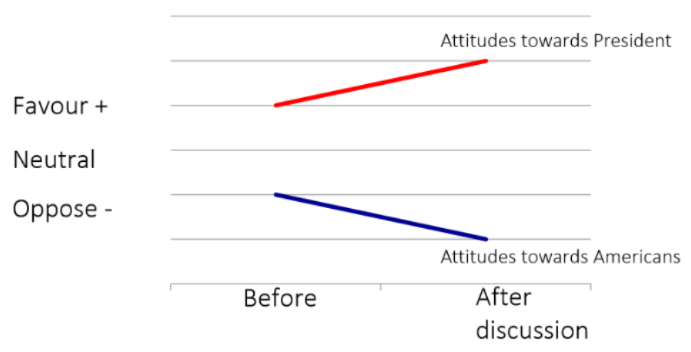
Moscovici + Zavalloni (1969) → the tendency for the group to make decisions that are more extreme than the mean of individual members’ initial positions BUT in the same direction
Stoner (1961) → groups recommended the riskier alt more than individuals
Subsequent research → groups don’t always make riskier decisions BUT group discussion enhances members’ initial views
How did Moscovici and Zavalloni (1969) demonstrate group polarisation?
140 M secondary students
Attitude scales toward president (Charles de Gaulle) + Americans with +/-/ambiguous items (calculated individual averages)
Asked groups of 4 to discuss the targets on different policies + reach a consensus → then asked to fill out the attitude scales again
Why does group polarisation occur?
Persuasive arguments/info influence
Like-minded others produce supportive but new arguments → strengthen the already-held opinion
Initial views can influence info sought to support this views (Schultz-Hardt, 2000)
Social comparison/norm influence
Seek social approval → group discussion indicates which views are socially desirable + values
Group members shift in the direction off the group to gain approval
Bandwagon effect → people may compete to appear to be stronger advocates of socially desired attitude poles
Pluralistic ignorance → ignorant of what everyone really thinks due to public vs private behaviour
Dispelled by group discussion
Social identity theory
People in discussion groups actively construct a rep of the group norm from the positions held by group members in relation to positions assumed to be held by outgroup
Minimise variability
Polarised away from outgroup
Self-categorisation → identification within group → conformity to ingroup norms (polarised norm = group polarisation)
What is groupthink?
Common process leading to irrational decision-making in gov, financial + military contexts → primarily caused by excessive group coherences
May be a specific instance of risky shift → group that already tends towards making a risky decision polarises through discussion to an even riskier decision (Myers + Lamm, 1975)
May be an aggregation of coping responses adopted by individuals to combat excessive stress
Callaway, Marriott + Esser (1985) → group members are under decision-making stress → adopt defensive coping strategies that involve suboptimal decision-making procedures (symptomatic of groupthink) → behaviour is mutually reinforced by members of the group → defective group decisions
What is risky shift?
Tendency for group discussion to produce group decisions that the mean of the members' pre-discussion ops but only if the pre-discussion mean already favoured risk
What did Irving Janis (1971) discover about groupthink?
Studied good + poor decisions made by US presidents + their advisers to see if they could be explained by social psych
E.g. the decision making that led to Bay of Pigs invasion (1961) → nearly all invaders were killed or captured
Groupthink = the desire to reach a unanimous decision overrides rational decision-making procedures
E.g. by suppressing dissent in the interest of group harmony
Antecedents and symptoms of groupthink
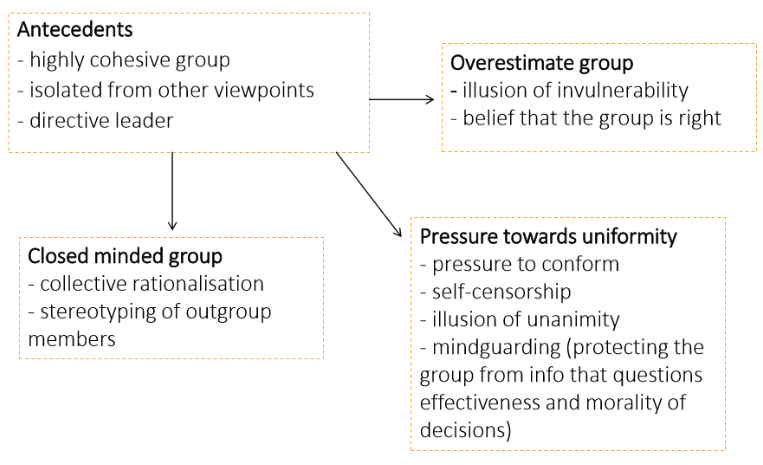
How does Janis (1982) suggest we prevent groupthink?
Be impartial
Encourage critical evaluation
Use breakout subgroups
Welcome outside critiques
Have a 2nd-chance meeting before deciding
What are social decision schemes?
Explicit or implicit decision-making rules that relate individual ops to a final group decision
Knowledge of the initial distribution of individual ops in the group + what rule the group is operating under allows prediction with a high degree of certainty of the final group decision -> can apply these to institutionalised groups (e.g. parliament) + informal groups (e.g. what film to go + see)
Particular rule the group adopts can be influence by the nature of the decision-making task
Intellectual tasks -> truth-wins rule
Judgemental tasks -> majority-wins rule
Decision rules differ in terms of strictness + distribution of power among group members
Strictness = degree of agreement required by the rule (unanimity = extremely strict, majority wins = less strict)
Distribution of power among members = how authoritarian the rule is (authoritarian rules concentrate power in 1 member, egalitarian rules spread power among all members)
Stricter rules have lower power concentration -> more egalitarian
Unanimity is very strict BUT low in power concentration
2/3 majority is less strict but has greater power concentration
What is Kerr’s social transition scheme?
Method for charting incremental changes in member ops as a group moves towards a final decision
Focuses attention on actual pattern of member positions moved through by a group operating under a particular decision
Members' ops are monitored during discussion (either by periodically asking or having them note any + every change in op) BUT intrusive (how much do they affect the natural ongoing process of discussion)
What is a hidden profile (Stasser and Titus, 2003)
Situation in which group members have shared info favouring an inferior choice/decision + unshared private info favouring a superior choice/decision
Typically groups choose an inferior alt -> make an inferior decision
Lu (2012) -> meta-analysis of 65 hidden profiles -> groups mentioned more pieces of common info than unique info + HP groups were 8x less likely to find the correct solution or come to an optimal decision than were groups having full info
Why typically occurs during brainstorming groups?
Process loss = deterioration in group performance in comparison to individual performance due to the whole range of possible interferences among members (e.g. losses due to coordination of member activities)
How does Paulus (1993) explain inferior performance in brainstorming?
Evaluation apprehension
Social loafing
Production matching
Norm formation → use of average group performance as a guide to how many ideas we should provide
Production blocking → interference effects from having to contend with others
Main obstacle
What techniques can improve the performance of brainstorms?
Electronic brainstorming -> reduces extent to which the production of new ideas is blocked by such things as listening to others or waiting for a term to speak
Heterogenous groups -> members have diverse types of knowledge about the topic creates a stimulating environment that alleviates production blocking
Why do we think brainstorming is effective?
Illusion of group effectivity (Stoebe, 1992) → exposure to new ideas, it’s fun, we think production blocking only happens to ourselves
Stroebe + Diehl (1994) -> nominal groups (individuals create own ideas + don't interact) are 2x as creative as groups that actually interact
What is group remembering?
Different people recall different info → when they come together, the group has effectively remembered more than one individual (Clark + Stephenson, 1985, 995)
Members communicate unshared info + groups recognises true info when it hears it (Lorge + Solomon, 1995)
On simplistic + artificial tasks, group superiority is more marked than on complex + realistic tasks
May be due to process loss → in trying to recall complex info, groups fail to adopt appropriate recall + decision strategies (don't fully utilise all of the group's human resources)
Constructive process (not collective regurgitation of facts) → an agreed joint account is worked out → guides individual members about what to store as a true memory + discard as incorrect
Reaching a consensus is subject to social influence processes + group decision-making biases
What is Wegner’s transactive memory?
Group members have a shared memory for who within the group remembers what + is the expert on what
Each individual is responsible for remembering only part of what the group needs to know but all members know who is responsible for each memory domain
Shared system for encoding, storing + retrieving info -> allows groups to remember significantly more info (Hollingshead, 1998)
Group-level rep -> is repped in the mind of the individual but it can emerge only through psychological involvement in a group + otherwise has no value/use
Related to McDougall's group mind (1920) = people adopt a qualitatively different mode of thinking when in a group
How does Wegner’s (1991) research support transactive memory?
When groups/couples first form the basis of transactive memory is usually social categorisation -> category-based transactive memory is the default mode
People stereotypically assign memory domains to individuals on the basis of their category membership
In most cases, groups go onto develop more sophisticated memory-assignment systems
Groups can negotiate responsibility for different memory domains
Groups can assign memory domains on the basis of relative expertise
Groups can assign memory domains on the basis of access to info
Potential pitfall:
Uneven distribution of memory means that there is a temporary loss/reduction in group memory when someone leaves -> can be disruptive
Groups often recover quickly (other people can shoulder the responsibility) BUT in couples, partners are irreplaceable
What is group culture?
Customs that describe large-scale social categories (such as ethnic or national groups)
Moreland, Argote + Krishnan (1996) -> culture is an instance of group memory -> can exist in smaller groups (e.g. sports teams, families
Analysis of group culture is most developed in study of work groups (Levine + Moreland, 1991)