Parliamentary System: House of Commons & Senate
 Call Kai
 Learn
Learn Practice Test
 Spaced Repetition
 Match
Match Flashcards
 Knowt Play
1/26

There's no tags or description
Looks like no tags are added yet.
Name | Mastery | Learn | Test | Matching | Spaced | Call with Kai |
|---|
No analytics yet
Send a link to your students to track their progress
27 Terms
Who forms the legislative branch? (Parliament)
The legislative branch in a parliamentary system, known as Parliament, is formed by two houses: the House of Commons and the Senate, which work together to create and pass legislation.
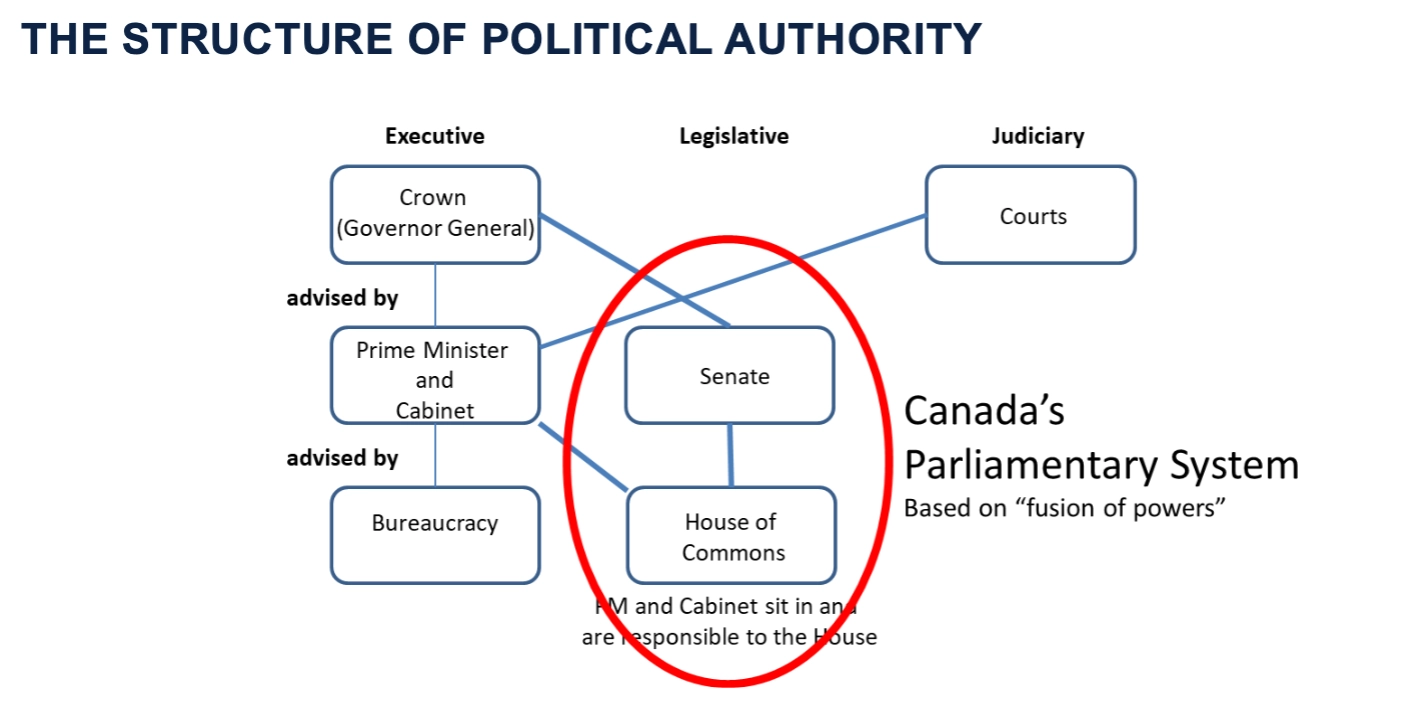
What are the four responsibilities of the House of Commons?
Legislation → debates and passes bills to create laws
Representation → articulates local (ie. citizens) and other interests
Scrutiny and accountability → holds the government accountable for its actions to the public
Legitimation → the “stamp” of democratic authority to gov. action
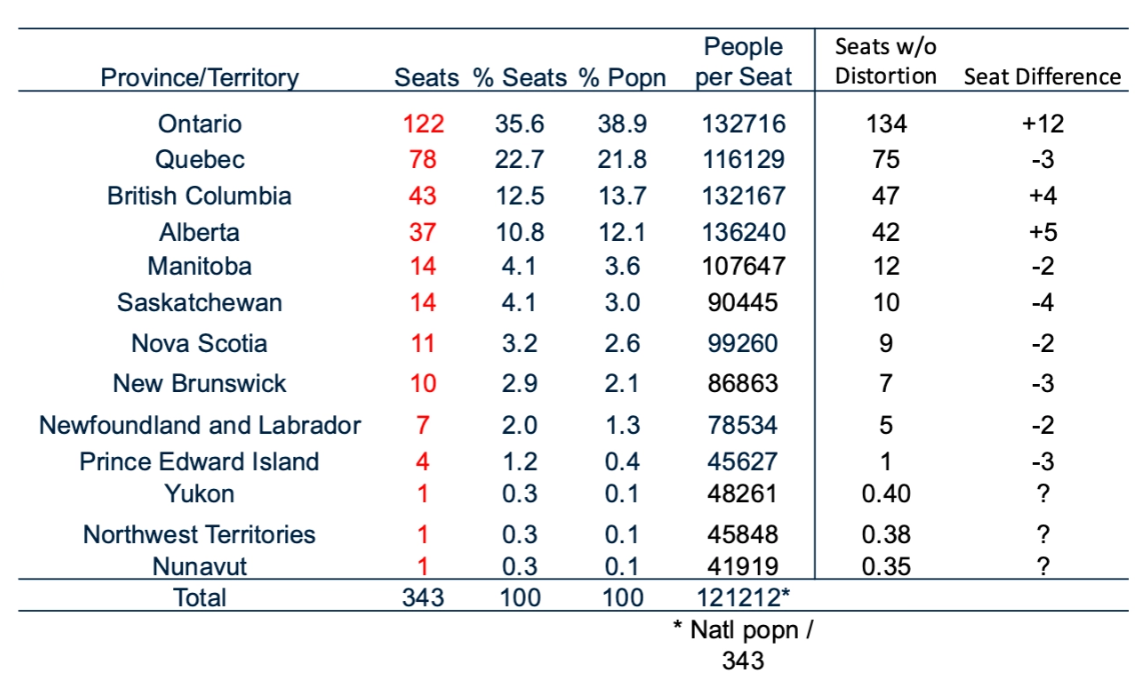
What is the distortion principle?
deviation from proportional representation in which the % of seats allocated to each province does not perfectly match its pecentage of Canada’s total population
What is party composition?
The arrangement and distribution of seats held by different political parties within a legislative body, reflecting their relative strength and influence.
What is the party composition of Canada?
Liberals (RED) form government (largest block), Conservatives (BLUE) are the Official Opposition, and the smaller parties are grouped to the side as smaller blocs. → reflects commitment to adversarial system
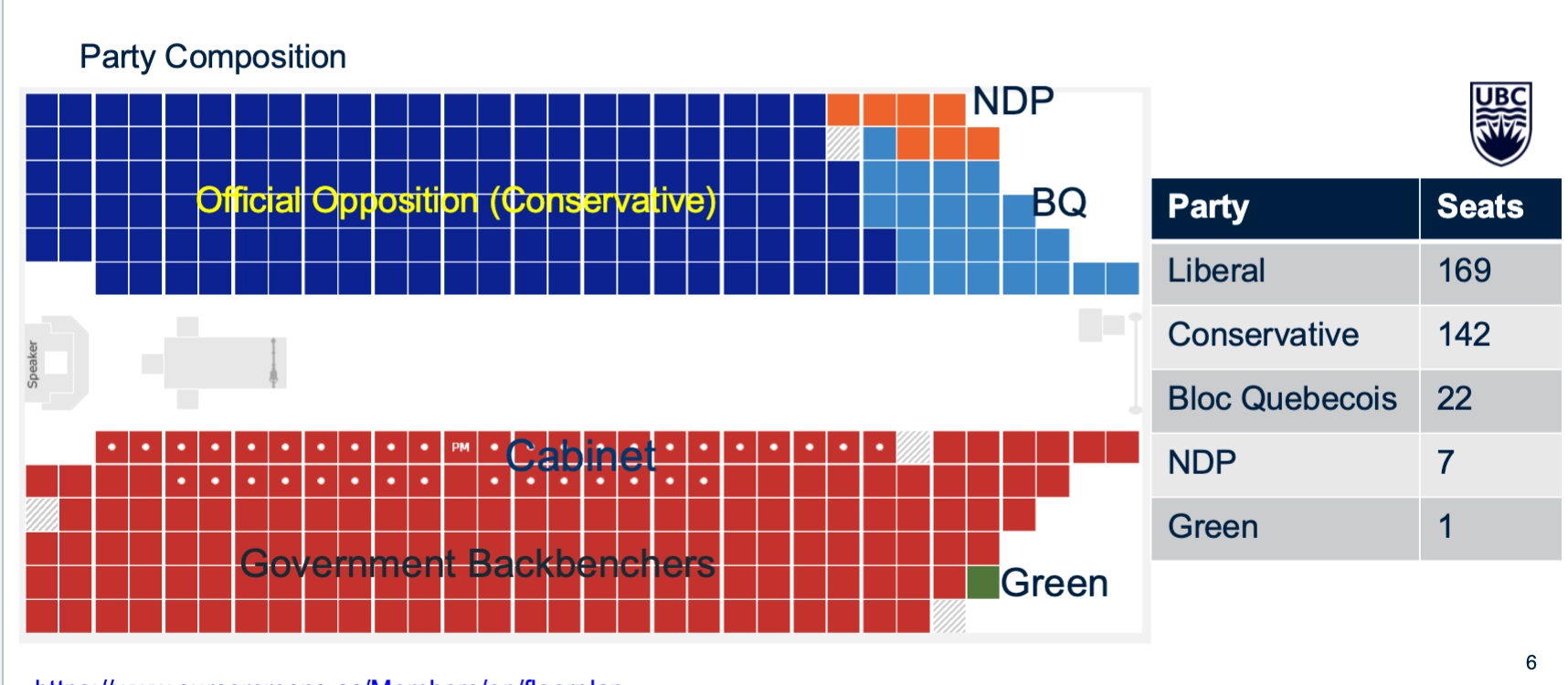
How does the party composition reflect commitment to adversarial systems?
It is a chamber set up to encourage structured conflict between governing and opposing teams, rather than consensus-building in one shared group by separating the partys and facing them to eachother.
What is socio-demographic representation?
A way we judge whether the House of Commons reflects Canadian society.
What is the socio-demographic representation of Women in Canada?
Women: 103 MPs (30.2%) → Green most, then NDP, then Liberal, then BQ, then Conservative.
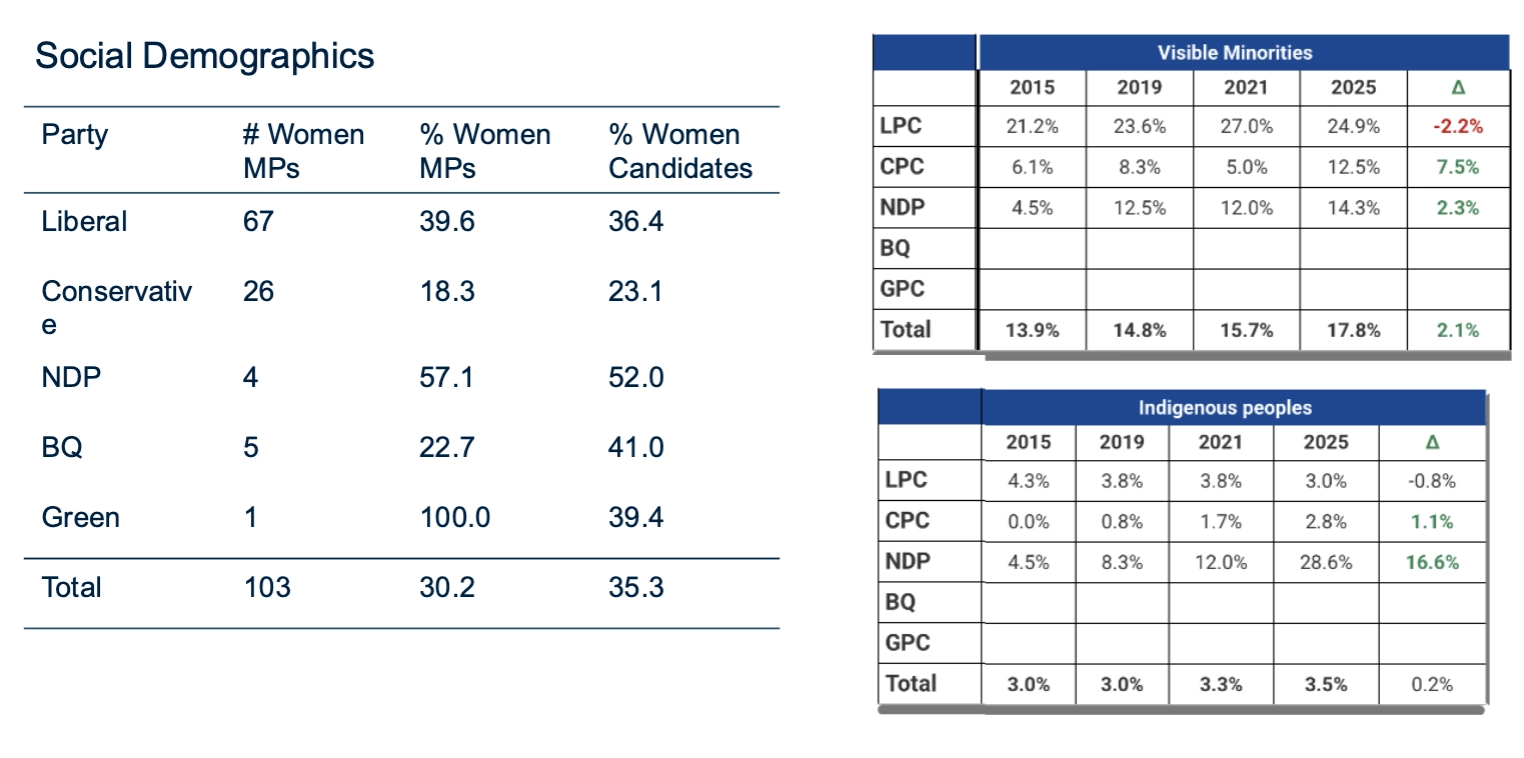
What is the socio-demographic representation of visible minorities in Canada?
Total (all parties): 13.9% (2015) → 17.8% (2025)
What is the socio-demographic representation of indigenous peoples in Canada?
Total (all parties): 3.0% (2015) → 3.5% (2025)
What is an adversarial system?
division into government members and opposition members, role of official opposition, work and physical arrangements of House.
What are the 3 theories of legislative representation?
delegate → acting as the voice of the constituents (those who elected them)
trustee → acting on one’s own beliefs and judgements
party member → acting according to party directions
Why would the house operate under strict party discipline?
adherence to direction of party leadership for:
ideological closeness
“team mentality”
electoral and parliamentary careers
What is democratic deficit of party discipline?
since party discipline concentrates influence in leadership, two classes of MPs are created: powerful MPs (prime minister, cabinet, party leaders) and less powerful MPs (most other MPs).
How can we empower ordinary MPs?
house of commons committees
private members’ bills
loosening party discipline
the reform act (2014)
What are house of commons committees?
Parliamentary committees where smaller groups of MPs can study specific issues, review legislation, and hold hearings. → offer MPs more opportunity to contribute beyond voting.
What are private members’ bills?
Legislation introduced by individual MPs rather than by Cabinet ministers → allows ordinary MPs to proposte their own laws although these have had historically low success rates
What is loosening party discipline?
reducing the strict requirement that MPs vote according to party leadership’s direction → this would allow MPS to vote more independently based on their constituents interests or their on judgement.
What is the Reform Act (2014)?
legislation resigned to restore caucus (the group of all MPs from a party) control over their leader → gives MPs more power to challenge or remove party leaders if needed.
What is a caucus?
a group of people in a political party, especially elected representatives, who meet to coordinate decisions and strategy
What is bicameralism?
A system of governance in which the legislature consists of two separate chambers or houses, the upper house being the senate and the lower the house of commons.
How is the Senate the “sober second thought”?
The Senate serves as a revising chamber that reviews legislation passed by the House of Commons, providing thoughtful scrutiny and considerations before the final approval, ensuring that laws are carefully evaluated. (elite check on unbridled democracy + regional rep)
Who sits in the senate?
roughly equal regional rep, appointed by the crown on advice of the PM (till age 75), and traditionally a chamber of patronage.
What are the powers of the Senate?
full power to initiate, amend, or block bills with the two exceptions of money bills and constitutional amendments. cannot block bills passed by the house by convention.
What was the senate reform under Trudeau?
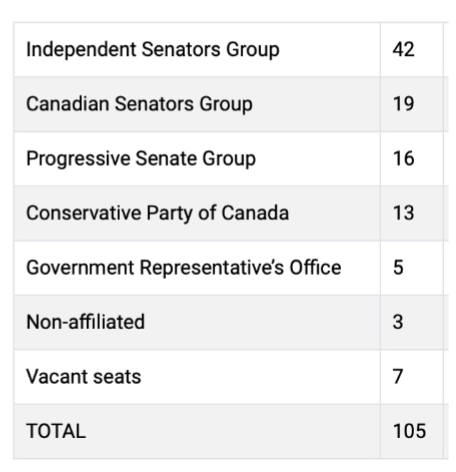
The Senate reform under Trudeau involved the removal of liberal senators from the caucus, the establishment of an independent advisory board for Senate appointments, and the creation of various independent groupings within the Senate, leading to a more active and assertive legislative body.
What are traditional criticisms of the Senate?
democratic deficit, partisanship, ‘do nothingness’
Does the senate add value?
Yes, in representation, deliberation, and legislative review + expertise but lacks democratic legitimacy, inequitable provincial representation, and lowkey unnecessary.