Taylor polynomials
 Call Kai
 Learn
Learn Practice Test
 Spaced Repetition
 Match
Match Flashcards
 Knowt Play
1/10

There's no tags or description
Looks like no tags are added yet.
Name | Mastery | Learn | Test | Matching | Spaced | Call with Kai |
|---|
No analytics yet
Send a link to your students to track their progress
11 Terms
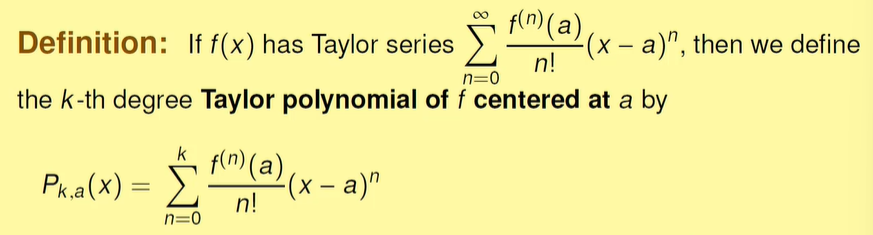
What is the formula for a Taylor polynomial
What is the taylor polynomial approximation
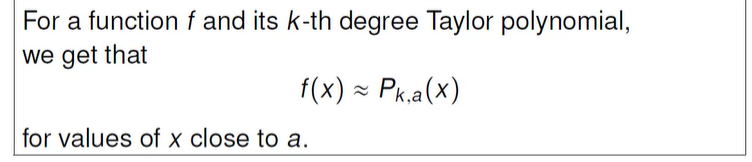

What does this mean
The 4 degree taylor polynomial centered at a=0

What significance does the 4 have
It means that you are finding the 4th degree polynomial and you cannot have x5, or x6 etc. Must be 4 or less than 4
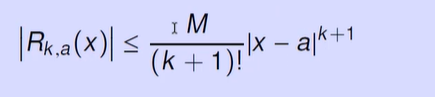
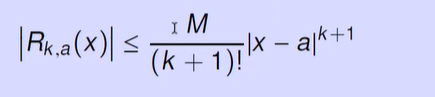
What is the taylor remainder formula
How does the difference between x and a affect the taylor remainder formula
The closer they are to each other, the smaller the error
Which number derivative are you finding when solving for the error
The k-th plus 1 derivative
Can you error bound be negative
No, if you get a negative, you may have forgotton an absolute value sign.
what do you have to remember when finding the 3rd, 4th, or 5th… degree Taylor polynomial.
The number is the exponent on the X. Not the number of terms (n).

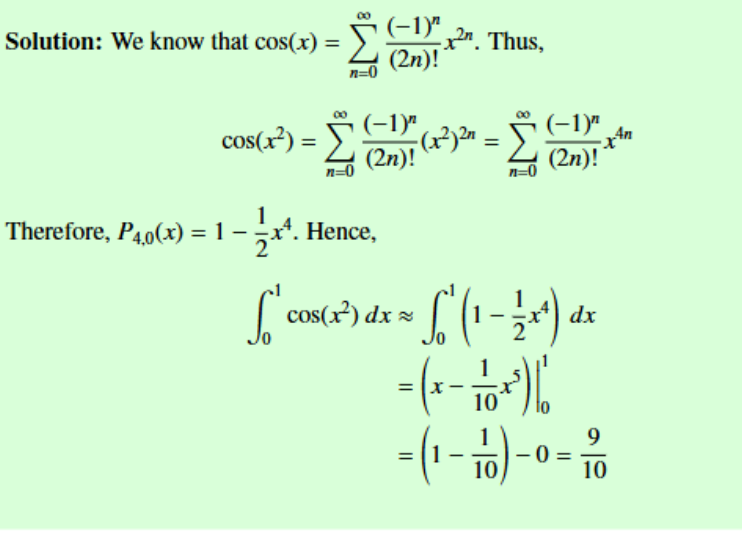
How should you solve integrals with the Taylor polynomial
You take the integral of the Pk,a formula (with the x’s) then you take the integral and solve
What are the steps for the finding the error of a Taylor polynomial estimation
You find the K+1 derivative and then see if it is increasing or decreasing.
You then either choose either the “K” or “a” value whichever makes the M larger (depending on if the K+1 is inc or dec)
Then you just plug in the values for Taylor Remainder Theorem equation and solve.