unit 5 exam (mcgraw hill)
 Call Kai
 Learn
Learn Practice Test
 Spaced Repetition
 Match
Match Flashcards
 Knowt Play
1/72

There's no tags or description
Looks like no tags are added yet.
Name | Mastery | Learn | Test | Matching | Spaced | Call with Kai |
|---|
No analytics yet
Send a link to your students to track their progress
73 Terms
what are the 3 eye tunics?
1) fibrous tunic (outer/ cornea and sclera)
2) vascular (uvea) (middle/ choroid, ciliary body, iris)
3) nervous (retina) (inner/ rods and cones)
what is the outer layer of the eye?
-fibrous tunic
-cornea: transparent, curved, refracts light
-sclera: white of eye, provides protection and shape for the eye
what is the middle eye layer?
-vascular tunic (uvea)
-choroid: contains blood vessels that provide nutrients to the retina (inner layer)
-ciliary body: ciliary muscles control shape of the lens
-iris: colored part of eye that controls pupil size and regulates amount of light entering eye
what’s the inner layer of the eye?
-nervous tunic (retina)
-rods and cones, the photoreceptor cells
-converts light energy into nerve impulses, signals that are sent to the brain
what is the anterior cavity of the eye?
-in front of the lens
-filled with aqueous humor
-maintains intercellular pressure and nourishes the cornea and lens
what’s the posterior cavity?
-behind the lens
-filled with vitreous humor (jelly)
-helps maintain the shape of the eye and keep the retina pressed against the choroid layer
what is the ciliary body?
-located around the lens in the vascular layer
-changes the shape of the lens to focus on near or distant objects (called accommodation)
what does the eyebrow do?
-prevent sweat and debris from entering the eyes
-shade from sunlight
what do eyelashes do?
-trigger a blink reflex when touched protecting the eye from debris
what do the palpebrae (eyelids) do?
-protect the eyes from debris and help tears across the surface
what does conjunctiva do?
-a thin transparent membrane that covers the sclera and lines the inside of the eyelids
-helps lubricants and protect the eye
what’s the lacrimal apparatus?
-tear duct
-produces and drains tears
-tears contains lysozyme to destroy bacteria and help keep the surface of the eye moist
light passes through what structures in order?
1) cornea (clear covering)
2) aqueous humor (liquid)
3) pupil (hole in iris)
4)lens (magnification)
5) vitreous humor (jelly)
6) retina - refraction bends the light rays so they can focus on the retina
how is a light ray processed?
-light passes through the pupil in the iris and is focused on the retina in the back of the eye with rods and cones
-light striking the retina is converted into action potentials
-the optic nerve conveys the action potentials to the brain
-the optic nerves cross at the optic chasms and convey APs to the opposite side of the brain for perception
-rods and cones → bipolar cells → ganglion cells → optic nerve → optic chasm → optic tract → thalamus → occipital visual cortex
what do rods do for vision?
-detect black and white
-concentrated around peripheral retina (side and night vision)
-low light = blurry vision
what do cones do for vision?
-detect color vision
-concentrated in the fovea centralis (tiny depression in back of retina)
-bright light = sharp vision
what is the blind spot of the eye?
-optic disc
-has no photoreceptors because it’s where the optic nerve exits the eye
what is the fovea centralis?
-in the back of the retina
-contains only cones
-sharpest most detailed vision
-tiny depression in the retina
what does the outer ear do?
-pinna (auricle), external auditory canal
-collects and directs sound waves toward the tympanic membrane (eardrum)
what does the middle ear do?
-auditory ossicles: malleus, incus, and stapes
-transmit and amplify vibrations from the eardrum to the inner ear
-the auditory tube (eustachian) connects the middle ear to the pharynx and helps equalize pressure on both sides of the eardrum
what does the inner ear do?
-bony labyrinth (bone) and membranous labyrinth (membrane)
-filled with fluids: perilymph, endolymph
-includes: → cochlea for hearing
→vestibule for static equilibrium,
→semicircular canals for dynamic equilibrium
→ hair cells in circular canals to help SENSE equilibrium and balance
what are the 6 steps to hearing?
1) sound waves are collected by the pinna and enter the external auditory canal
2) the tympanic membrane (eardrum) vibrates
3) vibrations move through the auditory ossicles: malleus→incus→stapes
4) stapes vibrations push against the oval window creating waves in the perilymph of the cochlea
5) the movement of fluid bends the hair cells within the cochlea
how does the olfactory pathway work?
1) airborne chemicals (odorants) dissolve in mucus covering the olfactory epithelium
2) olfactory receptor neurons detect the chemicals via chemoreceptors on their membranes
3) impulses travel along the olfactory nerve (1) to the olfactory bulbs
4) secondary neurons carry the signals to the olfactory cortex in the temporal lobe for perception
what do basal cells do?
-replace damaged olfactory neurons (taste cells) every 7-10 days
-supporting cells: provide metabolic and structural support
what are the 5 major tastants?
1) sweet (sugars)
2) salty (salts)
3) sour (acids)
4) bitter (alkaloids)
5) savory (umami)
what are the 4 types of tongue papillae?
1) filiform (front 2/3 leaf shape) (no taste buds, sense texture)
2) fungiform (tips and sides, mushroom shape) (taste buds)
3) circumvallate (back of tongue, largest) (taste buds and salivation)
4) foliate (sides) (sour/ bitter in children)
what is filiform?
-front 2/3 of tongue, leaf shape
-no taste buds, senses texture
what is fungiform?
-tip and sides of tongue, mushroom shape
-taste buds
what is circumvallate?
-back of tongue, largest
-taste buds and salivation
what is foliate?
-sides of tongue
-taste (bitter/sour) in children
what do gustatory cells do?
-detect chemicals (tastants)
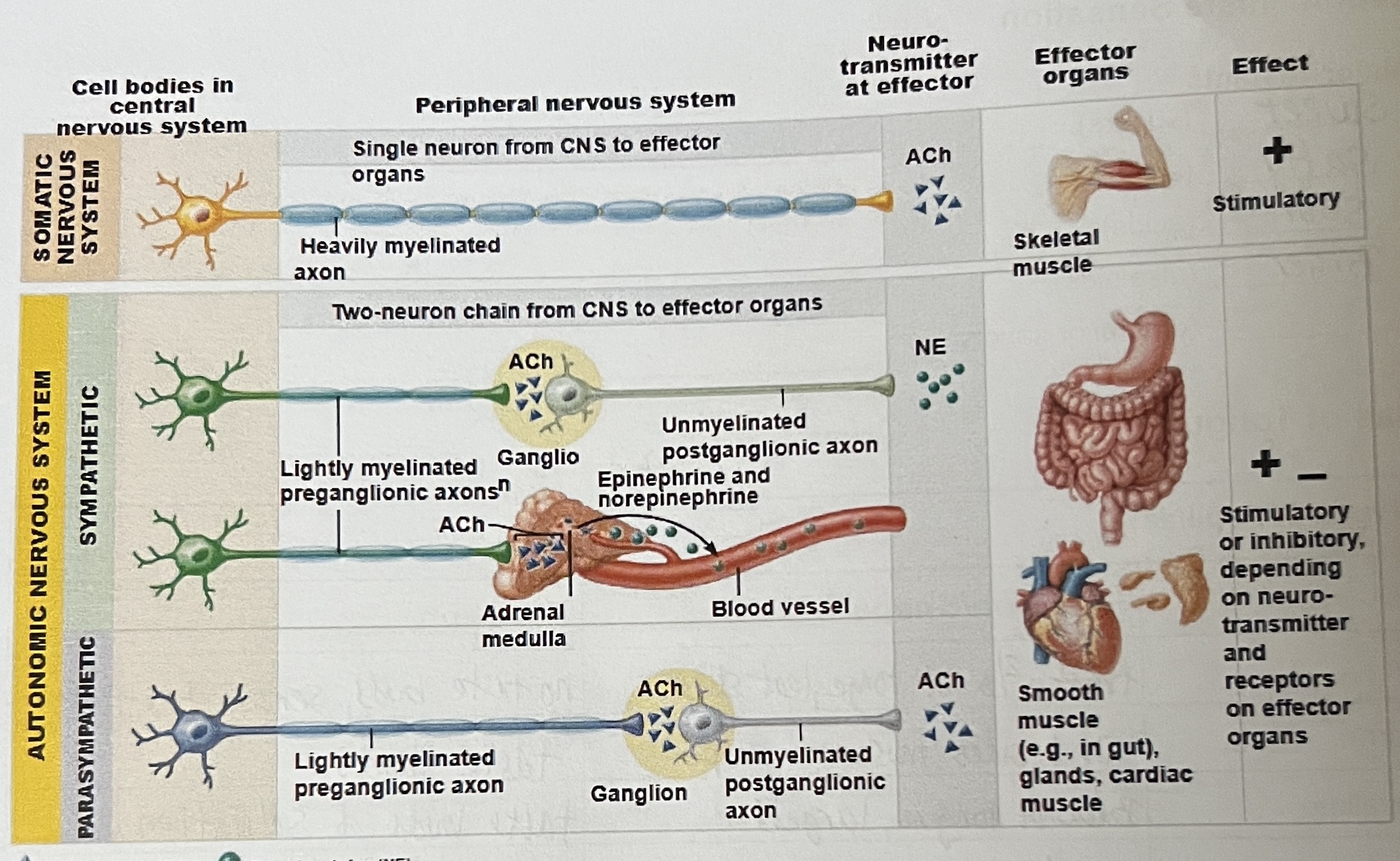
what does the autonomic nervous system do?
-controls involuntary functions (without conscious effort)
-heart rate, digestion, respiration
-split into: sympathetic and parasympathetic
what’s the response from the autonomic nervous system?
-cardiac, smooth muscles, glands
-involuntary
-TWO neurons in pathway (pre and post ganglionic)
-uses acetylcholine (ACh) or norepinephrine (NE)
-excitatory or inhibitory
what’s the response from the autonomic nervous system?
-skeletal muscles (voluntary)
-ONE motor neuron pathway
-uses acetylcholine (ACh)
-ALWAYS excitatory
somatic vs autonomic comparison
what’s the sympathetic nervous system do?
-fight or flight (prepares the body for stressful or emergency situations)
-dilated pupils
-increases: heart rate, sweating, respiration rate, blood glucose levels, increased release of epinephrine (adrenaline) from adrenal medulla
-decreases: urinary output activity (constriction on urinary sphincter), digestive activity
what does the parasympathetic NS do?
-rest and digest
-promotes activity’s that conserve energy and support routine maintenance functions (digestion and urination)
-slowed heart rate, constricted pupils, increased digestive activity
how does the anatomy of the sympathetic NS work?
-originates from the thoracic and lumbar output regions of the spinal cord
-sympathetic ganglia: close to the spinal cord in a chain called sympathetic chain
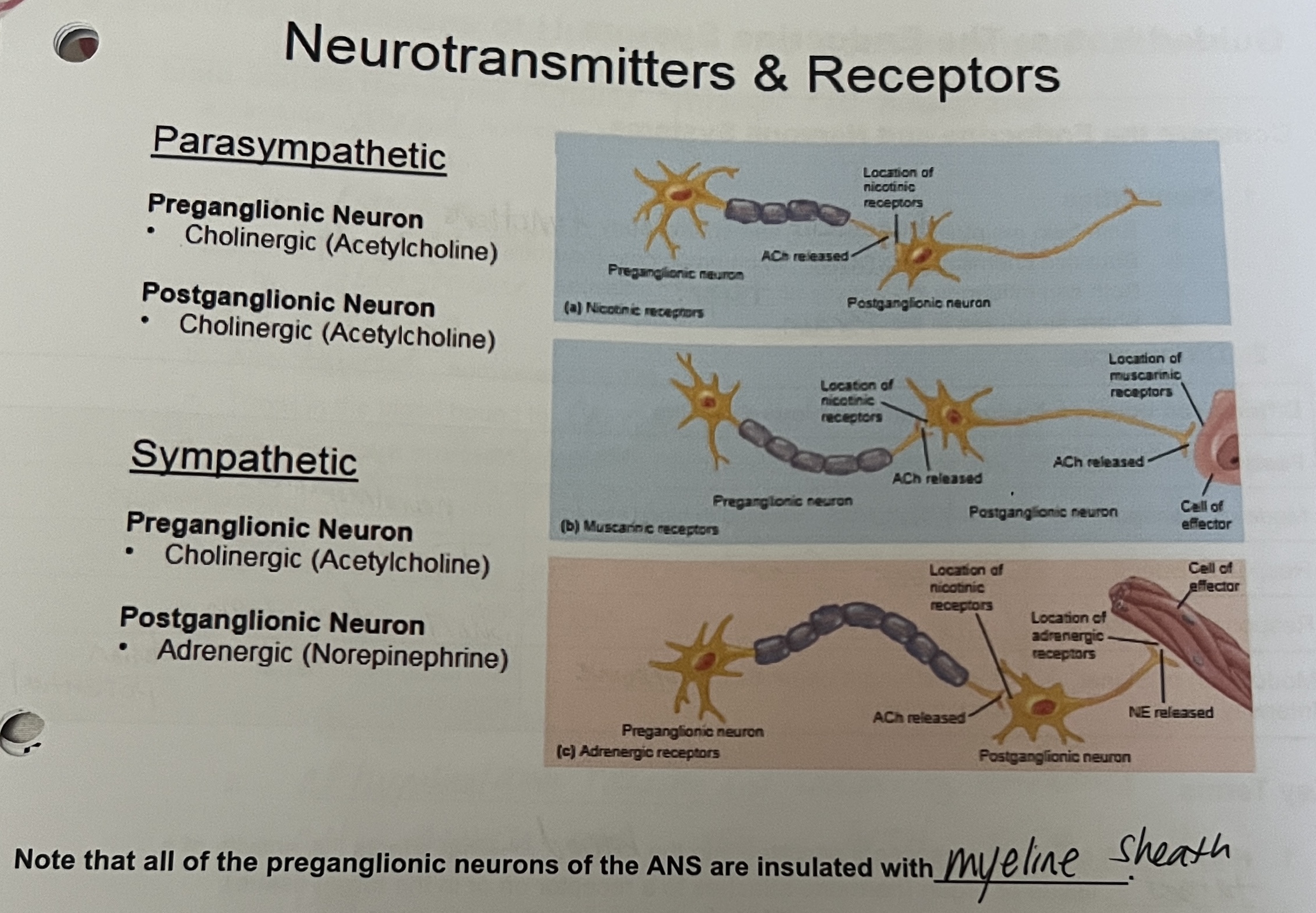
-length of PREganglionic fibers: short (myelin sheath)
-length of POSTganglionic fibers: Long (no myelin sheath)
-PREganglionic releases ACh
-POSTganglionic releases norepinephrine
how does the anatomy of the parasympathetic NS work?
-originated from the brainstem and sacral output regions of the spinal cord (craniosacral)
-(terminal) parasympathetic ganglia: near or within the target organs
-length of PREganglionic fibers: long (myelin sheath)
-length of POSTganglionic fibers: short (no myelin sheath)
-PREgamglionic releases ACh
-POSTganglionic releases ACh
how do the autonomic receptors work?
what does the endocrine system do?
-uses hormones released into the blood stream
-slower start, long lasting
-signal length depends on hormone concentration
what does the nervous system do?
-uses neurotransmitters to send messages
-fast, short duration
-signal strength depends on action potential frequency
what’s a hormone?
-a chemical messenger secreted into the blood that affects the activity of a target tissue or organ (hormone attaches to receptor in or in the target tissue)
what’s a target tissue?
-cells that have a specific receptor for a particular hormone (always scanning for that one hormone to activate)
what’s paracrine?
-hormone acts on nearby cells
what’s autocrine?
-hormone acts on the same cell that secreted it
what’s an exocrine gland?
-secretes substances (like enzymes or sweat) through a duct onto a surface or into a cavity
what are lipid soluble hormones? (soluble through cell membrane)
-include steroid hormones (testosterone, estrogen, progesterone, aldosterone, cortisol
-thyroid hormones (T3, T4)
-travel in the blood bound to carrier proteins
-receptors are located in the target cells cytoplasm and alter gene transcription
what are water soluble hormones? (not soluble through cells membrane)
-include peptide and amine hormones (epinephrine // norepinephrine // all hypothalamic releasing and inhibiting hormones // GH, oxytocin, ADH, TSH, ACTH, FSH, LH, PRL // insulin, glucagon, PTH, calcitonin etc.)
-travel freely in blood (not bound)
-receptors located on exterior surface of target cell
-mechanism: hormone binds to receptor → activates secondary messenger (like cAMP) → triggers enzyme activity → produces cellular responses
what does the hypothalamus do for anterior pituitary regulation?
-hypothalamus and pituitary gland are connected via the infundibulum
-hypothalamus controls the anterior pituitary through the hypothalamohypophysial portal system (network of blood vessels that connects them)
-hormones from the hypothalamus travel through this blood vessel network to the anterior pituitary
-hypothalamus releases releasing and inhibiting hormones that control anterior pituitary secretions
what’s a tropic hormone?
-hormones that stimulate other endocrine glands to release their hormones (specialized hormones from the anterior pituitary gland to turn on secretion)
what does the growth hormone (GH) do?
-anterior pituitary hormone
-causes release: GHRH from hypothalamus, low blood glucose, stress, decreased blood fatty acids
-target tissue: all body cells, especially bone and muscle
-function: stimulates growth of all bodies tissues, metabolism
what does the thyroid stimulating hormone (TSH) do?
-anterior pituitary hormone
-causes release: TRH from the hypothalamus
-target tissue: thyroid gland
-function: stimulates secretion of T3 and T4
→adipose: increased lipolysis and decreased glucose uptake
→liver: synthesis and secretion of insulin like growth factors
-promotes growth of bodies tissues
-(controls body’s metabolism, heart rate, temp and energy usage)
what does adrenocorticotropic hormone (ACTH) do?
-anterior pituitary hormone
-causes release: secreted in response to CRH (Corticotropin-releasing hormone) from hypothalamus, stress is a key stimulus
-target tissue: adrenal cortex
-function: stimulates cortisol release (stress hormone!)
-hypothalamus releases CRH to the anterior pituitary which releases ACTH which goes to the adrenal cortex and causes that to release cortisol (stress hormone, blood pressure)
what does follicle stimulating hormone (FSH) do?
-anterior pituitary hormone
-causes release: GnRH (Gonadotropin-Releasing Hormone) from hypothalamus
-target tissue: gonads
-function: stimulates gamete (egg/sperm production) (paired with LH)
-(starts the production of egg and sperm where LH finalizes it and makes testosterone)
what does luteinizing hormone (LH) do?
-anterior pituitary hormone
-causes release: GnRH (Gonadotropin-Releasing Hormone) from hypothalamus
-target tissue: gonads
-function: triggers ovulation, triggers testosterone secretion (paired with FSH which starts the production and LH finishes it)
what does prolactin do?
-anterior pituitary hormone
-causes release: TRH from hypothalamus (thyrotropin H), estrogen released, nursing baby
-target tissue: mammary glands
-function: stimulates milk production
-(baby sucks on nipple and it causes hypothal to release prolactin to make milk)
what does the posterior pituitary do?
1) two hormones, oxytocin and antidiuretic hormone (ADH) are made in the hypothalamus and stored and secreted by the posterior pituitary
2) hypothalamus and posterior pituitary are connected by the hypothalomohypophysial tract (nerve fibers). it carries action potentials to the posterior pituitary causing the release of hormones
-oxytocin= contractions, milk production (love hormone)
-antidiuretic hormone= regulates water balance from kidney reabsorption
what does antidiuretic hormone (ADH) do?
-POSTERIOR pituitary hormone
-causes release: low blood pressure (loss of blood volume), dehydration (increased blood osmolsrity- thick, viscous)
-target tissue: kidneys
-function: conserves water, decreases urine output
-(regulates water balance by causing kidneys to reabsorb water reducing urine, increasing blood volume and pressure)
what does oxytocin do?
-POSTERIOR pituitary hormone
-causes release: nursing baby, stretching on cervix (labor)
-target tissue: uterine muscles and mammary glands
-function: stimulates uterine contractions, milk ejection, positive feedback loop
-(simulates contractions speeding up labor, moves milk from duct to nipple, peripheral hormone(not produced in central ns))
what does the thyroid gland do? (endocrine)
-hormones: T3 and T4
-functions: increased basal metabolic rate (metabolism), regulates growth
-regulation: TSH stimulates production of T3 and T4
-(regulates rate your body uses calories/energy. metabolism)
-hormones: calcitonin
-functions: lowers blood Ca2+, inhibits osteoclasts, stimulates osteoblasts
-regulation: high blood calcium
-(builds bones to lower calcium levels)
what does the parathyroid gland do? (endo)
-hormones: PTH
-functions: raises blood Ca2+ by stimulating osteoclasts, promotes the formation of vitamin D
-regulation: Low Blood Ca2+
-(maintains healthy blood calcium levels by taking calcium from bones when low )
what does the adrenal cortex gland do? (endo)
-hormones: aldosterone
-functions: regulated Na+/ water balance by promoting Na+ reabsorption in the kidneys
-regulation: low blood pressure or high K+
-(balances SALTS (electrolytes) and blood pressure)
-hormones: cortisol
-functions: stress response, raises blood glucose
-regulation: ACTH
-(STRESS hormone, increases blood glucose levels, metabolism)
-hormones: DHEA (dehydroepiandrosterone)
-functions: pubic hair growth, female libido
-regulation: ACTH
what does the adrenal medulla gland do? (endocrine)
-hormones: epinepherine (E)(adrenaline)(effects heart) and norepinephrine (NE)(noradrenaline)(effects blood vessels)
-functions: fight or flight
-regulation: sympathetic stimulation, stress, physical activity, low blood glucose
what does the pineal gland do? (endocrine)
-hormones: melatonin
-functions: regulates sleep-wake cycle, biological clock
-regulation: darkness/ light exposure
what does the pancreas gland do? (endo and exocrine)
-hormones: insulin (beta cell of pancreatic islet)
-functions: lowers blood glucose
-regulation: high glucose
(islet means they work together raising or lowering the glucose)
-hormones: glucagon (target=liver) (alpha cell of pancreatic islet)
-functions: raises blood glucose
-regulation: low blood glucose
-hormones: somatostatin (delta cells) (growth hormone inhibiting hormone GHIH)
-functions: inhibits secretion of insulin, glucagon, hGH (universal inhibitor, tells top two to stop producing)(metabolism)
-hormone: pancreatic polypeptide (pp cells)
-functions: inhibits secretion of pancreatic enzymes and somatostatin (regulates appetite by shutting down all above 3 after food intake)
what does the ovaries gland do? (endocrine)
-hormones: estrogen and progesterone
-functions: reproductive cycle regulation, prep for pregnancy
-regulation: FSH (follicle stimulating hormone), LH (luteinizing hormone)
-During the first half of the menstrual cycle, FSH stimulates the maturation of ovarian follicles (egg production) and estrogen production, A sudden, rapid rise (surge) in LH causes the dominant follicle to rupture and release a mature egg, usually around day 14.
-The brain monitors progesterone and estrogen levels, adjusting GnRH pulses to control the release of FSH and LH
what does the testes gland do? (endocrine)
-hormones: testosterone
-functions: sperm production, male secondary characteristics
-regulation: LH (luteinizing hormone)
-LH release is triggered by Gonadotropin-Releasing Hormone (GnRH) from the hypothalamus to promote sperm production which means more testosterone
what does the thymus gland do?
-hormones: thymosin and thymopoietin
-functions: develop T-cells (immune development)
-regulation: active in childhood, shrinks with age
-thymus teaches white blood cells to distinguish between our body’s cells and foreign invaders to fight infections
what’s the optic chiasm?
-the 2 optic nerves will decussate at the optic chiasm (where they cross over eachother forming an X)
-allows the brain to combine visual info from both eyes to create a single unified image and enables depth perception
what does the lacrimal apparatus do?
1) tears are produced in the lacrimal gland
2) from gland to eye to cry or go to inner corner
3) inner corner has lacrimal canaliculli ducts
4) tears pass into nasal cavity
-tears from gland → lacrimal ducts → surface of cornea → from eye to lacrimal canaliculi → lacrimal sac → nasolacrimsl duct → nasal cavity
what 9 hormones does the anterior pituitary make and release? (adenohypopysis)
-thyroid stimulating hormone (TSH) = secretion of thyroid hormones
-follicle stimulating h (FSH)= sperm production/ estrogen in ovaries
-luteinizing h (LH)= ovulation, secretes progesterone, estrogen, testosterone
-human growth h (hGH or GH)= tissue growth, lipolysis, increases blood glucose
-prolactin (PRL)= milk production by mammary glands
-melanocyte stimulating h (MSH)= melanin production
-adrenocorticotropic h (ACTH)= stoma adrenal cortex to release cortisol
what is endocrine?
-directly into blood (target tissues have receptors looking out for certain hormones)