MATH 152 Exam III Formula Recognition
 Call Kai
 Learn
Learn Practice Test
 Spaced Repetition
 Match
Match Flashcards
 Knowt Play
1/45

There's no tags or description
Looks like no tags are added yet.
Name | Mastery | Learn | Test | Matching | Spaced | Call with Kai |
|---|
No analytics yet
Send a link to your students to track their progress
46 Terms
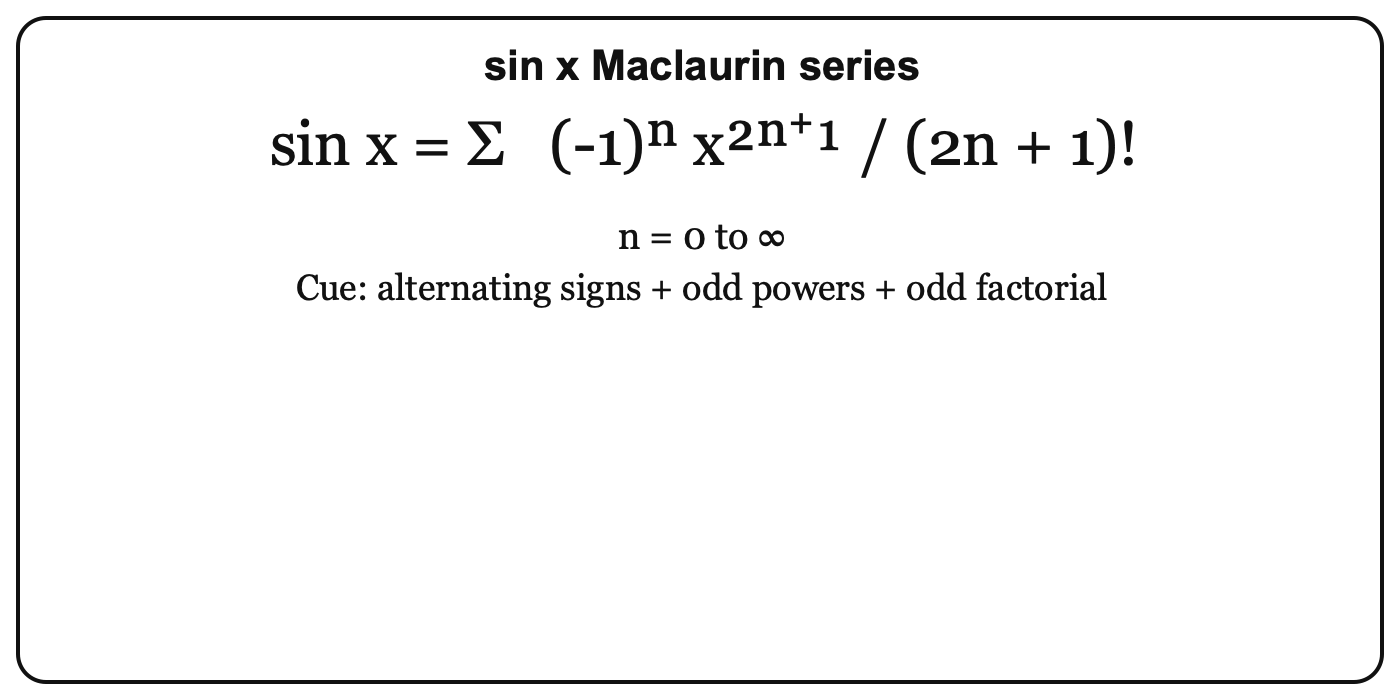
sin x Maclaurin series
sin x = sum from n=0 to infinity of (-1)^n x^(2n+1)/(2n+1)!
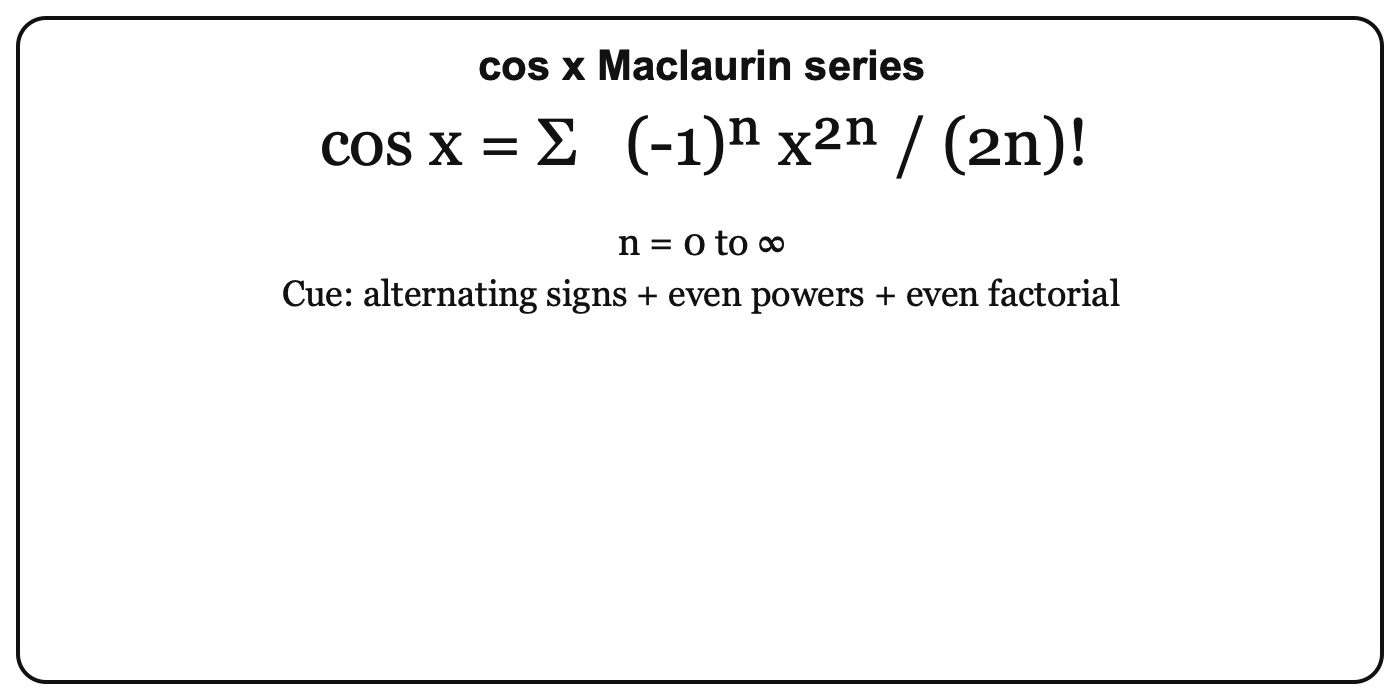
cos x Maclaurin series
cos x = sum from n=0 to infinity of (-1)^n x^(2n)/(2n)!
e^x Maclaurin series
e^x = sum from n=0 to infinity of x^n/n!
Geometric series
1/(1-x) = sum from n=0 to infinity of x^n, valid for |x| < 1
ln(1+x) series
ln(1+x) = sum from n=1 to infinity of (-1)^(n+1) x^n/n
arctan x series
arctan x = sum from n=0 to infinity of (-1)^n x^(2n+1)/(2n+1)
Sine vs arctan cue
Both alternate and use odd powers, but sine has factorial (2n+1)! while arctan has only (2n+1).
Series recognition: factorial in denominator
Think e^x, sin x, or cos x depending on powers/signs.
Series recognition: no factorial, plain powers
Think geometric series or ln/arctan depending on denominator and powers.
Substitution in a known series
Replace every x in the base series with g(x), then simplify only if needed.
Arctan disguise pattern
sum (-1)^n a^(2n+1)/(b^(2n)(2n+1)) = b arctan(a/b)
Power series interval first step
Rewrite into inside^n form, solve |inside| < 1, then check endpoints separately.
Endpoint: alternating 1/sqrt(n)
sum (-1)^n/sqrt(n) converges by Alternating Series Test.
Endpoint: positive 1/sqrt(n)
sum 1/sqrt(n) diverges because it is p-series with p = 1/2 < 1.
Alternating Series Test conditions
a_n decreases and a_n approaches 0.
Absolute value inequality rule
|A| < c means -c < A < c.
Binomial series formula
(1+x)^p = sum from n=0 to infinity of binomial(p,n) x^n
Generalized binomial coefficient
binomial(p,n) = p(p-1)(p-2)…(p-n+1)/n!
Binomial series first terms
(1+x)^p = 1 + px + p(p-1)x^2/2! + p(p-1)(p-2)x^3/3! + …
Binomial series convergence
For non-integer p, use |x| < 1 first, then check endpoints separately.
Binomial substitution cue
If the expression is (1 + something)^p, plug that something in for x.
Parabola horizontal form
(y-k)^2 = 4p(x-h)
Parabola vertical form
(x-h)^2 = 4p(y-k)
Parabola vertex
Vertex is (h,k).
Parabola: y squared cue
If y is squared, the parabola opens left or right.
Parabola: x squared cue
If x is squared, the parabola opens up or down.
Horizontal parabola focus and directrix
For (y-k)^2 = 4p(x-h): focus (h+p,k), directrix x = h-p.
Vertical parabola focus and directrix
For (x-h)^2 = 4p(y-k): focus (h,k+p), directrix y = k-p.
Completing the square rule
For y^2 + by, add and subtract (b/2)^2.
Ellipse cue
Both x^2 and y^2 appear, same sign, sum equals 1.
Horizontal ellipse form
(x-h)^2/a^2 + (y-k)^2/b^2 = 1, bigger denominator under x.
Vertical ellipse form
(x-h)^2/b^2 + (y-k)^2/a^2 = 1, bigger denominator under y.
Ellipse center
Center is (h,k).
Ellipse vertices
Move a units from the center along the major axis.
Ellipse foci relationship
c^2 = a^2 - b^2.
Ellipse direction cue
Bigger denominator tells the major axis direction.
Hyperbola cue
Both x^2 and y^2 appear with opposite signs.
Horizontal hyperbola form
(x-h)^2/a^2 - (y-k)^2/b^2 = 1.
Vertical hyperbola form
(y-k)^2/a^2 - (x-h)^2/b^2 = 1.
Hyperbola direction cue
The positive fraction tells the opening direction.
Hyperbola vertices
Move a units from the center in the opening direction.
Hyperbola foci relationship
c^2 = a^2 + b^2.
Horizontal hyperbola asymptotes
y-k = plus/minus (b/a)(x-h).
Vertical hyperbola asymptotes
y-k = plus/minus (a/b)(x-h).
Ellipse vs hyperbola c formula
Ellipse: c^2 = a^2 - b^2. Hyperbola: c^2 = a^2 + b^2.
Conic quick classifier
Parabola has one squared variable; ellipse has same-sign squared terms; hyperbola has opposite-sign squared terms.