bio cell division test review 3/8
 Call Kai
 Learn
Learn Practice Test
 Spaced Repetition
 Match
Match Flashcards
 Knowt Play
1/24

There's no tags or description
Looks like no tags are added yet.
Name | Mastery | Learn | Test | Matching | Spaced | Call with Kai |
|---|
No analytics yet
Send a link to your students to track their progress
25 Terms
What is formed at the end of meiosis?
a.two genetically identical cells
b. four genetically different cells
c. four genetically identical cells
d. two genetically different cells
b. four genetically different cells
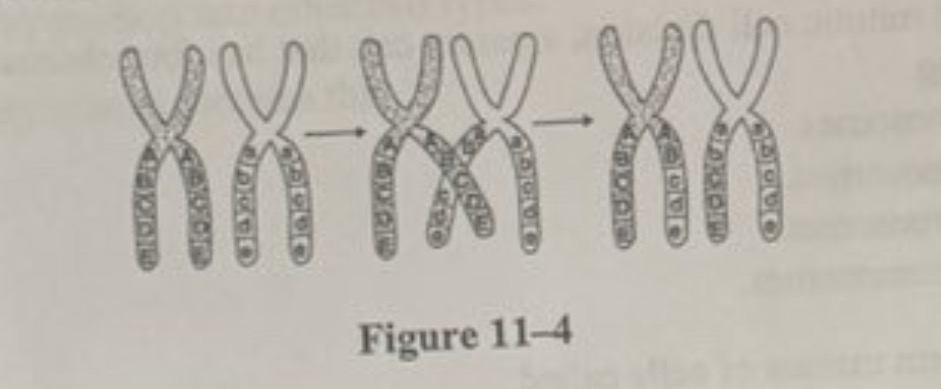
What is shown in Figure 11-4?
a. independent assortment
b. anaphase I of meiosis
c. crossing-over
d.replication
c. crossing-over
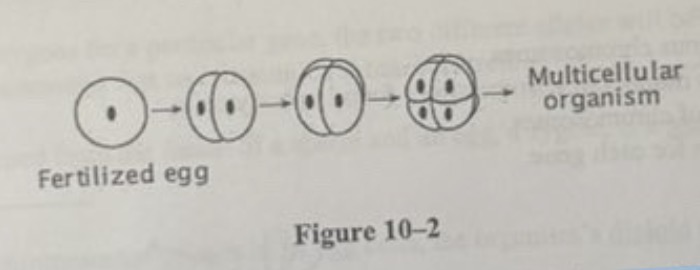
A multicellular organism begins life as a single cell—a fertilized egg with a complete set of chromosomes.
The picture in Figure 10-2 above shows how the cell divides to become two cells, then four cells, eight cells, and so on. Which of the following statements best describes what happens during this process?
a. Chromosomes are duplicated before cell division so that each new daughter cell has a complete set.
b. Chromosomes are divided evenly during cell division so that each new daughter cell has an equal share of the original set.
c. Chromosomes are stored in the original cell to direct the division of all daughter cells, which do not have their own chromosomes.
d. Chromosomes are randomly distributed during cell division so that some new cells have partial sets while others have complete sets.
a. Chromosomes are duplicated before cell division so that each new daughter cell has a complete set.
All of the following are problems that growth causes for cells EXCEPT
a. more demands on DNA
b. excess oxygen.
c. obtaining enough food
d. expelling wastes.
b. excess oxygen
After cell division, each daughter cell has:
a. a lower surface area/volume ratio than the parent cell.
b. a higher surface area/volume ratio than the parent cell.
C. more DNA in its nucleus than the parent cell.
d. less DNA in its nucleus than the parent cell.
b. a higher surface area/volume ratio than the parent cell.
Chromosomes form tetrads during
a. prophase I of meiosis.
b. metaphase I of meiosis.
c. interphase.
d. anaphase Il of meiosis
a. prophase I of meiosis.
During normal mitotic cell division, a parent cell that has four chromosomes will produce two daughter cells, each containing:
a. two chromosomes.
b. four chromosomes
c. eight chromosomes.
d. sixteen chromosomes.
b. four chromosomes
Cancer cells form masses of cells called a. tumors
b. cyclins
c. growth factors
d. p53
a. tumors
gametes have
a. homologous chromosomes
b. twice the number of chromosomes found in body cells
c. two sets of chromosomes.
d. one allele for each gene.
d. one allele for each gene.
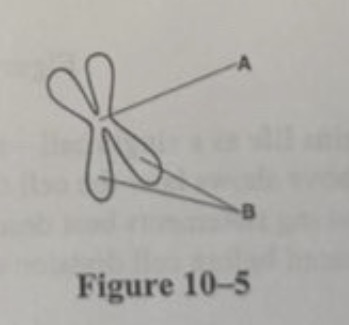
The structures labeled B in Figure 10-5 are called (relative to eachother)
a. centromeres.
b. centrioles.
c. sister chromatids.
d. spindles.
c. sister chromatids.
11. A tetrad consists of
a. two sets of sister chromatids that are homologous to eachother
b. the four copies of a chromosome that are normally present in cells
c. two sister chromatids that have each been replicated during interphase
d. a parental chromosome that was replicated to form a pair, then replicated again.
a. two sets of sister chromatids that are homologous to eachother
During early development, all cells in the embryo of a multicellular organism are identical. Later on in development, the cells will become specialized through a process called
a. apoptosis.
b. cytokinesis
c. differentiation
d. interphase.
c. differentiation
Why are stem cells important?
a. They have specialized DNA.
b. They are incapable of becoming cancer cells.
c. They have the potential to undergo cell division.
d. They have the potential to develop into other cell types.
d. They have the potential to develop into other cell types.
14. Cyclins are a family of closely related proteins that
a. regulate the cell cycle.
b. produce p53
c. cause cancer.
d. work to heal wounds.
a. regulate the cell cycle.
t or f: A single-celled organism would not be expected to undergo cell differentiation.
true
t or f:If an organism is heterozygous for a particular gene, the two different alleles will be separated during anaphase II of meiosis, assuming that no crossing-over has occurred.
false - anaphase I
t or f:The first cell that is formed from the fusion of a sperm and an egg, a zygote, is a multipotent stem cell.
false - totipotent
t or f:If an organism has 16 chromosomes in each of its egg cells, the organism's diploid number is 32.
true
t or f:Mitosis is a form of sexual reproduction, because the daughter cells that form are identical to the parent cell.
false - asexual
t or f: During cytokinesis, a cell undergoing cell division finally splits into two daughter cells.
false - telophase and cytokinesis
short answer: Contrast two cancer treatments:
Chemotherapy uses drugs that circulate throughout the body to kill cancer cells, primarily by interfering with cell division. Radiation therapy uses focused high-energy rays to damage or destroy cancer cells in a specific, localized area.
2. Biological advantage of sexual vs. asexual reproduction:
The biological advantage of sexual reproduction over asexual reproduction is the creation of genetic diversity. This genetic variation increases a population's ability to adapt to changing environments, as some individuals may possess traits that allow them to survive and reproduce under new conditions. Asexual reproduction produces genetically identical offspring, making the entire population more vulnerable to environmental changes.
3. How crossing over increases genetic variation:
Crossing over increases genetic variation for genes on the same chromosome by exchanging segments between homologous chromosomes.
This process shuffles alleles (different versions of a gene) that are located close to each other on a chromosome, creating new combinations of alleles that were not present in the original parental chromosomes.
4. Two differences between spermatogenesis and oogenesis:
Spermatogenesis starts at puberty and creates lots of equal-sized sperm. Oogenesis starts before birth, pauses, and creates one big egg (plus tiny polar bodies) only when fertilized.
5. Difficulty in developing cancer treatments:
It is more difficult to develop treatments that target cancer cells without harming the patient because cancer cells originate from the body's own cells. This means they share many similarities with healthy cells, making it challenging to find targets that are unique to cancer and absent in normal tissues. In contrast, pathogens like bacteria and viruses are foreign invaders with distinct structures and molecules that can be more easily targeted.