Week 4: Serology agglutination
 Call Kai
 Learn
Learn Practice Test
 Spaced Repetition
 Match
Match Flashcards
 Knowt Play
1/27

There's no tags or description
Looks like no tags are added yet.
Name | Mastery | Learn | Test | Matching | Spaced | Call with Kai |
|---|
No analytics yet
Send a link to your students to track their progress
28 Terms
Serology
Study of components in the blood, especially antibodies
serum
liquid portion of blood minus coag factors
most frequently encountered specimen in immunologic testing
separated from other components of a blood specimen via centrifuge
Serum vs plasma
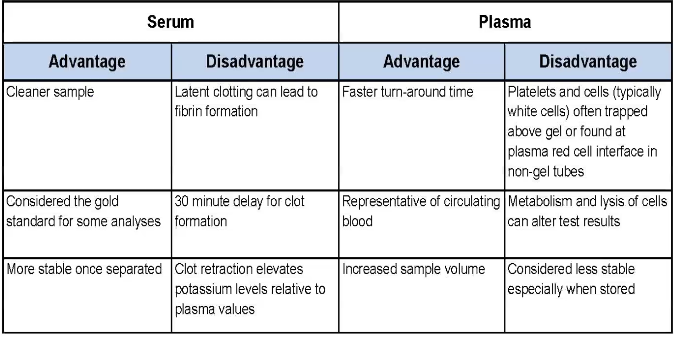
blood specimen preparation and measuring
ideally use fresh serum that hasn’t been heated
however, for certain tests, complement may need to be inactivated
heat sample to 56C for 30 min
Blood storage
between 2-8C for up to 72 hrs
frozen at -20C or below
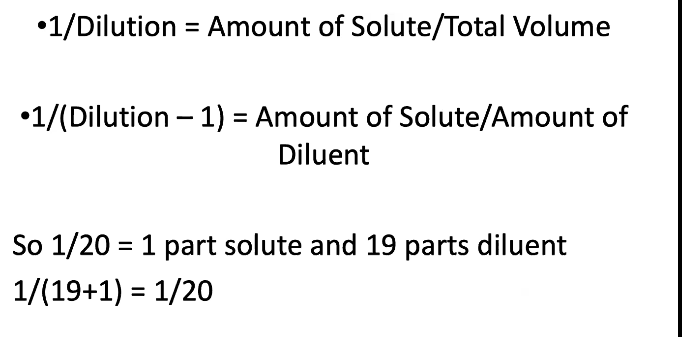
dilutions
solute is the material being diluted
diluent is the medium making up rest of solution
relationship between the 2 is expressed as a ratio or fraction
equations are used to determine:
total volume of a solution
amt of solute/diluent needed
sensitivity
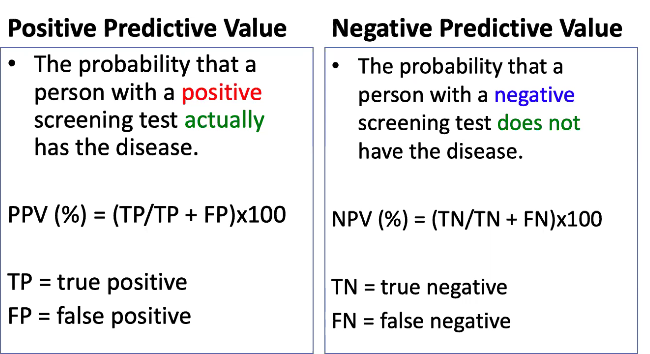
proportion of people who have a disease (or condition) and have a + tst
indicates how small an amount can be measured and still produce a + test result
sensitivity (%) = (TP/TP + FN) x 100
specificity
proportion of people who DON’T have a disease and have a - test
measures the substance that it is designed to measure, not interfering substance
specificity (%) = (TN/TN + FP) x 100
Test parameters
Antigen-antibody binding: affinity
initial attraction force between a Fab site on an antibody molecule and an epitope or determinant site on an antigen
strength of attraction depends on specificity of antibody for a particular antigen
avidity
sum of attractive forces between an antigen and an antibody that keeps the molecules tgt
involves the strength with which a multivalent antibody binds a multivalent antigen
measure of overall stability of an antigen-antibody complex
law of mass action
K= [AgAb]/[Ab[[Ag[
free reactants are in equilibrium with bound reactants
value of K depends on strength of binding between antibody and antigen
higher value of K:
larger amt of antigen-antibody complex
more visible or easily detectable the reaction
Precipitation reactions
involve combining soluble antigen with soluble antibody to produce insoluble complexes that are visible
require antigen and antibody to have:
multiple binding sites for one another
equal relative concentration of each
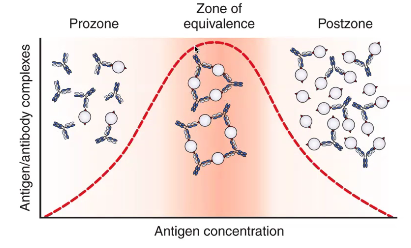
precipitation curve: zone of equilvalence
# of multi-valent sites of antigen and antibody are approx equal
to be detectable, precipitation reactions must be run in th zone of equilvalence
Prozone
antibody excess
antibody combines with only 1 or 2 antibody molecules
no cross-linkages are formed
false negatives reaction may occur as a result of high antibody concentration
if false- rxn is suspected, diluting out the antibody and performing test again may produce a + result
Postzone
small aggregates are surrounded by excess antigen
no lattice network is formed
presence of small amt of antibody may be obscured, causing fn results
test is repeated about a week later with specimen to give time for further production of antibody
if test is neg again, unlikely that patient has antibody
Precipitation rxn techniques
nephelometry - light scattered at an angle is measured
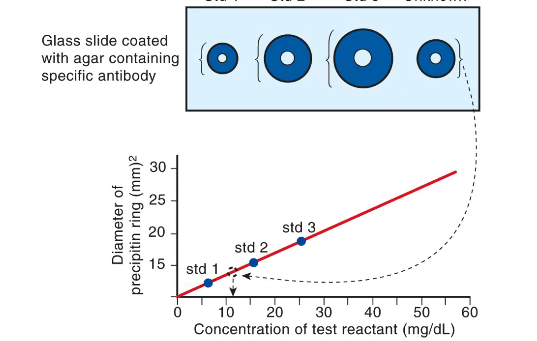
radial immunodiffusion - antigen diffuses out into a gel that is infused with antibody, measurement of radius
Ouchterlony double diffusion - both antigen and antibody diffuse out from wells and the lines of precipitate formed indicate relationship
immunoelectrophoresis
immunofixation electrophoresis
Radia immunodiffusion
RID is a single diffusion technique
antibody is in support gel, antigen in a well cut in the gel
antigen diffuses out until the point of equivalence is reached (end-point method)
square of the diameter is proportional to antigen concentration
Ouchterlony diffusion
double-diffusion technique
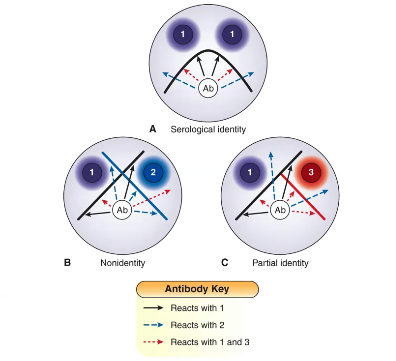
wells are cut in a gel, both antigen and antibody diffuse out radially
line of precipitate forms where antigen and antibody meet
3 possible patterns: identity, partial identity, nonidentity
Immunofixation electrophoresis
double diffusion technique
unknown antigen is electrophoresed, and then antibody is applied directly to the gel
precipitates form where antigen-antibody combination has taken place in gel
technique is used with serum as the antigen to determine over- or underproduction of antibody types
Agglutination
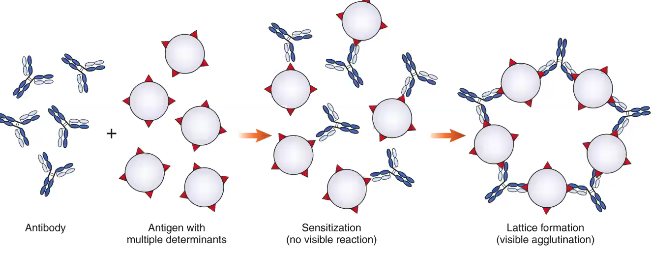
visible aggregation of particles resulting from combination with specific antibody
2 step process
sensitization (initial binding)
antigen and antibody unite through antigenic determinant sites
lattice formation (formation of large aggregates)
rearrangement of antigen and antibody bonds to form a stable lattice
produced by antibodies called agglutinins
direct agglutination
uses known bacterial antigens to test for presence of unknown antibodies in the patient
can also occur when antigens are found naturally on a particle
widal test
rapid screening test used to determine the possibility of typhoid fever
uses Salmonella O (somatic) and H (flagellar) antigens
ABO typing

Passive agglutination
used to detect:
RF
antibodies to Group A strep
antibodies to viruses such as rotavirus, CMV, rubella, varicella-zoster
antibodies to hepatitis viruses and HIV
process
antigen is attached to carrier particle
agglutination occurs if patient antibody is present
Reverse passive agglutination
used to detect microbial antibodies
detecting soluble antigens
process
antibody is attached to carrier particle
agglutination occurs if antigen is present in patient sample


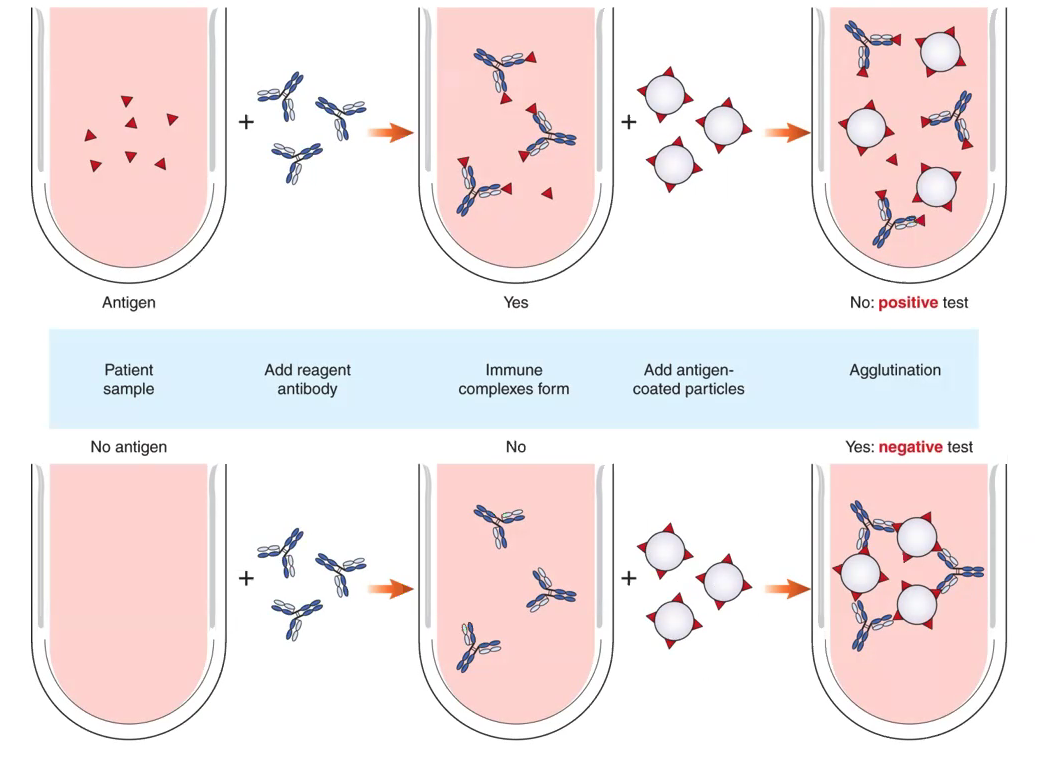
Agglutination inhibition
based on competition between particulate and soluble antigens for limited antibody-combining sites
lack of agglutination = + rxn
indirect agglutination
particles are coated with antigens not normally found on their surfaces
agglutination indicates presence of patient antibody
hemagglutination inhibition
RBCs spontaneously agglutinate if viral particles are present
lack of agglutination is + test, indicating presence of patient antibody
Particle-counting immunoassay (PACIA)
nephelometry
involves a laser in optical particle counter to measure the # of residual non-agglutinating particles in specimen
measures serum proteins, therapeutic drugs, tumor markers, certain viral antigens