Eco 231 - Exam 2 Questions
 Call Kai
 Learn
Learn Practice Test
 Spaced Repetition
 Match
Match Flashcards
 Knowt Play
1/47

There's no tags or description
Looks like no tags are added yet.
Name | Mastery | Learn | Test | Matching | Spaced | Call with Kai |
|---|
No analytics yet
Send a link to your students to track their progress
48 Terms
Prediction Equation (3 independent variables)
y(hat) = b0 + b1X1 + b2X2 + b3X3
F-test for overall fit in multiple regression
checks whether the model explains variation in the dependent variable
F=MSE/MSR
Implication of the F-test for a multiple regression
Reject H₀:
→ Statistically significant
→ At least one predictor variable is useful in explaining YFail to reject H₀:
→Not better prediction than the mean of Y alone
Null and alternate hypothesis for regression with 4 independent variables
Equation:
Y=b0+b1X1+b2X2+b3X3+b4X4+ei
Null hypothesis (H₀):
H0 = β1=β2=β3=B4=0
→ None of the independent variables explain Y
Alternative hypothesis (H₁):
At least one βi≠0
→ At least one independent variable helps explain Y
F-stat formula explaination
MSR (Mean Square Regression)
Measures how much variation in the dependent variable is explained by the model.MSE (Mean Square Error)
Measures the unexplained variation (the residual/error).If F is large → the model explains significantly more variation than noise → predictors are useful
If F is close to 1 → model is not much better than random noise
A large F-statistic (with a small p-value) leads you to reject H₀, meaning the model is statistically significant overall.
Look at P-value
Polynomial Regression

How do we interpret the coefficient on a quadratic variable in a regression?
Curve Direction
b2>0 → upward (U)
b2<0 → downward (n)
Marginal effect is not constant
Turning point
If b2>0 → min
If b2<0 → max
What is the logarithm transformation of the x and y variables?
The % change in y for every 1% change in x

What does the coefficient on the x variable tell us after a log-log transformation of both the x and y variables?
the elasticity
What is an indicator/dummy variable
variable that replaces a qualitative value
difference in the predicted outcome between the group coded as 1 and the group coded as 0
When there are m different groups in the data for an independent variable, how many dummy variables are needed to indicate the m groups?
one less than m
What does the coefficient on a dummy variable tell us in a regression model?
The average difference in Y between the group with D=1 and the group with D=0
If β1>0 → the “1” group has a higher outcome than the baseline
If β1<0 → the “1” group has a lower outcome
If β1=0 → no difference between groups
Can you show the difference using graphs?
Lower line = baseline group d=0
Upper line = dummy variable d=1
Vertical distance between lines =b1
What is an interaction term in a regression?
The effect of one variable on the outcome depends on the level of another variable.
The impact of X, changes when Z changes
What does the coefficient on the interaction of a dummy variable and an independent variable (x) tell us?
Y=β0+β1X+β2Z+β3(X⋅Z)+ϵ
X⋅Z is the interaction term
β3 tells you how the effect of X changes with Z
Can you show the difference using graphs?
When Z=0:
Y=β0+β1X
When Z=1:
Y=(β0+β2)+(β1+β3)X
The intercept is different (shift up/down)
The slope is also different (lines are not parallel)
The difference in slopes is caused by the interaction term β3
How is adjusted R-square different from R-square?
R-squared
Measures the percentage of variation in Y explained by the model
R2 always increases (or stays the same) when you add more variables
Adjusted R-Squared
Used when you have to compare 2 regressions
Adjusts R2 for the # of independent variables

How to use adjusted R-square to compare reduced vs. full model in regression analysis?
SSEr and SSEf are the error sum of squares for the reduced and full model
K and L are the number of independent variables in the full and reduced models
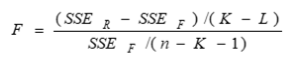
What other criteria could you use for model selection?
stepwise regression
begin with a simple regression then add more independent variables as controls
backward elimination method
begin with full model (F) then eliminate insignificant independent variables in reduced model (R)
How to assess linear assumptions?
Points in a straight trend are linear
How to correct for violations of linearity assumption?
Add a lagged value of the dependent variable as an explanatory variable
What are the ZINE assumptions for multiple regression models?
Zero as the expected value for ei
Independence of errors
Error values are statistically independent
Normality of errors
Error values are normally distributed for any given set of X values
Equal Variance (also called Homoscedasticity)
The probability distribution of the errors has constant variance
How to assess the assumption of constant variance?
points in straight trend are constant
Heteroscedasticity
variance of the error terms is not constant across observations
fan shape” in residual plots
makes standard errors wrong
messes up hypothesis tests and confidence intervals
How to correct heteroscedasticity?
robust standard errors
Transform dependent or independent variables
How to assess the assumption of normality for disturbance distribution?
normal probability plot should be a straight line
68% of the standardized residuals should be between -1 and 1
95% should be between -2 and 2
99% should be between -3 and 3
How to correct for violations of normality?
If the sample size is greater than 30, normality assumption is not a concern
For small sample, use Box-Cox transformation toy: yp where 0<p<1
How to assess the assumption that the disturbances are independent?
Autocorrelation of residuals in time-series data
Et = PEt-1 + Ut where 0 < p < 1
Test for first-order autocorrelation
residual analysis
Durbin-Watson test
Durbin Watson Test
Residual analysis for time series data
The d statistic for Durbin-Watson test
If residuals are uncorrelated, d = 2
If residuals are positively correlated, d <2
If residuals are negatively correlated, d> 2
How to correct violations of independence or autoregressive errors?
Add a lagged value of the dependent variable as an explanatory variable
What is correlation matrix?
are the pairwise correlations greater than 0.5?
How to deal with collinearity problem in regression?
The presence of a high degree of multicolinearityamong explanatory variables can cause:
insignificant coefficients on independent variables
unstable regression coefficients
Detecting multicollinearity
Correlation matrix: are pairwise correlations greater than 0.5?
Large F statistic for regression but small t statistics (low p value) for estimated coefficient
Correction for multicollinearity
Remove those variables that are highly correlated with others
How to detect outliers?
use standardized deviation (ef), focusing on those with a value greater than 2
How to correct outlier problem?
Transformations:
log(X) or log(Y)
Robust regression
What are the four components in a time series dataset?
Trend component (T)
Seasonal component (S)
Cyclical component (C)
Irregular component (R)
How do you identify them?
Trend
overall pattern
Seasonal
part of the variation that fluctuates in a stable way over time
Cyclical
regular cycles in the data with periods longer than one year
Irregular
part of the data not explained by the model
Smoothing Method
smooth away” the rapid fluctuations and capture the underlying behavior
recent behavior is a good indicator of behavior in the near future
Smoothing out fluctuations is generally accomplished by averaging adjacent values in the series
Simple Moving Average (SMA(4))
Yt = (Yt + Yt-1 + Yt-2 +Yt-3) / 4
Yt-1(hat) = Yt(hat)
Exponential Smoothing
EMA(0.7) = Yt(hat) = 0.7Yt + 0.3Yt-1(hat)
Y1(hat) = Y1
Autoregressive model
Yt(hat) = b0 + b1Yt-1 + b2Yt-2 + b3Yt-3
How is autoregressive model different from smoothing method?
Autoregressive
uses past values of the series itself
depends on lagged values of Y
statistical model to analyze structure
Smoothing
uses past observations and forecasts
depends on weighted averages of past values
forecasting technique
Estimation equation for the autoregressive model with 3 lags
y(hat) = b0 + b1Ylag1 + b2Ylag2 + b3Ylag3
What is a multiple regression-based model for time series data with seasonal factors?
Yt=β0 + β1t + β2D1 + β3D2 + ⋯ + βkDk + ϵt
How do you represent the 4 quarters in a regression model?
Step 1: create dummy variables (3)
D1=1 if Q1, else 0
D2=1D_2 = 1D2=1 if Q2, else 0
D3=1D_3 = 1D3=1 if Q3, else 0
Step 2: Write regression model
Yt=β0+β1D1+β2D2+β3D3+ϵt
Step 3: Interpret the coefficents
β0 → mean value in Q4 (baseline)
β1\beta_1β1 → difference between Q1 and Q4
β2\beta_2β2 → difference between Q2 and Q4
β3\beta_3β3 → difference between Q3 and Q4
Step 4: What the model implies
Q4: Y=β0Y = \beta_0Y=β0
Q1: Y=β0+β1Y = \beta_0 + \beta_1Y=β0+β1
Q2: Y=β0+β2Y = \beta_0 + \beta_2Y=β0+β2
Q3: Y=β0+β3Y = \beta_0 + \beta_3Y=β0+β3
MSE
mean squared error
how well a model’s predictions match the actual data
Yt: actual value
Y(hat)t: predicted (forecasted) value
n: number of observations
(Yt−Y(hat)t): error (residual)

MAD
mean absolute difference
measure of the average size of forecast errors, without squaring them
Yt: actual value
Y(hat)t: predicted (forecasted) value
n: number of observations
∣Yt−Y(hat)tl: absolute error (ignores sign)

MAPE
mean average percentage error
measures forecast accuracy as a percentage
makes it easy to interpret across different scales
Yt: actual value
Y(hat)t: forecasted value
n: number of observations
The fraction = percentage error for each observation

How do you choose the best forecasting model?
MAE → average absolute mistake
MSE → penalizes large errors more
MAPE → percentage error
The lower, the better