Chemistry Unit 1
 Call Kai
 Learn
Learn Practice Test
 Spaced Repetition
 Match
Match Flashcards
 Knowt Play
1/160

Earn XP
Description and Tags
Semester 1 2026
Name | Mastery | Learn | Test | Matching | Spaced | Call with Kai |
|---|
No analytics yet
Send a link to your students to track their progress
161 Terms
Atom
The basic building block of matter. It is made up of subatomic particles , protons, neutrons and electrons.
Atomic Number
The number of protons in the nucleus of an atom
Chemical Property
A property which can only be measured by reacting the substance chemically
Chemical Symbol
A symbolic representation of an element, usually one or two letters.
Compound
A pure substance made up of different types of atoms combined in a fixed ratio.
Diatomic
A molecule formed from two atoms only
Electron
A negatively charged, subatomic particle that occupies the region around the nucleus of an atom.
Electrostatic attraction
The force of attraction between a positively charged particle and a negatively charged particle.
Element
A substance made up of atoms with the same atomic number.
Ions
An atom or group of atoms with a positive or negative charge
Isotope
Each of two or more forms of the same element that contain equal numbers of protons but different numbers of neutrons in their nuclei.
Mass number
The number of protons and neutrons in the nucleus of an atom.
Monoatomic
Exists as a single atom of any element.
Neutron
An uncharged subatomic particle found in the nucleus of an atom.
Nucleon
A particle that makes up the nucleus of an atom. Protons and neutrons
Nucleus
The positively charged core at the center of an atom, consisting of protons and neutrons
Nuclide notation
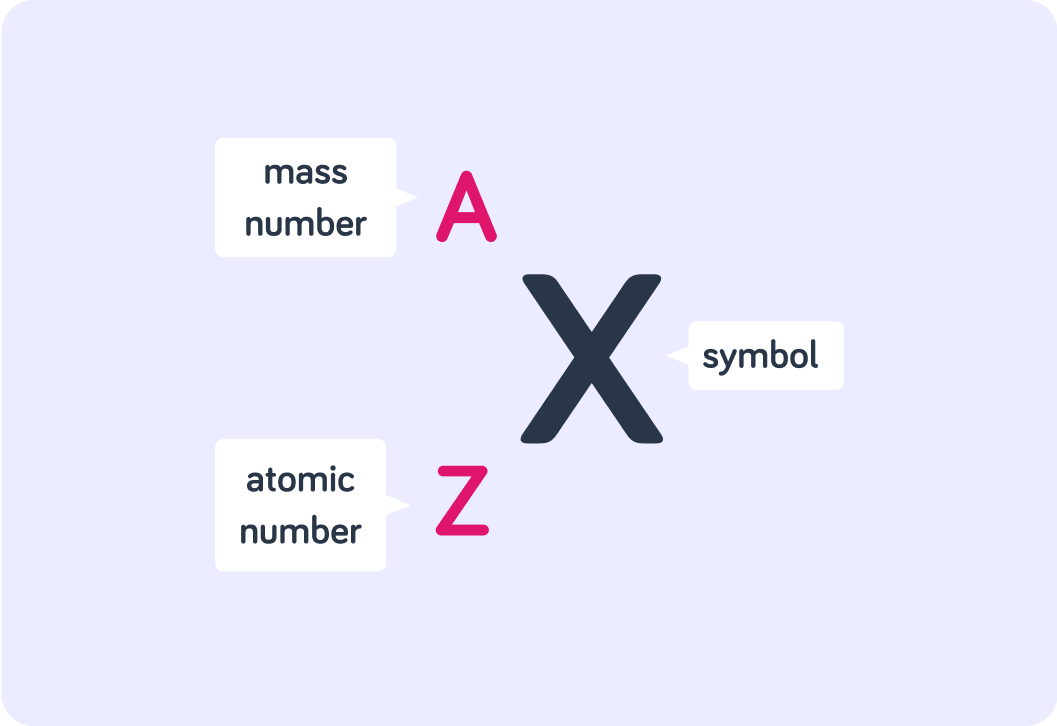
A way of representing an atom using the element symbol, atomic number, and mass number.
Physical Property
A property which can be measured without changing the substance into another substance.
Proton
Positively charged subatomic particles bound to neutrons in the nucleus of an atom.
Radioactive
Spontaneously undergoing nuclear decay to produce radiation such as beta particles alpha particles, gamma rays.
Relative atomic mass
The mass of an atom compound or molecule relative to the mass of an atom of C-12
Subatomic particle
A particle that makes up an atom, protons, neutrons and electrons
Bohr model
A theory of the atom proposed by Niel Bohr whihc states that electrons in an atom occupy fixed circular orbits that correspond to specific energy levels.
Electron shells
In a shell model of an atom, an electron shell is the fixed energy level that correpsond to a circular obrit level of the electrons
Electronic configuration
is a means of representing the number of electrons in each shell
Emission spectra
A spectrum produced when an element is excited by heat or radiation, It appears as distinct lines characteristic of the element.
Energy State
One of the diffeent level swhich are occupied by leectrons.
Excited state
Describes an atom in which electrons occupy a higher electron shell than teh loer energy levels possible.
Ground State
An atom in which the electrons occupy the lowest possible energy levels
Valence electron
An electron found in the outermost shell of an atom.
Valence shell
The highest energy shell of an atom that contains electrons, outermost shell
Condensed electron configuration
A shortened way of writing an electron configuration by using a noble gas before the element.
Orbital
An orbital is a component of s ubshell It is a region of space in which electrons move.
Quantum mechanics
A branch of science that describes the behaviour of extremely small particles such as electrons.
Subshells
Component of a shell made up of orbitals, each subshell can be regarded as an energy level that electrons can occupy.
Actinoids
They are located at the bottom of a periodic table, in period 7 of the f block
Alkali metals
A group 1 metal
Alkaline earth metals
Group 2 elements, they readily form +2 cations
Atomic radius
The distance from teh nucleus to the outermost electron, increase down a group, decrease across a period.
Block
Sections of the periodic table they determine th valence subshell.
Critical elements
Elements which are heavily relied upon by industry and scoiety which face some form of supply uncertaonty.
Groups
A vertical coluumn down a periodic table
Halogens
A group 17 element
Lanthanoids
found in period 6 of the f block
Metallic character
Is teh tendency for atoms to lose electrons and form cation, positibe ions,
Metalloids
An element which displays both metallic and non-metalliuc properties
Noble gases
An unreactive gaseous elemnt in group 17 of the periodic table, aprt from helium they have 8 electrons in their valence shell
Periods
A horizontal row of elements in teh periodic table, a new row correpsonds to a new shell.
Transition metals
An element in group 3-12 of the periodic table
Effective nuclear charge/core charge
The net positive charge experienced by an electron in an outer shell of an atom. It indicates teh attractive forece felt towards the nucleus by the valence electrons.
Electronegativity
The ability of an atom to attract electrons iun a acovalent bond towards itself.
Electrostatic force of attraction
The forec of attraction between a positively charge particle and a negatively charge dparticle
First ionization energy
The minimum amount of energy required to remove one electron from at atom WHILE IN THE GASEOUS STATE
Alloy
A substance forned when other materials are mixed with a metal
Cation
A positivelu chareg iion
Conductivity
Is teh ability of an atopm to conduct heat or electricuity.
Delocalized electron
An electron that is not restricted to teh region between two atoms.
Density
A measure of teh amount of mass per unit volume.
Ductility
An ability of a metal to be able to be drawn into a wire or stretched
Lattice
A regulare arrangement of large number of atoms, ions, or molecules
Lustre
Is the ability of an element to relfect light from its surface givong it a shiny appearance
Malleability
Th ability toi be able to be bent or beaten into sheets
Tensile strength (hardness)
The maximum resistance of a material to force which is pulling it apart befroe breaking.
Inert
Not chemically reactive (noble gases)
Reactivity
The ease with which a chemical can undergo reactions
Circular economy
An economy based on a model of production which aims to design out waste and pollution, keep products and materials in use adn regenrate natural systems.
Electrolysis
The production of a reaction by teh passage of electrical energy.
Ferrous
A material containing iron
Linear Economy
An economy in which raw materials are used to produce a proudtct and after the product is used it is thrown away.
Molten
Matgerials that are normally found as solid but ar eliquid
Non-ferrous
a metal other than iron or steel
Smelting
A process of applying heat to ore to extract a metal
Anions
A negativelky charged atom
Brittle
Shatters when given a sharp tap
Chemical Formula
A representation of a substance using symbols for its constituent elemnents, it shows the ratio of atoms presnt in teh substance,
Crystal lattice
Th esymmetrical three dimensional arrangement of atoms or ions within a crystal
Dissolve
To incorporate a solid gas into liquid so as to forma solution
Electrolyte
A solution or molten substaance that consudcts electricityby means if movement f ions
Ion - dipole attraction
is the electrostatic force of attraction between an ion and a polar molecule.
Ionic bond
Ionic compound
Solubility
Electron transfer diagram
Polyatomic ions
Empirical formula
Aqueous
Dissolution
Double replacement reaction
Insoluble
Ionic equation
Precipitate
Precipitation reaction
Solubility
Soluble
Spectator ion
Bond length
Bond strength
Covalent bond
Electronegativity
Intramolecular bonds