its over freak out and panic sell everything
 Call Kai
 Learn
Learn Practice Test
 Spaced Repetition
 Match
Match Flashcards
 Knowt Play
1/13

Earn XP
Description and Tags
swdefrgth
Name | Mastery | Learn | Test | Matching | Spaced | Call with Kai | Chat |
|---|
No analytics yet
Send a link to your students to track their progress
14 Terms
keplers 1st law
all orbits are conic sections, CM of two bodies is at the focus
keplers 2nd law
orbits sweep equal distances in equal time (r increases, v decreases - r decreases, v increases) - all based off conservation of angular momentum
keplers 3rd law
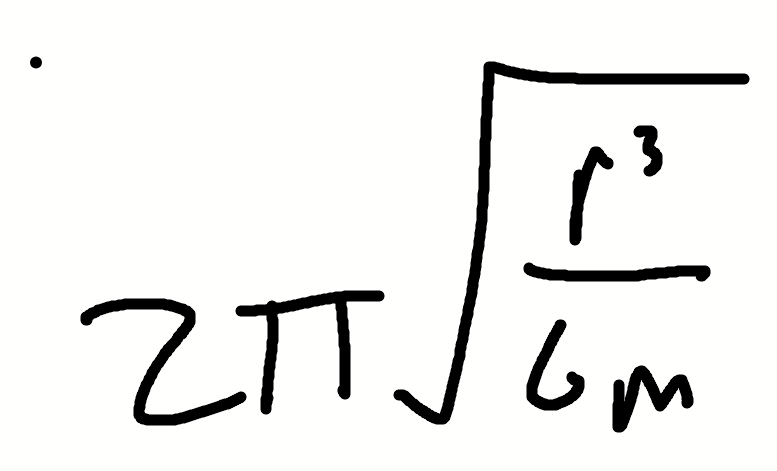
the square of the orbital period is proportional to the cube of the orbit’s semi major axis
(things further from a body take longer to complete an orbit)
orbital period
shell theorem
for planets, you can just act like all mass is centered at a single point - if you are inside a body, you need to account for the smaller mass as well as the smaller radius (proportional to volume)
requirements for circular motion w/o slipping
v=rw
the further away a body gets from a planet…
its potential energy increases (it goes from more negative to less negative, approaches 0)
work is…
FD
change in kinetic energy
integral of force
kinetic friction
mg* u_k
to find torque in weird multi object systems…
break it up into the individual components, calculate torque individually (AND DONT FORGET THAT YOU MUST CONSIDER THE ROTATIONAL INERTIA FOR ALL OBJECTS FOR THE NET I)
also dont forget torque on an object by gravity is at the center of mass, use rFsin(theta)
frequency
how many things in one second?
period
how many seconds to do one thing?
how to combine spring constants
1 / k_total = 1/k_1 + 1/k_2 + 1/k_3 …
torque vs angular momentum vs angular velocity
T = dL/dt = I * dw/dt