BOARD EXAM - ANACHEM
 Call Kai
 Learn
Learn Practice Test
 Spaced Repetition
 Match
Match Flashcards
 Knowt Play
1/63

There's no tags or description
Looks like no tags are added yet.
Name | Mastery | Learn | Test | Matching | Spaced | Call with Kai |
|---|
No analytics yet
Send a link to your students to track their progress
64 Terms
What are the types of Errors?
Systematic (Determinate) Error, Random Error (Indeterminate Error), and Gross Error
What are the 3 types of Systematic Error?
Method Error, Instrumental Error, and Personal Error
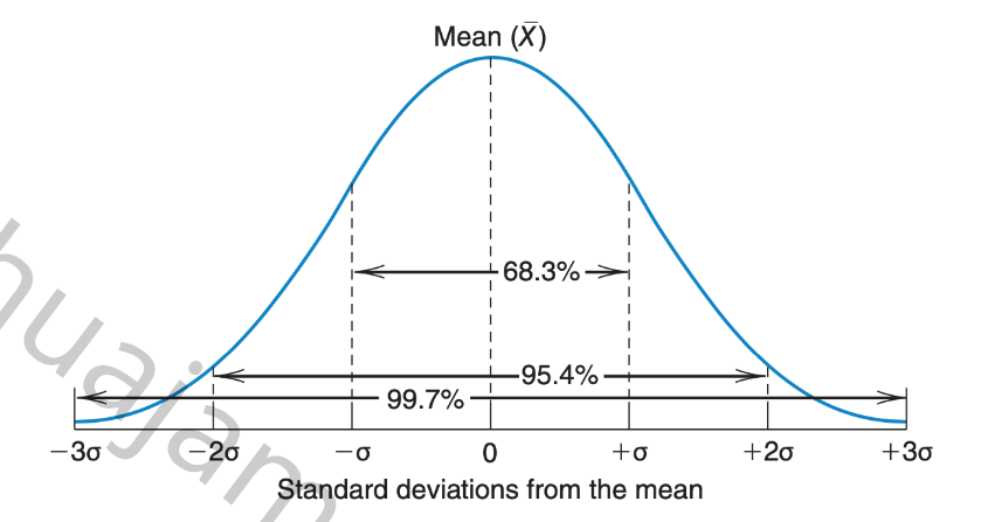
In Gaussian Distribution curve, what are the percentages of the values that lies in -σ to +σ, -2σ to +2σ, and -3σ to +3σ?
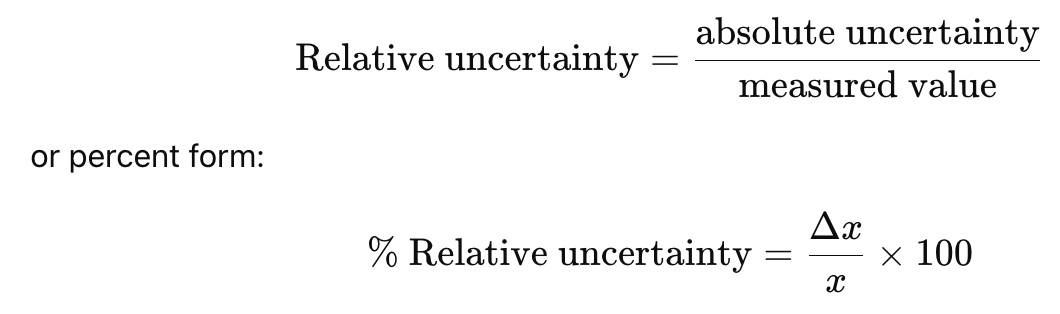
What is the difference between absolute uncertainty and relative uncertainty?
Absolute uncertainty = uncertainty in actual units (ex: 25.0 ± 0.2 mL)
Relative uncertainty = uncertainty compared to the size of the measurement
What is a confidence intervel?
Confidence interval is the range of values at which the true mean is expected to lie at a certain probability.
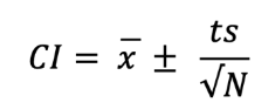
What is the equation for confidence interval?
What is confidence level?
Probability at which the true mean value lies within the confidence interval.
What is the significance level?
Probability at which the the true mean lies outside the confidence interval.
What is the purpose of Grubbs Test and Dixon’s Test (Q-test)?
to detect outliers is a small dataset
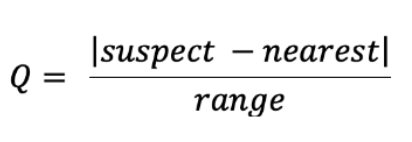
What is the equation for Dixon’s Test (Q-test)?
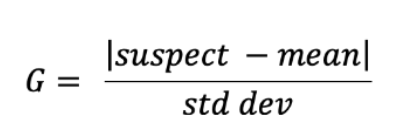
What is the equation for Grubb’s Test?
What is a one-sample t-test? And can you give me an example?
Compares the experimental mean to the accepted value (reference value)
Ex: you wanted to test a method by comparing the mean of the results to a reference standard and check whether there is a significant difference.
What is a two-sample t-test? And can you give me an example?
compares the means of two independent dataset.
ex. you wanted to check two methods to analyze an analyte and check if there is a significant difference.
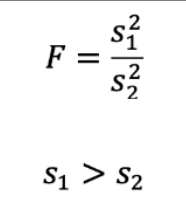
What is an f test? And can you give me an example?
An f-test compares the variance or precision of two independent dataset.
ex. you wanted to compare the precision of both methods and check if there is a significant difference
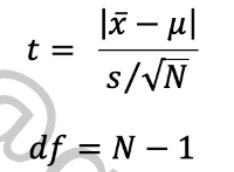
What is the equation for one sample t-test?
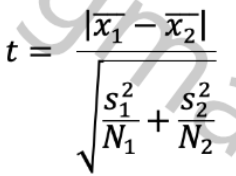
What is the equation for tow sample t-test?
What is the equation for F-test?
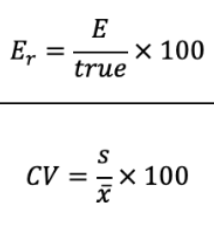
What is the difference between accuracy and precision?
accuracy is the measure of how close your measured value to the true accepted value, while precision is the measure of how close your value is.
How do you calculate the accuracy and precision of your dataset? And how do you know that it is accurate and precise?
if the value is < 5% of the %Error (relative error) and RSD (CV), then it is considered accurate and precise
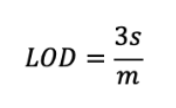
What is LOD? Provide the equation
Limit of Detection (LOD) is the lowest concentration of the analyte that can be detected.
What is LOQ? Provide the equation.
Limit of Quantification is the lowest concentration of the analyte that can be detected with accuracy and precision.
What is LOL?
Limit of Linearity is the maximum concentration or the signal at which the line begins to deviate.
What is the dynamic range? Provide the equation
Dynamic range is the range of the analyte’s concentration at which the method is accurate
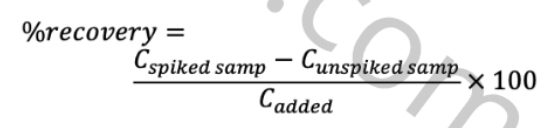
What is the equation for %recovery?
Pb2+ forms ____ precipitate with ___.
NOTE: this is a cation with notable confirmatory test.
Yellow, I-
Cu2+ forms _____ solution with ___.
NOTE: this is a cation with notable confirmatory test.
Blue, NH3
Fe3+ forms _____ solution with ___.
NOTE: this is a cation with notable confirmatory test.
red, SCN-
Al3+ forms _____ gelatinous precipitate with ___.
NOTE: this is a cation with notable confirmatory test.
white, OH-
Ni2+ forms _____ precipitate with ___.
NOTE: this is a cation with notable confirmatory test.
red, DMG - dimethylglyoxime
What is supersaturation?
Supersaturation is the unstable state where more solute is dissolve that it normally holds under equilibrium by manipulating the temperature or pressure.
If the von Weimarn ratio is low, or the relative supersaturation is low, what does that mean?
It means that it favor crystal growth formation because nucleation rate is slow or the driving force of forming nuclei is weak that the ions in the solution deposit into the existing nuclei, forming a larger, purer crystal.
If the von Weimarn ratio is high, or the relative supersaturation is high, what does that mean?
It means that it favors colloidal formation because rapid nucleation produces a very large number of tiny nuclei, leaving little solute available for crystal growth, resulting in finely divided particles.
What is nucleation?
Nucleation is the initial process where the ions or molecules (4 to 5) coalesce to form a stable cluster that can form into crystals.
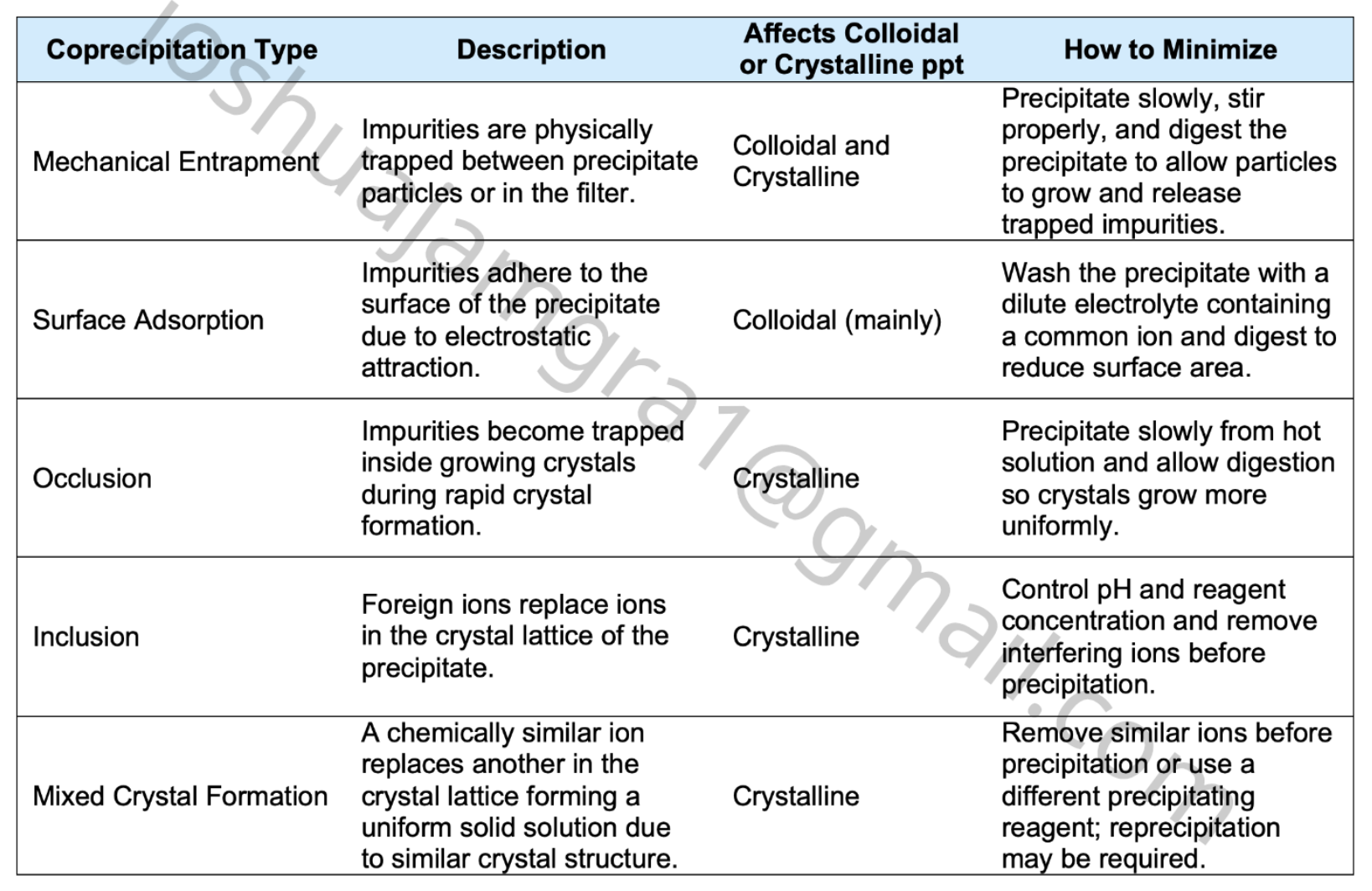
What are the types of coprecipitates? And what are the differences among them?
Can you explain what is digestion in gravimetry?
Digestion is the process of heating a freshly formed precipitate in its mother liquor and allowing it to stand so that small particles dissolve and redeposit onto larger crystals, improving crystal size and purity.
What is peptization?
Peptization is the opposite of coagulation. It is the process of converting a coagulated precipitate back into a colloidal sol by adding a small amount of a peptizing agent (electrolyte). The electrolyte provides ions that are adsorbed on the particle surface, giving them a charge and causing electrostatic repulsion that redisperse the particles into a stable colloid.
What reagent is commonly used to standardized strong acids?
Na2CO3
What is the molecular formula of KHP?
KHC8H4O4
Whats the difference between endpoint and equivalence point?
Endpoint - where color changes
Equivalence point - theoretical values where the moles of analyte and the titrant is equal.
What reagent is commonly used to standardized strong bases?
KHP
What is the Kjeldahl Mehod?
It is used to determine nitrogen and protein content in food, by converting N to NH3.
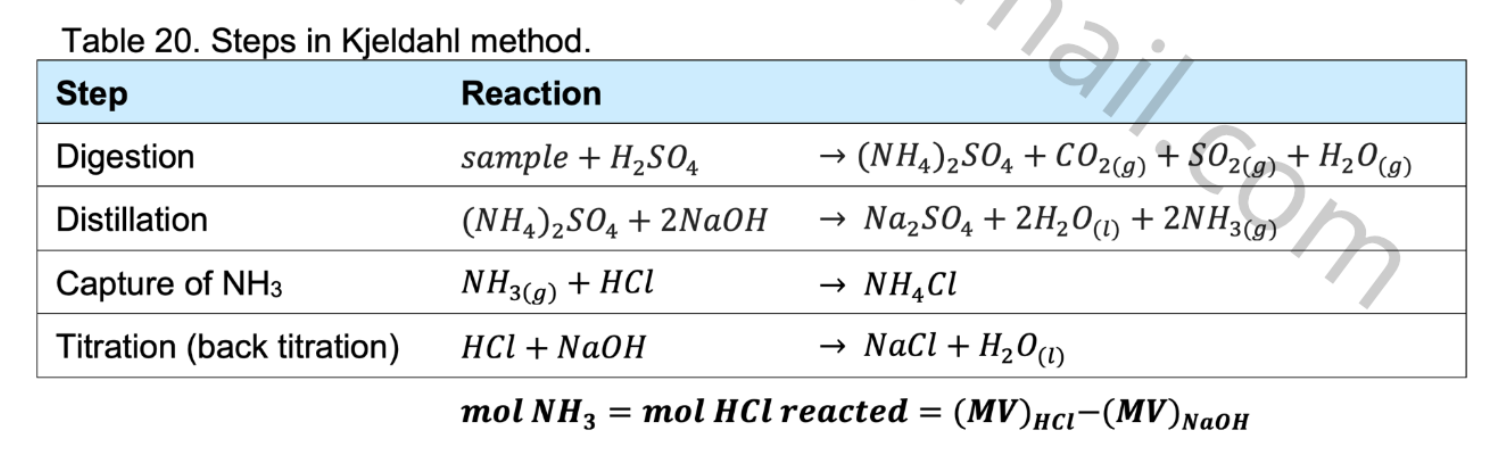
What are the steps in the Kjeldahl method, as well as the reaction?
Whats the difference between chelates and chelating agent?
Chelates are the complex formed (metal + ligand)
Chelating agent (ligand) - compounds that bind to the metal.
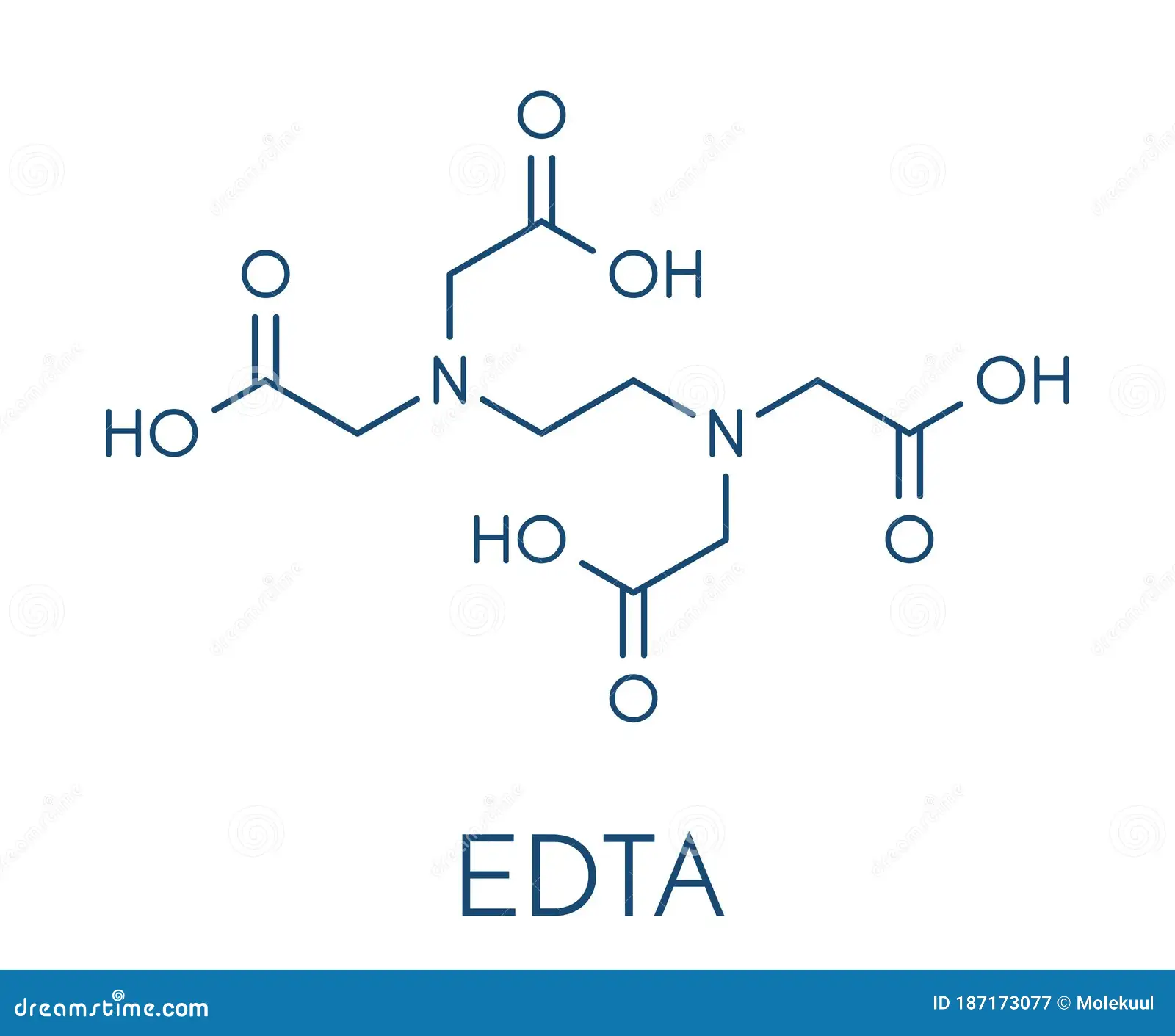
What is the chemical name and chemical formula of EDTA?
Ethylenediaminetetraacetic acid, C10H16N2O8.
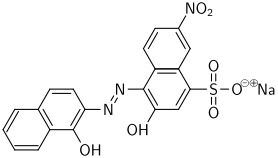
What is the commonly used indicator in EDTA?
EBT - Eriochrome Black T
Why is EDTA not suitable in acidic condition. And what is the pH range for it to be in suitable condition?
EDTA is not suitable in acidic condition because it wont bind effectively to the metal because of the protons. For it to be stable, it should be in 7-11 pH condition (commonly buffered around 10 by NH4Cl/NH3 buffer), for it to completely deprotonated or in active form Y4−.
What is the color change in EDTA?
red wine > blue
What is the mechanism of EDTA?
By displacing EBT as chelating agent due to high Kf of EDTA.
How many acidic protons are there in EDTA?
6
How many amine groups are there in EDTA?
2
What is the neutral form of EDTA?
H4Y
What is the Liebig Method in complexometric titration?
This method is used in determining CN- in solutions, by forming a complex of [Ag(CN)2]- and precipitating the excess Ag+ with KI, which produces yellow precipitate.
What is the colour of the precipitate in Liebig Method, indicating endpoint.
Yellow
What is the titrant, analyte, and indicator used in Liebig Method complexometric titration?
Analyte > sample containing CN-
Titrant > AgNO3
Indicator > KI
What is the principle behind Volhard Method?
Volhard Method is used to determine the conc. of halides (Cl-, Br-, I-) in the solution. This is achieved by reacting the sample with excess AgNO3 to form a precipitate, and back titrating it with SCN- to form of AgSCN ppt. The excess SCN- then forms a red complex with Fe3+, indicating the endpoint.
What is the titrant, analyte, and the indicator used in Volhard method?
Analyte > halides (Cl-, Br, I-)
Titrant > KSCN
Indicator > NH₄Fe(SO₄)₂·12 H₂O, ferric ammonium sulfate
What is the principle behind Mohr Method?
This method is used to determine Cl-, especially in the determination of Cl content in water and soil. The principle behind this method is is the precipitation of AgCl. The excess Ag+ is then reacted with the CrO4- producing a brick red precipitate.
What is the titrant, analyte, and the indicator used in Mohr’s method?
Analyte > halides (Cl-)
Titrant > AgNO3
Indicator > CrO4-
What is the principle behind Fajan’s Method?
This method is used to determine Cl content in complex matrices (e.g. urine). The principle behind this method is the adsorption of DCF (Dichlorofluorescein) on the surface of precipitate. The DCF adsorbs on the excess Ag+ producing a pink endpoint.
What is the endpoint in Fajans Method?
green > pink
What is the titrant, analyte, and the indicator used in Fajan’s method?
Analyte > halides (Cl-)
Titrant > AgNO3
Indicator > DMF
what is the difference between partition and adsorption chromatography?
partition chromatography relies on components dissolving differently between two liquid phases (solubility), while adsorption chromatography relies on components sticking to a solid surface (surface interactions)
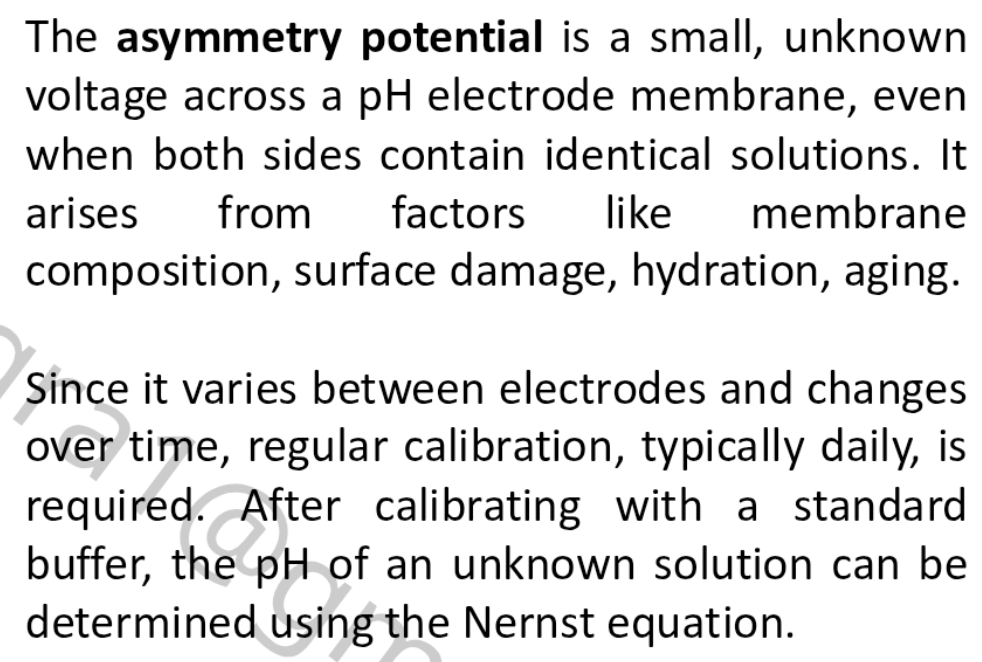
what is the equation for assymetry potential?
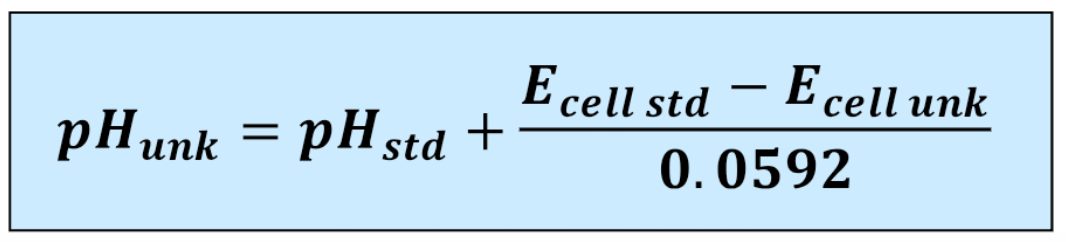
what is assymetry potential