Fundamentals and Acute Adjustments (I)
 Call Kai
 Learn
Learn Practice Test
 Spaced Repetition
 Match
Match Flashcards
 Knowt Play
1/29

Earn XP
Description and Tags
Semester 2, week 2
Name | Mastery | Learn | Test | Matching | Spaced | Call with Kai |
|---|
No analytics yet
Send a link to your students to track their progress
30 Terms
What two things act together for muscle performance?
Neural activation and muscle-tendon unit force
What is involved in neural activation?
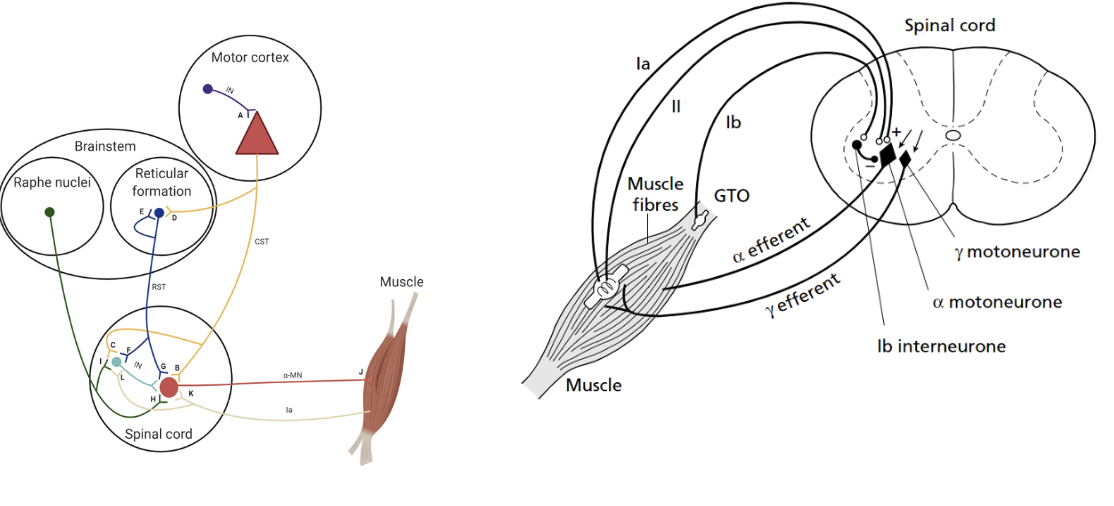
What are the two types of inputs from the nervous systems to the muscle (two broad ways nerves influence muscle cells)?
Ionotropic input
Metabotropic input
What is ionotropic input?
Membranes depolarised or hyperpolarised (neurotransmitter binds to ion channels on muscle membrane which changes membrane potential: depolarisation makes the muscle more likely to contract, hyperpolarisation makes contraction less likely)
What is metabotropic input?
Sets the excitability of the cell (neurotransmitter binds to G-protein-coupled receptors instead of ion channels, triggering intracellular signalling pathways. It sets or adjusts the excitability of the muscle cell rather than directly causing contraction)
What does the muscle spindle do?
Regulates or controls or senses the length of the muscle. If the muscle is severely stretched then fibres within the muscle spindle will send an excitatory signal back to the spinal cord which makes neurons excitable so they send signals
What is an evolutionary feedback mechanism to prevent excessive muscle forces being placed on the tendon?
Another pathway senses tension at the muscular tenderness junction which sends an inhibitory signal to the spinal cord producing the output of the muscle (Golgi tendon reflex)
What are the two types of actions the nervous system can produce?
Voluntary actions or reflexiv
What are voluntary actions?
Choosing to move (brain sends signals)
What are reflexive actions?
The result of the excitation of the receptors around the body
Where do signals converge?
Signal converge in the spinal cord in a structure called the alpha motor neuron. These are motor cells in the spinal cord that then connect to the muscle fibres.
What is the final common pathway/motor unit?
All the reflex signals and voluntary signals from the brain will amalgamate into a common signal in the spinal cord. A neuron normally innervates a group of fibres (depending on muscle type and location in body etc.)
What is innervation ratio?
How many fibres a given neuron innvervates/connects to
What is the size principal?
Way by which a motor unit controls muscle force:
Motor unit recruitment = activation of individual multi-unit
Smaller units/fibres are recruited first
Increases force means you have to recruit another neuron
Happens in order of increasing size
Smaller neurons have higher input resistance = for a change of voltage in the cell, there is a greater change in current in the cell
More signals needed to recruit larger neurons
Muscle/motor unit is the most basic functional contractile property in the neuromuscular system
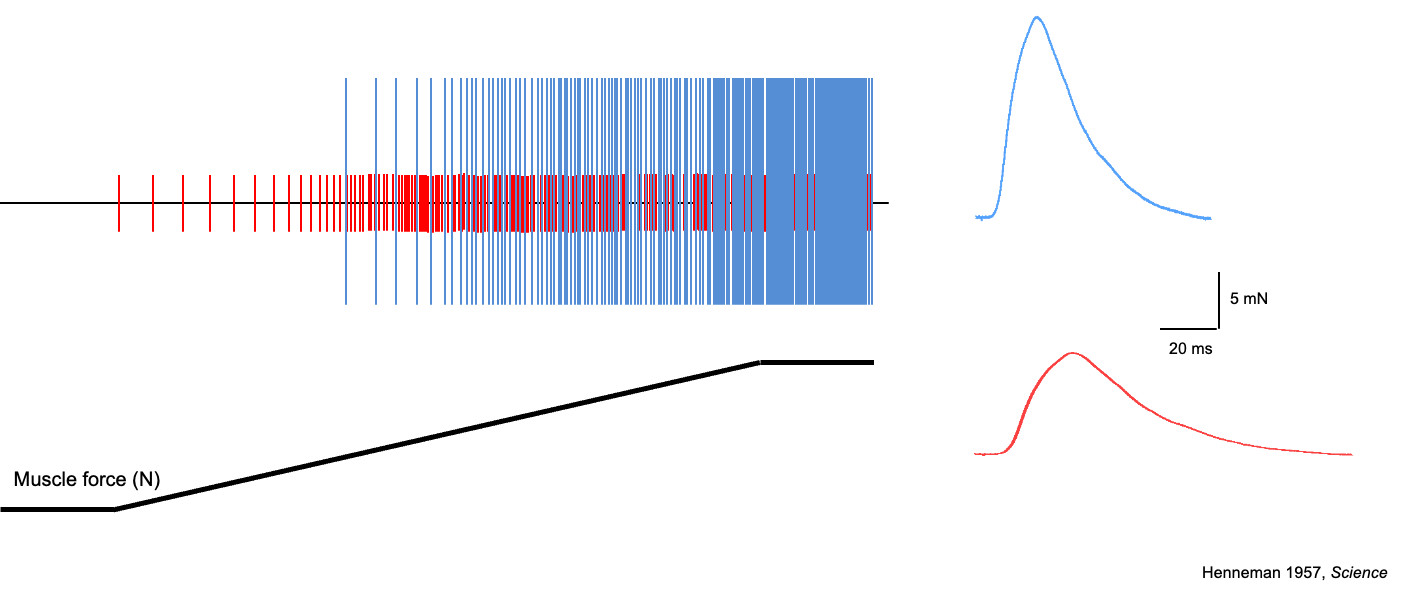
How is a muscle/motor unit characterised by?
How large the twitch is (more twitches means bigger muscle force)
Rate at which twitch is being produced
Relaxation of the twitch (how long does it take to get back to initial state)
Both magnitude and fused (smooth)
Frequency + motor unit recruitment
What is activation potential?
Acute way of how to modulate contractile properties of the muscle so that for the same input from the nervous system there's a greater output momentarily
What are the properties of activation potentiation?
Only lasts for a few minutes
Can acutely enhance performance without doing very much
Why sprinters jump before the get in the blocks
Why warm ups are important (prime nervous and muscular system to enhance performance)
How is muscle controlled?
Muscles that have a high innervation ratio typically use recruitment of additional motor units as the primary strategy to enhance force
Muscles that are more suited for fine motor control use rate coding or additional enhanced discharge rating to control muscle force
To do with the efficiency of the motor system
Smaller motor units recruited first (that have the highest input resistance and therefore need a very small voltage change to be depolarised) tend to reach the highest frequency of firing at the peak = onion skin phenomenon
What is feedback control?
A neuromuscular process where sensory receptors (like muscle spindles) send real-time data to the nervous system, allowing for automatic, rapid adjustments in muscle tension, length, and posture during movement or exercise
What is feedforward control?
Preprogrammed/ballistic movements performed with minimal reliance on sensory feedback during the action; used for very rapid movements where there is insufficient time for corrections.
Why does force decrease then increase again when 20% of maximum is held for as long as possible?
Forces are maximal = more motor units will be recruited
Discharge rates of units would have to be modulated
Initially discharge rate decreases (more motor units required)
Then system starts to increase as ran out of motor units
What are the differences between a motor unit and muscle fibre?
Motor unit type:
Slow twitch (S)
Fast-twitch, fatigue resistant (FR)
Fast-twitch, fatigable (FT)
Muscle fibre type:
Slow-twitch, oxidative (SO, Type I)
Fast-twitch, oxidative glycolytic (FOG, Type IIa)
Fast-twitch glycolytic (FG, Type IIx)
Motor unit and muscle fibre are not the same thing!
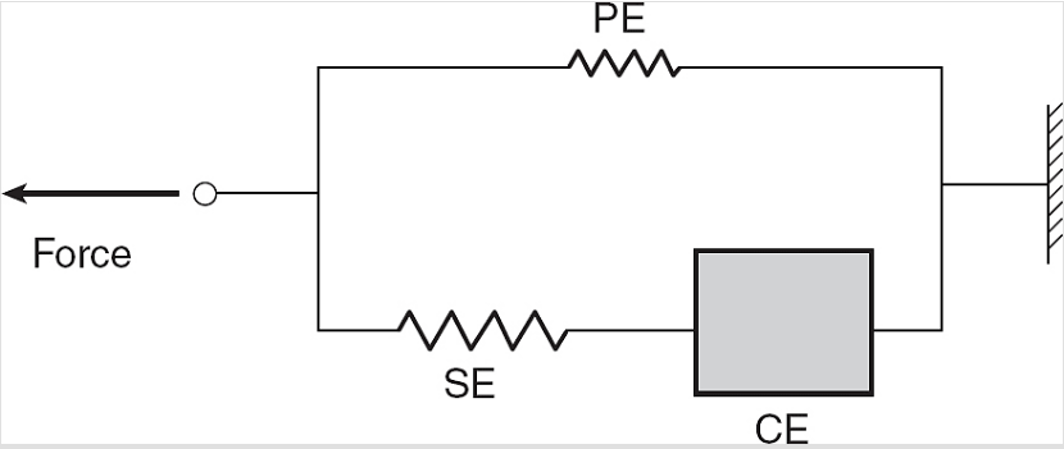
What is the Hill Muscle Model in muscle mechanical properties?
Contractile element represents the muscle fibres themselves that are contracting, directly controlled by the nervous system, and are effectively governed by the force length and velocity relationship of muscle fibre
Series elastic elements represent the elasticity of the cross bridges themselves and the tendons and other elastic structures within muscle tissue or muscle tendon units
Parallel elastic elements that represent the modulator of force or transmitter of force to the skeleton
Governed by force length and force velocity relationship
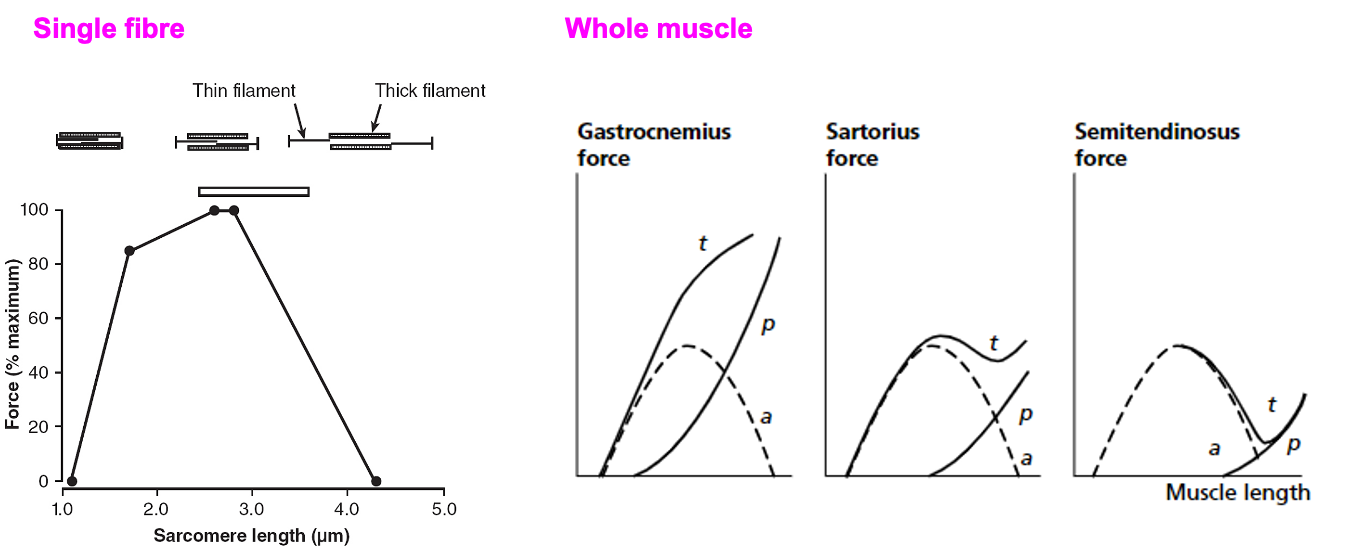
What is the force-length relationship for a single fibre and a whole muscle?
Single sarcomere, relationship = broadly parabolic (relates to the ability of the thin and thick filaments to attach to one another and move and therefore produce force) (active element)
Whole muscle there is elastic passive properties that passively produce force (tendons, elasticity of cross bridges)
T represents total = sum of active and passive force length relationships
Longer tendon (eg. Achilles) provides more passive force as well and longer muscle length
Cannot change the attachment of muscle which affects passive force
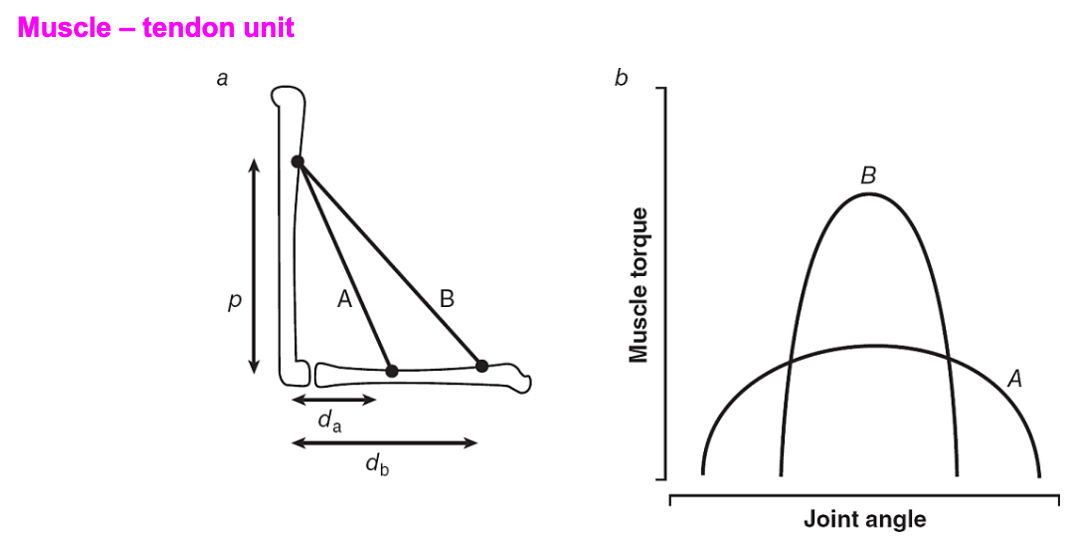
What is the force-length relationship of a muscle-tendon unit?
Torque production matters as that moves the skeleton
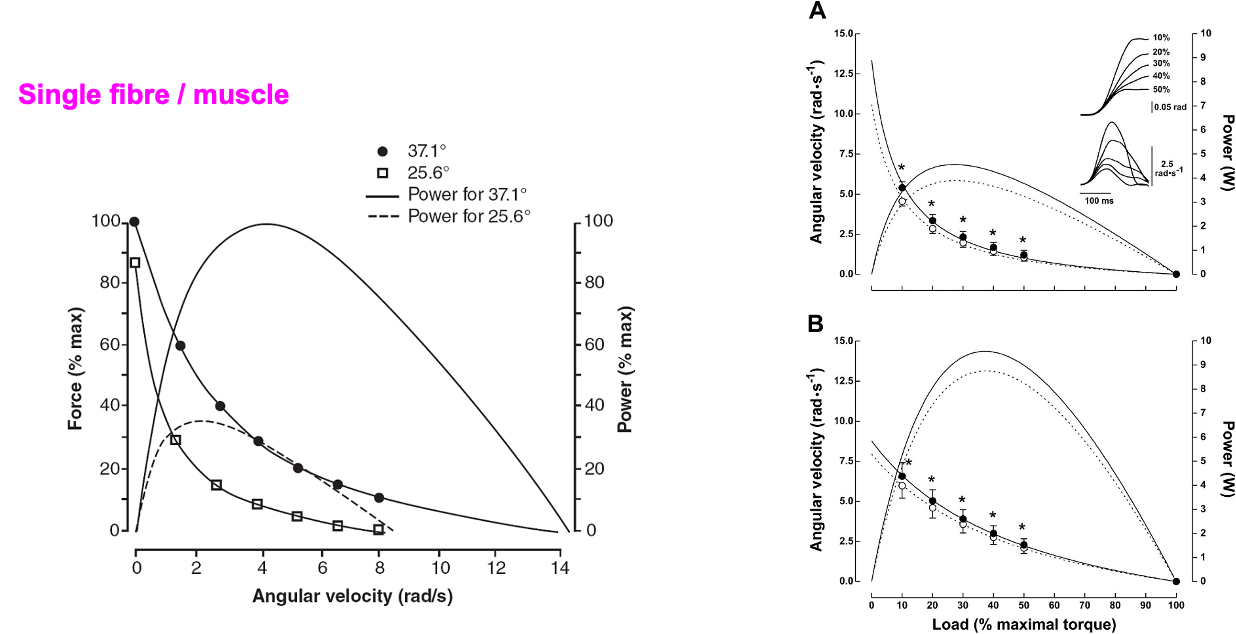
What is the force-velocity relationship of a single fibre/muscle?
Velocity at which muscle is contracting
If muscle is contracting at slow velocity, the cross bridges can attach very readily and produce a lot of force
If that velocity increases, the cross bridges cannot attach as quickly because we're not able to produce as much force because of the velocity of action
At the level of single muscles, in concentric actions, we typically see this sort of relationship with an exponential decay, whereby the force is very large, with very low velocity, and then with an exponential decay function, it progressively decreases
You can alter this acutely in two ways:
Enhancing the temperature of the muscle
Small contraction beforehand or warm up
Only applies to concentric actions
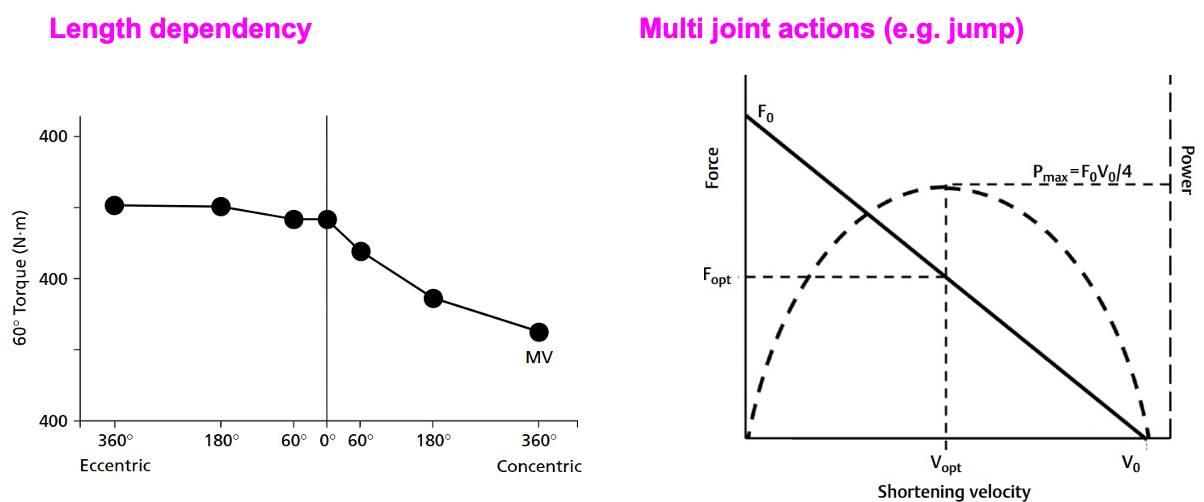
What is the length dependency relationship and multi-joint actions force-velocity relationship?
When it comes to eccentric actions, it has very poor relationship to velocity meaning that essentially forces during lengthening actions seems to be quite stable regardless of the velocity of that action
Ability to produce high forces under conditions of resisting something is not impaired or altered by the velocity in general
Multi-joint actions (sprinting, jumping), relationship is linear due to multiple single joint actions accumulating together
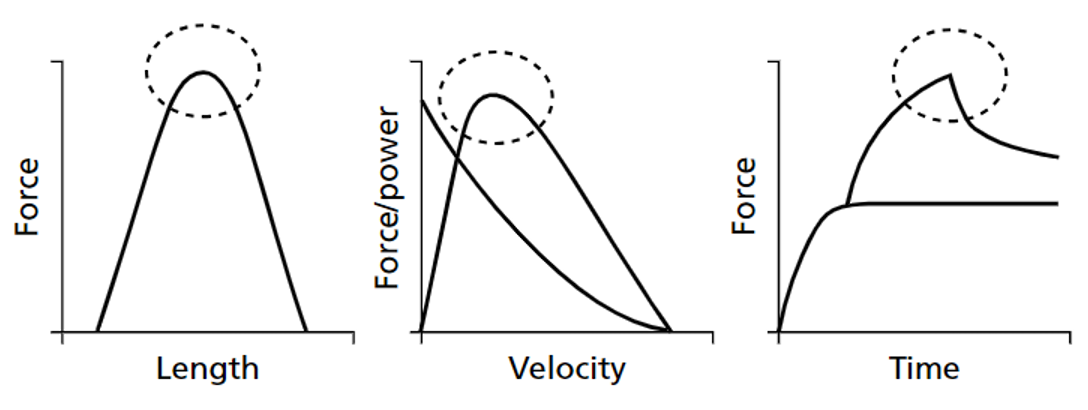
How do you maximise muscle mechanical properties?
Fibres arranged in parallel, forces produced by fibres will multiply and force output will increase
Why bigger muscles tend to be stronger
What is the stretch-shortening cycle?
Most actions in sport are a combination of eccentric, isometric and concentric pattern of force production = stretch-shortening cycle
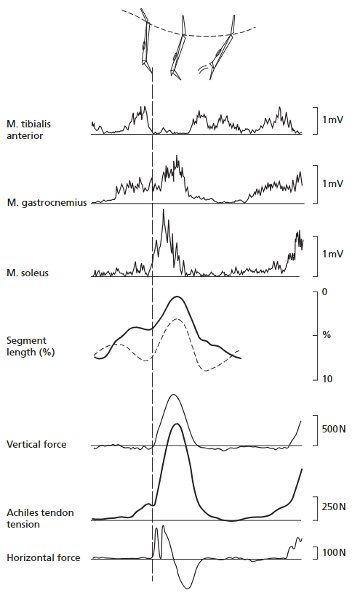
What is a summary of the fundamental and acute adjustments (I)?
Input to CNS are either reflexive or voluntary
Motor unit is the basic functional property of the neuromuscular system that transforms the activation signal and transduces it into contractile activity
The control of force is achieved via motor unit recruitment and rate coding
A single action potential leads to a motor unit twitch - most contractions are achieved by a series of action potentials that result in overlapping twitches which summate to produce tetanus
The force produced by a muscle is also influenced by contractile properties of muscle fibres, the arrangement of these fibres within the muscle, and the attachment sites of these muscles on the skeleton
Mechanical muscle properties are characterised by distinct force-length and force-velocity relationships at the level of single fibre and the whole muscle; these are different from relationships observed during "real-life" joint actions
Most of muscle performance does not happen in isolation, but as a combination of eccentric, isometric and concentric contractions - known as stretch-shortening cycle