Oncology Unit (BioMed 3 Final) Diagram | Quizlet
 Call Kai
 Learn
Learn Practice Test
 Spaced Repetition
 Match
Match Flashcards
 Knowt Play
1/47

There's no tags or description
Looks like no tags are added yet.
Name | Mastery | Learn | Test | Matching | Spaced | Call with Kai |
|---|
No analytics yet
Send a link to your students to track their progress
48 Terms
TERM
What cyclin is asociated with the phase G1?
DEFINITION
Cyclin D
TERM
What cyclin is associated with phase G1/S?
DEFINITION
Cyclin E
TERM
What cyclin is associated with phase S?
DEFINITION
Cyclin A
TERM
What cyclin is associated with the phase M?
DEFINITION
Cyclin B
What are the leading risks to developing cancer? (8)
· Age
· Alcohol
· Cancer-Causing Substances
· Diet
· Hormones
· Obesity
· Radiation (ex: UV)
· Tobacco
What are tummor supressor genes?
genes that slow down cell division, repair DNA damage, or trigger cell death when damage is severe
What are proto-oncogenes?
genes that code for proteins that stimulate cell growth division and growth
What are oncogenes?
-cancer causing gene
-proto-oncogenes mutated due to exposure to mutagens or carcinogens
What is apoptosis?
programmed cell death
How does apoptosis relate to cancer/cell cycle?
kills cancerous cells so that they can't replicate and proliferate
What is p53?
a tumor suppressor protein that stops the cell cycle when DNA is damaged and can trigger cell death if the damage cannot be repaired
What happens if p53 is absent or not triggered?
-no inhibition of cancerous cells
-uncontrolled cell division
What are cyclins?
-proteins that regulate the timing of the cell cycle by activating enzymes that move the cell from one phase to the next
-internally regulate the cell
What are Cyclin-dependent kinases (CDKs)?
-enzymes that control progression through the cell cycle
-must bind to cyclins to become active
What characteristic is constant and what changes for CDKs?
-constant: the number of CDKs
-changed: active/inactive state
Summary of CDK and Cylcin Interactions:
1. Cyclin activates CDK
2. CDK binds to phosphate
3. Enzyme is activated
True or False: Cyclins do not degrade and the number present is constant.
False
-(# of cyclins is NOT constant)
-(# of CDKs ARE constant)
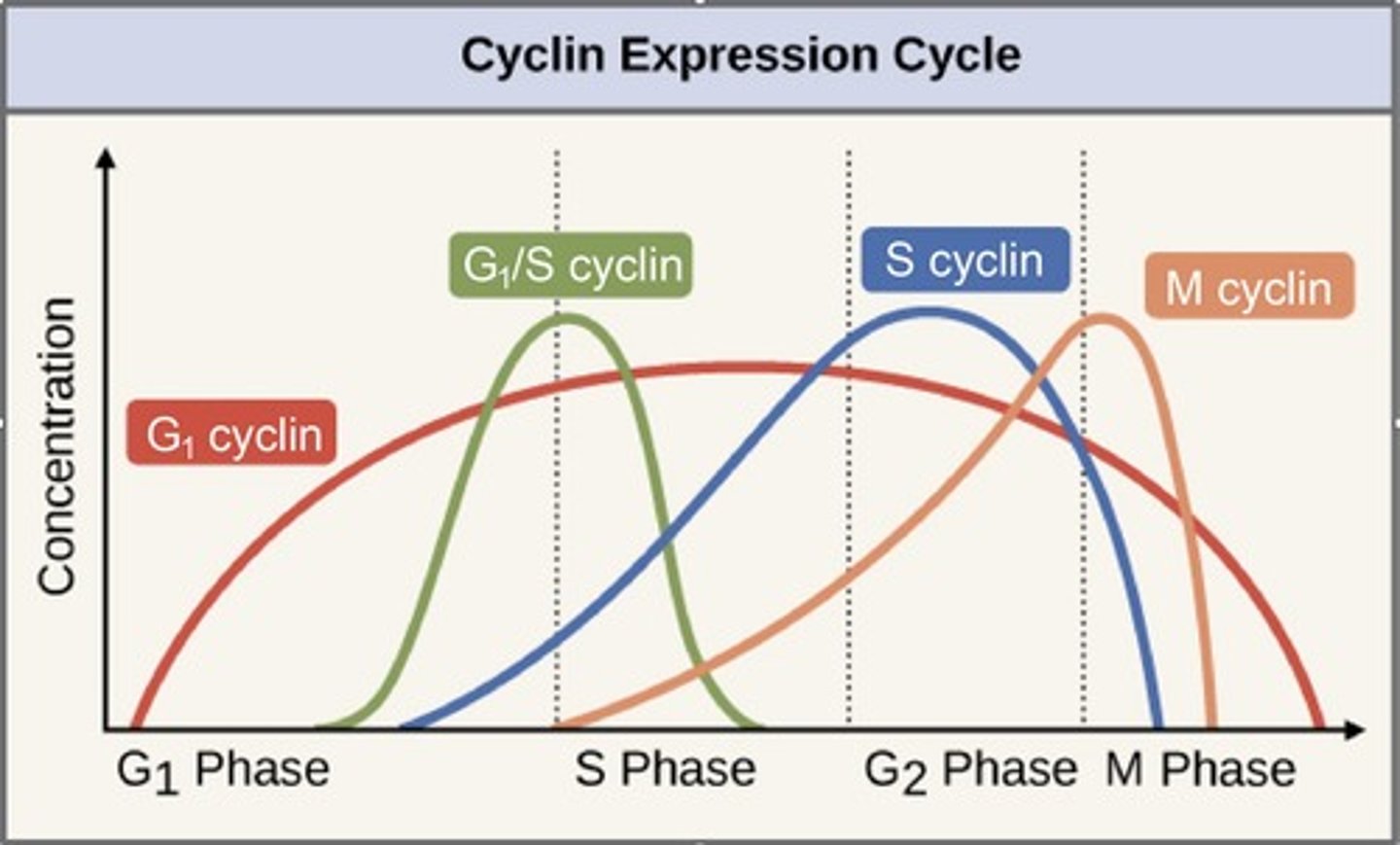
What are the 4 cyclins present in the cell cycle?
1. D
2. E
3. A
4. B
What is the function of the 4 cyclins present in the cell cycle?
help signal cell to go from one phase to another
What is the function of fluctuating cyclin and activated CDK concentrations?
-trigger the transition from one cell phase to another
What causes cyclin and CDK concentrations to increase and what cuases them to decrease?
-increase: triggered by internal signal or external growth factors
-decrease: the degregation of cyclin
What is cancer?
the disease caused by an uncontrolled division of abnormal cells in a part of the body.
What is a benign tumor?
non-cancerous tumor that does not spread
What is a malignant tumor?
-mass of cancer cells that can spread
-grows rapidly and spreads to other tissues
What is metastasis?
the spread of cancer from the primary site to distant organs or tissues
What is G0 phase?
resting phase
What are the 4 cell cycle stages?
1. G1 Phase
2. S Phase
3. G2 Phase
4. M Phase
Key Points of G1 Phase
-cell growth
-normal cell functions
-prepare for cell division
Key Points of S Phase
-DNA Synthesis
-Cell replicates its genetic material
-DNA duplicates
Key Points of G2 Phase
-Duplicates necessary proteins and organelles
-Prepares for mitosis
Key Points of M Phase
-Nucleus divides producing 2 cells
Why is it crucial to prevent mutatations before the cell transitions to S phase?
-DNA will be replicated leading to permanent errors
-Damaged/mutated cells can then replicate possibly resulting in cancer
What is internal regulation?
Control of the cell cycle from within the cell, such as checkpoints that monitor DNA damage and completion of DNA replication
What is external regulation?
Control of the cell cycle by signals from outside the cell, such as growth factors that tell a cell when to divide or stop dividing
Fill in the Blank: A ligand is an ________ ______ that stiumlates cell division. _____ _______ are specialized ligands.
1. external signal
2. Growth factors
3 main Growth Factors in Cell Regulation
1. Epidermal Growth Factor
2. Platelet Derived Growth Factor
3. Growth Hormones
What is Maturation Promoting Factor (MPF)?
a cyclin-Cdk complex that triggers a cell's passage past the G2 checkpoint into the M phase
How do kinases activate target proteins?
by adding phosphate groups (phosphorylation) from amino acids
What are favorable growth conditions for cells?
-Adequate supply of food
-Oxygen and water
-Suitable temperatures
-Ability to eliminate waste products
What is cell anchorage dependence?
cells must be attachted to a surface to replicate
What is density dependent inhibition?
when cells grow and start crowding each other they send out signals to stop dividing
What is RAS?
-A signaling protein that promotes cell growth and division
-Mutations can cause it to stay active and drive uncontrolled cell division
Characteristic of Cancer Cells (5):
1. Abnormal Nuclei
2. Varried Sizes and Shapes
3. Disorganized Growth
4. Uncontrolled Growth
5. Ability to Invade other Tissues
Characteristics of Healthy Cells (4):
1. Stable DNA
2. Adhere to neighboring cells
3. Stay within their designated tissue boundaries
4. Uniform structure and growth
Radiation Therapy:
-Treatment of cancer with a radioactive substance, x-ray, or radiation
-Shrink or damage cancer cell DNA
Chemotherapy:
-Use of powefrul drugs to treat diseases such as cancer
-Kills rapidly dividing cells in body
Carcinogens:
Cancer causing agents
Still learning (4)
You've started learning these terms. Keep it up!