6- Alkane, Alkene, Alkynes
 Call Kai
 Learn
Learn Practice Test
 Spaced Repetition
 Match
Match Flashcards
 Knowt Play
1/82

There's no tags or description
Looks like no tags are added yet.
Name | Mastery | Learn | Test | Matching | Spaced | Call with Kai |
|---|
No analytics yet
Send a link to your students to track their progress
83 Terms
b. Paraffins
The common name or alias for alkanes
a. Olefins
b. Paraffins
c. Alkynes
d. Aromatics
d. sp³
The hybridization of carbon atoms in alkanes
a. sp
b. sp²
c. sp³d
d. sp³
d. CₙH₂ₙ₊₂
The general molecular formula for open-chain alkanes
a. CₙH₂ₙ
b. CₙH₂ₙ₋₂
c. CₙH₂ₙ₊₁
d. CₙH₂ₙ₊₂
c. CₙH₂ₙ
The general molecular formula for cyclic alkanes
a. CₙH₂ₙ₊₂
b. CₙH₂ₙ₋₂
c. CₙH₂ₙ
d. CₙH₂ₙ₊₁
d. -ane
The suffix used to name alkanes in IUPAC nomenclature
a. -ene
b. -yne
c. -ol
d. -ane
c. They have very stable single bonds
The reason alkanes have minimal reactivity compared to other organic functional groups
a. They have multiple bonds
b. They contain oxygen atoms
c. They have very stable single bonds
d. They are sp² hybridized
d. Free radicals
The only type of reagent that can react with alkanes due to their stable single bonds
a. Nucleophiles
b. Electrophiles
c. Lewis acids
d. Free radicals
d. Free radical substitution
The first standard reaction of alkanes halogens
a. Combustion
b. Nucleophilic substitution
c. Electrophilic addition
d. Free radical substitution
c. Combustion
The second standard reaction of alkanes that can occur either completely or partially
a. Halogenation
b. Nucleophilic substitution
c. Combustion
d. Electrophilic addition
d. 2
1) Free-radical substitution (halogenation)
2) Combustion (either complete or partial)
The total number of standard reactions undergone by alkanes
a. 4
b. 3
c. 1
d. 2
c. Combustion
The type of alkane reaction defined as a reaction with O₂
a. Substitution
b. Elimination
c. Combustion
d. Addition
The condition required for complete combustion of alkanes
a. Limited O₂ supply
b. Absence of heat
c. Unlimited O₂ supply
d. Presence of acid catalyst
c. Unlimited O₂ supply
b. CO₂ + H₂O + CO + C
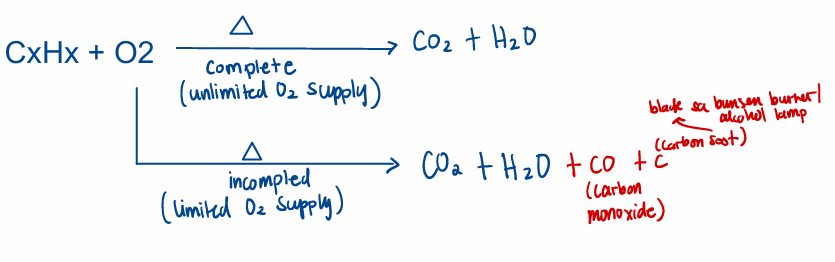
The products of incomplete combustion of an alkane with limited O₂ supply
a. CO₂ + H₂O
b. CO₂ + H₂O + CO + C
c. CO + C + CO₂
d. CO₂ + CO
a. CO₂ + H₂O
The products of complete combustion of an alkane with limited O₂ supply
a. CO₂ + H₂O
b. CO₂ + H₂O + CO + C
c. CO + C + CO₂
d. CO₂ + CO
c. Limited O₂ supply
The condition that leads to incomplete combustion of alkanes
a. Unlimited O₂ supply
b. Excess heat
c. Limited O₂ supply
d. Presence of water
c. Carbon monoxide (CO) &
d. C
The additional product formed in incomplete combustion that is NOT present in complete combustion
a. CO₂
b. H₂O
c. Carbon monoxide (CO)
d. C
d. Carbon (C)
The carbon-containing solid product formed during incomplete combustion of alkanes, also known as carbon soot
a. Carbon dioxide (CO₂)
b. Carbon monoxide (CO)
c. Carbonate
d. Carbon (C)
c. Black or sooty flame
The visual indicator of incomplete combustion seen in a Bunsen burner or alcohol lamp
a. Blue flame
b. Colorless flame
c. Black or sooty flame
d. Yellow-orange flame
c. Free Radical Substitution
Type of reaction undergone by alkanes where R· = halogen
a. Nucleophilic Addition
b. Electrophilic Substitution
c. Free Radical Substitution
d. Nucleophilic Substitution
d. Alkyl halide (CH3R)

study the succeeding reaction
Product formed when CH4 (methane) reacts with one equivalent of R· (halogen radical)
a. Alkyl dihalide (CH2R2)
b. Carbon tetrahalide (CR4)
c. Trihalide (CHR3)
d. Alkyl halide (CH3R)
c. Chain Initiation
Step in free radical substitution defined by formation of free radical as the side product
a. Chain Propagation
b. Chain Termination
c. Chain Initiation
d. Chain Substitution
d. UV light
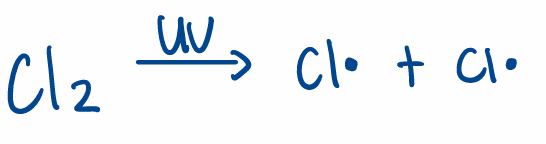
Reaction condition required for chain initiation in free radical substitution of Cl2
a. Heat (Δ)
b. Pressure
c. Acid catalyst
d. UV light
d. Chain Propagation
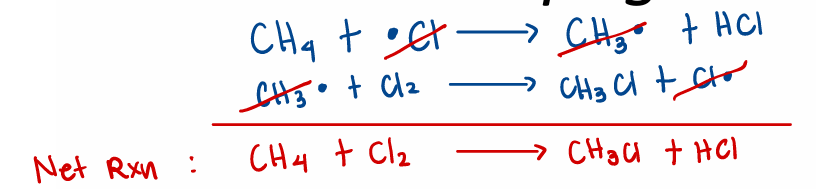
Step in free radical substitution where the radical is seen on both sides of the equation
a. Chain Initiation
b. Chain Termination
c. Oxidative Addition
d. Chain Propagation
d. CH4 + Cl2 → CH3Cl + HCl
Net reaction of CH4 and Cl2 in free radical substitution
a. CH4 + Cl2 → CH3· + HCl
b. CH4 + Cl2 → CH2Cl2 + H2
c. CH4 + Cl2 → CH4Cl + Cl·
d. CH4 + Cl2 → CH3Cl + HCl
c. Chain Termination
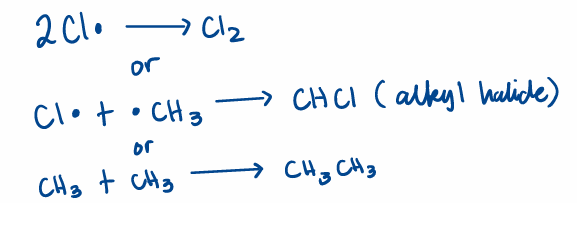
Step in free radical substitution where radicals are eliminated (nawawala radicals)
a. Chain Propagation
b. Chain Initiation
c. Chain Termination
d. Chain Substitution
c. Olefins
Another name for alkenes
a. Paraffins
b. Alkynes
c. Olefins
d. Aromatics
d. CnH2n
Molecular formula of alkenes (open-chain, one double bond)
a. CnH2n+2
b. CnH2n-2
c. CnHn
d. CnH2n
c. -ene
Suffix used for naming alkenes
a. -ane
b. -yne
c. -ene
d. -ol
b. Electron-rich double bonds = welcomes electrophiles
Property of alkenes that describes their double bonds as electron-rich, causing them to welcome electrophiles
a. Electron-poor double bonds = repels nucleophiles
b. Electron-rich double bonds = welcomes electrophiles
c. Electron-rich double bonds = welcomes nucleophiles
d. Electron-poor double bonds = welcomes electrophiles
d. Electrophilic Addition
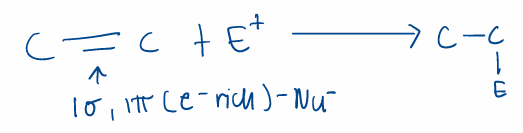
Common mechanism for standard reactions of alkenes
a. Free Radical Substitution
b. Nucleophilic Addition
c. Electrophilic Substitution
d. Electrophilic Addition
b. 1σ, 1π bonds
Components of the double bond in alkenes that make them electron-rich
a. 2σ, 1π bonds
b. 1σ, 1π bonds
c. 2σ, 2π bonds
d. 1σ, 2π bonds
1) Hydrogenation/Reduction
2) Halogenation
3) Hydrohalogenation
4) Hydration
5) Hydroxylation
Standard reactions of alkenes
d. Hydrogenation
Alkenes reaction defined as addition of H₂
a. Halogenation
b. Hydration
c. Hydrohalogenation
d. Hydrogenation
c. Alkane
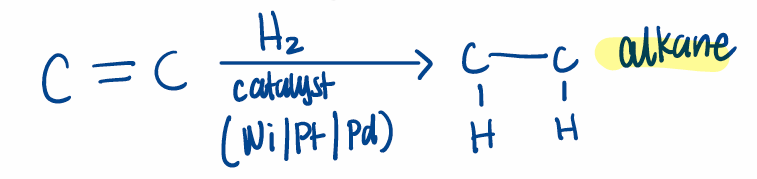
Product formed when an alkene undergoes Hydrogenation
a. Alcohol
b. Alkyl halide
c. Alkane
d. Vicinal dihalide
b. Ni, Pt, Pd
Catalysts used in the Hydrogenation of alkenes
a. HCl, H₂SO₄, H₃O⁺
b. Ni, Pt, Pd
c. X₂, HX
d. H₂O, H⁺
c. Halogenation
Alkenes reaction defined as addition of X₂
a. Hydrohalogenation
b. Hydration
c. Halogenation
d. Hydroxylation
d. Vicinal dihalide
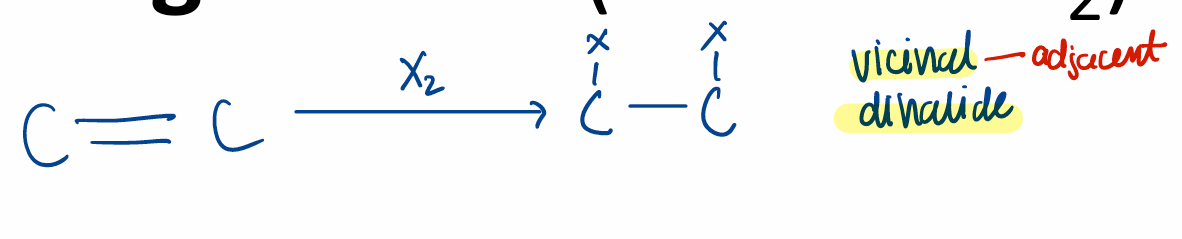
Product formed when an alkene undergoes Halogenation
a. Alkyl halide
b. Alkane
c. Alcohol
d. Vicinal dihalide
b. Vicinal dihalide
Term that describes the product of Halogenation where halogens are added to adjacent carbons
a. Geminal dihalide
b. Vicinal dihalide
c. Alkyl halide
d. Terminal dihalide
a. Hydrohalogenation
Alkenes reaction defined as addition of HX
a. Hydrohalogenation
b. Hydration
c. Hydrogenation
d. Halogenation
c. Alkyl halide

Product formed when an alkene undergoes Hydrohalogenation
a. Alcohol
b. Vicinal dihalide
c. Alkyl halide
d. Alkane
c. Hydration
Alkenes reaction defined as addition of H₂O
a. Hydroxylation
b. Hydrohalogenation
c. Hydration
d. Halogenation
b. Alkene is electron-rich; H₂O is electron-rich nucleophile; nucleophile + nucleophile = no reaction
Reason why mixing an alkene with H₂O alone produces no reaction
a. Alkene is electron-poor; H₂O is electron-rich nucleophile; nucleophile + nucleophile = no reaction
b. Alkene is electron-rich; H₂O is electron-rich nucleophile; nucleophile + nucleophile = no reaction
c. Alkene is electron-rich; H₂O is electron-poor electrophile; electrophile + electrophile = no reaction
d. Alkene is electron-poor; H₂O is electron-poor electrophile; electrophile + electrophile = no reaction
d. Alcohol
Product formed when an alkene undergoes Hydration with HCl and H2SO4
a. Alkane
b. Vicinal dihalide
c. Alkyl halide
d. Alcohol
b. HCl or H₂SO₄
BEQ
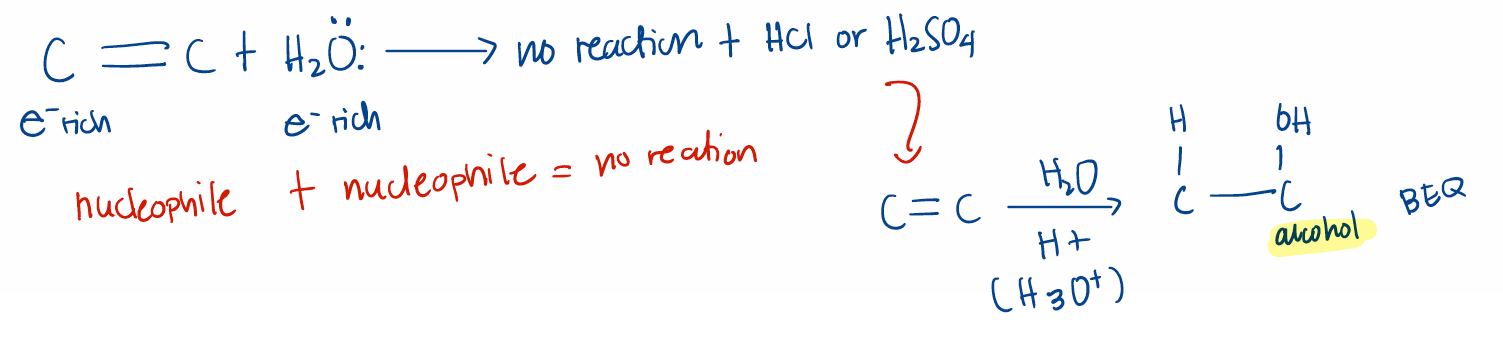
Reagents that can be used as the acid catalyst in the Hydration of alkenes
a. Ni or Pd
b. HCl or H₂SO₄
c. X₂ or HX
d. NaOH or KOH
a. Hydroxylation
Alkenes reaction defined as addition of hydroxyl groups via oxidation
a. Hydroxylation
b. Hydration
c. Hydrohalogenation
d. Halogenation
b. KMnO₄, OH⁻
Reagents used in the Hydroxylation of alkenes
a. H₂O, H⁺ (H₃O⁺)
b. KMnO₄, OH⁻
c. Ni, Pt, Pd with H₂
d. X₂ in inert solvent
c. Violet
Color of KMnO₄ used as reagent in Hydroxylation of alkenes
a. Brown
b. Colorless
c. Violet
d. Orange
c. MnO₂ (brown precipitate)
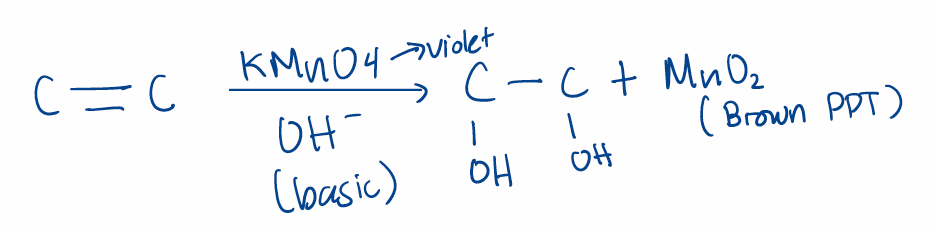
By-product formed alongside the Diol during Hydroxylation of alkenes using KMnO₄/OH⁻
a. HCl (colorless gas)
b. KCl (white precipitate)
c. MnO₂ (brown precipitate)
d. MnSO₄ (pale pink precipitate)
d. Diol
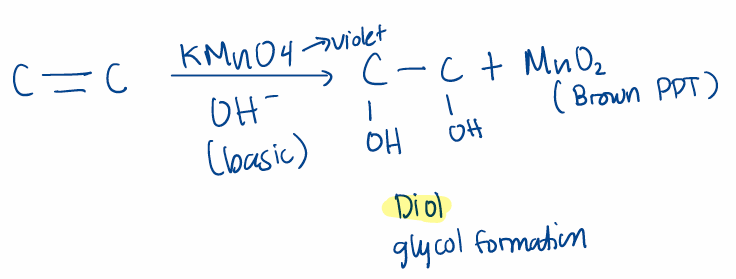
Product formed when an alkene undergoes Hydroxylation
a. Alkane
b. Alkyl halide
c. Vicinal dihalide
d. Diol
b. Glycol formation
Another term for the Diol product formed during Hydroxylation of alkenes
a. Aldehyde formation
b. Glycol formation
c. Ketone formation
d. Ester formation
c. Baeyer's Test for Unsaturation
Qualitative test for unsaturation that applies the Hydroxylation reaction of alkenes
a. Lucas Test
b. Tollens' Test
c. Baeyer's Test
d. Fehling's Test
b. Markovnikov's Rule
Rule that governs the orientation of electrophilic additions in alkenes, also described as "rich gets richer"
a. Zaitsev's Rule
b. Markovnikov's Rule
c. Hückel's Rule
d. Saytzeff's Rule
b. Lesser number of substituents
According to Markovnikov's Rule, H adds to the carbon with
a. Greater number of substituents
b. Lesser number of substituents
c. Equal number of substituents
d. No substituents
d. Greater number of substituents
According to Markovnikov's Rule, X adds to the carbon with
a. Lesser number of substituents
b. No substituents
c. Equal number of substituents
d. Greater number of substituents
c. Stability (3° > 2° > 1°)
Basis of Markovnikov's Rule in electrophilic addition reactions
a. Electronegativity (F > Cl > Br > I)
b. Reactivity (1° > 2° > 3°)
c. Stability (3° > 2° > 1°)
d. Polarity (δ+ > δ-)
d. 2-chloropropane
2° carbocation
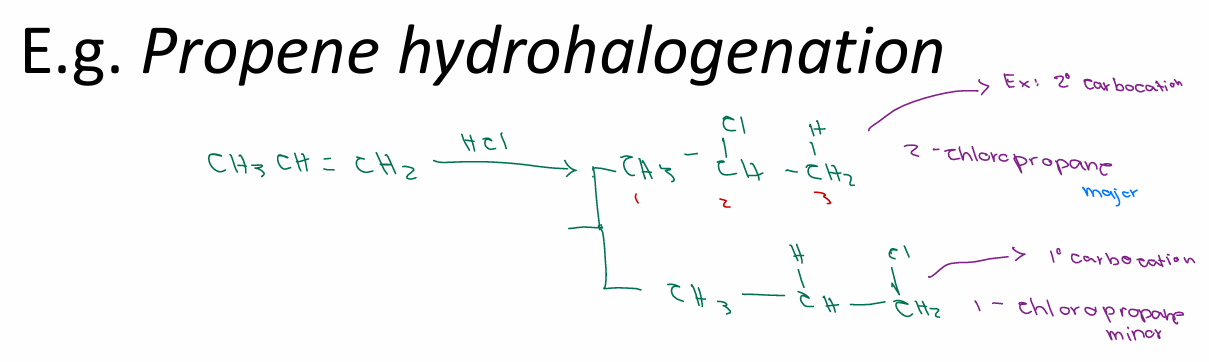
Major product formed in the hydrohalogenation of propene (CH₃CH=CH₂) with HCl following Markovnikov's Rule
a. 1-chloropropane
b. 3-chloropropane
c. 1,2-dichloropropane
d. 2-chloropropane
d. 1-chloropropane
2° carbocation
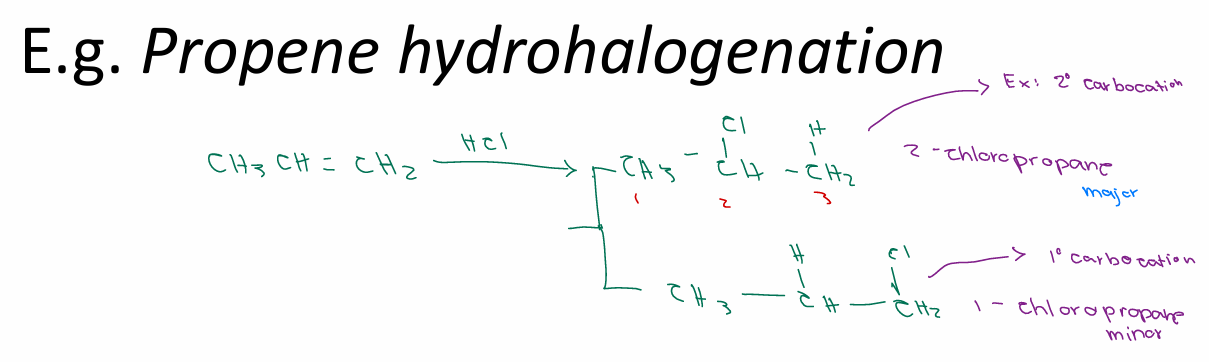
Minor product formed in the hydrohalogenation of propene (CH₃CH=CH₂) with HCl
a. 2-chloropropane
b. 1,2-dichloropropane
c. 2,2-dichloropropane
d. 1-chloropropane
c. Electrophilic Addition
Markovnikov's Rule specifically applies to the orientation of which type of reaction in alkenes
a. Free Radical Substitution
b. Nucleophilic Substitution
c. Electrophilic Addition
d. Elimination Reaction
c. Acetylenes
Another name for alkynes
a. Paraffins
b. Olefins
c. Acetylenes
d. Aromatics
c. CnH2n-2
Molecular formula of alkynes (open-chain, one triple bond)
a. CnH2n+2
b. CnH2n
c. CnH2n-2
d. CnHn
d. -yne
Suffix used for naming alkynes
a. -ane
b. -ene
c. -ol
d. -yne
a. Electron-rich triple bonds = welcome electrophiles
Property of alkynes that describes their triple bonds causing them to welcome electrophiles
a. Electron-rich triple bonds = welcome electrophiles
b. Electron-poor triple bonds = welcome nucleophiles
c. Electron-rich triple bonds = welcome nucleophiles
d. Electron-poor triple bonds = welcome electrophiles
d. 1σ, 2π bonds
Components of the triple bond in alkynes that make them electron-rich
a. 2σ, 2π bonds
b. 1σ, 1π bonds
c. 2σ, 1π bonds
d. 1σ, 2π bonds
d. Electrophilic Addition
Common mechanism for all standard reactions of alkynes
a. Free Radical Substitution
b. Nucleophilic Addition
c. Electrophilic Substitution
d. Electrophilic Addition
c. All reactions of alkynes are like alkenes
Statement that describes the relationship between alkyne reactions and alkene reactions
a. All reactions of alkynes are like alkanes
b. All reactions of alkynes are like aromatics
c. All reactions of alkynes are like alkenes
d. All reactions of alkynes are like paraffins
1) Hydrogenation/Reduction
2) Halogenation
3) Hydrohalogenation
4) Hydration (followed by tautomerization)
Standard reactions of alkynes (4)
b. Followed by tautomerization
Unique feature of Hydration in alkynes that distinguishes it from Hydration in alkenes
a. Followed by halogenation
b. Followed by tautomerization
c. Followed by hydrogenation
d. Followed by hydroxylation
a. Hydrogenation
Alkyne reaction defined as addition of H₂
a. Hydrogenation
b. Hydrohalogenation
c. Hydration
d. Halogenation
c. Pd/Pt/Ni
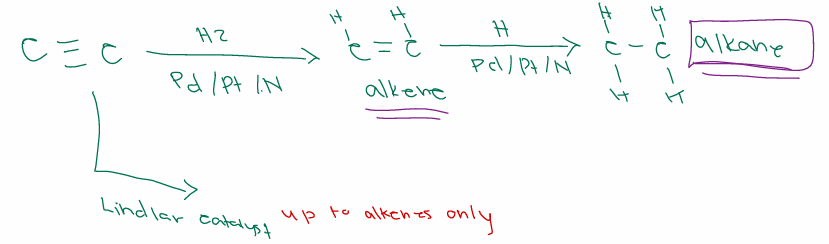
Catalyst used in the complete Hydrogenation of alkynes producing an alkane
a. Lindlar catalyst
b. HCl or H₂SO₄
c. Pd/Pt/Ni
d. KMnO₄/OH⁻
b. Alkene
Intermediate product formed during the first step of Hydrogenation of alkynes before becoming an alkane
a. Alcohol
b. Alkene
c. Alkyl halide
d. Diol
c. Lindlar catalyst
Catalyst used in Hydrogenation of alkynes that stops the reaction at the alkene stage only
a. Pd/Pt/Ni
b. KMnO₄
c. Lindlar catalyst
d. H₃O⁺
d. Alkane
Final product formed when an alkyne undergoes complete Hydrogenation using Pd/Pt/Ni
a. Alkene
b. Diol
c. Alkyl halide
d. Alkane
b. Halogenation
Alkyne reaction defined as addition of X₂
a. Hydrohalogenation
b. Halogenation
c. Hydration
d. Hydroxylation
c. Vinyl dihalide
Intermediate product formed during the first step of Halogenation of alkynes
a. Alkane
b. Geminal dihalide
c. Vinyl dihalide
d. Tetrahalide
d. Tetrahalide

Final product formed when an alkyne undergoes complete Halogenation with excess X₂
a. Vicinal dihalide
b. Alkyl halide
c. Geminal dihalide
d. Tetrahalide
c. Hydrohalogenation
Alkyne reaction defined as addition of HX
a. Halogenation
b. Hydration
c. Hydrohalogenation
d. Hydrogenation
c. Vinyl halide
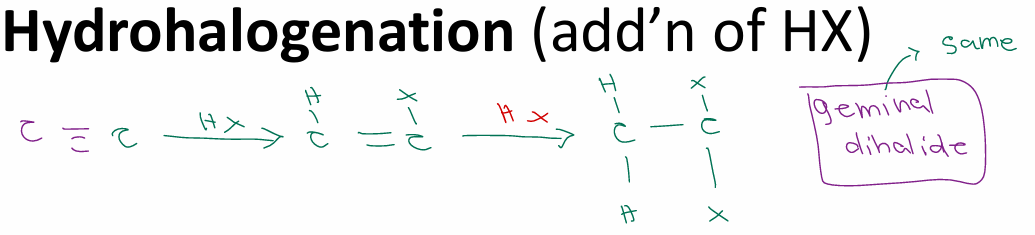
Intermediate product formed during the first step of Hydrohalogenation of alkynes
a. Alkane
b. Tetrahalide
c. Vinyl halide
d. Geminal dihalide
c. Geminal dihalide
Final product formed when an alkyne undergoes complete Hydrohalogenation with excess HX
a. Tetrahalide
b. Vicinal dihalide
c. Geminal dihalide
d. Alkyl halide
b. Halogenation yields tetrahalide; Hydrohalogenation yields geminal dihalide
Key distinction between the final product of Halogenation vs. Hydrohalogenation of alkynes
a. Halogenation yields geminal dihalide; Hydrohalogenation yields tetrahalide
b. Halogenation yields tetrahalide; Hydrohalogenation yields geminal dihalide
c. Both yield vicinal dihalide
d. Both yield geminal dihalide
c. Hydration
Alkyne reaction defined as addition of H₂O
a. Halogenation
b. Hydrohalogenation
c. Hydration
d. Hydroxylation
d. Enol

Intermediate product formed during Hydration of alkynes before rearrangement
a. Alcohol
b. Ketone
c. Aldehyde
d. Enol
c. Unstable
enol = initial = unstable
ketone = final = stable
Stability of the enol intermediate formed during Hydration of alkynes
a. Stable
b. Highly reactive
c. Unstable
d. Inert
d. Ketone
Final stable product formed after rearrangement of the enol intermediate in Hydration of alkynes
a. Alcohol
b. Aldehyde
c. Ester
d. Ketone