CELL BIOLOGY (WEEK 2)
 Call Kai
 Learn
Learn Practice Test
 Spaced Repetition
 Match
Match Flashcards
 Knowt Play
1/46

There's no tags or description
Looks like no tags are added yet.
Name | Mastery | Learn | Test | Matching | Spaced | Call with Kai |
|---|
No analytics yet
Send a link to your students to track their progress
47 Terms
What are all the parts of a eukaryotic cell?
cytoplasm
plasma membrane
nuclear envelope
nucleolus
nucleus
nuclear pore
rough er
smooth er
centrosome
ribosome
mitochondrian
lysosome
golgi complex
cilia
peroxisome
What are the properties of DNA?
holds genetic code
double stranded
consists of deoxyribose sugar, phosphate group, and the nitrogenous bases (A, T, G, C)
What are the properties of RNA?
involved in protein synthesis (mRNA, tRNA, rRNA)
single stranded
consists of ribose sugar, phosphate group, and nitrogenous bases (U, A, G, C)
What is the central dogma of life?
DNA does replication + requires enzymes (proteins)
transcription of DNA to RNA
translation of RNA to proteins
What occurs during DNA replication?
DNA must be copied for cell division
old DNA strands act as templates for new strands
DNA polymerase is the enzyme that makes DNA copies
What occurs during the transcription of DNA to RNA?
portion of DNA is copied into complementary messemger RNA molecule via RNA polymerase
mRNA moves from nucleus to cytoplasm to ribosome
What occurs during RNA translation?
mRNA sequencec is translated into amino acid on the ribosome; produces polypeptide
the mRNA sequence is called a codon and is read 3 nucleotides at a time
codons code for a particular amino acid
tRNA matches the mRNA sequence to the amino acid
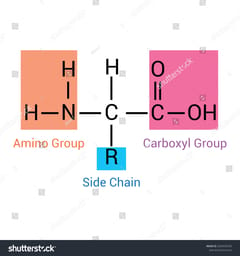
What are the parts of an amino acid?
amino group
carboxyl group
r group / side chain
How can we compare prokaryotes and eukaryotes?
eukaryotes are larger at 10-100 um; prokaryotes are smaller at 1-10 um
both contain carbohydrates, proteins, nucleic acids, and lipids
eukaryotes have multiple and linear chromosomes found in the nucleus
prokaryotes have single, circular chromosomes found in the nucleoid; can also contain plasmids
What is a plasmid?
small circles of DNA that do not encode essential genes
How does eukaryote cell division occur?
mitosis which consists of 4 phases
requires a mitotic spindle
How does prokaryote cell division occur?
binary fission where equal division of a bacterial cell into two cells occurs
How does eukaryote genetic variation occur?
meiosis
crossing over
independent assortment
How does prokaryote genetic variation occur?
horizontal gene transfer from the same generation
What is transformation?
bacteria collect DNA fragments (from lysed bacterial cells) in their environment
integrates fragments into bacteria’s own dna
What is transduction?
genetic transfer between bacterioa using a bacteriophage
bacteriophage = viruses that infect bacteria
What is conjugation?
DNA is directly transferred from one bacterium to another which requires direct cell to cell contact
happens via pilus or mating bridge
What traits do bacteria acquire by HGT?
antibiotic resistance
toxins like shiga
ability to use different nutrients like galactose fermenting enzyme
How can we compare organelles in eukaryotes and prokaryotes?
eukaryotes have organelles like mitochondria or choroplast
prokaryotes have no organelles
How can we compare ribosomes in eukaryotes and prokaryotes?
eukaryotes have free and bound ribosomes
prokaryotes have smaller and less dense + free form ribosomes only
What do eukaryotes contain in their plasma membranes?
phospholipid bilayer
cholesterol which is important for membrane stability, fluidity, and permeability
has channels that allow for osmosis, active transport, facilitated diffusion, etc
What do prokaryotes contain in their plasma membranes?
phospholipid bilayer
no cholesterol or sterols
can use osmosis, active transport, and facilitated diffusion
How can we compare the cell walls of eukaryotes and prokaryotes?
eukaryotes vary as some may have none, cellulose, silica (algae), or chitin (fungi)
prokaryotes has cell walls made of peptidoglycan
What is peptidoglycan?
made up of n-acetylglucosamine (NAG) and N-acetylmuramic acid (NAM)
contains side chains of amino acids between NAG and NAM
cross bridge amino acids
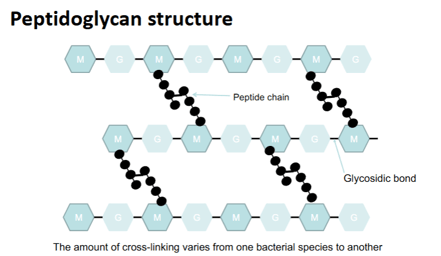
What are the names of chains / bonds in the peptidoglycan?
peptide chain
glycosidic bond
cross linking
What is a gram positive bacteria?
thick peptidoglycan layer
has techoic acids that aid in cation transport, cell wall structure, and antigenic specificity
stains purple with gram stain
What is a gram negative bacteria?
thin peptidoglycan layer
outer membrane with lipopolysaccharides (LPS), lipoproteins, porins, and phospholipids
stains pink with gram stain
What is the difference of susceptibility in gram positive and gram negative bacterias?
gram positive bacteria are more susceptible to antibiotics and disinfectants (eg. staphylococcus and streptococcus spp.)
gram negative bacteria are less susceptible to antiobiotics and disinfectants (eg. escherichia coli, salmonella spp.)
What is glycocalyx?
sticky carbohydrate layer present in prokaryotes and eukaryotes BUT with different functions
How can we describe the glycocalyx in a eukaryote?
carbohydrates bond proteins and lipids in plasma membrane
functions to strengthen cell surface, attach cells together, and in cell to cell recognition
How can we describe the glycocalyx in prokaryotes?
carbohydrates outside cell wall with similar functions
has a capsule that is an organized and firmly attached; helps bacteria avoid phagocytosis
has a slime layer that is disorganized and loosely attached
What is the importance of movemnent?
allows for cells to find mates
find favourable conditions away from danger or a palce with optimal conditions for cellular functions
reach new environments which reduces competition and increases odds of survival
What is taxis?
movement of a cell
phototaxis for light response
thermotaxis for temp response
chemotaxis for nutrient / chemical response (follows gradient)
What is positive and negative taxis?
positive: cell moves towards stimulus
negative: cell moves away from stimulus
What is a flagella?
long flexible tail found at one side of a cell
What is a cilia?
multiple small and short projections on the cell
What is atrichous?
no flagella
What is peritrichous?
flagella all over the cell
What is a polar flagella?
flagella at one or both ends
monotrichous = at one end
amphitrichous = at both ends
lophotrichous = a bunch at one end
How does running or swimming occur in a prokaryote?
flagella moves counter clockwise to propel bacteria in one direction
How does tumbling occur in a prokaryote?
the flagella splay out and move clockwise preventing forward movement
allows for change of direction
How does swarming occur in a prokaryote?
rapid wave like movement in peritrichous bacteria
What are endospores?
gram positive cells only (and only prokaryotes)
one bacteria forms one endospore
highly durable and dehydrated cells that survive harsh environments
can be released into environment via sporulation
can revert to a vegetative / growing state
What is a fimbriae?
only in prokaryotes
short appendages that enable attachment rather than movement
present in biofilm formation
adhesion to epithelial cells can cause disease
can consist of a few to hundreds
What is a pilus?
long hair like appendages used for motility and dna transfer
only one to two per cell
only in prokaryotes
What are inclusions?
reserves found in prokaryotes that contain certain nutrients for use when in extreme environments
What are axial filaments / endoflagella?
prokaryotes only
found mostly in spiral shaped bacteria + inside bacterial cell
causes spiral / corkscrew motion