EAI - 2 - Confucianism Part 1
 Call Kai
 Learn
Learn Practice Test
 Spaced Repetition
 Match
Match Flashcards
 Knowt Play
1/29

There's no tags or description
Looks like no tags are added yet.
Name | Mastery | Learn | Test | Matching | Spaced | Call with Kai |
|---|
No analytics yet
Send a link to your students to track their progress
30 Terms
Han classification of schools
Schools
Ru 儒 — Confucianism
Mo 墨 — Mohism
Ming 名 — School of Names / Logicians
Fa 法 — Legalism
Dao 道 — Daoism
Yinyang 陰陽 — Naturalists
Exam takeaway
“Schools” are partly later Han classifications, not always self-contained ancient groups.
Confucianism vs Neo-Confucianism vs New Confucianism
Confucianism = broad early tradition;
Neo-Confucianism = Song/Ming metaphysical revival influenced by Buddhism/Daoism;
New Confucianism = modern reinterpretation of Confucianism.
Sources / textual history
Point
Han scholars reconstructed, edited, and copied ancient texts.
This may have rewritten texts.
Sources include:
transmitted texts
archaeological finds
manuscripts
Exam takeaway
Ancient Chinese texts are layered and edited; do not treat them as pure direct records.
Warring States
Point
481–221 BCE = wars.
States challenge Zhou king and rulers assume the title of wang 王
“Hundred Schools.”
Main concern: stable political order.
Exam takeaway
Ancient Chinese philosophy is mostly political philosophy because it responds to disorder.
Confucius basic biography
Key facts
551–479 BCE.
Born in Lu.
Chinese name: Kongzi 孔子, Master Kong.
Given name: Qiu 丘.
Poor civil servant background, shi 士.
Itinerant philosopher.
About 30 main disciples.
Tried to persuade rulers to rule virtuously.
Mostly rejected.
Later becomes basis of Han state ideology.
Exam takeaway
Confucius was a failed political adviser in life, but became central to Chinese ethics and government after death.
Lunyu 論語
Point
Main work: Analects.
20 chapters.
Compiled by disciples.
Parts added after his death.
Central to Chinese philosophy/politics.
Not systematic.
Dialogues.
Confucianism developed gradually.
Exam takeaway
Lunyu preserves Confucian sayings/dialogues but is not a systematic philosophical treatise.
Transmitter or innovator?
Point
Was Confucius transmitting old Zhou ideals or creating something new?
Did he distinguish outer behavior from inner morality?
Point
Confucius calls himself transmitter, not creator.
Idealizes Zhou kings and sages.
Ruler should govern through virtue de 德, not excessive laws.
Personal example matters.
Compare Legalism!
using of laws to govern.
Exam takeaway
Confucius presents himself as transmitter, but his reinterpretation of ritual and virtue is innovative.
Ritual li 禮
Point
Li = ritual, rites, manners, proper behavior.
Binds humans, spirits, family, society, and numinous realm.
Regulates hierarchy, authority, power.
Includes reciprocal relations.
in other philosophical systems is the role of family very different.
Based on family and ancestors.
Humanizes authority. Humanizing effect on authority.
Exam takeaway
Li is both religious and political: it creates ordered relationships.
Ritual performance vs inner attitude
Point
Confucius does not want empty performance.
Inner moral quality matters.
Exam takeaway
Ritual must express inner virtue, not just external correctness.
Junzi, yi, li, sun, xin
Terms
Junzi 君子 — superior person / gentleman
Yi 義 — righteousness / rectitude
Li 禮 — ritual propriety
Sun 孫 — modesty/deference
Xin 信 — trustworthiness
Point
Junzi uses righteousness as substance.
Ritual puts it into action.
Modesty expresses it.
Trust completes it.
Exam takeaway
The junzi is defined by moral substance expressed through proper conduct.
Ren 仁
Point
Humaneness/benevolence.
Governs human relationships.
Innate but must be practiced.
Starts like a child’s love for parents.
Includes mutual respect.
Includes filial piety. 孝
Political: ruler must have ren.
Inhumane ruler can lose Mandate of Heaven.
Related to li (ritual) and yi(righteousness).
Exam takeaway
Ren is both ethical and political: personal virtue supports legitimate rule.
Dao 道
Point
Dao = right path / normative socio-political order.
In Confucius, Dao means moral-political order.
Compare across schools!
Dao is central in all Chinese schools.
Each school interprets it differently.
Always specify whose Dao: Confucian, Daoist, Legalist, etc.
Exam takeaway
In Confucianism, Dao is the Way of proper ethical-political order.
Five Relations
Relations
ruler – subject
father – son
husband – wife
older brother – younger brother
friends
Exam takeaway
Confucian society is built from ordered relationships, not isolated individuals.
Filial piety later
Point
Later Confucianism formalized/legalized filial piety.
Stories of extreme filial sacrifice developed.
Including extreme form of self sacrafice → during the song
Buddhism had to adapt to filial piety in China.
Tang law integrated filial piety.
Offences became “Ten Grave Crimes.”
Xiaojing 孝經 compiled early Han.
Still VERY relevant in Chinese society.
Exam takeaway
Filial piety becomes ethical, legal, religious, and social.
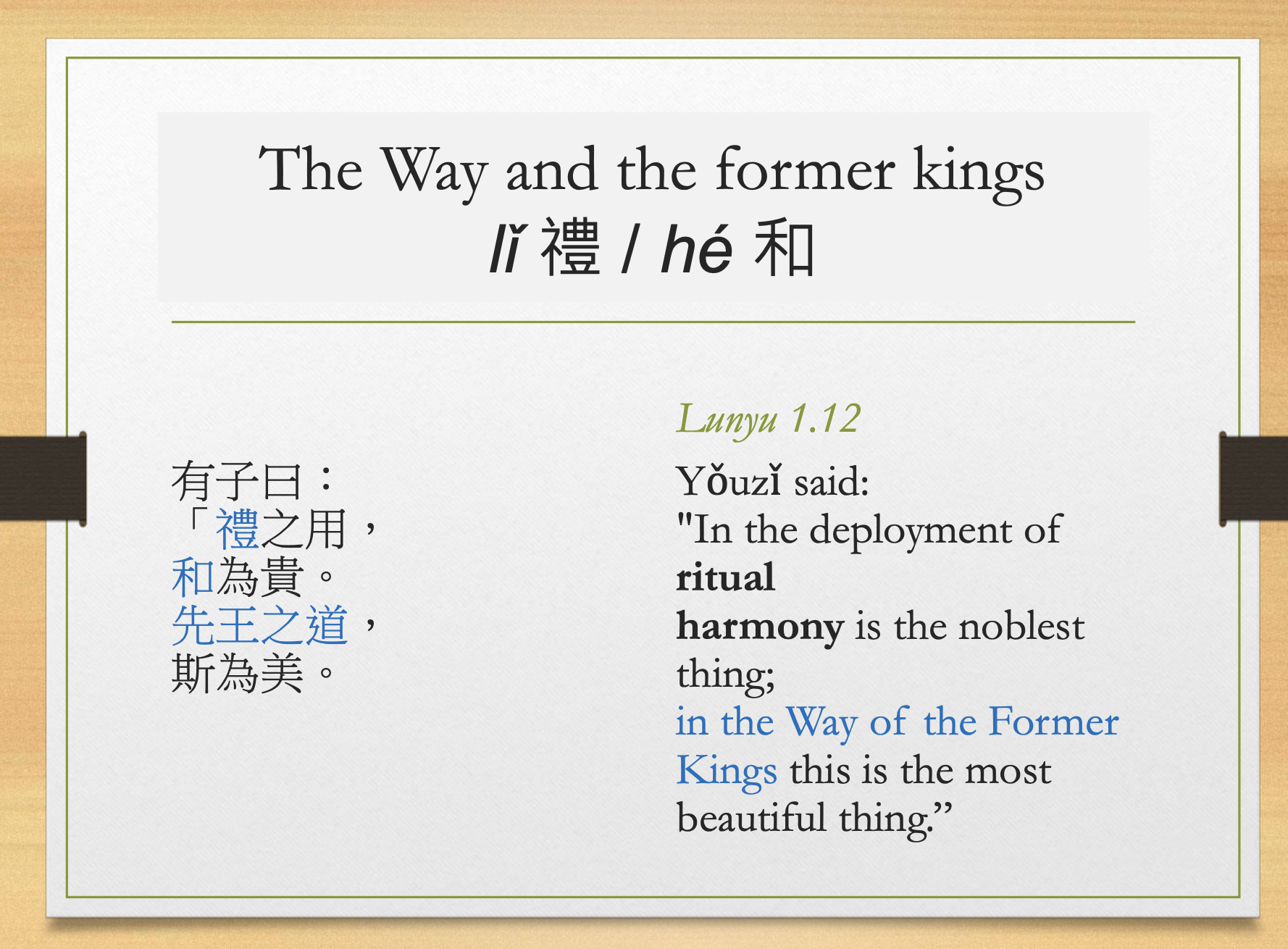
Way and former kings Slide 85
Point
Ritual produces harmony he 和.
The Way of former kings valued harmony.
Exam takeaway
Confucius links ritual, harmony, and idealized ancient rulership.
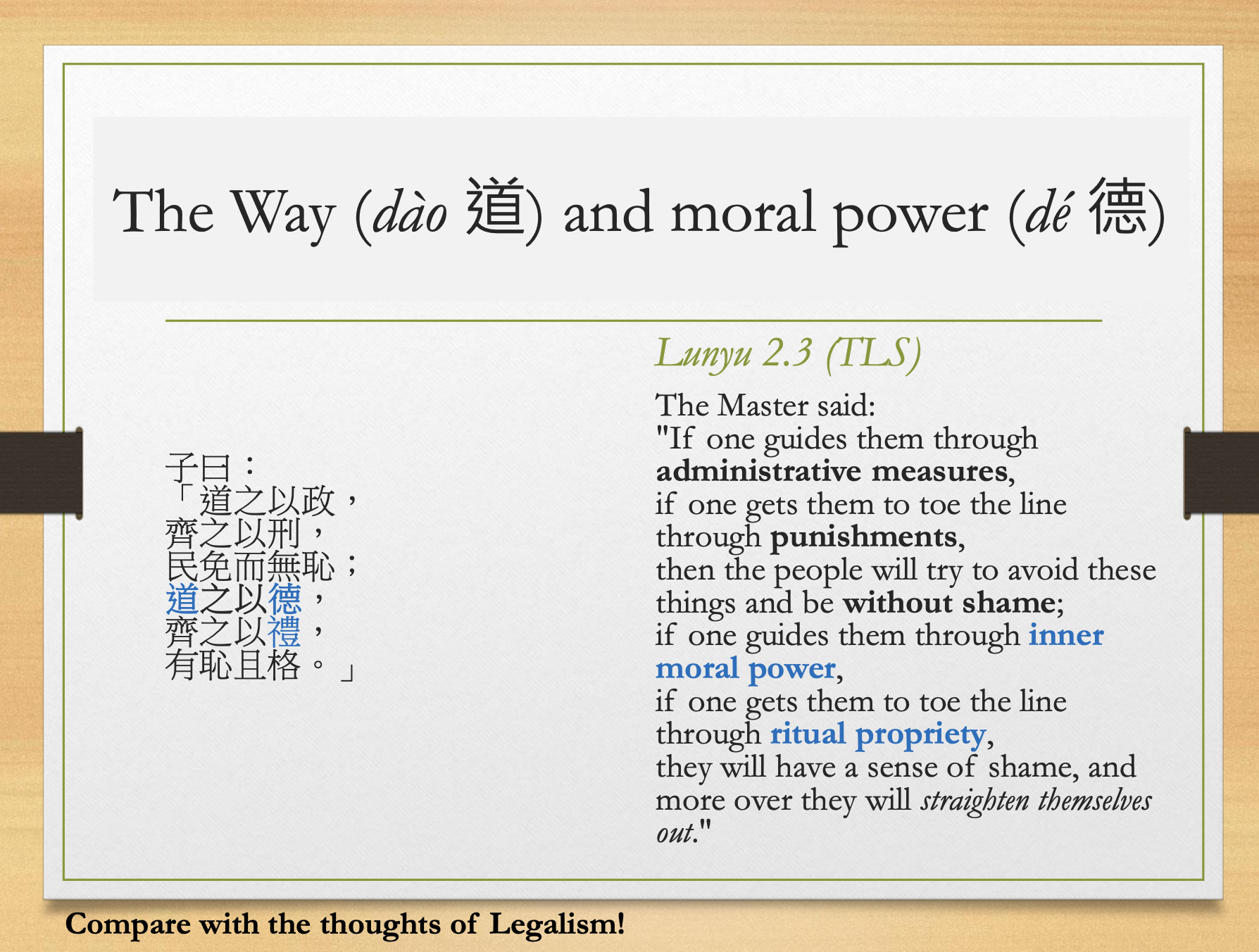
Dao and de 德 vs punishment 胜利的86
Point
Rule by punishments: people avoid punishment but feel no shame.
Rule by virtue and ritual: people develop shame and correct themselves.
Compare Legalism.
Exam takeaway
Confucianism prefers moral transformation over coercive law.
Other key terms confucianisme
Terms
Zhong 忠 — loyalty
Yi 義 — righteousness
Shu 恕 — sympathy/reciprocity
Golden Rule: do not do to others what you do not want done to yourself.
Exam takeaway
Confucian ethics is relational and reciprocal.
Ideal man
Terms
Junzi 君子 — gentleman / superior person
Shengren 聖人 — sage
Shanren 善人 — excellent/good person
Exam takeaway
Confucius has several ideals of moral personhood, not just one.
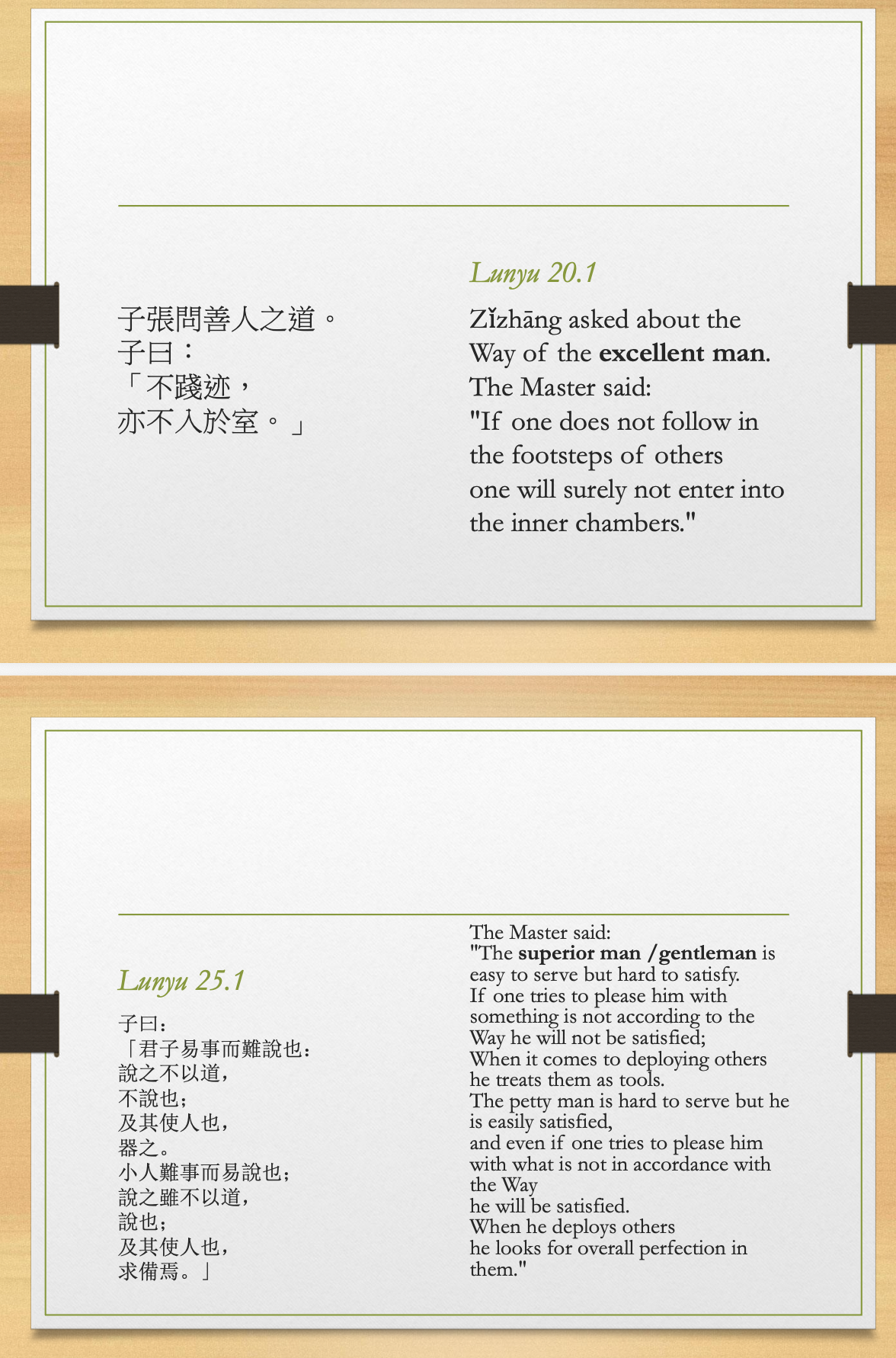
Junzi vs petty man slide 94
Junzi
Easy to serve.
Hard to please.
Only satisfied by what accords with Dao.
Uses people according to their capacities.
Petty man
Hard to serve.
Easy to please.
Accepts what is not Dao.
Expects perfection from others.
Exam takeaway
Junzi judges by moral Way; petty man judges by selfish preference.
Heaven Tian 天 slide 95
Point
Confucius says Heaven took Yan Yuan.
Question: is Heaven personal here?
Know
Tian in Confucius can feel morally/divinely active, but not like a fully personal Christian God.
Exam takeaway
Confucian Tian is morally powerful but ambiguous: partly cosmic, partly personal.
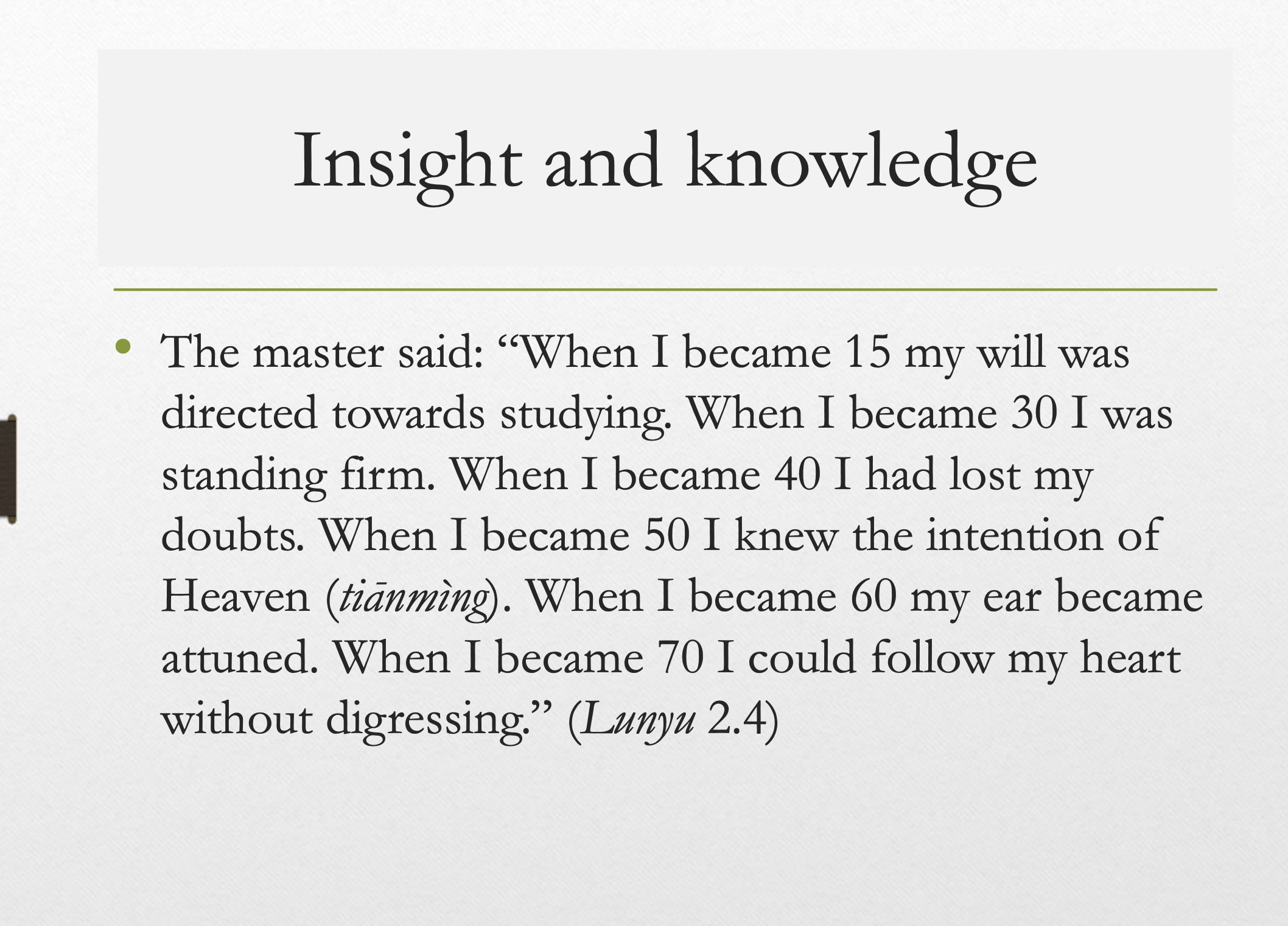
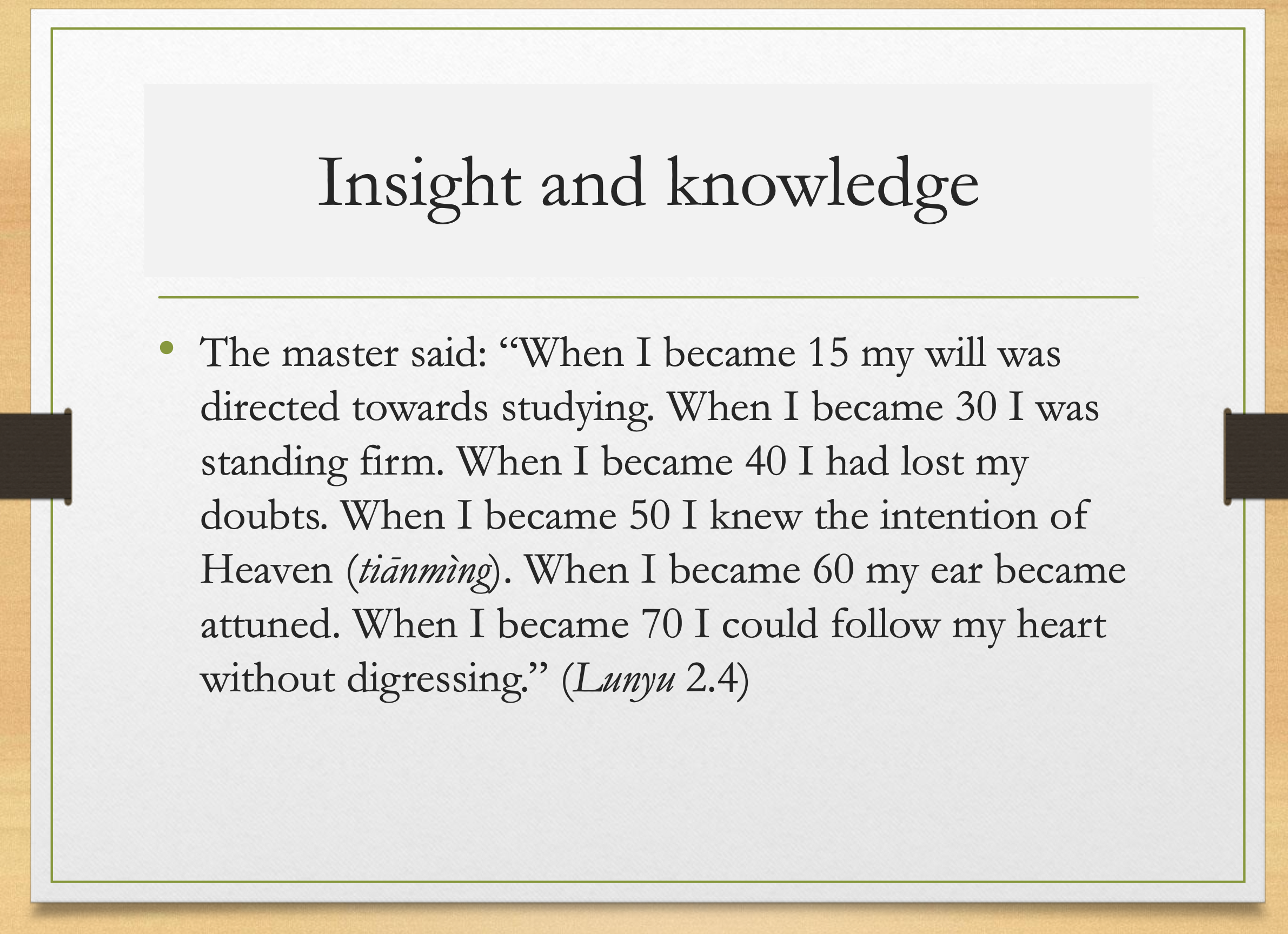
Confucius’ stages of life
Point
15: devoted to study.
30: established.
40: no doubts.
50: knew Tianming.
60: ear attuned.
70: follows heart without transgressing.
Exam takeaway
Confucian cultivation is lifelong and gradually aligns desire with moral order.
Confucian classics
Texts
Yijing 易經 — Book of Changes
Shujing 書經 / Shangshu 尚書 — Book of Documents
Shijing 詩經 — Book of Songs/Odes
Ritual books:
Liji 禮記
Zhouli 周禮
Yili 儀禮
Chunqiu 春秋 — Spring and Autumn Annals
Yuejing 樂經 — Book of Music, lost/traditional
Exam takeaway
These texts later became associated with Confucius and Confucian tradition.
Book of Documents
Point
Collection of documents beginning with mythical rulers.
Parts added by Han Confucians.
Contains Mandate of Heaven.
Ideal ruler is harmonious with Heaven.
Ruler acts like father to tianxia 天下, “all under Heaven.”
Ideal ruler avoids war and creates order through harmony.
Exam takeaway
Shujing links rulership, Heaven, virtue, and cosmic-political order.
Mandate of Heaven chapter slide 99
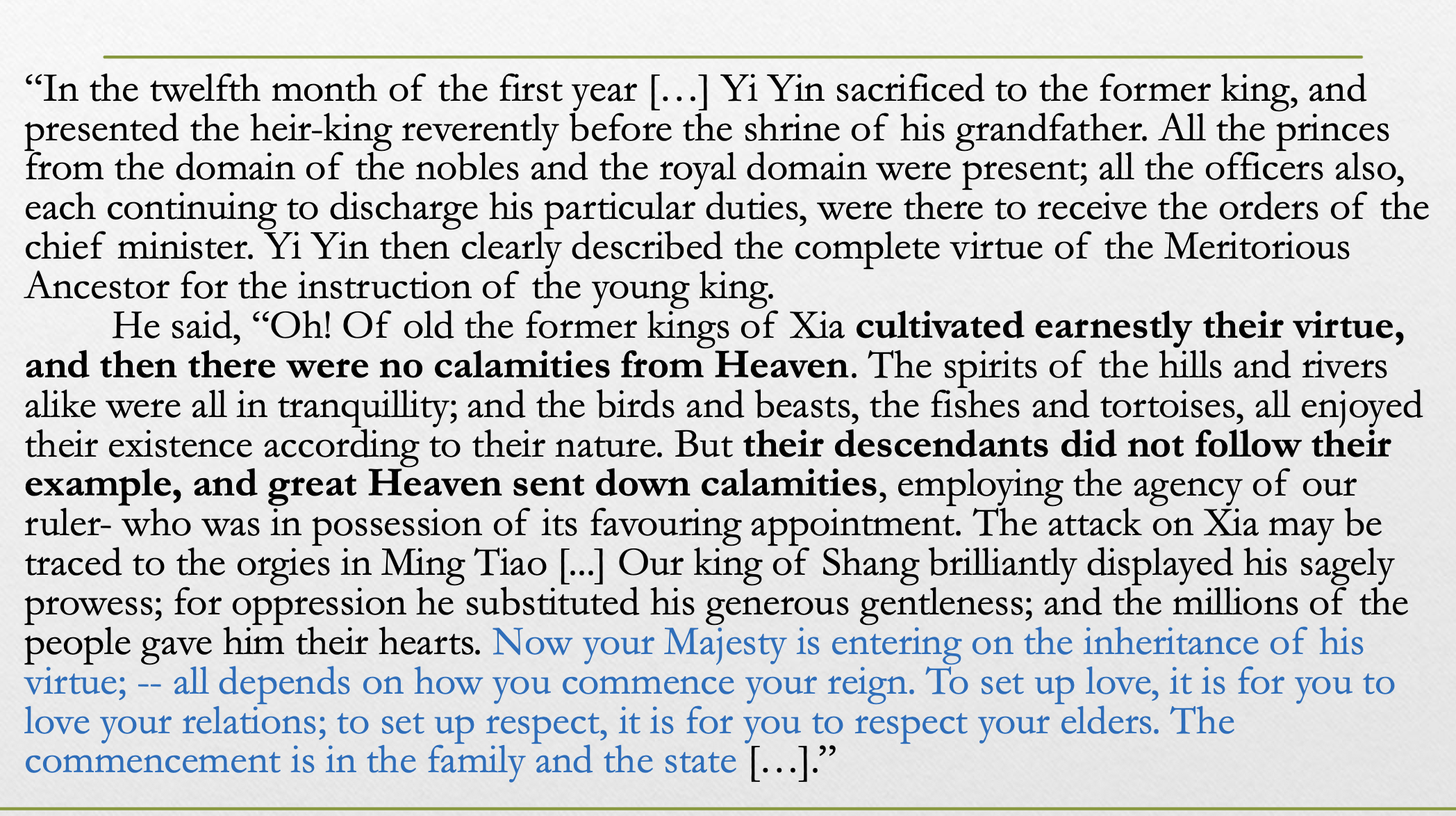
Point
Former Xia kings cultivated virtue and avoided Heaven’s calamities.
Descendants failed.
Heaven sent calamities and transferred favor.
Shang ruler receives Heaven’s appointment.
Virtue wins people’s hearts.
Exam takeaway
Mandate of Heaven explains dynastic change morally: bad rulers lose Heaven, virtuous rulers gain legitimacy.
Good rulership
Point
Former king cared about human bonds.
Listened to criticism.
Followed ancient wisdom.
Showed intelligence in high position.
Showed loyalty in lower position.
Used people according to their strengths.
Exam takeaway
Ideal rulership combines virtue, humility, listening, loyalty, and proper use of people.
Warnings against bad rulership
Key points
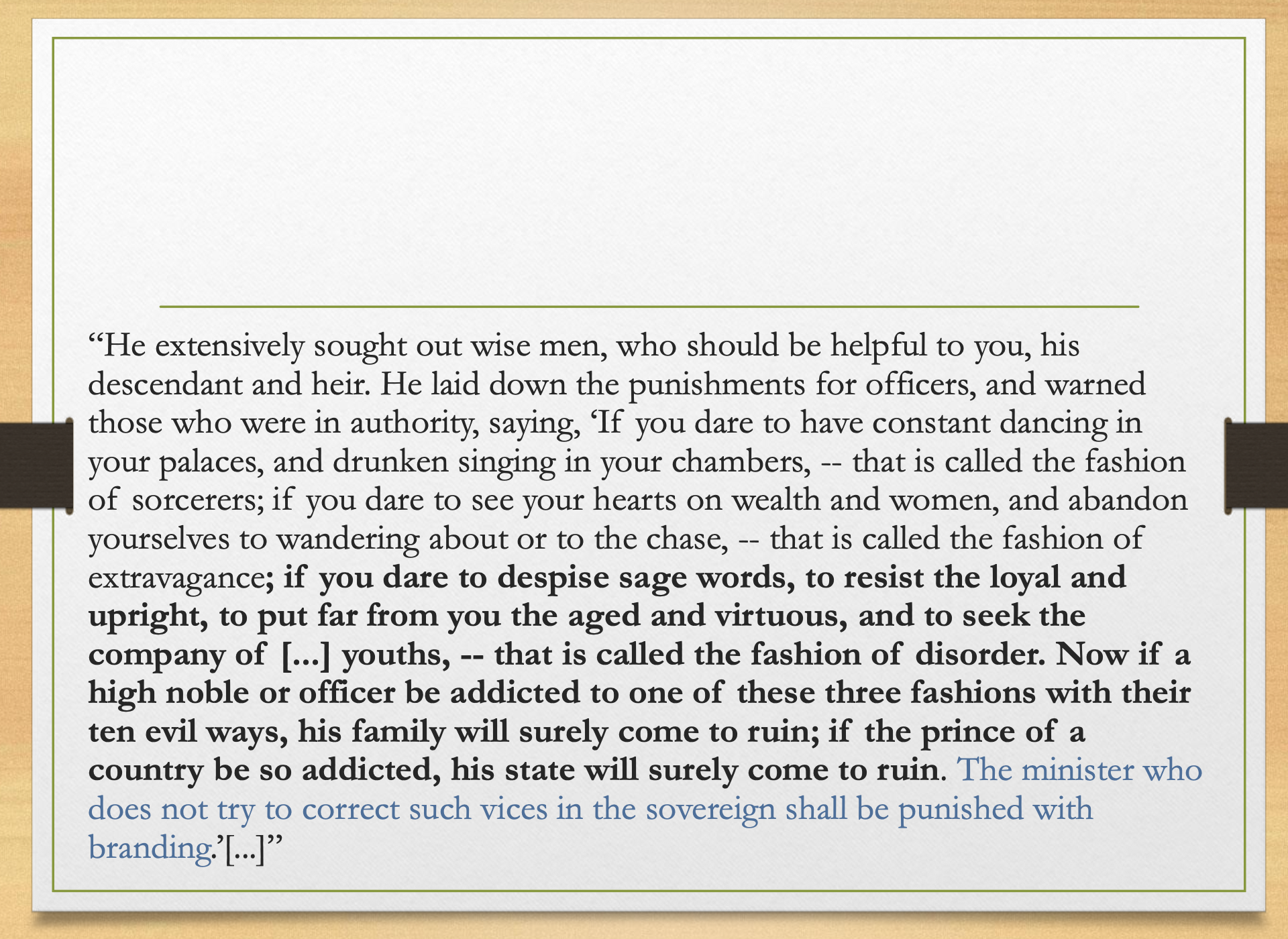
The ruler is warned against three corrupt habits:
1. Sorcerer-style behavior
constant dancing in palaces
drunken singing in chambers
basically ritual/pleasure disorder
2. Extravagance
obsession with wealth
obsession with women
wandering around
excessive hunting
3. Disorder
despising sage words
resisting loyal/upright ministers
rejecting the aged and virtuous
surrounding oneself with bad youths
Meaning:
Bad personal behavior becomes political danger.
If an official behaves this way:
his family can collapse.
If a prince/ruler behaves this way:
his state can collapse.
If ministers do not correct the ruler:
they are also guilty.
Exam takeaway
In Confucian political thought, the ruler’s morality is not private. Personal vice leads to political ruin.
Heaven rewards virtue and punishes evil
Main idea
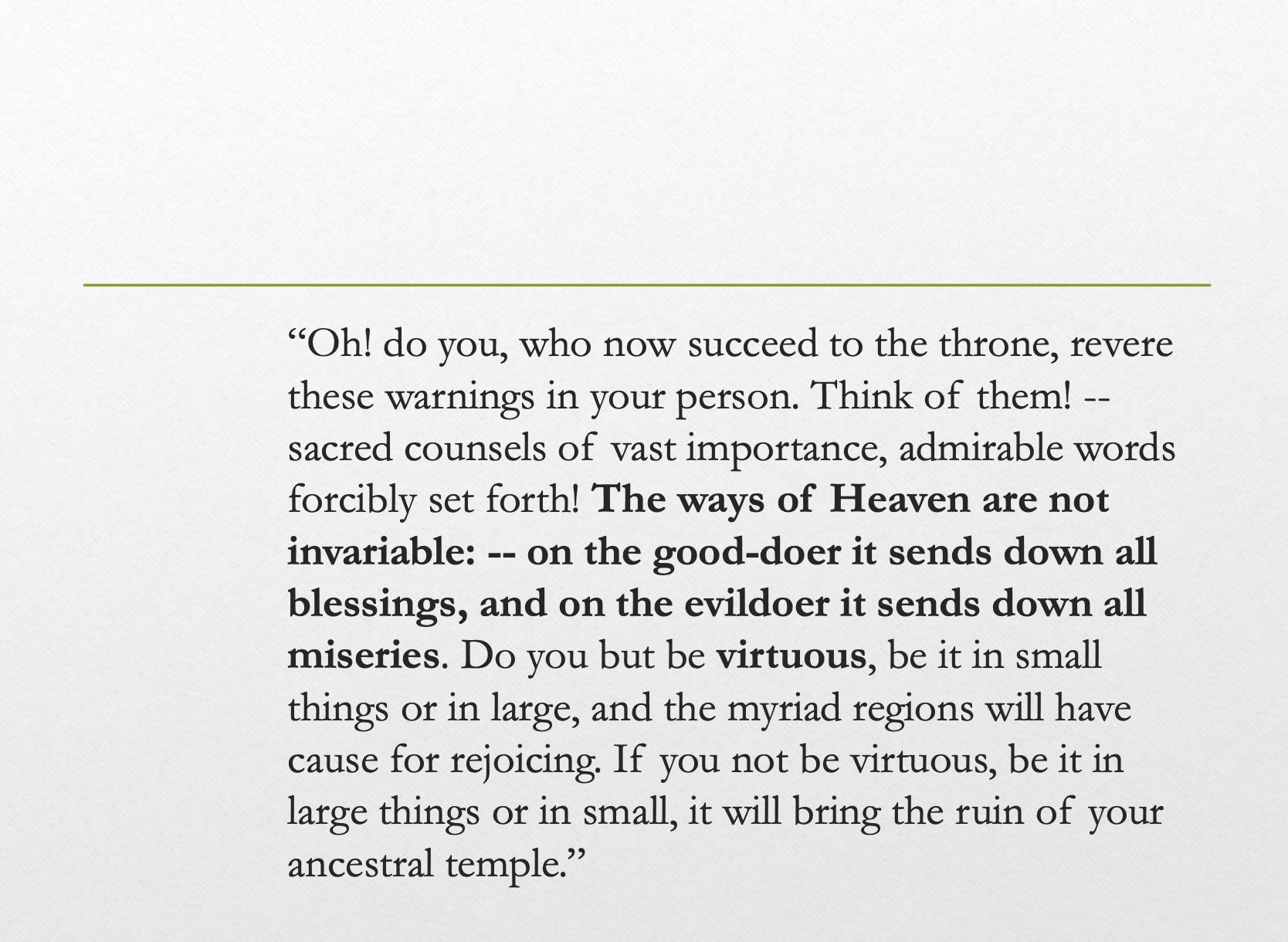
Heaven’s favor is conditional.
Key points
The ruler must respect earlier warnings.
Heaven’s ways are not invariable.
Heaven blesses the good-doer.
Heaven sends misery on the evildoer.
Virtue brings joy to the realm.
Lack of virtue brings ruin to the ancestral temple.
Meaning
This is basically Mandate of Heaven logic:
Good ruler → Heaven supports him.
Bad ruler → Heaven withdraws support.
Exam takeaway
The Mandate of Heaven is moral and conditional: political legitimacy depends on virtue, not bloodline alone.
Book of Songs / Shijing 詩經
Main idea
The Book of Songs is a collection of poetry used in the Confucian classical tradition.
Key points
Contains:
popular songs
aristocratic poetry
ritual/sacrificial songs
Three types:
1. Ballads
160 poems
from 15 states
many popular songs
2. Odes
105 poems
mostly aristocratic
3. Offering songs
40 songs
include sacrifices in Zhou, Lu, and Song
Meaning
The Book of Songs is not just literature.
It preserves:
social values
ritual practices
political ideals
emotional/moral expression
Exam takeaway
The Shijing became a Confucian classic because poetry was seen as morally and politically meaningful, not just artistic.
Ritual books
Main idea
The ritual books describe rites and connect ritual with ethics.
Key points
Describe performance of rites.
Include philosophical discussions.
Traditionally linked to Confucius and his disciples.
Important concept: relation between ritual and morality.
Important for ruler and subject.
Rituals reenact cosmic order.
Meaning → Ritual is not empty ceremony. It reflects and recreates the correct order of the cosmos and society.
Exam takeaway
In Confucianism, ritual connects ethics, politics, hierarchy, and cosmic order. That is why li 禮 matters so much.
Spring and Autumn Annals / Chunqiu 春秋
Main idea
The Spring and Autumn Annals is a historical chronicle that became important through commentaries.
Key points
Describes events from 722–481 BCE.
Original text is short.
Later long commentaries were added.
Important commentary: Zuozhuan 左傳, “Commentary to the Left.” Important meta-point
Commentary literature is massively important in Chinese philosophy.
Why? → Because later thinkers often express new ideas through commentaries on older classics. So innovation is often hidden as interpretation.
Exam takeaway
Chinese philosophy often develops through commentary. Later thinkers present new ideas as explanations of classical texts, which becomes very important for Neo-Confucianism.