Zoology Lecture 4 (Birds/mammals/biodiversity)
 Call Kai
 Learn
Learn Practice Test
 Spaced Repetition
 Match
Match Flashcards
 Knowt Play
1/79

There's no tags or description
Looks like no tags are added yet.
Name | Mastery | Learn | Test | Matching | Spaced | Call with Kai |
|---|
No analytics yet
Send a link to your students to track their progress
80 Terms
Larynx
Opens and closes glottis during respiratory cycle and prevents foreign material from entering the lower respiratory tract
Trachea
Conducts air to and from the lungs during respiration
Heart
Four-chambered organ (two atria, two ventricles) that receives oxygenated blood from the lungs and pumps it via the arteries throughout the body
Crop
Stores ingested food to await passage to gizzard; found in seed- and grain-eating species
Proventriculus
Mixes food with peptic enzymes for digestion
Gizzard
Thick-walled, muscular pouch that pulverizes and churns food prior to its passage into the intestine; larger in seed-eating species
Pancreas
Produces digestive enzymes that are released into the small intestine
Intestine
Continued digestion of food particles; transports feces to coprodeum of cloaca via peristalsis
Cloaca
Common chamber for collection of materials from the digestive, excretory, and reproductive systems prior to their discharge from the body; partitioned into a coprodeum, urodeum, and proctodeum as in reptiles
sebaceous gland
Secretes oily compound that coats feathers, preventing moisture absorption
Ureters
Transport uric acid mixture from the kidneys to the cloaca
Kidneys
Paired organs that filter nitrogenous wastes from the blood and produce dry uric acid with little water that is transported to the urodeum of the cloaca, where it mixes with feces as it is released from the body
Auditory tube
Channels sound waves to auditory receptors; similar to the ear canal of humans
Cerebellum
Primarily a reflex center for integration of skeletal muscle movements; responsible for coordination and balance
Optic lobes
Process visual information from the eyes
Cerebrum
Largest portion of the brain; interprets sensory impulses and coordinates voluntary movements
Stomach
Produces hydrochloric acid and pepsinogen, which aid in the chemical breakdown of food
Pyloric sphincter
Muscular band that regulates the flow of chyme from the stomach into the duodenum
Liver
Produces bile, converts glucose to glycogen for storage, detoxifies many constituents of the absorbed digested compounds
Bile duct
Transports bile from the lobes of the liver directly to the duodenum
Duodenum
Receives chyme from the stomach along with bile and digestive enzymes from the liver and the pancreas
Jejunum
Responsible for the majority of nutrient absorption and reabsorption of water
Ileum
Continues process of nutrient absorption and reabsorption of water
Cecum
Large, thin-walled pouch demarcating the beginning of the large intestine; contains anaerobic bacteria responsible for fermentation of cellulose and other plant materials; has a reduced appearance and function in carnivores and omnivores
Descending colon
Responsible for reabsorption of water and electrolytes; transports feces to the rectum via peristalsis
Rectum
Final site of water reabsorption and feces dehydration
Class Aves
-birds
-flight(key adaptation) shapes anatomy, ecology, and behavior
-diurnal
-excellent vision, colors & movement are important cues
Diurnal
out during the day
Feathers (birds)
-unique to birds & all birds have them
-composed of keratin-homologous with reptilian scales
-non-living when fully grown (molt)
-precede flight & birds
Skeletal adaptations (birds)
-pneumatized or honeycombed bones
-light, kinetic diapsid skull (can move jaws independently)
-rigid vertebral column with synsacrum, mobile neck
-keeled sternum & furcula
-bones in forelimb- reduced in number & fused to reduce weight
Synsacrum
fusion of hip bones for flight support
Furcula
fused clavicle for muscle attachment
Sternum
flight muscles attach
Muscles (birds)
-highly adapted for flight
-main muscle mass in legs proximal to body and center of gravity
-flight muscles: pectoralis and supercoracoideus- rope & pully system
Wing structure (birds)
-airfoil
-shape varies based on the type of flight
-aquatic birds have dense bones and waterproofed wings
Airfoil
creates both lift and thrust
Digestive system (birds)
-efficient & rapid
-toothless
-large muscular gizzard in stomach
-cloaca (combined urogenital opening)
Respiratory/circulatory system (birds)
-high metabolic rate (endothermic)
-4 chambered heart to separate blood to lungs & body
-1 way movement of air through respiratory system (9 interconnected air sacs)
-high amount of oxygen in lungs all the time to keep up with metabolism
Endothermic
use physiological control to maintain body temperature
Excretory system (birds)
-adapted for production of shelled amniotic eggs
-main nitrogenous waste: uric acid
-no bladder
-salt glands in marine birds
Senses (birds)
-poor sense of smell and taste
-very keen sense of hearing and acute eyesight
Reproductive system (birds)
-designed to decrease weight
-males scrotal only during mating season
-males lack a penis
-females only left ovary is functional
Polygamy
more than one mate during a breeding season
Monogamy
single mate (90% of bird species)
Seasonal monogamy
most birds only pair during the mating season but may not be faithful
Ratites (Paleognathae)
-emu, ostrich, kiwi
-flightless birds
-no keel on sternum
-poorly developed pectoral muscles
Mammal shared common ancestor
Therodontia (subclass of therapsid reptiles)
-high metabolic rate
-increased jaw musculature
-skeletal changes: upright stance
-secondary bony palate
Hair (mammals)
-definitive: no homologs
- composed of keratin from dermis
-variously modified
Glands (mammals)
1) scent glands: communication (not unique)
2) sweat glands: evaporative cooling
3) sebaceous glands: protects hair
4) mammary glands: used to lactate young
Lactation
-reproduction not tied to seasonal food supply
-store fat and energy in milk to use later
-mom can raise offspring solo
-makes vivipary easier- young born at relatively undeveloped state
Remodeled jaw joint (mammals)
reduction in bones in lower jaw and changes in joints. more rigid/less kinetic. strong, not flexible. more acute hearing sensitivity. bones from reptiles are repurposed to be inner ear in mammals
dentary squamosal joing
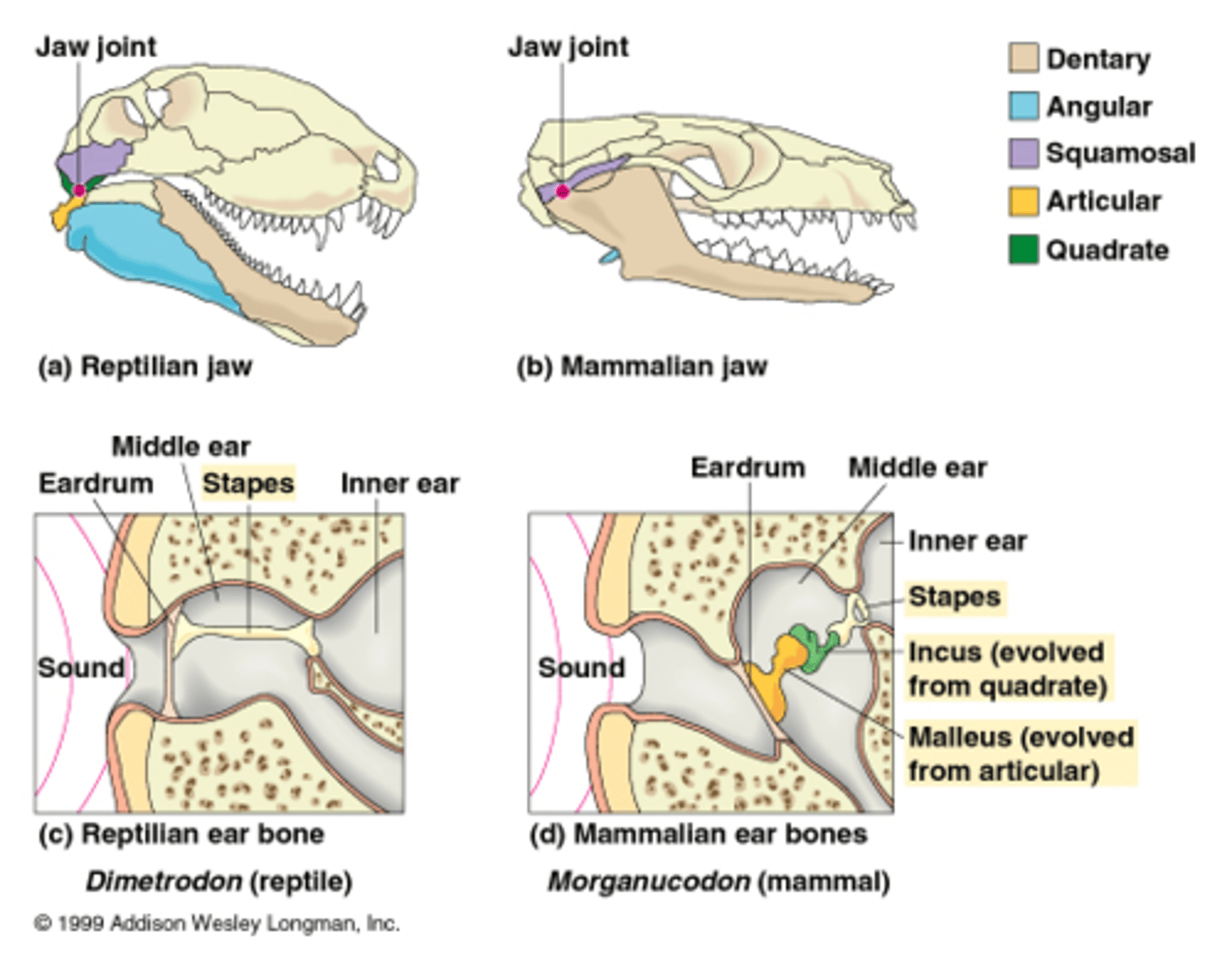
Middle ear
mammals- stapes, malleus, incus
reptiles-stapes
transmitting vibrations to sensory structure
Teeth (mammals)
-heterodont teeth
-teeth that differ in form
-deciduous and permanent
-varied definition based on diet
Mammal characteristics
-amniotes
-endothermic
-high metabolic rate
-most are nocturnal
-sensory adaptations
occlusion
bottom teeth match with top
Heterodont teeth
teeth that differ in forms. opposite of homodont
Reproductive cycles (mammals)
Males fertile at any time
Females:
-estrous cycle (heat)
-menstrual cycle
Estrous cycle
-heat
-seasonal
-receptive only during brief time
Menstrual cycle
receptive throughout the cycle
Monotremes (Subclass Prototheria)
-egg laying mammals: no gestation
-only 5 extant species
-duckbilled platypus and echidna
-only Australia and new guinea
-most primitive group of mammals
-short incubation time with yolk
-tuft of hair for milk
-cloaca
-oviparous
Marsupials (subclass Theria, Metatheria)
-kangaroos, koalas, opossums
-south America and Australia
-short gestation (1-2 weeks)
-prolonged lactation
-simple placenta so viviparous
-marsupium: pouch
Placentals (subclass Theria, Eutheria)
-amniotic egg
-found worldwide
-long gestation
-advanced placenta- young complete embryonic development in uterus of female
-precocial or altricial
-moms energy during gestation
Precocial
able to move and be independent right after birth (horses)
Altricial
still need extensive care from mother after birth (humans)
Placentals v marsupials
-placentals reproduce at faster rate, especially at smaller body size
-placentals are far smarter; larger brains for body size
-females in each invest much in young, but at different times/rates
1) marsupials: lactation
2) placentals: gestation
-marsupials have low species diversity
Whales and artiodactlys
even toed mammals
-returned to sea about 50mya
-fossil whales have artiodactyl ankles
Measuring biodiversity
1) species richness: total number of species w/in an area
2) genetic diversity: total variety of genes w/in a single species
3) endemic species: species that occur here and nowhere else
4) ecosystem diversity: total number of ecosystems in the region
Ecosystem importance
-aesthetic and ethical
-pharmacological
-loss of unique organisms- extremophiles
-overall earth health
-ecosystem services:
purification of air/water
erosion control, reduction of flooding
-soil composition
-nutrient cycles
-balance of pests and plagues
The biodiversity crisis
-land surfaces altered by humans
-freshwater used by humans
-current extinction rates are higher
-30,000 species per year go extinct
Threats to biodiversity
1) habitat destruction & fragmentation
2) introduced species
3) climate change
4) overexploitation
5) pollution/light/noise
Disruption of food chains
-hard to predict what happens when one or more species are removed/ added to the food chain
Extinctions
-typically followed by rebound
-new niches to fill
-disaster species thrive in disrupted areas
-large number of species go extinct at the same time in a global pattern
-background/previous
Anthropocene
a proposed geological epoch dating from the commencement of significant human impact on earth's geology and ecosystems, including, but not limited to, anthropogenic climate change
Preserving our world
-off-site preservation: zoos, aquaria, botanical gardens, seed banks
-educational awareness
-research/genetic pool
-habitat corridors (green bridges)
Re-introduction
create a new population in original habitat
issues:
-try to ensure genetic appropriateness
-solve initial problem
-behavior (training)
-does ecosystem still work?
-low success rate
-expensive
Preserves
factors to consider:
1) how to choose
2) how to manage
3) size
4) how to protect
5) human use
6) funding
Introduced species
-disruption of food chain
- no natural predators
-can outcompete
-unexpected consequences
Climate change
-unpredictable weather patterns
-hardiness zones
-breeding timing
-light signals
-food sources
-temp cues
Fragmentation
when habitats are split apart and surrounding areas are degraded
background extinction
normal number of extinctions