Microeconomics and Personal Finances: Income, Spending, and Investment Strategies
 Call Kai
 Learn
Learn Practice Test
 Spaced Repetition
 Match
Match Flashcards
 Knowt Play
1/25

There's no tags or description
Looks like no tags are added yet.
Name | Mastery | Learn | Test | Matching | Spaced | Call with Kai |
|---|
No analytics yet
Send a link to your students to track their progress
26 Terms
What should you consider when making career decisions?
Max income potential, marginal product of labor, human capital, specialization, and lifestyle.
What types of jobs are likely to disappear due to automation?
Routine non-cognitive (low skilled) and routine cognitive (mid-skilled) jobs.
What characteristics define jobs of the future?
Non-routine, non-cognitive (low skilled) and non-routine, cognitive (high skilled) jobs.
What are key skills for adding human value to non-routine jobs?
Creativity, social intelligence, and the ability to think outside the box.
What three factors should you consider when spending?
Opportunity cost of time, human capital needed, and physical capital needed.
When does DIY make sense?
When the opportunity cost of time is low, high human capital isn't needed, and physical capital costs are manageable.
What is the Law of Diminishing Marginal Utility?
As consumption increases, the additional satisfaction gained from consuming more decreases.
What is a utility-maximizing budget?
A budget that evaluates spending decisions based on marginal utility per dollar spent.
What is zero-sum budgeting?
A budgeting method where each dollar is allocated to maximize utility, both now and in the future.
What are the steps to evaluate if trimming your personal budget is worth it?
1. Consider a scaled back level of consumption. 2. Figure out the percentage difference in cost. 3. Assess satisfaction differences. 4. Decide to trim or keep based on satisfaction.
How is wealth defined?
Wealth is the value of all assets owned minus liabilities.
What is investing?
Buying assets to build wealth, including financial assets and real estate.
What are examples of physical and financial assets?
Physical assets: real estate, collectibles, personal belongings. Financial assets: stocks, bonds, mutual funds, cash.
What is the opportunity cost of holding too much cash?
Cash erodes due to inflation and does not contribute to wealth building.
What is the return on investment (ROI)?
The increase in wealth resulting from owning an asset, expressed as a percentage.
What are the components of stock returns?
Capital gains and dividends.
What is the Efficient Market Hypothesis?
It states that asset prices reflect all publicly available information, making it hard to pick undervalued stocks.
What is the difference between active and passive investing?
Active investing involves selecting individual stocks to outperform the market, while passive investing aims to match market returns through index funds.
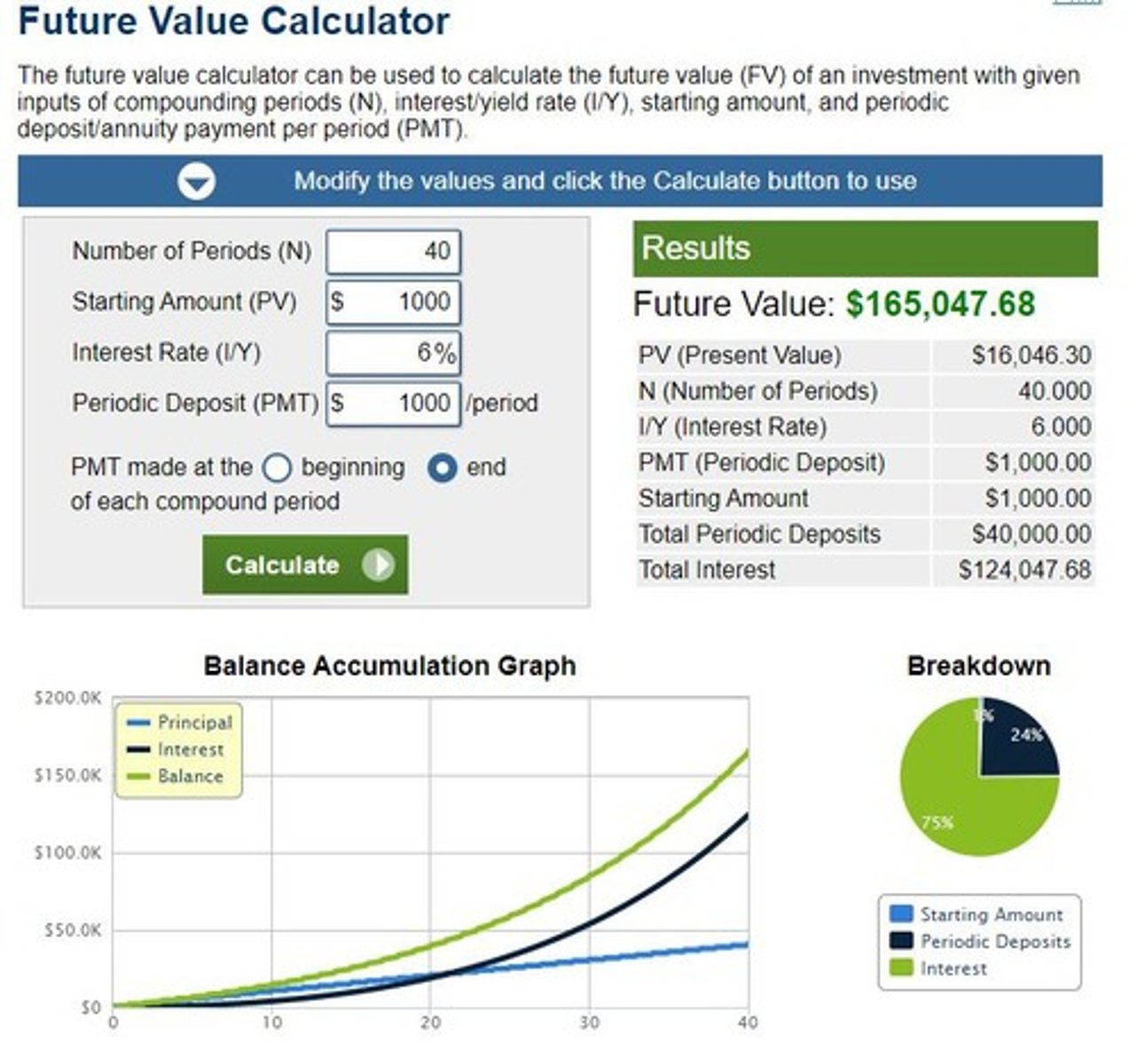
What is compounding in investing?
Earning returns on previous returns, leading to exponential growth of wealth.
What should you consider when choosing investments?
Risk level, expected return on investment (ROI), expertise needed, and time commitment.
What is the goal of active investing?
To achieve a better than average return on investment (ROI).
What is the goal of passive investing?
To achieve the average return on investment (ROI) of a diversified group of assets.
What is the significance of opportunity cost in personal finance?
It helps evaluate the trade-offs of spending decisions and investment choices.
What are some non-monetary benefits to consider in career choices?
Work style, expected work schedule, and training costs.
What is the impact of competitive markets on investment returns?
High returns require higher risk due to competition in investment markets.
What should you do if your current consumption does not provide additional satisfaction?
Consider trimming your budget for that item.