Lecture 04: Cardio Examination
 Call Kai
 Learn
Learn Practice Test
 Spaced Repetition
 Match
Match Flashcards
 Knowt Play
1/32

There's no tags or description
Looks like no tags are added yet.
Name | Mastery | Learn | Test | Matching | Spaced | Call with Kai |
|---|
No analytics yet
Send a link to your students to track their progress
33 Terms
Incremental exercise: HR and CO
- Increases linearly with increasing work rate
- Reaches plateau at 100% VO2 max
Incremental exercise: BP
- Mean arterial pressure increases linearly
- Systolic BP increases
- Diastolic BP remains fairly constant
A PT is performing an exercise stress test on a 45-year- old male patient. The patient resting values are BP 130/90 mm Hg. HR 75 bpm and RR 24 breaths/min. Which of the following is an ABNORMAL response to vigorous aerobic exercise?
A. Diastolic blood decreases to 88 mm Hg
B. Diastolic blood pressure increases to 100 mm Hg
C. Respiratory rate increases to 34 breaths/minute
D. Systolic blood pressure decreases to 100 mm Hg
D. Systolic blood pressure decreases to 100 mm Hg
Generally, SBP is supposed to linearly increase with exercise. DBP can increase or decrease by 10 but if SBP drops more than 20 during exercise then it is a serious concern.
The patient's medical history includes hypercholesterolemia, and type 2 diabetes. The patient's systolic BP is 122 mm Hg, and diastolic BP is 77 mm Hg. Which of the following categories MOST appropriately describes the type of hypertension?
A. Normal
B. Elevated
C. Pre-hypertension
D. Stage 1
B. Elevated
Normal BP
Less than 120/80 mm Hg
Elevated BP
- Systolic between 120-129 and
- Diastolic less than 80
Stage 1 hypertension
- Systolic between 130-139 or
- Diastolic between 80-89
Stage 2 hypertension
- Systolic at least 140 or
- Diastolic at least 90 mm Hg
Hypertensive crisis
- Systolic over 180 and/or diastolic over 120
- With patients needing prompt changes in medication if there are no other indications of problems, or immediate hospitalization if there are signs of organ damage
A 32-year-old healthy male is working out on a stationary bike in an outpatient physical therapy clinic. After the first 4 minutes of constant-load, sub-maximal exercise, VO2 reaches steady state, indicating that:
A. Levels of lactic acid in the blood has reached steady state.
B. The ATP demand is being met aerobically.
C. The exercise should be discontinued immediately.
D. The respiratory rate is insufficient to meet the ATP demand.
B. The ATP demand is being met aerobically.
When oxygen is not available, the cell is forced to produce energy (ATP) through ANAEROBIC processes, that produce much less energy (about 15x less) than AEROBIC process.
A 30 years old male client visits a town which is 9000 feet above sea level. What are the INITIAL cardiovascular responses during the first week in town?
A. Increased BP, increased cardiac output with tachycardia and no significant changes in SV.
B. Decreased BP, decreased cardiac output with bradycardia and increased SV.
C. Increased BP, decreased cardiac output with bradycardia and increased SV.
D. Decreased BP, increased cardiac output with tachycardia and increased SV.
A. Increased BP, increased cardiac output with tachycardia and no significant changes in SV.
Altitude changes
- HR increases
- BP increases
- Cardiac output increases
- Stroke volume has no change
A PT is using aquatic therapy to treat a 29-year-old patient who had a recent ACL repair. The patient is immersed to the level of sternoclavicular notch. Which of the following is the MOST expected physiological response of aquatic therapy?
A. Decreased cardiac output
B. Decreased systolic blood pressure
C. Increased heart rate
D. Increased V02 max
B. Decreased systolic blood pressure
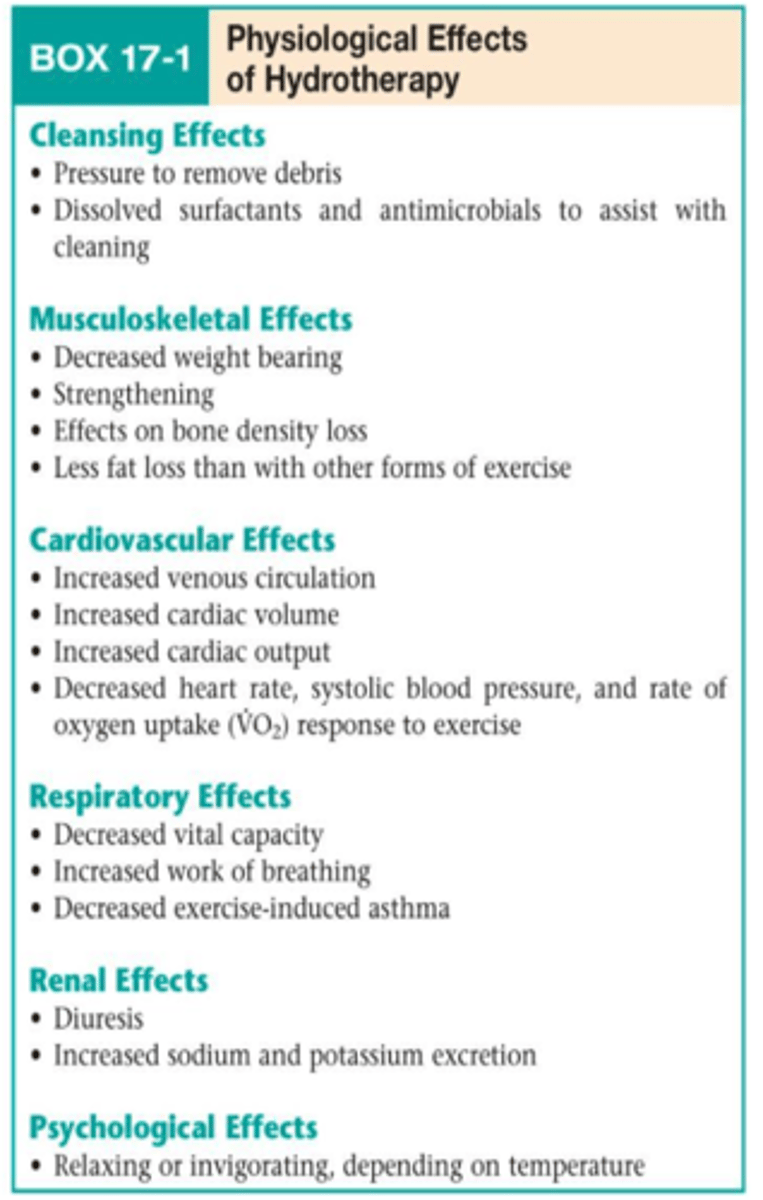
During aquatic therapy, the heart is relaxing —> HR decreases, SBO decreases, CO increases, SV increases. Hydrostatic pressure is going to pump blood efficiently, so SV will increase and CO will increase too. Vital capacity decreases as the hydrostatic pressure pushes on the lungs and reduces the inflation.
Aquatic therapy: CV effects
- HR decreases
- BP decreases
- Stroke volume increases
- Cardiac output increases
Aquatic therapy: respiratory effects
- Vital capacity decreases
- Work of breathing increases
Aquatic therapy: MSK effects
- Weight bearing decreases
- Edema decreases
Beta blockers and HR
- Compete with epinephrine and norepinephrine for beta adrenergic receptors in the heart
- Reduce heart rate and contractility
- Lower the myocardial oxygen demand
Who are beta blockers prescribed to?
Patients with coronary artery disease and hypertension
What do beta blockers do during exercise?
Beta blockers lower HR during exercise
The 54-year-old male patient's chart states that they havebeen taking beta-blockers for the past 5 years. Prior to starting an exercise training program, the patient should receive an explanation of the:
A. Greater benefits from cardiovascular exercise to be achieved at lower SBP rather than at higher SBP levels.
B. Need to use measures other than heart rate to determine intensity of exercise.
C. Greater benefits from cardiovascular exercise to be achieved at lower HR than at higher HR levels.
D. Need for longer warm-up periods and cool-down periods during exercise sessions.
B. Need to use measures other than heart rate to determine intensity of exercise.
HR response to exercise is blunted due to beta blocker, so cannot measure HR to determine exercise intensity and perceived exertion. Its important to consider RPE of the patient.
A 45-year-old male with a BMI of 38 kg/m2 is enrolled in a 6-week fitness training program. Which is the MOST appropriate measure to assess change in fitness from pre and post fitness training?
A. The time it takes for the heart rate to return to baseline
B. Resting respiration rate at pre training
C. Rating on a Wong Baker scale
D. Increase in blood pressure during exercise
A. The time it takes for the heart rate to return to baseline.
A 65-year-old is performing 6-min walk test for endurance testing post MI. After walking for 50 feet on level surface, the patient reported 7/20 on the RPE scale and oxygen saturation at 94%. Which of the following actions would be MOST appropriate?
A. Terminate the test
B. Continue the test on the level surface
C. Activate emergency system
D. Take a break until oxygen returns to 100%
B. Continue the test on the level surface
RPE of 7/20 during 6MWT is close to no exertion. Oxygen saturation also looks good. There are no red flags so it is safe to continue with the test.
When performing a 6MWT, the path should be leveled and free from possible distractions and obstacles in the pathway.
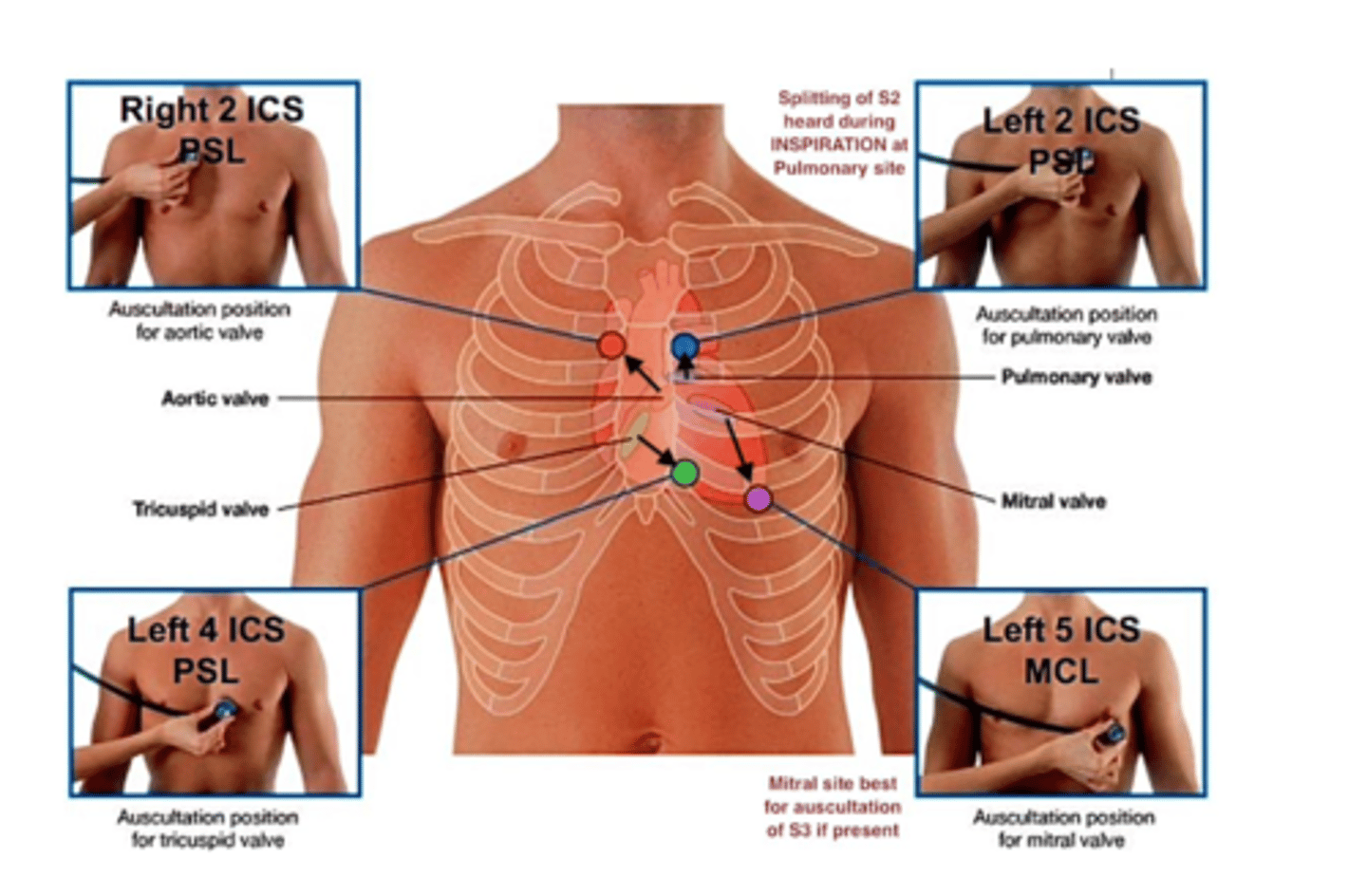
Auscultation landmarks: aortic
2nd IC space, right sternal border
Auscultation landmarks: pulmonic
2nd IC space, left sternal border
Auscultation landmarks: tricuspid
4th IC space, left sternal border
Auscultation landmarks: mitral
5th IC space, midclavicular line
Heart sounds: S1
- "Lub"
- Closure of the mitral and tricuspid valves
- Beginning of the ventricular systole (contraction)
- Best heard with the diaphragm of the stethoscope at the apex
Heart sounds: S2
- "Dub"
- Closure of the aortic and pulmonary valves
- Beginning of ventricular diastole (relaxation)
- Best heard with the diaphragm of the stethoscope at the aortic area
Heart sounds: S3
- Ventricular gallop
- Rapid ventricular filling
- Can be a normal finding in children and young adults
- Best heard with bell of stethoscope
Heart sounds: S4
- Atrial gallop
- Ventricular filling and atrial contraction
- Can be normal finding in older and athletic adults and children
- Best heard with bell of stethoscope
A 48-year-old male patient reports of shortness of breath and complains of fatigue. During the examination, the PT examines patient's heart sounds before starting an exercise program. Which valve is being auscultated in the picture?
A. Tricuspid valve
B. Pulmonary valve
C. Mitral Valve
D. Aortic Valve
B. Pulmonary valve
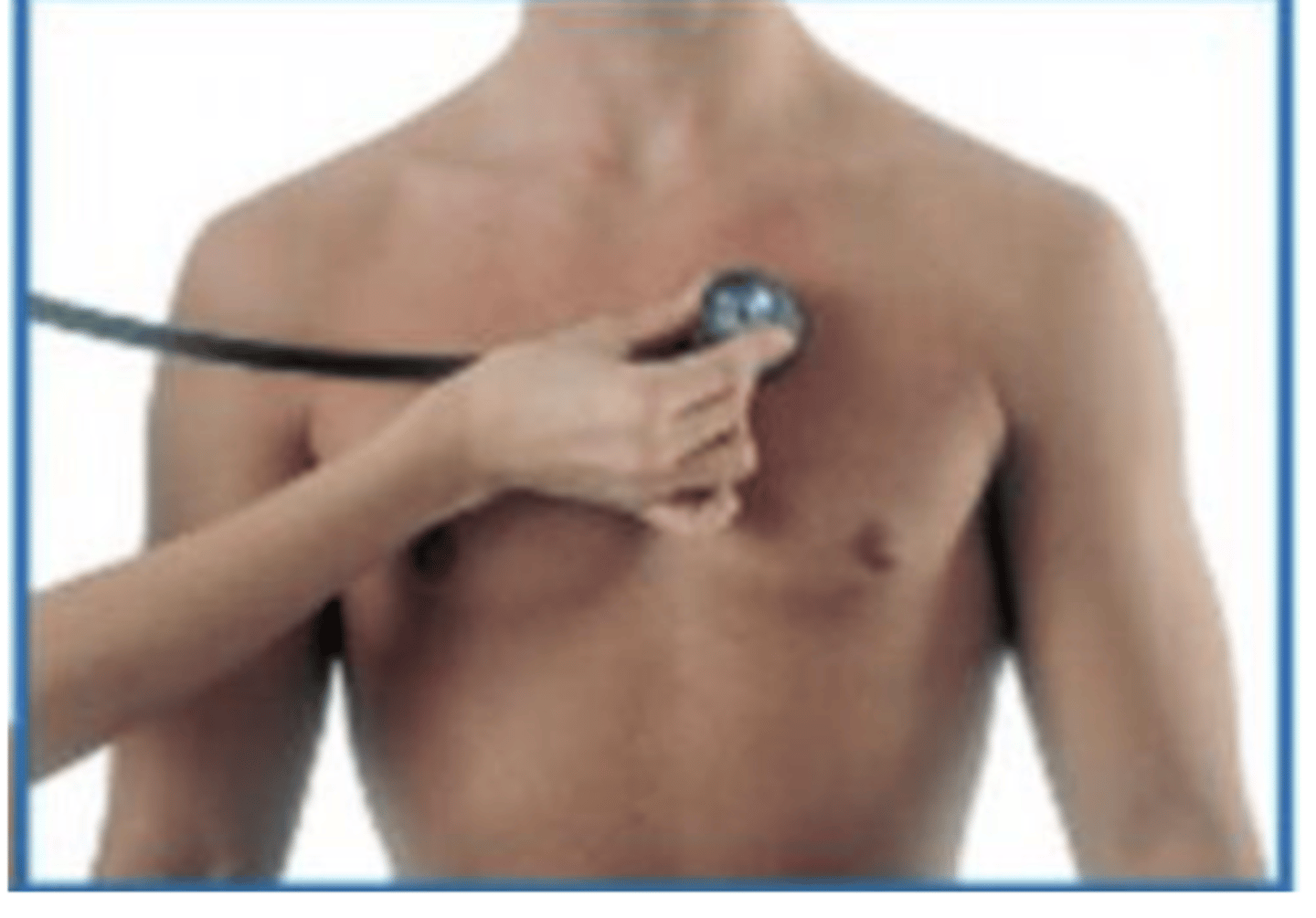
Heart auscultation
-T o listen to the intensity and quality of heart sounds at chest surface
- To detect abnormality, not to Dx
- Perform in quiet, well-lit room
- Pt. should be undressed and draped
- Stethoscope should be directly on skin
A PT is treating a patient with complains of chest pain. The PT attempts to assess heart sounds with a stethoscope. Which of the following is true about the first sound during auscultation of the heart?
A. The first sound is of the closure of the aortic and pulmonic valves
B. The first sound is of the closure of the mitral and tricuspid valves
C. The first sound is of the opening of the aortic and pulmonic valves
D. The first sound is of the opening of the mitral and tricuspid valves
B. The first sound is of the closure of the mitral and tricuspid valves