Chromatography
 Call Kai
 Learn
 Practice Test
 Spaced Repetition
 Match
 Flashcards
 Knowt Play
1/17

Earn XP
Description and Tags
18 Terms
TLC Mobile phase
Mobile Phase → Liquid phase that moves over the stationary phase.
Composed of organic solvents with varying polarities.
Determines the speed at which compounds travel on the TLC plate.
Polar compounds interact more with polar mobile phases.
TLC Stationary phase
Stationary Phase → Solid phase coated on the TLC plate.
Usually highly polar silica gel or alumina gel.
Determines the separation of compounds based on their interaction with the stationary phase.
Less polar compounds move faster on the plate, while polar compounds interact more with the stationary phase and move slower.
TLC — mobile phase vs stationary phase
Key Differences:
Mobile phase is the moving component, while the stationary phase remains fixed.
Mobile phase composition varies in polarity, affecting compound separation.
Stationary phase composition remains constant, providing consistent interaction with compounds.
How does TLC work?
Spotting the Plate:
Prepare a diluted solution of the compound, use capillary tube to transfer to TLC starting points;
Avoid large spot sizes that cause overcrowding
Developing the Plate:
Place the TLC plate in a TLC jar containing a solvent, which travels up the plate
Solvent moves up, separating compounds because different compounds travel at different rates.
Calculating Rf Values:
Measure the distance traveled by the compound spot and the solvent front.
Calculate the Retention Factor (Rf) using the formula:
Rf = distance traveled by compound / distance traveled by solvent.
Interpreting Results:
Higher Rf values = less polar compounds
Lower Rf values = more polar compounds
Comparison with known standards or controls helps identify and quantify components in the sample.
Compounds with different polarities partition between mobile and stationary phases differently.
Visualizing the TLC plate
Colored compounds can be seen directly.
Non-colored compounds…
I2 stain → iodine vapor will complex with organic compounds creating brown spots to help us visualize the spots
UV lamp → used for compounds capable of absorbing UV light, resulting in darkened spots with green fluorescent background
Spots are circled to calculate Rf
Calculate an Rf value
Rf = (distance traveled by compound) / (distance traveled by solvent)
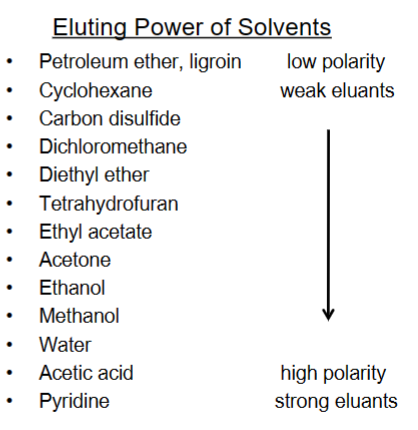
eluting power of solvents
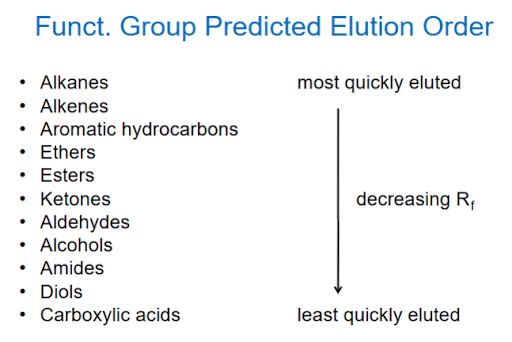
Functional group eluting order
What makes an ideal separation?
Ideal separation:
distinct bands, clearly separated compounds
efficient elution, each compound elutes separately
limited overlap between bands
yield, recovering desired compounds efficiently
What is the effect of changing solvent system polarity?
If solvent polarity is increased
Compounds with higher polarity will elute faster
All Rf values will increase.
If solvent polarity is decreased
Compounds with lower polarity will elute faster
All Rf values will decrease.
Consequence:
Adjusting solvent polarity alters the relative elution order of compounds, affecting their separation on the TLC plate.
How do you use TLC to monitor a reaction?
compare the TLC plates before and after the reaction to see changes in spot positions with the different compounds involved in the reaction
How do you run a column to separate compounds?
Prepare the column with a stationary phase, such as silica gel or alumina.
Load the mixture onto the top of the column.
Elute the column by passing a solvent through it.
Collect fractions as different compounds elute at different rates.
Analyze collected fractions to identify and purify the desired compound.
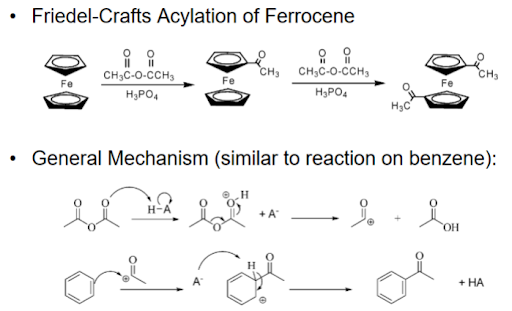
Mechanism of Friedel Crafts acylation using ferrocene, acetic anhydride, and phosphoric acid
Why is it necessary to use a drying tube for this reaction? How would your isolated products change if the drying tube was not present?
Used to prevent moisture from entering the reaction vessel.
Moisture can react with the reagents or products, affecting the yield and purity of the reaction.
Without drying tube, products could be contaminated with moisture, leading to lower yields or unwanted side reactions.
What (if anything) would happen to your separation of compounds in this laboratory if, by mistake, you eluted the chromatography column with petroleum ether, then methanol, then ether?
Would result in poor separation of compounds
Different compounds have different affinities for solvents based on their polarity, so using wrong elation solvent can lead to improper separation, products eluding together, or not eluding at all
What is the problem with spotting too much sample on the TLC plate? Too little sample?
Spotting too much sample:
Overcrowded spots
Merging or overlapping spots
Inaccurate Rf values
Uneven spread of solvent front
Spotting too little sample:
Faint spots
Difficult visualization
Poor separation and resolution
When conducting this experiment, you will run a TLC to check for reaction progress. What exactly do you need to see on the TLC plate which will tell you that it is ok to start working up the reaction mixture?
On the TLC plate…
you need to observe the disappearance of the starting material spot; this indicates that the reaction has progressed sufficiently.
It suggests that the desired products have formed.
The appearance of new spots corresponding to the products indicates completion.
Rank the following solvents in terms of their polarity (i.e. from most polar to least).
Petroleum Ether, Methanol, Ether, Dichloromethane
Methanol
Dichloromethane
Ether
Petroleum Ether