Exam 2
 Call Kai
 Learn
Learn Practice Test
 Spaced Repetition
 Match
Match Flashcards
 Knowt Play
1/26

There's no tags or description
Looks like no tags are added yet.
Name | Mastery | Learn | Test | Matching | Spaced | Call with Kai |
|---|
No analytics yet
Send a link to your students to track their progress
27 Terms
Muscular fitness definition
The ability of muscles to exert force and sustain effort, encompassing both muscular strength and muscular endurance
Muscle structure
-600+ skeletal muscles, varying in shape and size
-Sarcomere: the smallest contractile unit made of proteins
-Myofibril: made of many sarcomeres
-Single muscle fiber: made of many myofibrils
-Fascia: connective tissue surrounding muscles, providing stability while being flexible
-Agonists: primary joint movers
-Synergists: accessory joint movers
-Antagonists: muscles that oppose movement
-Only muscles that are used during exercise will adapt to the stress
-Different training loads stimulate different muscle fibers
Fiber types
-Type I: slow-twitch, high oxidative capacity, a lower contractile force capability, and better for endurance activities
-Type II: fast twitch, high glycolytic capacity, a higher contractile force capability, and better for strength and power activities
-The ratio of the two fiber types varies and is largely dependent on heredity
-Fiber type can’t be changed; however, training can alter their involvement in movements
Size principle
-Muscle fibers are innervated by a motor neuron, and this neuromuscular gathering is called a motor unit
-The size of a motor unit, as well as the number of fibers within a motor unit, varies within different muscles
-Recruitment occurs from the largest groups to the smallest groups, depending on demands
-Smaller or low-threshold motor units (mostly type I fibers) are recruited first, and larger or high-threshold motor units (mostly type II fibers) are recruited later
Types of contractions/knee angles and force outputs (think lab):
-Concentric contractions: occur when the muscles are shortening
-Eccentric contractions: occur when the muscles are lengthening
-Isometric contraction: static, action occurs when the muscle is loaded, however no movement at the joint takes place
-Static action: typically happens during the “sticking point” of an exercise when the force produced by the muscle equals the resistance
-The highest force produced occurs during an eccentric muscle action
-The maximal force produced during an isometric muscle action is greater than that seen during a concentric contraction
-As the velocity of movement increases, the amount of force that is generated decreases during a concentric muscle contraction and increases during an eccentric muscle action
-Progression during eccentric actions must occur slowly to reduce the risk of muscle strain
Strength comparison criteria
-The 1-RM is the standard muscular strength assessment
•The heaviest weight that can be lifted only once
•Assumes proper technique
-A 10-RM can also be used to assess muscular strength.
-Standardized conditions for muscular fitness assessment include the following:
•Aerobic warm-up
•Equipment familiarization
•Strict posture
•Consistent repetition duration (movement speed)
•Full ROM
• Use of spotters (when necessary)
Flexibility definition
-ROM of a joint or group of joints; specific to each joint and to the demands of individual activities
-Due to differing anatomical structures, the ROM of one joint may not predict the
ROM of other joints
Factors affecting flexibility:
-Body type: hypertrophied muscle or large quantities of adipose may limit performance on flexibility tests, resulting from soft tissue blocks
-Age: aging causes increases in muscle stiffness and decreases in ROM and static flexibility; also, orthopedic conditions associated with joints may limit ROM
-Gender: generally, females are more flexible than males, attributed to differences in pelvic structure and hormones
-Muscle properties: visco-elastic properties of muscle tissue play a major role in the ROM of a joint
-Physical activity: individuals who are less physically active generally have greater muscle stiffness and decreased static flexibility; joints will be moved through a fuller ROM during exercise than would normally occur in daily life
-Warm-up: warm-up activities increase muscle temperature, not ROM. Studies have shown that static stretching programs have greater benefits when warm-ups are completed before stretching exercises
-Overtraining: overstretching may result in hypermobility or joint laxity and may increase the risk of joint injuries
-Joint structure/tissue: joint structure, agonist and antagonist muscle length, health of joint tissue, temperature of tissue being stretched; The ROM of a given joint is influenced byits bony structure and the soft tissue structures surrounding it
Static
slow and constant motion that is held in the final position, or point of mild discomfort, for 15-30 seconds for up to 4 reps; involves relaxation and concurrent elongation of the stretched muscle without stimulation of a stretch reflex
-Achieved through the use of external forces, like gravitational force, a partner, or specific exercise equipment
-Does not provide the increase in muscle temperature and blood flow redistribution that is needed before and after exercise. An additional method is needed for proper warm-up and cool-down
-Evidence whether static stretching is associated with increased or decreased performance is inconsistent
Dynamic
utilizes slow and controlled, sport-specific movements that are designed to increase core temperature and enhance activity-related flexibility and balance; no comprehensive list of movements is available; both static and dynamic stretching can improve ROM, and the evidence is inconclusive about which technique is more effective
-Achieved through the voluntary use of skeletal muscles in combination with external forces
Ballistic
Involves rapid and bouncing-like movements in which the resultant momentum of the body or body segments is used to extend the joint through the full ROM; Myotatic reflex can be stimulated, and high muscle tension can result; No longer recommended; Creates higher risk for injury
Proprioceptive Neuromuscular Facilitation (PNF)
Techniques combining passive stretch with isometric and concentric muscle actions designed to utilize the autogenic and reciprocal inhibition responses of the Golgi tendon organs and muscle spindles
Three techniques:
-Hold-relax
-Hold-relax with agonist contraction
-Agonist contraction
Each technique has three phases:
-Passive pre-stretch
-Passive stretch
-Contractions
For PNF stretching to be effective, a partner must be properly trained in the technique; However, data is inconclusive to determine whether PNF is better than other stretching methods
Muscle spindles
3 to 10 specialized, intrafusal muscle fibers that are innervated by motor neurons and provide information about rate of change in muscle length
-When stimulated, there is a dual response in which a rapid tension development is initiated in the stretched muscle and inhibited in the antagonist muscle
-Response is known as a stretch or myotatic reflex
-Inhibitory response in the antagonist muscle is known as reciprocal inhibition
-Slow static stretch minimizes the myotatic reflex
Golgi tendon organs
Located in the myotendinous junction to identify and provide a response to changes in the amount of tension (static) and the rate of tension (dynamic) development
-When the GTOs are stimulated, there is a dual response in which tension development is inhibited in the contracting muscle (autogenic inhibition) and initiated in the antagonist muscles
-During PNF, the active tension development in the muscle prior to a stretch elicits autogenic inhibition, which promotes further lengthening of the affected muscle
Balance definition
Body’s ability to maintain its line of gravity within its base of support, whether stationary or moving
Systems of balance:
-Visual system: Provides orientation
-Vestibular system: Detects head motion and spatial orientation
-Somatosensory/Proprioceptive system: Feedback from muscles, joints, and skin
Motor systems:
Once you receive sensory input what happens?
-Cerebellum – fine-tunes movement, coordinates timing, adapts based on experience
-Brainstem – integrates vestibular and sensory information
-Cortex – contributes to voluntary and anticipatory control (bracing)
Postural responses:
-Ankle strategy: Used for small, slow perturbations; Gentle sway, small muscle activations
-Hip strategy: Used for larger, faster perturbations; Movement happens at hips and upper
and lower body move opposite (Ex: hip shift to counteract body sway)
-Stepping strategy: Used when center of mass moves beyond your base of support; Take a step to regain stability
Factors affecting balance:
-Concussion
-CAI (chronic ankle instability)
-Injury
-Cognition
-Aging (remember balance training is recommended in 65+)
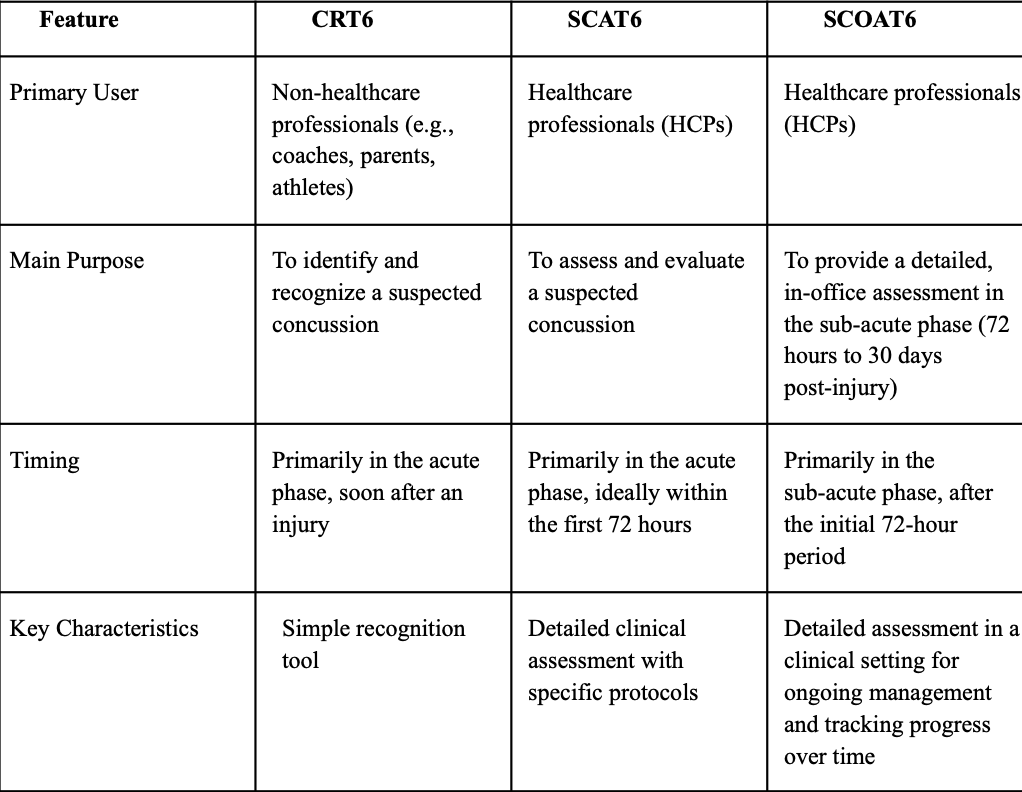
Concussion definition
Traumatic brain injury caused by a direct blow to the head, neck or body resulting in an impulsive force being transmitted to the brain that occurs in sports and exercise-related activities. This initiates a neurotransmitter and metabolic cascade, with possible axonal injury, blood flow change and inflammation affecting the brain. Symptoms and signs may present immediately, or evolve over minutes or hours, and commonly resolve within days, but may be prolonged
Neurometabolic cascade (know the order!):
1. Ionic flux and glutamate release
2. Energy crisis
3. Cytoskeletal damage
4. Axonal dysfunction
5. Altered neurotransmission
6. Inflammation
7. Cell death (maybe)
Recovery:
-10-14 days on average
-RTL/RTA protocols needed
-5 stage protocols are common
-Light aerobic activity is recommended
-DO NOT LOCK SOMEONE IN A DARK ROOM
Prolonged Recover
-Injury risk; Up to 3 years after symptom recovery
-Driving
-Second impact syndrome; Second concussion before previous one is healed; Potentially fatal
Evaluation:
Jump testing (why do it)
-Vertical jumping is a fundamental movement in many sports
-In many sports, higher caliber athletes tend to jump higher
-Most athletes can perform it
-It does not require expensive equipment
-It is safe
-It is not fatiguing as long as the volume is kept low
-Very good during rehab
-A simple, practical, valid and reliable measure of lower-body power
Technology when testing:
-Pasco force plates: 1000 Hz max sample rate, 1000 data points per second, can have dual force plates (right vs. left), 2 axis
-Jump mat: collects air time/jump time; extremely portable
Countermovement jumps vs. static jumps:
Countermovement
Attempts to take advantage of stretch-shortening cycle
-SSC consists of stretch of muscle-tendon units and activation of stretch reflex
-Stretch of tendons (and muscle to a small degree) causes potential energy to be stored as elastic energy; When this is used in a timely manner, it acts much like snapping a stretched rubber band
-Quick stretch of a muscle activates muscle spindles, which sends a signal back to the spine, which sends a signal back to the muscle and causes contraction
SSC is a more common mode of muscle and tendon movements in sports
-It is often argued that CMJ has greater ecological validity than SJ
-Higher than SJH because it produces a greater net impulse to system mass ratio than SJ
Static
-The involved muscles are at a higher activation level and there is much less tissue slack due to the countermovement in CMJ than in SJ
-SSC does appear to contribute but the contribution is rather minor compared to the higher activation level
Another reason is that in CMJ, there is an opportunity to start the concentric phase from a deeper position
-Attempts to remove SSC
-While it is not possible to eliminate, holding still and resuming concentric contraction without eccentric contraction reduces SSC
-SJ aims to examine muscles’ ability to produce force concentrically
-Some research suggests SJ is more sensitive to fatigue, but more research is needed (still up for debate as some researchers and sport practitioners believe the way in which we produce force is a better indicator)
Net impulse:
-change in an object's momentum, which is equal to the net external force acting on it multiplied by the time interval over which the force is applied
-The determinant of JH
-Net impulse to system mass ratio (take-off velocity)
-Net impulse = the difference between the area above the system weight line and the area below
-With system mass being constant, greater net impulse means greater jump height