Introduction to Biology - Exam 4 Study Guide
 Call Kai
 Learn
Learn Practice Test
 Spaced Repetition
 Match
Match Flashcards
 Knowt Play
1/40

There's no tags or description
Looks like no tags are added yet.
Name | Mastery | Learn | Test | Matching | Spaced | Call with Kai |
|---|
No analytics yet
Send a link to your students to track their progress
41 Terms
Vector
Organism that does not cause disease but spreads infection to another host
Malaria = mosquito
Variables changing from Climate change
Temp
Precip
Stronger storms, floods, drought
Hemoglobin
4 polypeptide subunits
a subunits are identical
b subunits are identical
each subunits binds to nonprotein = heme
Transcription
Initation
Elongation
Termination
Transcription: Initation
1) Sigma binds to RNA polymerase
2) Creases holenzyme (whole enzyme
3) Sigma binds to promoter region of DNA
4) RNA polymerase unzip double helix of DNA
5) Template strand moves trhough channel in RNA polymerase where NTPs are found
6) NTp is bound to the DNA template strand, RNA polymerization begins
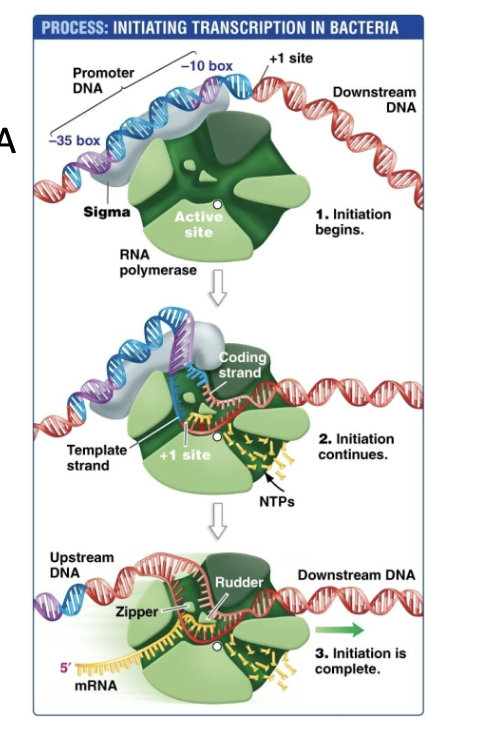
Transcription: Elongation
7) RNA polymerase moves along DNA template strand, synthesizing mRNA
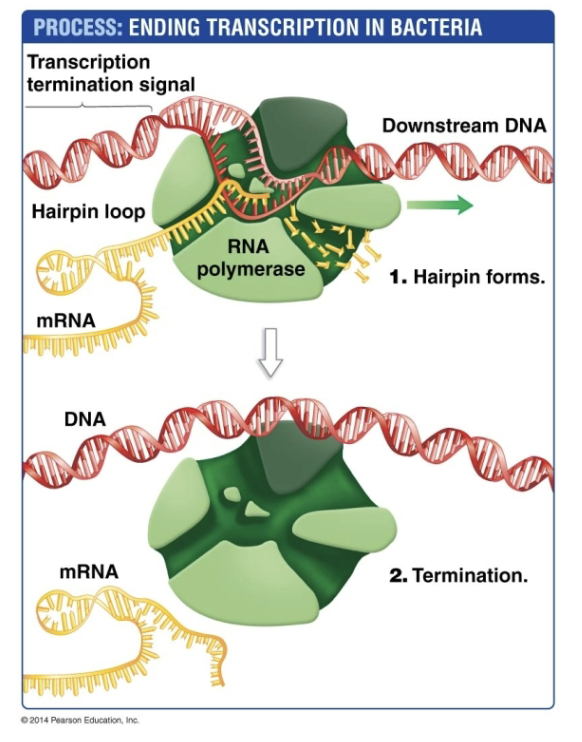
Transcription: Termination
8)Transtion ends when transcriotion-terminal signal is reached
9) mRNA folds on itself = hairpin
10) mRNA detach from polymerase
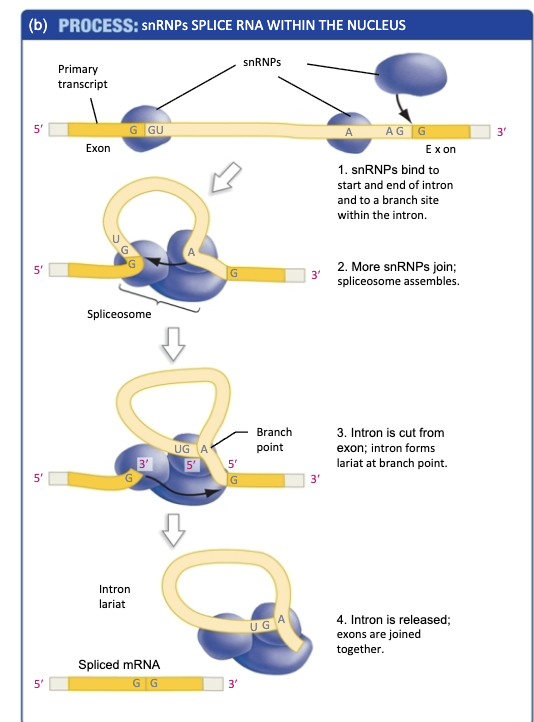
Splicing
Removal of introns›
exons: coding
introns: non-coding
1) snRPSs bind to start / end of intro and to branch sitte
2) snRNPS join together
3) Intron is cut from exon: intron froms lariat at branching point
4) Intron released + exons joined together
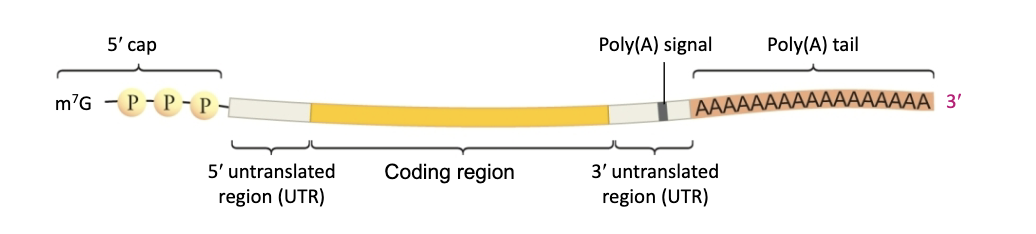
Capping off
1) once mRNA seperates cap is added to 5’ end
2) poly(A) tail added to 3’ end of pre-RNA
creates mature + protect
tRNA
Interpreters for Protein Synthesis
1) tRNA attaches to mRNA molecule at anticodone + codon
2) Amino acid attaches at 3’ end›
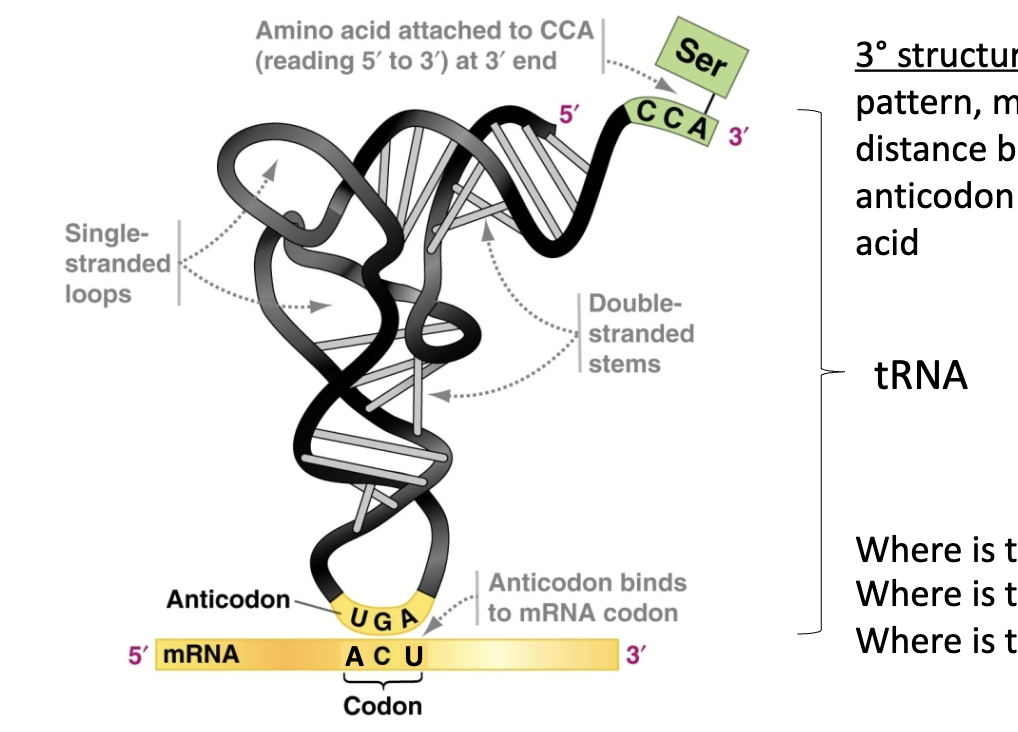
Ribosomes - key features›
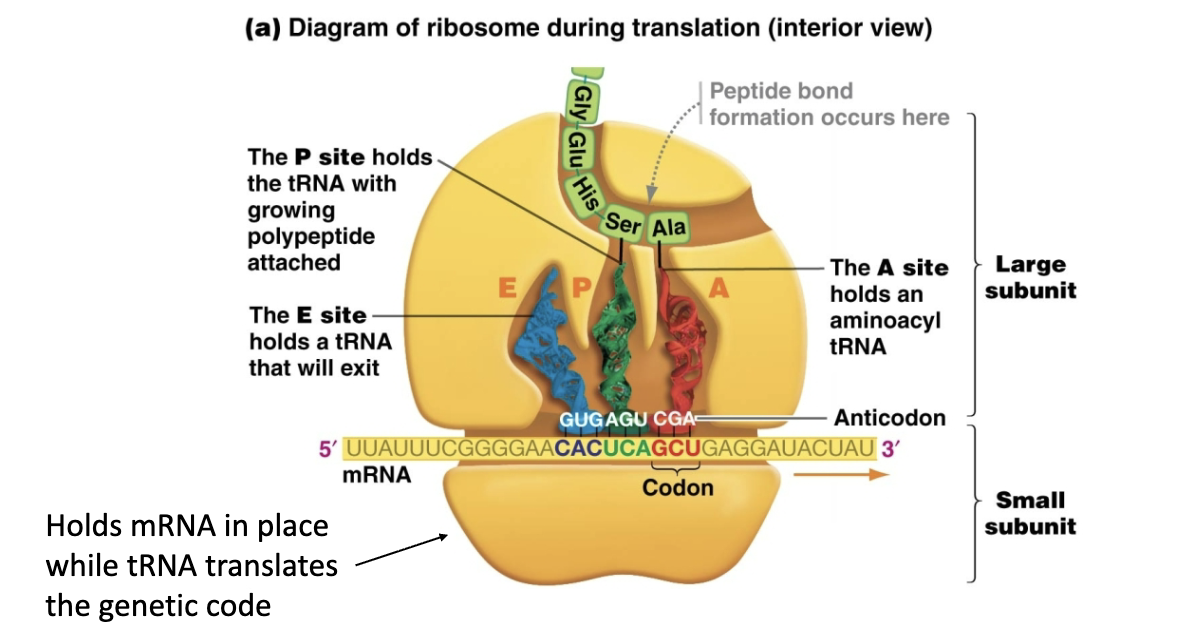
Translation: Overview
1) tRNA diffues into ribosome A side and if anticodon matches the codon of mRNA line up
Peptide bond forms between AA
3) Ribosomes moves across mRNA by one codon, and tRNAs move through the ribsomes
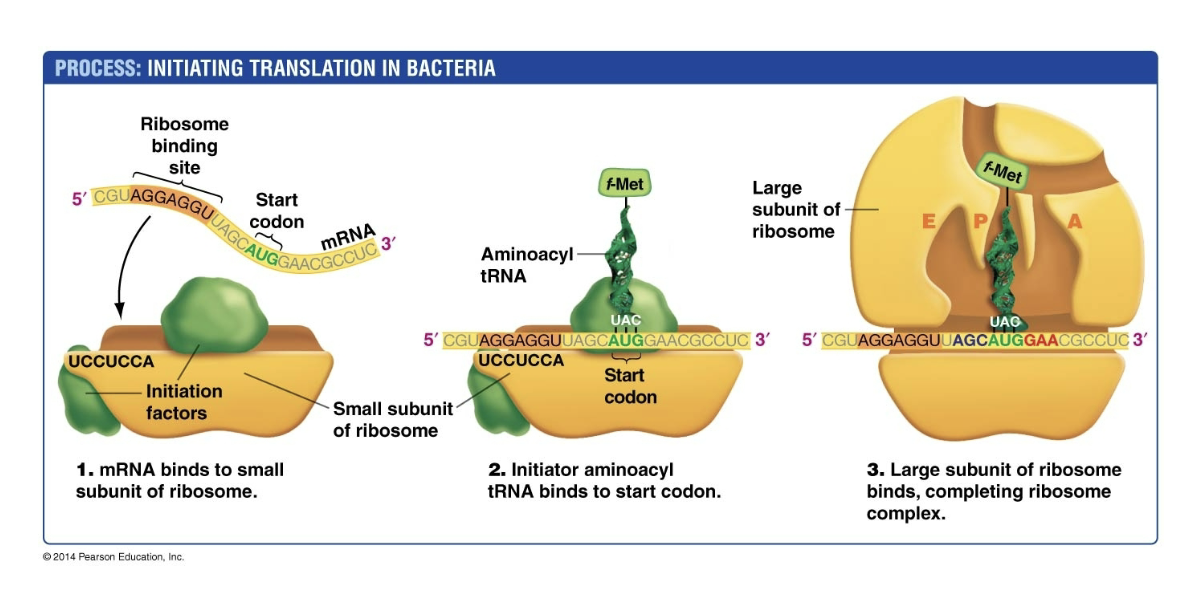
Translation: Initiation
1) mRNA binds to small submit of ribosome
2) Initator aminoacly tRNA bins to start codon
3) Large subunit of ribsome binds = ribosome complex
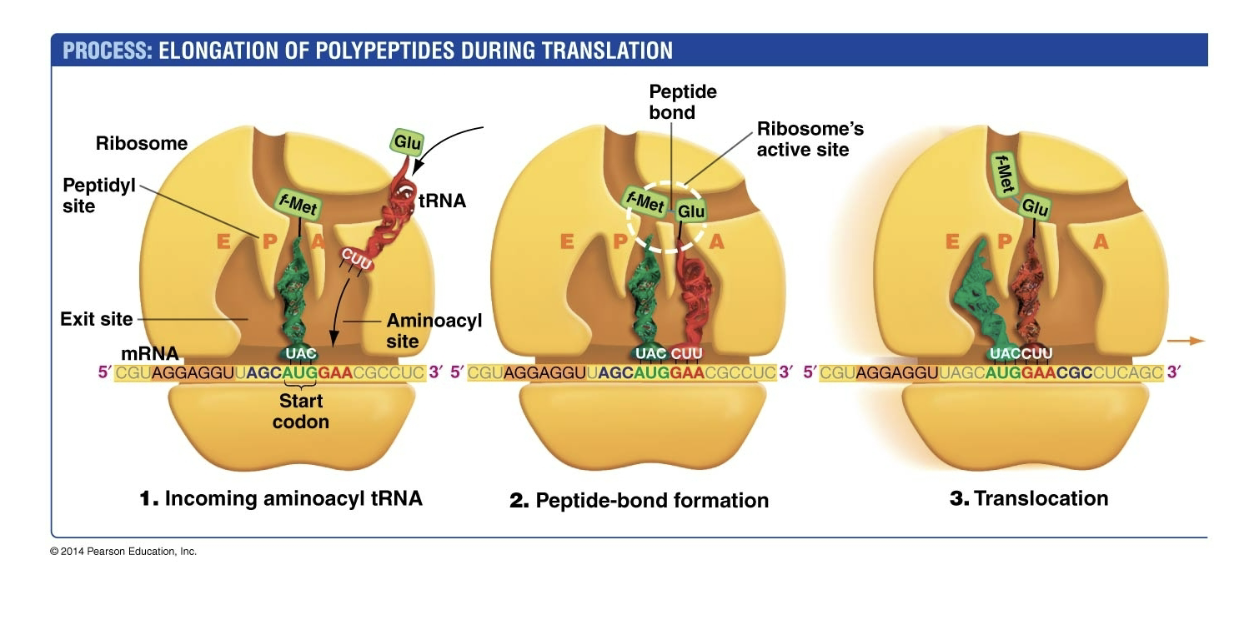
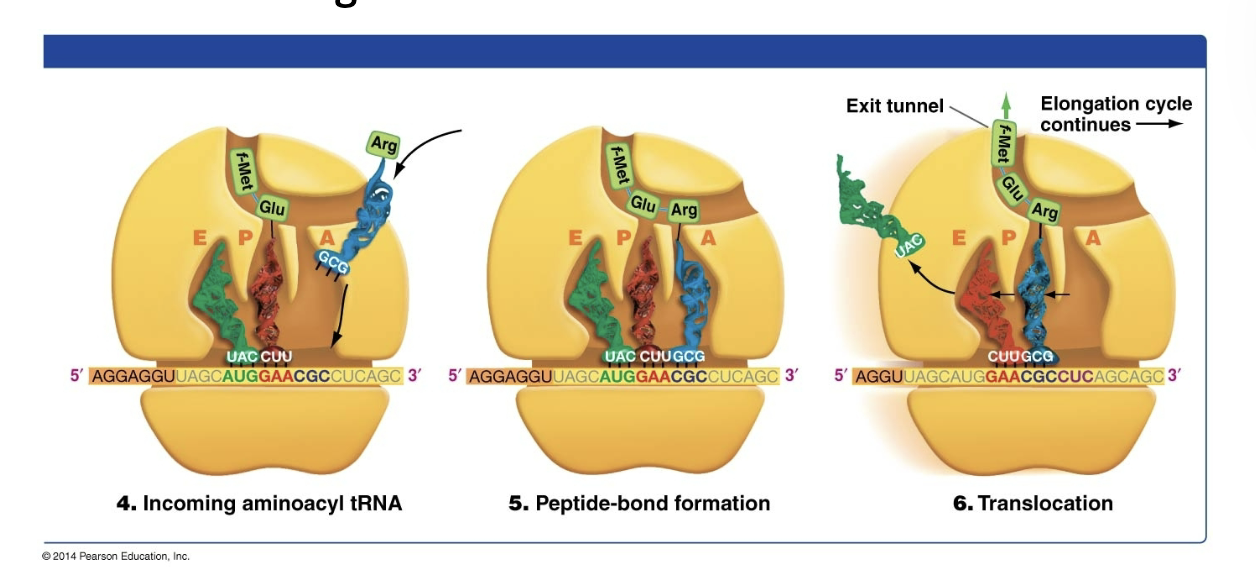
Translation: Elongation (1)
4) Incoming aminoacyl tRNA
5) Peptide-done formation
6) Translocation›
Translation: Elongation (2)
7) Incoming aminoacyl tRNA
8)Peptide-bond formation
9) Translocation
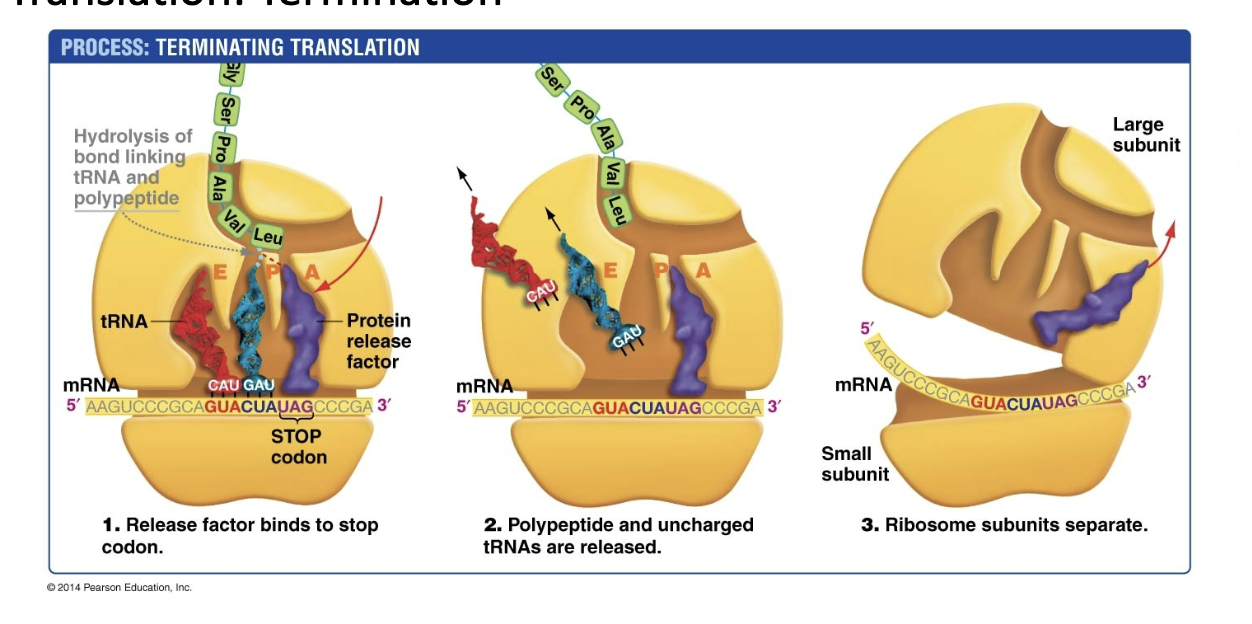
Traslation: Termination
10) Release factor binds to stop codon
11) Polypeptide + uncharged tRNAs are released
12) Ribosome subunit separate
Translation: Processing
1) Folding
2) Chem mod
Sugar / lipid group
Phosepate group = change shape
Gene Expression
Each cell has same gentic information
Differnital cell expression: expression of different sets of genes in cells with the same genome
Histone
proteins that DNA is wrapped around
Nucleosome
package of DNA, histones, other proteins
packed into 30nm fibers and attached to scaffold proteins
Chromatin
complex of DNA, proteins, histones = eukaryotic chromsomes
framework for chromosomes
Default state: turned off
Actice state: actively being transcribed
Epigenetics
study of heritable changes in gene expression that occur without a change in the DNA sequence
Pesticdes
-Function
-Classifcation:
Chem strucutre
Target species
Mode of Action
Toxicity
-Nature
Exposure to Pesticdes
1) Acute
Irriation, death
2)Long Term
Depression, reproducice funcitons, death
DDT
alterns methylation patterns
low methylation = active genes
and can be heritary
Physiology
Study of the function of organism (how tey work)
1) Energy + resource use METABOLISM
2)Maintenance of system inegriry - HOMEOSTASIS
3) REPRODUCTION
Proximate = Mechanism + Ontology
How organisms work
Mech: how does it work
Ontgeny: how trait develop
Ultimate = Adaptaion + Phylogeny
How species came to form
Adap: benefit does it add to survival
Phy: do others have it as well? - where it come from
What all living orgnaism share
1) Energy: fuel an organism needs to maintain function
2)Cells: organziton that organisms are composed of
3)Information: genetic and enviorment = used to regulate celluar proces
4) Evolutio: organsism change over time
Cells
1) Self organizaion: metabolism
obtain energy + raw materiams from surrounding enviorment
preform various chem reaction
elimate waste product
synthesize proteins
2) Self regulation: homeostaous
detect/respond to changes
control exchange of materials
repair damages
fix abnormailites
3) Self support / movements:
move by way of strucutes that help materials move into/out of cells
4) Self-replication:
reproduce to continute existence of species + repair damage cells
LVL OF CElls organization
Tissues
Organs
Systmes
Body
Tissues:
Group of cells with similar strucures
Tissues: M
Muscular: contract and generation of force (skeletal)
Tissues: N
Nervouse: initation and tranmission of electral impules (brain)
Tisseus: E
Epithelial: exchnage of materials
sheets: covers cover + lines (skin)
glands: specilizaed for secreation
Exocrine: outsidel (sweat)
Endocrine: inside (hormones)
Tissues: C
Connective: connects, supports, body arts
Losse: attaches epithelial tissue to underlying strucutres
Dense: tendons + ligaments that connect skeletal, muscles, bones, organs
Support: bones + carilage that give shape
Fluidd: cells + liquid extracellular matrix (blood)
Organ system
Group of cellular / extracellular componds that organization to perform a specific function (digestive system)
Surface-area to volume-ratio
Volume increases faster than surface area with increased “size”
Small organism = increases surface area per vol
Larger organ = decrease surface area per vol
SA = 6 x L2 (for one cub) 6:1
Vol = L3 (for one cube) 3: 1
Metabolic Rate + Basal Metabolic Rate
Overall rate of energy consumption by an indivdual
How much oxygen cosumber per gram per hour
Resting Metabolic Rate
Inverse relation between bozy size and BMR
Thermoregulation
How to obtain heat
Endotherm: inner heat - produce own heat to warm tissue
Ectotherm: outer heat - uses the environment for heating tissue
Homotherms (same heat): keep body temp constant (mammals)
Poikilotherm (varied heat): temp fluacate depending on conductions (fish, reptiles)
Torpor
Energy-conserving physiologcal state which dereases in metabolic rate
Hibernation: cold / low food
Estivation: dry / hot weather