Microeconomics
 Call Kai
 Learn
Learn Practice Test
 Spaced Repetition
 Match
Match Flashcards
 Knowt Play
1/196

There's no tags or description
Looks like no tags are added yet.
Name | Mastery | Learn | Test | Matching | Spaced | Call with Kai |
|---|
No analytics yet
Send a link to your students to track their progress
197 Terms
Principles 1-10
Fundamental concepts that guide economic decision-making, including scarcity, opportunity cost, and marginal analysis.
People face trade-offs
the cost of something is what you give up to get it
Rational people think at the margin
People respond to incentives
Trade can make everyone better off
Markets are usually a good way to organize economic activity
Governments can sometimes improve market outcomes
A country’s standard of living depends on its ability to produce goods and services
Prices rise when the government prints too much money
Society faces a short-run trade-off between inflation and unemployment
trade-offs
when making a decision, a person must give up something to get or do something
ex. “guns and butter“- more a society spends on the military, less it can spend on consumer goods
clean environment and level of income- regulation of firms for a cleaner environment and improved health makes it more likely that firms will earn smaller profits, pay lower wages, and charge higher prices
-social trade-off between efficiency and equality
opportunity cost
whatever must be given up to obtain some item
marginal decision-making
making decisions that consider marginal change- incremental adjustments to an existing plan
-rational people make decisions by comparing marginal benefits and marginal costs
-a rational decision maker takes an action if and only if the action’s marginal benefit exceeds its marginal cost
the role of incentives
an incentive is something that induces a person to act
-people respond to incentives by comparing costs and benefits
Adam Smith and the invisible hand
made the most famous observation in all of economics: firms and households in competitive markets acts as if they are guided by an “invisible hand“ that leads them to desirable outcomes
-directs economic activity
scarcity
the limited nature of society’s resources
economics
the study of how society manages its scarce resources
efficiency
the property of society getting the most it can from its scarce resources
equality
the property of distributing economic prosperity uniformly among the members of society
opportunity cost
whatever must be given up to obtain some item
rational people
people who systematically and purposefully do the best they can to achieve their objectives
marginal change
an incremental adjustment to a plan of action
incentive
something that induces a person to act
market economy
an economy that allocates resources through the decentralized decisions of many firms and households as they interact in markets for goods and services
property rights
the ability of an individual to own and exercise control over scarce resources
market failure
a situation in which a market left on its own does not allocate resources efficiently
externality
the impact of one person’s actions on the well-being of a bystander
market power
the ability of a single economic actor (or small group of actors) to have a substantial influence on market prices
productivity
the quantity of goods and services produced from each unit of labor input
inflation
an increase in the overall level of prices in the economy
business cycle
fluctuations in economic activity, such as employment and production
Economics is best defined as the study of _______.
how society manages its scarce resources
Your opportunity cost of going to a movie is _______.
the total cash expenditure needed to go to the movie plus the value of your time
A marginal change is one that _______.
incrementally alters an existing plan
Because people respond to incentives, _______.
-policymakers can alter outcomes by changing punishments or rewards
-policies can have unintended consequences
-society faces a trade-off between efficiency and equality
International trade benefits a nation when _______.
all nations are specializing in producing what they do best
Adam Smith's "invisible hand" refers to _______.
the ability of free markets to reach desirable outcomes, despite the self-interest of market participants
Governments may intervene in a market economy in order to _______.
-protect property right
-correct a market failure due to externalities
-achieve a more equal distribution of income
The main reason that some nations have higher average living standards than others is that _______.
some nations have higher levels of productivity
If a nation has high and persistent inflation, the most likely explanation is _______.
the government creating excessive amounts of money
If a government uses the tools of monetary policy to reduce the demand for goods and services, the likely result is ________ inflation and ________ unemployment in the short run.
lower; higher
the two roles of economists
scientists: try to explain the world
policy advisors: try to improve it
the role of assumptions
simplify the complex world and make it easier to understand
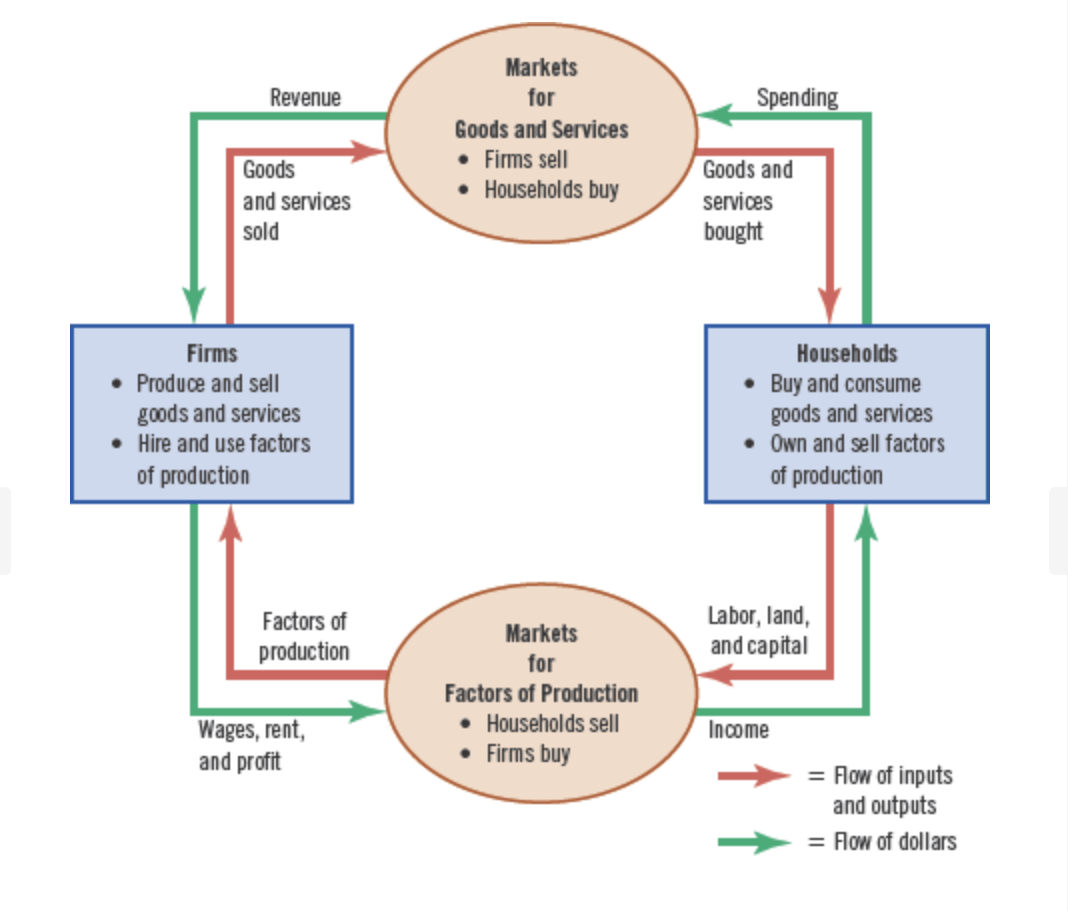
Circular Flow Model
a visual model of the economy that shows how dollars flow through markets among households and firms
Production Possibility Frontier (PPF)
a graph that shows the combinations of output that the economy can possibly produce with the available factors of production and production technology
efficient/inefficient
efficient: economy getting all it can from the scarce resources it has available (points on the PPF)
inefficient: under the PPF
feasible/not feasible
feasible: on or inside PPF
not feasible: points outside PPF
slope represents tradeoff
slope of PPF represents tradeoff of opportunity cost
constant opportunity cost vs. increasing opportunity cost
constant opportunity: a straight downward sloping line
increasing opportunity: bowed- out line- trade-off worsens as you produce more of a good
normative vs. positive statements
normative: claims that attempt to prescribe how the world should be
positive: claims that attempt to describe the world as it is
microeconomics vs. macroeconomics
microeconomics: the study of how households and firms make decisions and how they interact in markets
macroeconomics: the study of economy-wide phenomena, including inflation, unemployment, and economic growth
why economists disagree
Economists may disagree about the validity of alternative positive theories of how the world works.
Economists may have different values and, therefore, different normative views about what government policy should aim to accomplish.
An economic model is _______.
a simplified representation of some aspect of the economy
The circular-flow diagram illustrates that, in markets for the factors of production, _______.
households are sellers, and firms are buyers
A point inside the production possibilities frontier is _______.
feasible but not efficient
All of the following topics fall within the study of microeconomics except _______.
the influence of the government budget deficit on economic growth
Which of the following is a positive, rather than a normative, statement?
Law X will reduce national income.
The following parts of government regularly rely on the advice of economists: _______.
Department of Treasury
Office of Management and Budget
Department of Justice
Economists may disagree because they have different _______.
hunches about the validity of alternative theories
judgments about the size of key parameters
political philosophies about the goals of public policy
Most economists believe that tariffs are _______.
a poor way to raise general economic well-being
determine/define absolute advantage
the ability to produce a good using fewer inputs than another producer
compute opportunity costs

determine/define comparative advantage
the ability to produce a good at a lower opportunity cost than another producer
specialization and trade
based on comparative advantage
when people produce goods in which they have a comparative advantage, total production rises
understand why trade is mutually beneficial
Trade can benefit everyone because it allows people to specialize in the activities in which they have a comparative advantage.
identify terms of trade
For both parties to gain from trade, the price at which they trade must lie between their opportunity costs.
imports
goods produced abroad and sold domestically
exports
goods produced domestically and sold abroad
Before Frank and Ruby engage in trade, each of them _______.
consumes at a point on their production possibilities frontier
After Frank and Ruby engage in trade, each of them _______.
consumes at a point outside their production possibilities frontier
In an hour, Mateo can wash 2 cars or mow 1 lawn, and Sophia can wash 3 cars or mow 1 lawn. Who has the absolute advantage in car washing, and who has the absolute advantage in lawn mowing
Sophia in washing, neither in mowing
Between Mateo and Sophia, who has the comparative advantage in car washing, and who has the comparative advantage in lawn mowing?
Sophia in washing, Mateo in mowing
When Mateo and Sophia produce efficiently and make a mutually beneficial trade based on comparative advantage,
Mateo mows more and Sophia washes more
A nation will typically import those goods in which _______.
other nations have a comparative advantage
Suppose that in the United States, producing an aircraft takes 10,000 hours of labor and producing a shirt takes 2 hours of labor. In China, producing an aircraft takes 40,000 hours of labor and producing a shirt takes 4 hours of labor. What will these nations trade?
China will export shirts, and the United States will export aircraft
Kayla can cook dinner in 30 minutes and wash the laundry in 20 minutes. Her roommate takes twice as long to do each task. How should the roommates allocate the work?
There are no gains from trade in this situation
describe a market
a group of buyers and sellers of a particular good or service
characteristics of competitive markets
a market in which there are many buyers and many sellers so each has a negligible impact on the market price
ceteris paribus
'holding other things constant' or 'all other things being equal.'
law of demand
as the price of a good or service increases, the quantity demanded by consumers decreases
-price and quantity demanded move in opposite directions
law of supply
keeping other factors constant, an increase price results in an increase in quantity supplied
change in quantity demanded vs. change in demand
quantity demanded: the amount of a good that buyers are willing and able to purchase
change in demand:
increase in demand- demand curve shifts to the right
decrease in demand- demand curve shifts to the left
non-price determinants of demand (demand shifters)
number of buyers
income: normal goods vs. inferior goods
price of related goods: substitutes vs. complements
tastes/preferences
expectations: future income and future prices
inferior goods are not economic bads
example of an inferior good might be bus rides
market demand vs. individual demand
market demand: the sum of all individual demands for a particular good or service
individual demand: quantity of a good or service a single consumer is willing and able to buy at various prices
change in quantity supplied vs. change in supply
quantity supplied: the amount of a good that sellers are willing and able to sell
change in supply: when the price of a good rises, the quantity supplied also rises, and when the price falls, the quantity supplied falls as well
non-price determinants of supply (supply shifters)
number of sellers
input prices
technology
expectations: future prices
market supply versus individual supply
sum of the supplies of all sellers
equilibrium: equilibrium price and equilibrium quantity
equilibrium price: the price that balances the quantity supplied and the quantity demanded
equilibrium quantity: the quantity supplied and the quantity demanded at the equilibrium price
shortage
a situation in which the quantity demanded is greater than the quantity supplied
surplus
a situation in which the quantity supplied is greater than the quantity demanded
comparative statics (changes in equilibrium): due to changes in demand/supply or both
single shift
two shifts
the allocation of resources
In market economies, prices are the signals that guide decisions and allocate scarce resources. For every good in the economy, the price ensures that supply and demand are in balance.
normal good
a good for which, other things being equal, an increase in income leads to an increase in demand
inferior good
a good for which, other things being equal, an increase in income leads to a decrease in demand
substitutes
two goods for which an increase in the price of one leads to an increase in the demand for the other
complements
two goods for which an increase in the price of one leads to a decrease in the demand for the other
The best definition of a market is
a group of buyers and sellers of a good or service
In a perfectly competitive market,
every seller takes the price of its product as set by market conditions
The market for which product best fits the definition of a perfectly competitive market?
eggs
A change in which of the following will not shift the demand curve for hamburgers?
The price of hamburgers
Which of the following will shift the demand curve for pizza to the right?
An increase in the price of hamburgers, a substitute for pizza
If pasta is an inferior good, then the demand curve shifts to the ________ when ________ rises.
left; consumers' income
Which of the following moves the pizza market up along a given supply curve?
An increase in the price of pizza
Which of the following shifts the supply curve for pizza to the right?
A decrease in the price of cheese, an input to pizza
Movie tickets and film streaming services are substitutes. If the price of film streaming increases, what happens in the market for movie tickets?
The demand curve shifts to the right
The discovery of a large new reserve of crude oil will shift the ________ curve for gasoline, leading to a ________ equilibrium price.
supply; lower
If the economy goes into a recession and incomes fall, what happens in the markets for inferior goods?
Prices and quantities both rise
Which of the following might lead to an increase in the equilibrium price of jelly and a decrease in the equilibrium quantity of jelly sold?
An increase in the price of grapes, an input into jelly