BIOL 667 - Comprehensive
 Call Kai
 Learn
Learn Practice Test
 Spaced Repetition
 Match
Match Flashcards
 Knowt Play
1/51

There's no tags or description
Looks like no tags are added yet.
Name | Mastery | Learn | Test | Matching | Spaced | Call with Kai |
|---|
No analytics yet
Send a link to your students to track their progress
52 Terms
What is an introduced species?
A. A species that introduces themselves on their own to another species in the same habitat.
B. A species that is introduced by humans in regions they were historically absent in.
C. A species that is introduced to ecologists for the first time.
D. A species that is newly introduced to the general public for the first time.
B. A species that is introduced in regions they were historically absent in by humans.
Which of the following are NOT other terms used synonymous with “Introduced Species?”
A. Alien Species
B. Exotic Species
C. Nonnative Species
D. Nonindigenous Species
E. They all have been used synonymously.
E. They all have been used synonymously.
Which of the following are examples of Invasive Species that originated from Europe?
A. Spongy Moth (Lymantria dispar)
B. Emerald Ash Borer (Agrilus planipennis)
C. Zebra mussel (Dreissena polymorpha)
D. A. and B.
E. A. and C.
E. A. and C.
Habitat fragmentation is best defined as:
A. Complete destruction of habitat
B. Division of continuous habitat into smaller patches
C. Natural seasonal habitat shifts
D. Increase in biodiversity
B. Division of continuous habitat into smaller patches
Which of the following is NOT a common cause of fragmentation?
A. Urbanization
B. Roads
C. Natural selection
D. Agriculture
C. Natural selection
A major consequence of fragmentation is:
A. Increased mutation rates
B. Barriers to dispersal
C. Increased rainfall
D. Decreased edge habitat
B. Barriers to dispersal
According to Fahrig (2017), most ecological responses to fragmentation were:
A. Negative
B. Neutral
C. Positive
D. Unknown
C. Positive
Increased functional connectivity means:
A. Organisms cannot move between patches
B. Movement between patches is easier
C. Habitat size increases
D. Predators dominate prey
B. Movement between patches is easier
Edge effects typically result in:
A. Lower temperatures
B. Higher humidity
C. Increased wind exposure
D. Reduced sunlight
C. Increased wind exposure
Which species is most likely to benefit from edge habitats?
A. Interior specialists
B. Generalists
C. Deep Forest species
D. Aquatic-only species
B. Generalists
Metapopulations consist of:
A. One large continuous population
B. Multiple isolated species
C. Spatially separated populations linked by migration
D. Only extinct populations
C. Spatially separated populations linked by migration
A “source” population:
A. Has negative growth
B. Supplies individuals to other populations
C. Is always extinct
D. Exists only temporarily
B. Supplies individuals to other populations
Maximum Sustainable Yield occurs:
A. At lowest population size
B. At carrying capacity
C. At intermediate population size
D. At extinction
C. At intermediate population size
Logistic growth is represented by:
A. Exponential equation
B. dN/dt = rN(1−N/K)
C. Linear growth
D. Random fluctuation
B. dN/dt = rN(1−N/K)
Overexploitation becomes more likely when:
A. Prices decrease
B. Population size increases
C. Prices increase
D. Resources are abundant
C. Prices increase
The “tragedy of the commons” refers to:
A. Equal resource distribution
B. Overuse of shared resources
C. Government regulation
D. Sustainable harvesting
B. Overuse of shared resources?
An introduced species is:
A. Native to the ecosystem
B. Brought by humans to new areas
C. Always invasive
D. Always harmful
B. Brought by humans to new areas
Naturalized species:
A. Cannot reproduce
B. Maintain self-sustaining populations
C. Are always extinct
D. Are native species
B. Maintain self-sustaining populations
Invasive species:
A. Are always beneficial
B. Spread rapidly and harm native species
C. Cannot reproduce
D. Stay localized
B. Spread rapidly and harm native species
Propagule pressure refers to:
A. Predator density
B. Number of individuals introduced
C. Soil nutrients
D. Climate variability
B. Number of individuals introduced
A common trait of invasive species:
A. Slow reproduction
B. Narrow niche
C. High reproductive rate
D. Poor dispersal
C. High reproductive rate
Kudzu is known for:
A. Preferring interiors
B. Thriving in edge habitats
C. Being aquatic
D. Being a predator
B. Thriving in edge habitats
Ocean acidification is caused by:
A. Nitrogen
B. CO₂ dissolving in water
C. Oxygen loss
D. Temperature drops
B. CO₂ dissolving in water
Methane is:
A. Less potent than CO₂
B. More potent short-term greenhouse gas
C. Not a greenhouse gas
D. Only from plants
B. More potent short-term greenhouse gas
Albedo refers to:
A. Heat production
B. Reflection of sunlight
C. Wind speed
D. Ocean salinity
B. Reflection of sunlight
Sea level rise is primarily driven by:
A. Soil erosion
B. Ice melt and thermal expansion
C. Wind
D. Rainfall
B. Ice melt and thermal expansion
Climate change causes plant shifts:
A. Downward
B. Toward equator
C. Upslope and poleward
D. No movement
C. Upslope and poleward
Keystone species:
A. Are most abundant
B. Have disproportionate ecological impact
C. Are always predators
D. Are always plants
B. Have disproportionate ecological impact
The Minimum Viable Population (MVP) is the:
A. Largest population size
B. Smallest population for long-term survival
C. Temporary population
D. Maximum population
B. Smallest population for long-term survival
Protected areas are most effective when they are:
A. Open access
B. Heavily urbanized
C. Patrolled and isolated
D. Small and fragmented
C. Patrolled and isolated
SLOSS stands for:
Single Large Or Several Small
A circular reserve shape is preferred because:
A. It is easier to build
B. There is more edge habitat
C. There is less edge habitat
D. It is cheaper
C. There is less edge habitat
Biological corridors:
A. Increase isolation
B. Reduce gene flow
C. Promote dispersal
D. Cause extinction
C. Promote dispersal
Fragmentation increases:
A. Core habitat
B. Edge habitat
C. Ocean salinity
D. Rainfall
B. Edge habitat
Species requiring core habitat are most vulnerable in:
A. Large patches
B. Fragmented landscapes
C. Oceans
D. Deserts
B. Fragmented landscapes
Genetic drift is strongest in:
A. Large populations
B. Small populations
C. Stable populations
D. Connected populations
B. Small populations
Biological corridors primarily:
A. Reduce predation
B. Increase isolation
C. Promote gene flow
D. Increase competition
C. Promote gene flow
Which is an example of overexploitation?
A. Conservation breeding
B. Sustainable fishing
C. Commercial whaling
D. Reforestation
C. Commercial whaling
Renewable resources:
A. Cannot regenerate
B. Regrow over time
C. Are always unlimited
D. Include fossil fuels
B. Regrow over time
A high price for a species:
A. Reduces harvesting
B. Encourages conservation
C. Increases overexploitation
D. Has no effect
C. Increases overexploitation
Which is NOT an introduction pathway?
A. Ballast water
B. Wheel wells
C. Natural selection
D. Food trade
C. Natural selection
Invasive species often:
A. Have narrow niches
B. Reproduce slowly
C. Thrive in disturbed habitats
D. Cannot disperse
C. Thrive in disturbed habitats
Arctic warming is:
A. Slower than the global average
B. Equal to the global average
C. Faster than the global average
D. Not occurring
C. Faster than global average
Sea level rise affects:
A. Only oceans
B. Coastal populations
C. Only polar regions
D. Forests only
B. Coastal populations
Ocean acidification impacts:
A. Birds
B. Shell-forming organisms
C. Mammals only
D. Soil microbes
B. Shell-forming organisms
A landscape in which total habitat area remains constant but is subdivided into smaller patches would most likely:
A. Decrease edge habitat
B. Increase edge-to-core ratio
C. Eliminate dispersal barriers
D. Result in no ecological change
B. Increase edge-to-core ratio
What is Species Diversity?
A. How diverse the species are based on phenotypes/physical characteristics.
B. How diverse the species are based on genotypes.
C. How diverse the species are based on population numbers of the different species.
D. How diverse the species are based on the number of different species.
E. A combination of C. and D.
What is Species Diversity? (Open-Response)
The diversity of the number of species and the abundance/population of each species in a particular area.
What is Genetic Diversity? (Open-Response)
The diversity of the genetic variation (DNA sequences, alleles, gene frequencies, etc.) within species.
What is Ecosystem Diversity? (Open-Response)
The diversity of ecosystems within a specific bigger area or the planet.
What is a Keystone Species? (Open-Response)
A species that has a disproportionally effect on other species livelihood in an ecosystem while making up a small percentage of the ecosystem’s biomass.
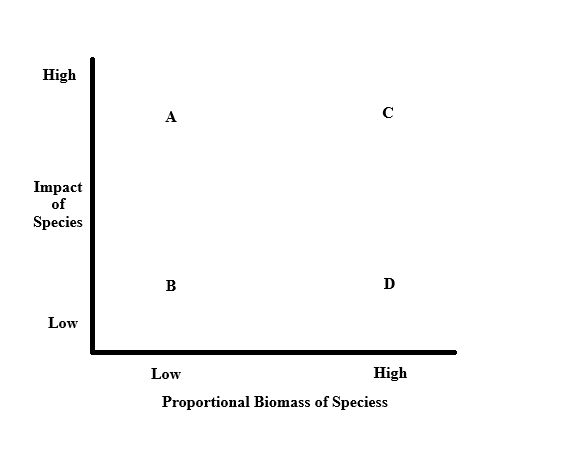
Label the following letters.
A. Keystone Species
B. Rare Species
C. Dominant Species
D. Common Species