1.11-1.16 Forces, Scalars/Vectors, & Friction
0.0(0)
Studied by 4 people Call Kai
 Learn
Learn Practice Test
 Spaced Repetition
 Match
Match Flashcards
 Knowt Play
Card Sorting
1/31

Earn XP
Description and Tags
Last updated 12:56 PM on 4/17/23
Name | Mastery | Learn | Test | Matching | Spaced | Call with Kai |
|---|
No analytics yet
Send a link to your students to track their progress
32 Terms
1
New cards
Force
Push or pull on an object with mass causing it to accelerate (change its velocity). Force is measured in newtons (N)
2
New cards
Forces act on bodies and can have affects that cause these bodies to change their …
1. Speed; acceleration or deceleration
1. E.g: Thrust of engine’s magnitude can affect car’s speed if air resistance (drag) stays constant.
2. Shape; stretching, compression, or deformation
1. Hooking a mass onto the end of a spring can cause it to stretch.
3. Direction; change direction of motion due to force
1. Sun’s gravitational attraction can change the direction of a comet’s orbit/motion.
3
New cards
Types of forces
1. Contact forces
2. Non-contact forces
3. Weight
4. electrostatic
5. Thrust
6. Upthrust (buoyant force)
7. Friction
8. Air resistance (drag)
9. Compression
10. Tension
11. Normal reaction force
4
New cards
Contact forces
Forces experienced only when 2 bodies are in contact.
5
New cards
Non-contact forces
Forces that do not require 2 bodies to be in contact to be experienced.
6
New cards
Weight (gravitational force, force of gravity)
Force between any 2 bodies with mass due to gravitational attractions between them. When 2 objects with mass are close enough together, they exert gravitational forces on each other, which we measure as weight.
7
New cards
Electrostatic
Force of attraction or repulsion between 2 charged bodies.
8
New cards
Thrust
Force that propels an object in a particular direction, which is created by expelling mass at high velocity in the opposite direction to the desired movement. This expulsion creates an equal and opposite reaction force (thrust) which propels the body in the desired direction.
9
New cards
Upthrust (buoyant force)
Upward force exerted by a fluid (liquid or gas) on the body immersed in the fluid, which opposes the object’s weight.
10
New cards
Friction
Force that opposes/resists motion between 2 surfaces in contact with each other, it results in dissipation of thermal energy (heat). Friction emerges when surfaces rub against each other because of the way imperfections on the 2 surfaces at molecular level push against one another.
11
New cards
What do imperfections mean on surfaces?
Areas on surfaces that are not perfectly smooth.
12
New cards
Air resistance (drag)
Force of friction between air particles and objects moving in/through the air, which opposes the relative motion of an object as it passes through the air.
13
New cards
What causes air resistance?
Particles in the air move in the direction opposite to/from an object as it passes through the air, hence creating friction and creating resistance/opposition to the object’s movement. Air resistance may increase or decrease depending on the shape as well as speed pf the moving object.
14
New cards
Compression
Force that squeezes an object inwards.
15
New cards
Tension
Force that stretches an object; forces pull/stretch the body in opposite directions, causing it to stretch.
16
New cards
Normal reaction force
Force between any 2 objects in contact. This force is perpendicular to the surface of contact, and is equal in magnitude but opposite in direction to the weight of the object in contact with the surface. The normal reaction force prevents objects from passing/falling through the surface it’s in contact with.
17
New cards
Quantity
Characteristics or properties of an object that can be measured. All quantities are either scalar or vector.
18
New cards
Scalar quantity
Quantities that can be fully described by a magnitude (numerical size/value) alone.
19
New cards
Examples of scalar quantities
Distance (m)
Speed (m/s)
Time (s)
Mass (kg)
Temperature (K)
Pressure (Pa or N/㎡)
All forms of energy (J)
Work done (J)
Current (A)
Potential difference (V)
Resistance (Ω)
Volume (㎥)
Density (kg/㎥)
and many more …
Speed (m/s)
Time (s)
Mass (kg)
Temperature (K)
Pressure (Pa or N/㎡)
All forms of energy (J)
Work done (J)
Current (A)
Potential difference (V)
Resistance (Ω)
Volume (㎥)
Density (kg/㎥)
and many more …
20
New cards
Vector quantity
Quantity described by both a magnitude (numerical size/value) and a direction.
21
New cards
Examples of vector quantities
Displacement (m)
Velocity (m/s)
Acceleration (m/s^2)
Force (N)
Weight (N)
Moment (Nm)
All forces are vector quantities because they have both a magnitude/size and direction.
Velocity (m/s)
Acceleration (m/s^2)
Force (N)
Weight (N)
Moment (Nm)
All forces are vector quantities because they have both a magnitude/size and direction.
22
New cards
How do scalar and vector quantities relate with one another?
Sometimes vectors and scalars align in corresponding pairs because they measure the same thing and have the same units. E.g: mass and weight, speed and velocity, distance and displacement, etc.
23
New cards
Free-body diagrams
Diagrams showing all forces acting on a body by drawing arrows.
Length of arrow shows force’s magnitude: longer arrow → higher magnitude of force, shorter arrow → lower magnitude of force.
Direction arrow points in shows direction force acts in.
Pure free body diagrams depict objects as a point particle. However in IGCSE, the object is still drawn. Some forces are at an angle and are therefore described with respect to the horizontal or vertical.
Length of arrow shows force’s magnitude: longer arrow → higher magnitude of force, shorter arrow → lower magnitude of force.
Direction arrow points in shows direction force acts in.
Pure free body diagrams depict objects as a point particle. However in IGCSE, the object is still drawn. Some forces are at an angle and are therefore described with respect to the horizontal or vertical.
24
New cards
Resultant force (a.k.a. net force)
Single force describing the overall result of all forces acting on a body, it’s obtained through vector addition.
25
New cards
Vector addition
Adding or combining 2 or more vectors to obtain a single vector with the same effect as all the original vectors acting together. Resultant forces are vectors so show the object’s final direction and magnitude of force.
26
New cards
What are the conventional signs for directions in vectors?
\+ for up or right
\- for down or left
Opposite directions can also be described as negatives of one another. E.g: When required to describe a leftward force, a right ward force would be negative and subtracted from the leftwards force.
\- for down or left
Opposite directions can also be described as negatives of one another. E.g: When required to describe a leftward force, a right ward force would be negative and subtracted from the leftwards force.
27
New cards
What happens when the resultant force is 0?
Opposite forces all cancel out → Resultant force = 0 (i.e. Σ Forces = 0) → Balanced forces → No acceleration (no change in velocity) → Stationary objects stay stationary, moving objects move at a constant speed in the same direction.
28
New cards
What happens when the resultant force ≠ 0?
Opposite forces don’t all cancel out → Resultant force ≠ 0 (i.e. Σ Forces ≠ 0) → Unbalanced forces → Acceleration (change in velocity) → stationary objects move, moving objects speed up/slow down/change direction.
29
New cards
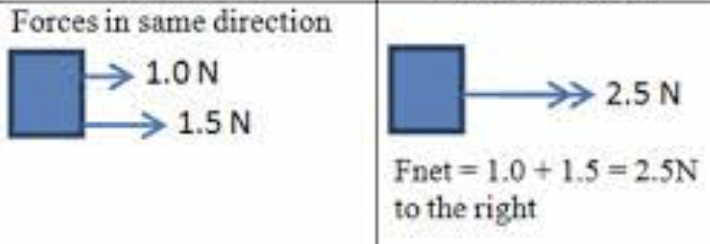
How to calculate resultant forces of forces that act along a line in the same direction?
Add the 2 or more forces together, state the number of newtons (including the units) and the direction of the force (as forces are vector quantities).
30
New cards
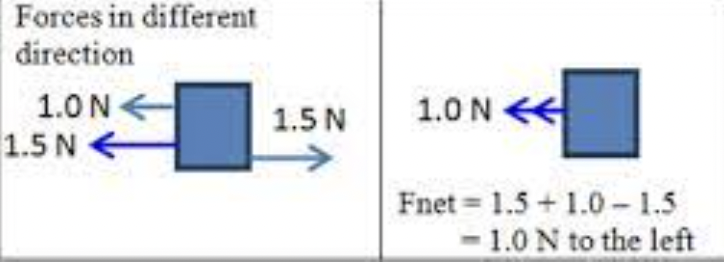
How to calculate resultant forces of forces that act along a line in opposite directions?
Subtract 1 force from the other. The resultant force will be the subtraction result (in the direction of the force that was NOT subtracted from the other or whichever direction specified from the question - in this case you need to change which force is subtracted from which). State the number of newtons (including the units) and the direction of the force (as forces are vector quantities).
31
New cards
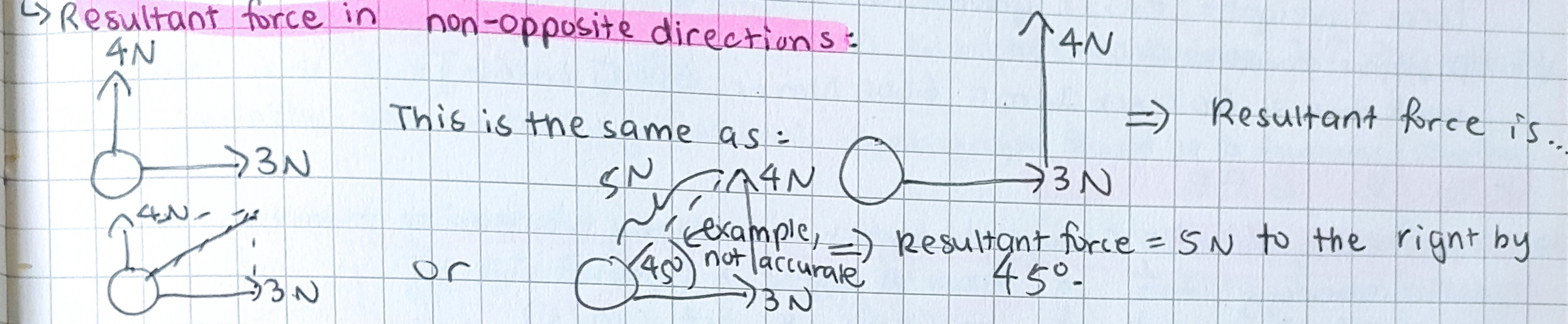
How to calculate resultant forces of forces that are perpendicular to one another?
Move one of the forces over such that the end of 1 force is connected to the start of the other force. Use Pythagoras’ theorem to calculate the resultant force and state its direction.
32
New cards
Friction forces … the … of an …
oppose, motion, object