Greek Religion: Term 2 Week 7: Other Festivals:
 Call Kai
 Learn
Learn Practice Test
 Spaced Repetition
 Match
Match Flashcards
 Knowt Play
1/60

There's no tags or description
Looks like no tags are added yet.
Name | Mastery | Learn | Test | Matching | Spaced | Call with Kai |
|---|
No analytics yet
Send a link to your students to track their progress
61 Terms
Name some festivals that occurred in Sparta
Hyakinthia
Gymnopaidia
Karneia
Name a festival that occurred in Achaea- North Peloponnese
Achaea- North Peloponnese :
Laphria (dedicated to Artemis)
Name some festivals that occurred in Boetia
Daphnephoria
Daidala (festival that occurs on mt chithaeron, involving the burning of wooden idols)
What are myths often heavily connected to?
Think of myth, we have seen in Athens how myths are often heavily connected to the Athenian rituals within festivals.
What type of society was Sparta and how did religion play into this?
Very military based society but they did seem to be very religious people, this religious life is heavily tied in to the military life
What did festivals form a part of in Sparta?
Festivals form part of social initiation of men especially
Whats an agoge?
Agoge was military intiation and education
What happened to boys in Sparta when they were seven? Can we trust where this knowledge comes from?
Aged 7, boys were separated from families and put into herds- wouldn’t be fully integrated members of society intil age of 30
The details around this are sketchy, most of our knowledge about them comes from Xenophon (he is more trust worthy though as his sons grew up in the spartan system). A lot of our info comes from Athenian sources- very few from the Spartans themselves
How did these adolescents feed themselves?
At some point these adolescents fed themselves through theft- this may be in certain rituals/festivals?
Whipping
Boys were whipped at the altar of Artemis Ortheia- period in country (fox time- phouaxir) after which (according to Xenophon in lace. Poll. 2.9) as part of a cult game (maybe), the outsiders have to steal as much cheese as they can from the altar, defended by youths with whips. Blood is dropped on the altar. Procession in long Lydian robes follows.
In imperial period the whipping became a spectator sport- about enduring pain
Where is initiation more clearly seen?
Initiation more clearly seen in rituals linked to Apollo
What is the Hyakinthia in Sparta?
Festival for Apollo Hyakinthia
What myth does this conenct to?
Myth linked to accidental death of Hyacinthus, lover of Apollo- Apollo kills him with a discus (accidentally)
When did the festival occur and how long did it last?
Spring festival lasting 3 days
Where was this festival centred on?
Centred at sanctuary of Apollo at Amyklai, a few miles from Sparta (but festival widespread- month name Hyakinthios widespread in Dorian calendar)
What does Xenophon report about the festival?
Xenophon (Hellenica 4.5.11) reports that the Spartans interrupted their campaigns in order to be able to return to Lakonia so as to participate. Paean sung by Amyklaians mentioned by Xenophon (Hel. 4.5.11, Ag. 2.17)
Give a Roman period description of the Hyakinthia by Polychetes
Roman period description by Polycrates (FGrHist 588 F 1)
Day 1: mourning for Hyakinthos, a lover of Apollo whose tomb is at Amyklai
Day 2 and 3: celebrations, procession involving choruses and musical performance
Write out the myth of Hyacinth and Apollo from Apollodorus
Apollodorus 1.3.3
Clio fell in love with Pierus, son of Magnes, in consequence of the wrath of Aphrodite, whom she had angered. with her love of Adonis; and having met him she bore him a son Hyacinth, for whom Thamyris, the son of Philammon and a nymph Argiope, conceived a passion, he being the first to become enamored of males.
But afterwards Apollo loved Hyacinth and killed him involuntarily by the cast of a discus
What does Hyacinth having an old name show?
Hyacinthus having an old name is potentially a local hero that was subsumed into Greek mythology
What does Pausanias say about a statue of Athena
Tall statue of Athena- possibly around 15m
Pausanias 3.19.2:
‘I know of nobody who has measured the height of the image, but at a guess one would estimate it to be as much as thirty cubits. It is not the work of Bathycles, being old and uncouth; for though it has face, feet, and hands, the rest resembles a bronze pillar. On its head it has a helmet, in its hands a spear and a bow.’
The pedestal of the statue is fashioned into the shape of an altar and they say that Hyakinthos is buried in it, and at the Hyakinthia, before the sacrifice to Apollo, they devote offerings to Hyakinthos as to a hero into this altar through a bronze door, which is on the left of the altar.
What is the Hyacinthus in Sparta?
This is a spring ritual for Apollo linked to initiation, more linked to the story of the death of Apollo's lover. Festival of naked boys
When did the Gymnopaidia take place?
Summer festival around July
Who was the Gymnopaidia important for?
Important for whole of Spartan population- initiation of younger boys and girls (like Athenian Apatouria and Anthesteria)
Who was barred from entering the Gymnopaidia?
Admission barred to unmarried men (who as Karneatai organise the Karneia)
What occurred in the Gymnopaidia?
Songs and dances around statues of Aollo, Artemis and Leto; performances of Choruses in city theatre
What did Xenophon write about the Gymnopaidiai after the battle of Leuctra 371 BC?
The Gymnopaidiai after the battle of Leuctra 371 BC
‘The messenger who was sent to carry the news of the calamity to Lakedaimon arrived there on the last day of the festival of the Gymnopaidiai, when the chorus of men was in the theatre.’- Xenophon Hellencia (6.4.16)
What did Pausanias write about the Gymnopaidiai?
Pausanias (3.`3.8-10):
‘[8] And there is a place called Platanistas [Plane-tree Grove] from the unbroken ring of tall plane trees growing round it. The place itself, where it is customary for the youths to fight, is surrounded by a moat just like an island in the sea; you enter it by bridges. On each of the two bridges stand images; on one side an image of Heracles, on the other a likeness of Lycurgus. Among the laws Lycurgus laid down for the constitution are those regulating the fighting of the youths.
[9] There are other acts performed by the youths, which I will now describe. Before the fighting they sacrifice in the Phoebaeum, which is outside the city, not far distant from Therapne. Here each company of youths sacrifices a puppy to Enyalius, holding that the most valiant of tame animals is an acceptable victim to the most valiant of the gods. I know of no other Greeks who are accustomed to sacrifice puppies except the people of Colophon; these too sacrifice a puppy, a black bitch, to the Wayside Goddess. Both the sacrifice of the Colophonians and that of the youths at Sparta are appointed to take place at night.
(10) At the sacrifice the youths set trained boars to fight; the company whose boar happens to win generally gains the victory in Plane-tree Grove. Such are the performances in the Phoebaeum. A little before the middle of the next day they enter by the bridges into the place I have mentioned. They cast lots during the night to decide by which entrance each band is to go in. In fighting they use their hands, kick with their feet, bite, and gouge out the eyes of their opponents. Man to man they fight in the way I have described, but in the melee they charge violently and push one another into the water.’
What must be considered when looking at Pausanias’ writings on it?
He is writing years and years after the event so it may be completely different now to how Xenophon wrote about it 600 years earlier
What is the Karneia?
Sparta- Karneia:
Harvest festival in August
Who organised and funded the Karneia?
Organised and funded by unmarried men- Karneatai
What happened in the Karneia festival?
A man decked with garlands (perhaps the priest himself) started running, pursued by a band of young men called (grape runners); if caught, good luck.
Nine tents were set up in the country with a citizen in each represented phratries who fested in honour of Apollo
What was the Karneia an imitation of?
According to Demetrius of Scepsis (in Athenaeus iv.141), the Karneia was an imitation of life in camp
Were women active in the Karneia festival?
There were females rights and things that they did but we don’t hear that much about them because we learn info from Xenophon who is a soldier and wants to tell us about the soldier things- very biased view of the rituals that focus on men, spartan women were viewed with great respect in their society
Were there sacrifices at the Karneia?
A ram may have been sacrificed (evidence from Thurii)
Write out Pausanias’ description of the Artemis Laphria at Patrai (Patras)
Pausanias Description of Greece 7.18.11-13:
[11] Every year too the people of Patrai celebrate the festival Laphria in honour of their Artemis, and at it they employ a method of sacrifice peculiar to the place. Round the altar in a circle they set up logs of wood still green, each of them sixteen cubits long. On the altar within the circle is placed the driest of their wood. Just before the time of the festival they construct a smooth ascent to the altar, piling earth upon the altar steps.
[12] The festival begins with a most splendid procession in honour of Artemis, and the maiden officiating as priestess rides last in the procession upon a car yoked to deer. It is, however, not till the next day that the sacrifice is offered, and the festival is not only a state function but also quite a popular general holiday. For the people throw alive upon the altar edible birds and every kind of victim as well; there are wild boars, deer and gazelles; some bring wolf-cubs or bear-cubs, others the full-grown beasts. They also place upon the altar fruit of cultivated trees.
[13] Next they set fire to the wood. At this point I have seen some of the beasts, including a bear, forcing their way outside at the first rush of the flames, some of them actually escaping by their strength. But those who threw them in drag them back again to the pyre. It is not remembered that anybody has ever been wounded by the beasts
Where does the Daphnephoria take place?
Thebes- Daphnephoria:
What does Daphnephoria mean?
The daphnephoria means laurel carrying
What are our sources for the Daphnephoria?
Sources:
Pindar fr.94b - Daphnephorikon for Agasikles
Pausanias 9.10.4 – boy from aristocrats becomes yearly priest of Apollo
Proclus C5AD Chrest. in Photius (Cod. 239, pp. 321a-b Bekker)
What was the Daphnephoria?
Daphnephoria was a festival held every ninth year at Thebes in Boeotia in honour of Apollo Ismenius or Galaxius
What is our earliest source for this festival?
Pindar fr.94 Daphnephorikon for Agasikles
Write out what Pindar wrote on it
golden(robed)
. . . . . .
For Loxias has come
gladly to shed immortal glory
on Thebes.
But quickly tying up my robe
and carrying in my gentle hands a splendid branch
of laurel, I shall hymn
the all-glorious house of Aioladas
and of his son Pagondas,
my maidenly head flourishing
with garlands,
and I shall imitate in my songs,
to the accompaniment of lotus pipes,
that siren’s loud song
which silences the swift blasts
of Zephyr, and whenever with the strength of
winter
chilling Boreas rages
swiftly over the sea . . .
many are the former things . . .
as I adorn them in verses, while the others . . .
Zeus knows, but it is proper for me
to think maidenly thoughts
and to say them with my tongue.
Neither for a man nor woman, to whose offspring
I am devoted, must I forget a fitting song.
As a faithful witness for Agasikles
I have come to the dance
and for his noble parents
because of their hospitality, for both of old
and still today they have been honoured
by their neighbours
for their celebrated victories
with swift-footed horses,
for which on the shores of famous Onchestos
and also by the glorious temple of Itonia
they adorned their hair with garlands
and at Pisa . . .
(and the root?)
holy . . . to Thebes
of the seven gates.
And then (bitter anger?) provoked
on account of these men’s wise ambition
a hateful and unrelenting strife,
but he cherished the faithful
ways of justice.
. . .of Damaina, stepping forth now
with a . . . foot, lead the way for me, since the first
to follow you on the way will be your kindly daughter,
who beside the branch of leafy bay
walks on sandals.
whom Andaisistrota has trained
in skills . . .
and she, with works
of innumerable,
having yoked
Do not, you two, thirsting for nectar … of mine,
Go to the
Salty …
Who is Loxias mentioned at the top of the writing?
Apollo
What is this writing from Pindar the actual words of?
These are actual words rhat would have been sang by the women in this ritual
What is this
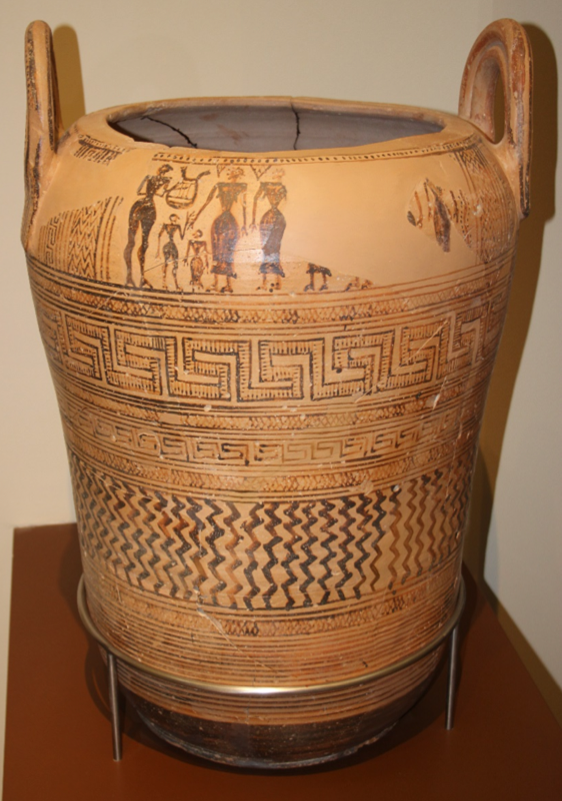
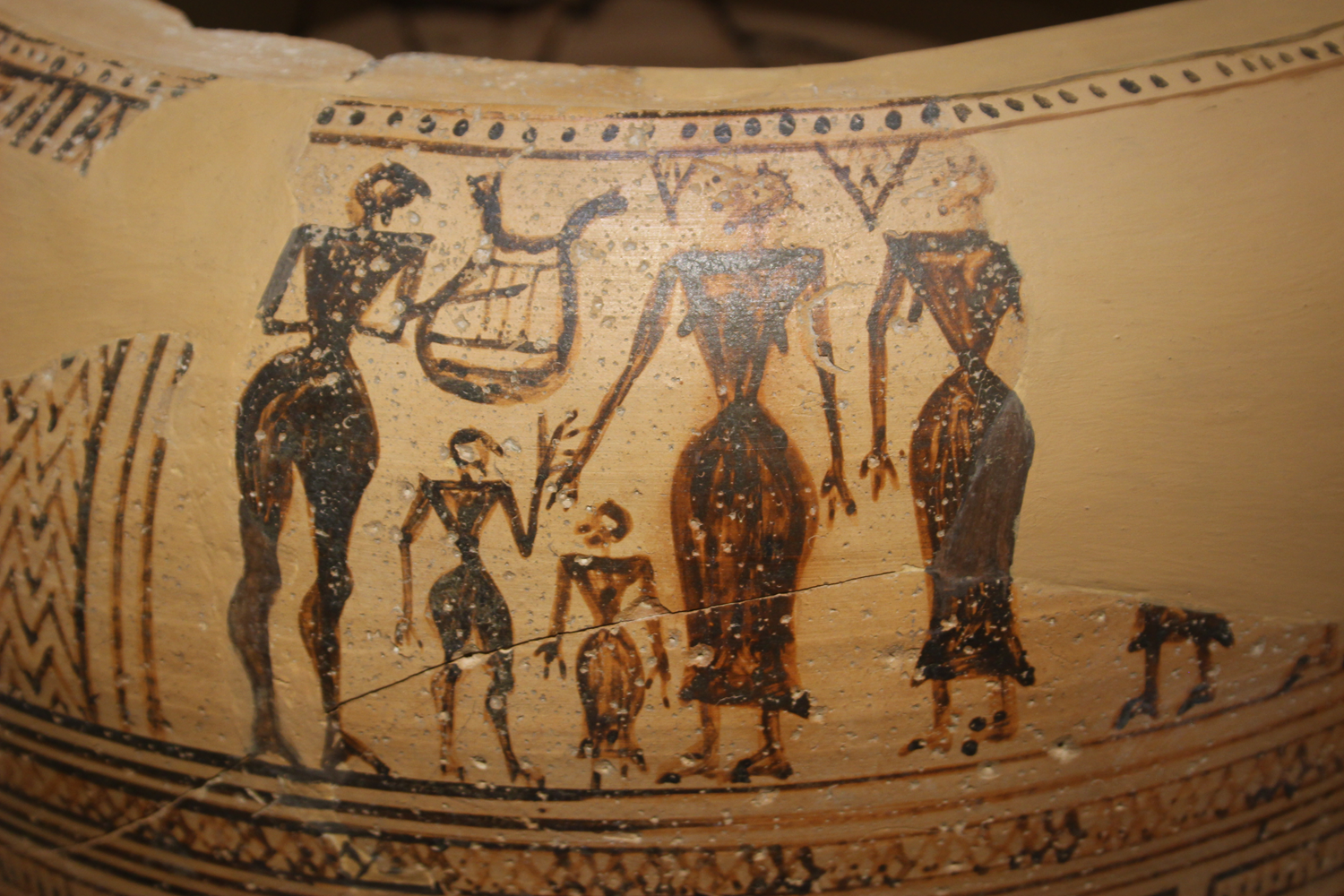
Pyri pithos (ca.720-700BC)
Museum of Thebes.
Potentially the earliest depiction of the festival/ritual (Daphnephoria)
What did Pausanias write on the Daphnephoria?
Pausanias (9.10.4)
[4] The following custom is, to my knowledge, still carried out in Thebes. A boy of noble family, who is himself both handsome and strong, is chosen priest of Ismenian Apollo for a year. He is called Daphnephoros [Laurel-bearer], for the boys wear wreaths of laurel leaves. I cannot say for certain whether all alike who have worn the laurel dedicate by custom a bronze tripod to the god; but I do not think that it is the rule for all, because I did not see many votive tripods there. But the wealthier of the boys do certainly dedicate them. Most remarkable both for its age and for the fame of him who dedicated it is a tripod dedicated by Amphitryon for Heracles after he had worn the laurel.
What did Photios write on the Daphnephoria?
Photios, Bibliotheca, 239: Proclus’ Chrestomathy - Daphnephoria
[Proclus - Greek Neoplatonist philosopher AD412-485; Photius – Patriarch of Constantinople – AD815-893]
239.321b And the reason is this: the Aeolians who lived in Arne and the surrounding areas left there in response to an oracle, and invading Thebes were destroying that place which was formerly occupied by the Pelasgians. They made truces for the establishment of a festival of Apollo which they both held in common, and with some cutting up laurel on Helicon, others offered it to Apollo near the Melas river. But Polematas, leader of the Boeotians, dreamed of a young man giving him his armour and ordering him to make prayers to Apollo by bringing laurels every nine years. And after three days of fighting he prevailed over his enemies and performed the laurel-bringing himself; and afterwards this custom is still observed.
The laurel-bringing (daphnephoria) is this: an olive branch is wrapped with laurels and flowers of various colours and a bronze sphere is attached to the tip of the branch, with smaller ones hanging off of it; around the middle of the branch they put smaller balls than the tip and fasten purple garlands; the ends of the branch they wrap with a saffron-colored robe. By these it is meant for the top-most sphere to represent the sun (which they ascribe to Apollo), the one below represents the moon, the attached balls represent the constellations and stars, and the garlands represent the course of a year: for they make 365 of these.
The laurel-bringing is lead by a child with both parents living, and their closest relative carries the garlanded branch, which they call the “kopo”. The laurel-carrier follows them holding the laurel, with their hair let down, carrying a golden crown and wearing a bright robe down to their feet which are both bound with bandages; a chorus of young girls follows closely after, holding olive-branches and singing. And they sent the laurel-carrier to [the sanctuary of] Apollo Ismenius and Chalazios [or Galaxios]. And the tripod-processional song (tripodophorikon) is sung by the Boeotians with a tripod leading the way.
Does what Photios describe sound like Classical Greece?
Nothing about this sounds like classical Greece, it seems more similar to later dates eg. the Hellenistic worlds interests
What is the Daidala- in Plataia
a festival of reconciliation that was held every few years in honor of Hera, consort of the supreme god Zeus at Plataea, in Boeotia
What sources so we have for the Daidala?
Mycenaean Linear B document- essentially talks about delivering stuff around Boetia
Plutarch Fr.157
Pausanias 9.2.7-9.3.1
What does Plutarch write about how Zeus and Hera were married ?
They say that Hera, having been raised in Euboia, was stolen away by Zeus while still a virgin and brought to Boiotia and hidden away, Kithairon (the King/mountain) giving them a shady cave and natural chamber….And when their marriage was revealed, first near Kithairon and then at Plataia, their intercourse uncovered, Hera was named Teleia and Gamelia…(‘wife’ and ‘married’)
Where does the procession in the Daidala take place?
The Asopos is where the big procession starts from and they process all the way from the river to the top of Mt Cithaeron
What did Plutarch write about the origin of the daidala festival?
Plutarch Fr 157 (cont.)
And I should perhaps tell here a simple tale.
It is related how Zeus - when Hera had quarrelled with him and no longer wished to sleep with him and had hid herself away - wandering about at his wits’ end chanced upon Alalkomenes the autochthon, who instructed him that he must trick Hera by pretending to marry another.
Working with Alalkomenes, secretly they cut down a stately beautiful oak and shaped it and clothed it like a bride and called it Daidale. Then they sang the wedding hymn, and the nymphs of the river Triton brought the water for bathing, and Boiotia provided flutes and revellers.
And when this was done Hera could stand it no longer but came down from Kithairon, with a following of Plataian women, and running in anger and jealousy came towards Zeus. But when the counterfeit was revealed, with delight and laughter she was reconciled to him and herself led the bride. She bestowed honour on the wooden image and named the festival Daidala. Nevertheless she burnt it, despite its being lifeless, because of her jealousy.
What is this a tale of?
The tale is one of gods being close, separating and then through a ruse gods reconciling
What did Pausanias write on the origins of the Daidala festival?
Pausanias 9.2.7-9.3.1
At Plataia is a temple of Hera, worth a look for its size and the beauty of its statues.
On entering there is Rhea, holding a rock wrapped in swaddling clothes, bringing it to Kronos as if it was the child she bore; the next they call Hera Teleia, a large standing figure of great size: both are Pentelic stone and the work of Praxiteles.
Next is another Hera, seated, and made by Kallimachos: they call this goddess Nympheuomene after the following story.
They say that Hera withdrew to Euboia, being angry with Zeus for some reason or other, and that when unable to persuade her to come back, Zeus went to Kithairon who ruled Plataia at the time: for in wisdom Kithairon was second to none.
So Kithairon told Zeus to make a wooden image and to place it, veiled, upon a carriage drawn by oxen, and say that he was wedding Plataia, daughter of Asopus.
And he took Kithairon’s advice. And Hera immediately learned of this and returned at once. When she approached the wagon and whisked off the clothing from the image, she was delighted at the trick, finding a wooden image as opposed to a nymph, and made her reconciliation with Zeus.
Because of this reconciliation they celebrate the Daidala festival, so named because of old the wooden idols were named daidala. I believe they called them so even before Daidalos son of Palamaon was born in Athens: I think he was named after the daidala later and was not given the name at birth.
How similar is Pausanias’ story to Plutarch’s?
The stories are generally the same but little details have changed, idea of it never really being fixed everything is developing and changing
How often does Pausanias say the festival takes place and what occurs there?
Pausanias 9.3.3-9.3.4:
And so the Plataians celebrate the festival in the seventh year (every six years) - so said my native guide – though in truth a lesser amount of time by my reckoning:
We wished to calculate the time between one Daidala and another, but were unable to do so.
The festival is celebrated in the following way. There is a grove not far from Alalkomenai where the trunks of the oaks are the mightiest in Boiotia (see map).
The Plataians, coming to this grove, set out portions of boiled meat. They take no notice of any of the other birds, but only of the ravens – for whose arrival they keep a strict watch. And they watch to see on which tree the bird settles which has snatched up the meat.
Whichever tree it settles in, this they cut down and make the daidalon from: for they also call the wooden image itself the daidalon.
Write out what Pausanias wrote about the Great Daidala
The Plataians alone celebrate this festival, calling it the Small Daidala.
The festival of the Great Daidala the Boiotians celebrate with them every sixty years, the period, they say, that the festival was abandoned during the Plataians’ exile.
Fourteen wooden idols are ready, prepared by them in each cycle at the Small Daidala.
These the Plataians, Koroneians, Thespians, Tanagraians, Chaironeians, Orchomenians, Lebadeians and Thebans draw lots for – for the Thebans also resolved to reconcile with the Plataians and partake in the common assembly and to send a sacrifice to the Daidala, when Kassandros the son of Antipater re-founded Thebes.
And the smaller towns take for themselves an image according to sub-district.
Having adorned the image [they carry it] to the Asopus they place it upon a wagon, with a woman as bridesmaid. They again draw lots over the arrangement with which they will lead the procession. Then they drive the wagons from the river to the peak of Kithairon.
What does Pausanias say about the altar and sacrifice?
An altar has been prepared by them upon the peak, and the make the altar in the following way: joining quadrangular pieces of wood together they fit them together as if they were making a stone building, and having raised it to a height place brushwood on top.
The cities and their magistrates each having sacrificed a cow to Hera and a bull to Zeus dedicate the victims filled with wine and incense together with the daidala upon the altar, and wealthy private individuals sacrifice whatever they want; those less well-off sacrifice smaller cattle, all the victims being dedicated in the same way.
Along with these the fire consumes the altar itself and destroys it utterly. And this is the biggest fire and most visible far-away that I know of.
How has the daidala changed?
This festival had changed to something of regional importance rather than just local, it developed over time
What is the meaning of the daidala?
Hieros Gamos
Departure/return of goddess
Swearing of oath
Fire/fertility
Holocaust as reparation
What is the politics of the Daidala?
Politics:
Celebration of unification of Boeotians with Thebes; division by lots based on Boiotian federal divisions (tele); visible fire showing unified Boeotian identity to all; fire sacrifice warning to those who break oath of unity
But may have existed well before Boeotian unity…So the meaning of the festival itself changes through time according to external circumstances