HBS EOP Study Guide
 Call Kai
 Learn
Learn Practice Test
 Spaced Repetition
 Match
Match Flashcards
 Knowt Play
1/206

There's no tags or description
Looks like no tags are added yet.
Name | Mastery | Learn | Test | Matching | Spaced | Call with Kai | Chat |
|---|
No analytics yet
Send a link to your students to track their progress
207 Terms
____ refers to the position that humans are in when doctors are using directional and regional terms to describe them.
Anatomical Position
____ is the front part of a human, including face and abdominal region, while_______ is the back part of a human, including shoulder blades and heels.
Anterior, posterior
______ refers to something that is higher up on the body, while ______ refers to something lower on the body.
Superior, inferior
_____________ refers to something closer to the midline, while ______________ refers to something further away from the midline.
medial, lateral
_______________ refers to something on an appendage closer to the trunk, while ______________ refers to something further away from the trunk.
proximal, distal
___________ refers to something closer to the surface of the skin, while ___________ refers to something that is further within the body.
superficial, deep
____________ refers to something associated with the spinal side of the body, while _______________ refers to something associated with the abdominal side of the body.
dorsal, ventral
Regional term: abdominal
tummy
Regional term: antecubital
where blood is taken from - inside of elbow
Regional term: axillary
armpit
Regional term: brachial
arm
Regional term: buccal
cheek
Regional term: calcaneal
heel
Regional term: carpal
hands/wrist
Regional term: cephalic
head
Regional term: cervical
neck
Regional term: coxal
upper part of pelvis - part of the hip you can feel
Regional term: digital
fingers/toes
Regional term: femoral
thigh
Regional term: gluteal
booty
Regional term: inguinal
groin
Regional term: lumbar
lower back
Regional term: nasal
nose
Regional term: occipital
back of the head
Regional term: olecranal
elbow (back)
Regional term: oral
mouth
Regional term: orbital
eye
Regional term: patellar
knee (front)
Regional term: pelvic
pelvis
Regional term: popliteal
back of knee
Regional term: sacral
tailbone
Regional term: scapular
shoulder blade
Regional term: sternal
sternum (chest/between left and right ribs)
Regional term: tarsal
feet/ankle
Regional term: thoracic
chest cavity
Regional term: umbilical
belly button
Regional term: vertebral
spine
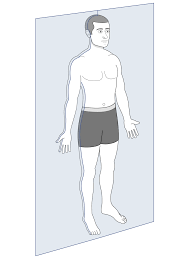
what plane is this?
coronal plane
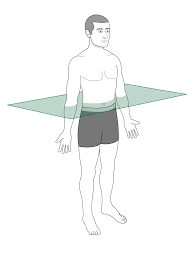
what plane is this?
transverse plane
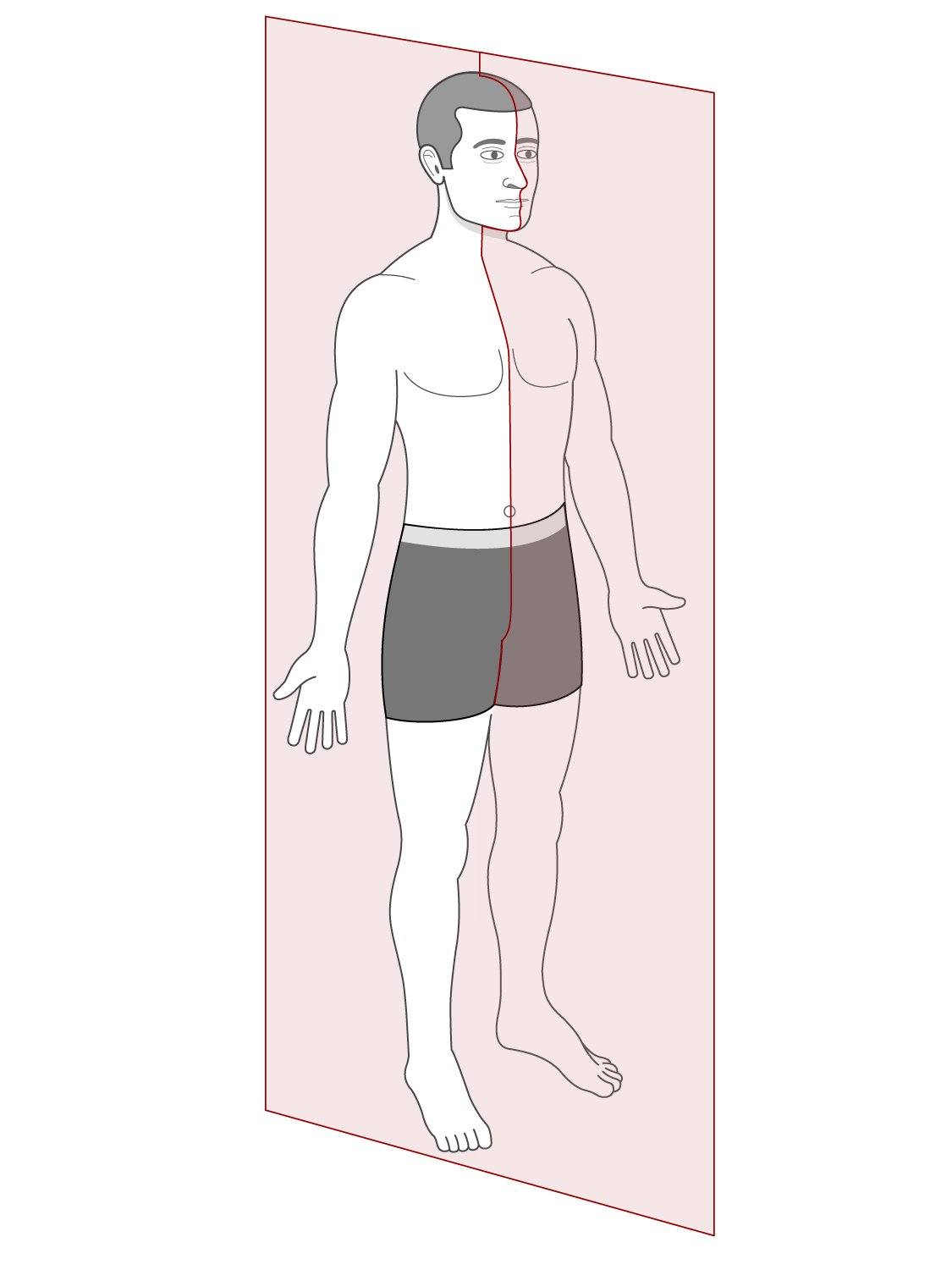
The ____ divides the both into equal left & right proportions while the ___ divides them into unequal proportions
median plane, sagittal plane
Name the 6 body cavities and its two positional sides.
cranial, dorsal, pelvic, ventral, thoracic, vertebral, abdominal, abdomino-pelvic
___________s work together to form ___________s, which work together to form _________________s, which work together to make ___________ ______________s. These all together make an organism!
cells, tissues, organs, organ systems
What are the 4 types of tissues?
Nervous, epithelial, muscle, and connective tissues
___________ tissue is made of neurons and helps receive, interpret, and respond to signals.
nervous
___________ tissue lines the outer surfaces of all organs and blood vessels.
epithelial
___________ tissue can be striated, smooth, or cardiac. Its main function is to contract.
muscle
___________ tissue supports the body. It holds organs in place, attaches muscle to bone, links bones with joints, and allows tissues to stretch; adipose (fat) is a type of connective tissue.
connective
What are the 4 types of bones (think shape)?
Flat, long, short, irregular
____are cells that help in the building of bones
Osteoblasts
___are cells that help with the breaking down of bone.
Osteoclasts
What are the four stages of fracture repair? Describe them.
Hematoma formation - blood vessels break , creating masses at the fracture sites, clots then provide the initial framework for healing
Fibrocartilaginous callus formation - New capillaries begin to form into the clotted blood in the damaged area, repair tissues is formed, closes the gap between the broken bones
Bony Callus Formation- fibrocartilage callus is gradually replaced by one made of spongy bone, Osteoclasts and osteoblasts move to the area and multiply
Bone Remodeling- callus is remodeled with the help of osteoclasts and osteoblasts. The shape of the bones will gradually return to normal
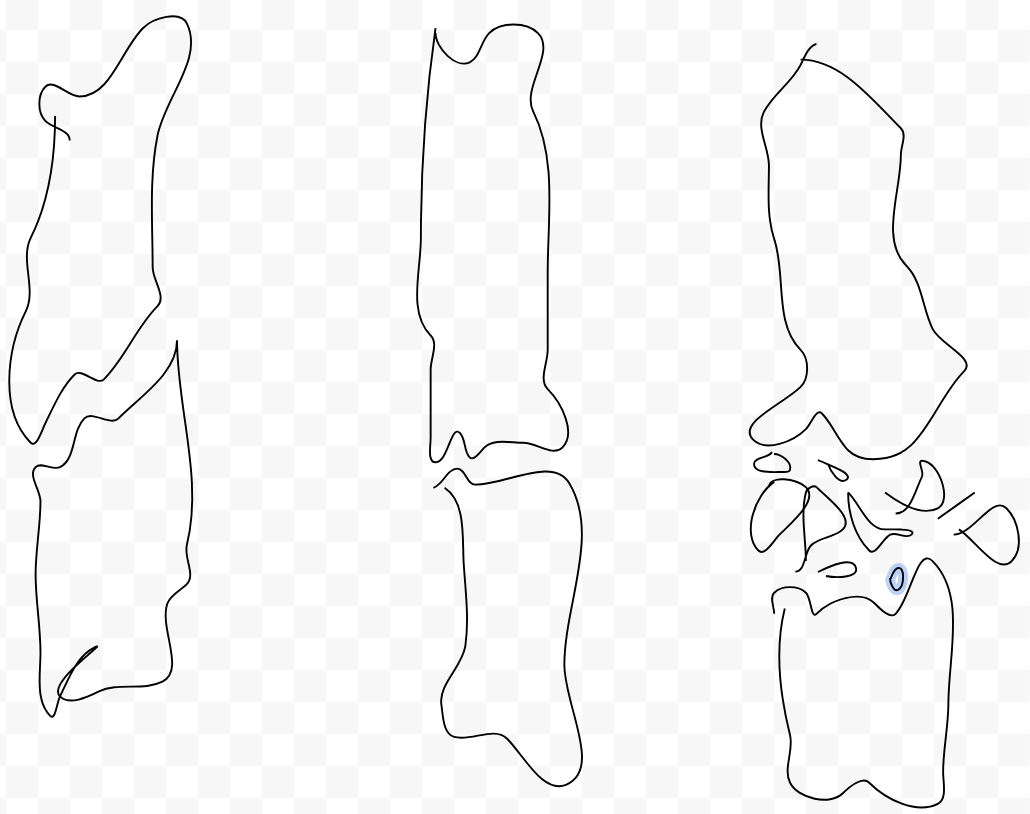
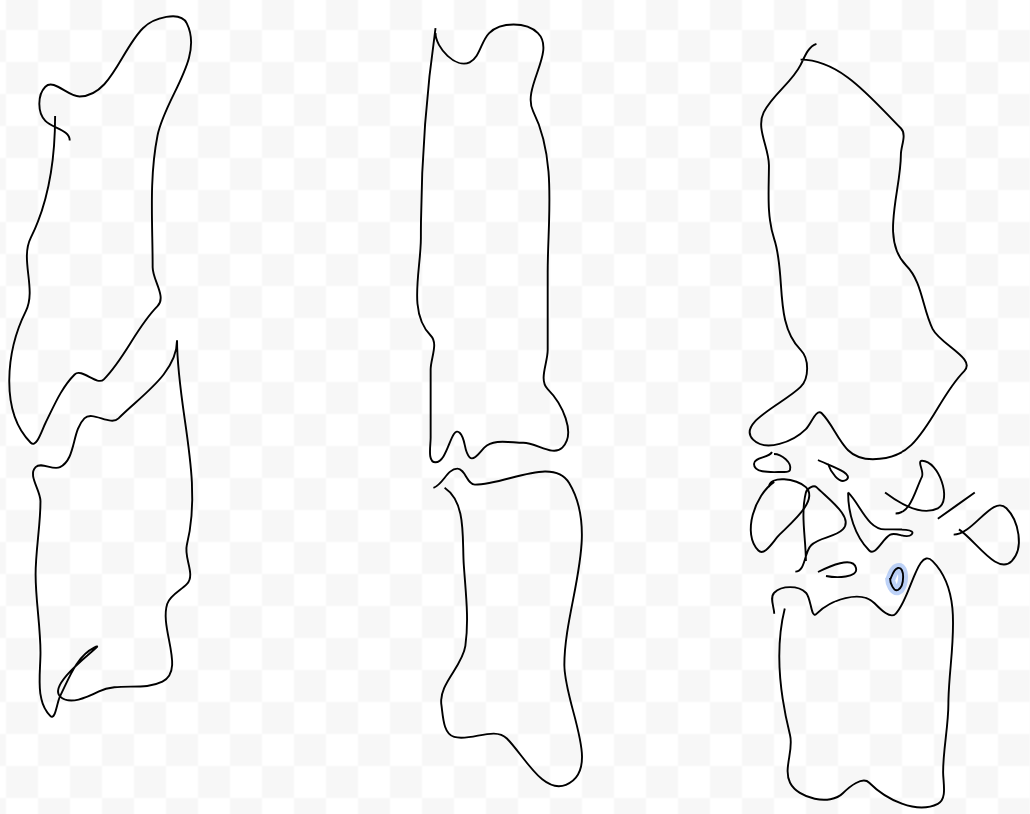
what fracture is the left one?
spiral fracture
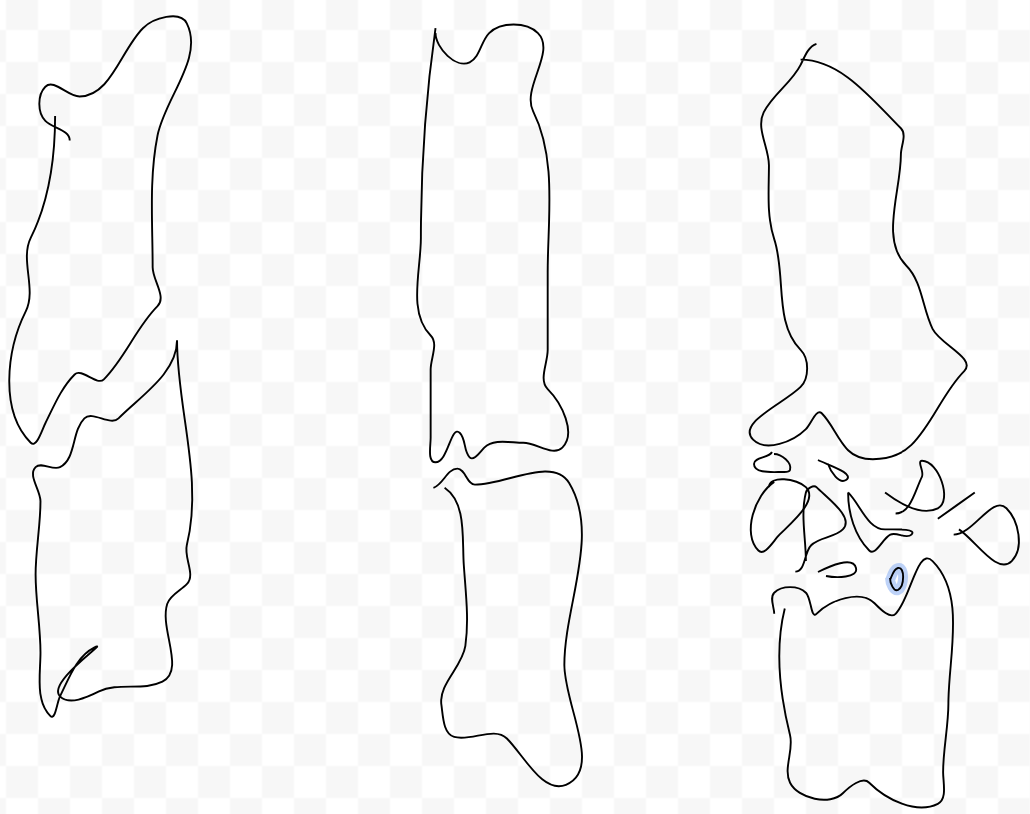
what fracture is the middle one?
transverse fracture
what fracture is the right one?
impact (aka comminuted)
___________ scans provide a 2D image of the interior of the body.
X-Ray
_____ scans don’t use radiation and can provide detail of very fine soft tissue.
MRI
____________ scans create an image of internal body structures such as tendons, muscles, joints, blood vessels, and internal organs.
CT
__________ muscle is striated and voluntary.
Skeletal
_____ muscle is not striated and involuntary.
Smooth
__________ muscle is striated and involuntary.
Cardiac
6 muscle rules
Muscles have at least two attachments and must cross at one joint
Muscles “pull” to get shorter
Attachment that moves is the insertion, attachment that is stationary is the origin
Muscles that decrease angle are flexors, increase angle are extensors
Muscles work in opposing pairs
Muscle striations point to attachment and show the pull of direction
Differentiate between: Rotation and Circumduction
rotation is around the axis, circumduction is circular
Differentiate between: Abduction and Adduction
abduction moves away from midline; adduction moves toward
Differentiate between: Depression and Elevation
depression lowers; elevation raises
Differentiate between: Flexion and Extension
flexion decreases angle; extension increases angle
Differentiate between: Plantar Flexion and Dorsiflexion
plantar flexion points toes down; dorsiflexion raises toes up
In a muscle, the ____________ refers to the attachment that does not move
origin
In a muscle, the ______ refers to the attachment that does move.
insertion
______________ joints are fixed - primarily made of collagen.
Fibrous
______________ joints have some movements - primarily hyaline cartilage.
Cartilaginous
______________ joints are moveable - they contain synovial fluid to reduce friction.
Synovial
List the 6 types of joints
Ball and socket, hinge, pivot, saddle, plane, condyloid
What is the purpose of a goniometer?
to measure joint range of motion.
__________ of __________ refers to the amount of movement each joint can do. It properly assesses injuries and helps measure progress through physical therapy.
Range, motion
What type of injury is diagnosed with the posterior drawer test?
PCL injury
What type of injury is diagnosed with the valves stress test?
MCL injury
What type of injury is diagnosed with the varus stress test?
LCL injury
What type of injury is diagnosed with the anterior drawer test?
ACL injury
___________ motion is the type of motion that occurs when your knees are tilted in and your toes are pointed out.
Valgus
________ motion is the type of motion that occurs when your knees are bent outwards.
Varus
Differentiate between the central nervous system and the peripheral nervous system.
The central nervous system deals with the brain and spinal cord of the body and receives, processes, then sends signals to the rest of the body while the peripheral nervous system deals with the rest of the nerves of the body and receives those signals.
______________ is the area of the brain containing the four lobes.
Cerebrum
The four lobes are: ___________, ___________, ______________, and ______________.
frontal, parietal, temporal, occipital
The _______________ is the area of the brain underneath the cerebrum that helps with muscle control and balance.
cerebellum
The _______________ consist of medulla oblongata, pons, and midbrain. It helps with breathing, blood pressure regulation, and sleeping.waking.
brain stem
Name the part of the brain based on its function:
Behavior and personality, planning, voluntary muscle movements, mood, emotions, social interactions, and attention
Frontal lobe
Name the part of the brain based on its function:
Processing smell and sound, language understanding
Temporal lobe
Name the part of the brain based on its function:
Sensing touch, temperature, pressure, and pain, spatial processing, language, and memory
Parietal lobe
Name the part of the brain based on its function: Visual Perception
Occipital lobe
Name the part of the brain based on its function:
Muscular coordination and balance
Cerebellum
Name the part of the brain based on its function:
Breathing, blood pressure, sleeping and waking
Brain stem
Name the part of the brain based on its function:
Center for pain perception
Thalamus
Name the part of the brain based on its function:
Communication between hemispheres of the brain
Corpus callous
Name the part of the brain based on its function:
Coordinates autonomic nervous system, pituitary gland, body temperature, thirst, hunger, sleep, and emotion
Hypothalamus
Name the part of the brain based on its function:
Long Term memory
Hippocampus
_________ refer to the ridges on the brain, while ___________ refer to the valleys within the ridges of the brain.
Gyri, sulci
_________ are cells in the nervous system that provide protection and maintain homeostasis for neurons.
Glial cells
__________ neurons send signals to the brain, while ____________ send signals within the brain. __________ neurons send signals to muscles.
sensory, interneurons, motor
The ______________ uses ATP to diffuse 3 ________ ions out of the cell and 2 ___________ ions into the cell to maintain resting potential.
sodium-potassium pump, sodium, potassium
Resting membrane potential is ___________ mV.
-70