biology 1620 final exam
 Call Kai
 Learn
Learn Practice Test
 Spaced Repetition
 Match
Match Flashcards
 Knowt Play
1/164

There's no tags or description
Looks like no tags are added yet.
Name | Mastery | Learn | Test | Matching | Spaced | Call with Kai |
|---|
No analytics yet
Send a link to your students to track their progress
165 Terms
gene
a specific, hertiable segment of dna on a chormosome
e.g. eye color
allele
one of two or more alternative versions of a gene located at the same specific position on a chromosome
e.g. blue eyes vs brown eyes
genotype
the genetic composition of an organism
e.g. AA, Aa, aa, etc.
phenotype
observable traits
e.g. hair color, height, blood type, etc.
homology
similarity in characteristics between different organisms due to inheritance from a common ancestor
evolution
the change in alleles of a population over time
natural selection
a fundamental mechanism of evolution where organisms with heritable traits better suited too their environment are more likely to survive and reproduce
what is the mechanism of evolution
nautral selection
what is the result of natural selection
evolution
typological thinking / essentialism
viewed species as fixed types, emphasing an ideal form
population thinking (darwin)
viewing species as diverse populations where variation is crucial and “types” are just the average
the great chain of being
a pre-drawinian hierarchy that orders all existence linearly from inanimate matter to god (humans above animals + plants)
darwin’s four postulates :
individuals within a species show variation
these variations are heritable
more offspring are produced than can survive
survival + reproduction are not random (natural selection favors those with advantageous traits)
evidence that species are not unchanging and are all related :
i. fossil record includes transitional species
ii. observed evolution (e.g. antibiotic resistence) shows that species can change over generations
iii. universal genetic code, shared biochemical pathways, homologous structures, molecular similarities, phylogenetic tress, biogeography
adaptation
a genetic change in a population over time
(individuals acclimate, populations adapt)
acclimation
a change in phenotype in an individual to accommodate environmental stress
vestigial trait
structures that have lost most of their function through evolution (e.g. tailbone)
adaptations are constrained by
existing traits
a trait can only evolve from a previously existing one
fitness trade off
a compromise between traits
(e.g. strong immune system → decreased reproduction because of energy allocation)
when does an allele become fixed
when it is the only present variant for a gene (100%)
types of natural selection
directional selection
stabilizing selection
disruptive selection
balancing selection
directional selection
selects for one extreme, decreases genetic variation
stabilizing selection
selects foor an intermediate of the extremes, decreases genetic variation
disruptive selection
selects for both extremes, increases genetic variation
balancing selection
selects to maintain the prior amount of genetic variation
asexual reproduction
one parent producing genetically identical offspring
sexual reproduction
two parents producing genetically unique offspring
ploidy
the number of complete sets of chromosomes in a cell
ploidy of mitosis
is maintained
ploidy of meiosis
is halved
gametes
reproductive cells (n)
a diplontic life cycle produces gametes by
meiosis
a haplontic life cycle produces gametes by
mitosis
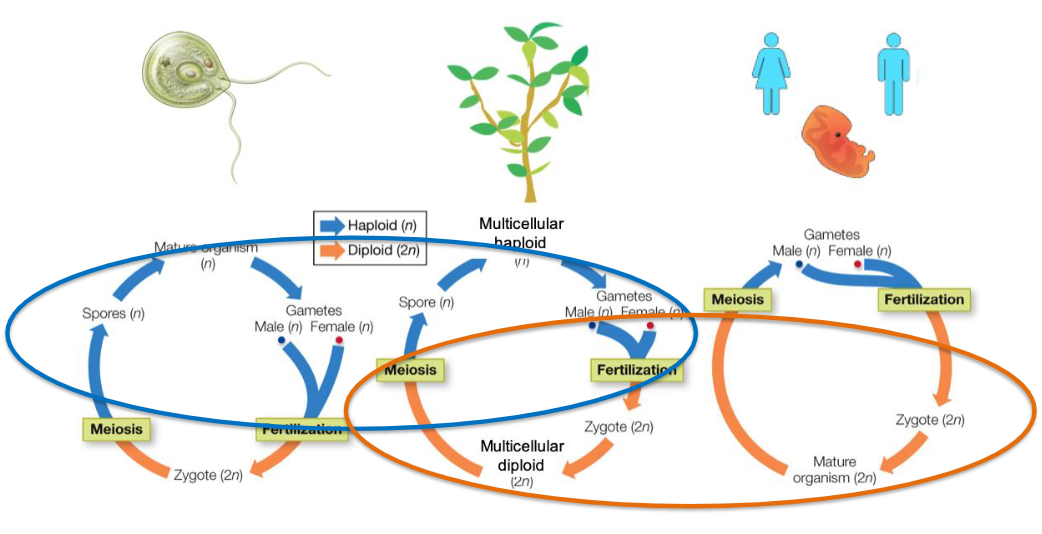
MEMORIZE IMAGE
OKAY?
2-fold cost of sex
sexual reproduction generally taxes twice as much energy/resources as asexual reproduction because only females (50%) can reproduce
sexual reproduction increases
adaptability
sexual reproduction is advantageous in :
rapidly changing enviornments
environments with parasites or pathogens
organisms can reduce the 2-fold cost of sex by :
sex switching
having both asexual + sexual life cycles
increasing paternal investment
muller’s ratchet
says that asexual populations will over time gain many delterious mutations, leading to a “mutation meltdown” or extinction
how is sexual reproduction beneficial against parasites
parasites adapt at a fast rate to infect hosts
sexual reproduction makes it harder for parasites to adapt because each individual is unique and unpredictable
(aka - there’s no universal trait for the parasite to exploit)
species concepts
biological species concept
morphological species concept
ecological species concept
phylogenetic species concept
biological species concept
species are groups that can interbreed + produce fertile offspring
pros : works well for most animals
cons : cannot be used for fossils + asexual organisms, difficult to apply to geographically seperated organisms
morphological species concept
species are groups based on their physical traits + structure
pros : can be used for fossils + asexual organisms
cons : subjective, variation of phenotypes may be misleading, allopatric speciation
ecological species concept
species are groups based on their ecological niches
pros : emphasizes adaptation, can be used for asexual organisms
cons : niche boundariesare subjective, niches are occupied by a large array of organisms
phylogenetic species concept
species are the smallest monophyletic group a phylogenetic tree
pro : uses genetic data
cons : can split populations into many small species
prezygotic isolation
prevents organisms from mating or fertilizing
e.g. habitat isolation, behavioral isolation, gametic isolation
postzygotic isolation
issues after fertilization
e.g. offspring dies young, has low fitness, is sterile
allopatric speciation
geographic isolation splits a population
sympatric speciation
reproductive isolations splits a population living in the same area
genetic drift
a random change in allele frequencies within a population due to change events, significantly reduces genetic variation
! includes bottleneck effect + founder effect !
bottleneck effect
large population is reduced to a small population left that become homogenous, reduces genetic variation
founder effect
where a few individuals leave a large population to establish a new population, limiting the gene pool to the small group that left, reduces genetic variation
gene flow (migration)
the transfer of alleles from one population to another
increases genetic variation
hypotheses for origin of life molecules :
i. primordial soup (miller-harold urey experiment)
ii. extraterrestrial
iii. hydrothermal vents
primordial soup theory (miller-harold urey experiment)
a spark in the atmosphere began with gases and water, creating amino acids
extraterrestrial theory
organic molecules were delivered to earth by meteorites
hydrothermal vents theory
earth’s core provided energy near deep sea vents
rna world hypothesis
early life was based on rna because :
rna can store genetic information
rna can act as an enzyme
rna can self replicate
darwinian threshold hypothesis
early life exchanged genes freely through horizontal gene transfer
afterwards, cells became complex enough that vertical inheritance became dominant
luca
the most recent organism from which all current life descends (not the first life form)
probably had dna, ribosomes, cell membrane, basic metabolism
evidence life existed 3700 mya :
stromatolite fossils (date back to 3.7 billion years ago)
carbon isoptope ratios showing biological compatibility (lighter carbon is preffered)
universal genetic code across all life
atmospheric conditions of early earth
high co2, almost no o2
bacteria + archaea are both
prokaryotes
prokaryotes
have no nucleus or membrane-bound organelles
bacteria have cell walls made of _____ while archaea have _____ in cell walls
pepitdoglycan, pepitoglycan
bacteria have _____ fatty acids while archaea have _____ fatty acids
ester linked, ether linked
bacteria ribosomes are similar to
other prokaryotes
archaea ribosomes are similar to
eukaryotes
bacteria are sensitive to many ____ that archaea are resitant to
antibiotics
bacteria are found ___ while archaea are found ____
nearly everywhere, in extreme conditions
autotrophs
organisms that use co2 as a carbon source
heterotrophs
organisms that consume other organisms for organic carbon
phototrophs
organisms that use light energy
chemotroph
organisms that use chemical energy
photoautotrophs
use light energy to convert co2 to organic carbon
e.g. plants, cyanobacteria
photoheterotrophs
use light as energy but must get carbon from other organisms
e.g. purple non-sulfur bacteria, heliobacteria, aquatic bacteria
chemoautotrophs
use chemical energy to convert co2 to organic carbon
e.g. archaea
chemoheterotrophs
use chemical energy and gets carbon from other organisms
e.g. animals, many bacteria
prokaryotes are more ____ than eukaryotes
metabolically diverse
prokaryotes can perform (metabolically) :
oxygenic photosynthesis
anoxygeneic photosynthesis
aerobic + anaerobic respiration
fermentation
nitrogen fixation
sulfur reduction
methanogenesis
the most energy is produced when glucose
is accepted by h2o, producing o2
when o2 is not available
organisms use weaker acceptors and less energy is produced
anoxygenic photosynthesis
uses electron donors other than water
does not product oxygen
uses one photosystem
cyclic electron flow
found in green sulfur bacteria + purple sulfur bacteria
oxygenic photosynthesis
uses water as an electron donor
produces oxygen (o2) as a byproduct
uses two photosystems
non-cyclic electron flow
found in cyanobacteria, algae, plants
evolution of photoautotrophs
3.5 bya - first photoautotrophs wwere anoxygenic bacteria → earth dominated by anaerobic, sulfur-based bacteria
2.5 bya - cyanobacteria evolves oxygenic photosynthesis, leadding to the great oxidation event
after the great oxidation event - atmospheric oxygen accumulates → rapid extinction of anerobic organisms + rapid evolution of aerobic organisms
evolutionary innovations of oxygenic photosynthesis
water splitting (provides electrons + releases o2)
combining of photosystems
non-cyclic electron transport (produces ATP + NADPH)
chlorophyll (pigment) captures light energy
calvin cycle (rubisco) for co2 fixation
impacts of oxygenic photosyntehsis
oxygen increased in the atmosphere + oceans
aerobic respiration → more energy production
great oxidation event → extinction + adaptation of anaerobes
geology :
red beds indicate modern levels of oxygen
banded iron formations (BIFs) indicate microbial iron oxidation
snowball earth
reduced amounts of greenhouse gases (specifically co2) leading to global cooling
what happened to co2 when cyanobacteria increased
co2 decreased
the cyanobacteria are using it as a reactant of photosynthesis
ozone layer
atmospheric oxygen (o2) formed ozone (o3)
ozone accumulated in the stratosphere and blocked out harmful uv radiation, allowing organisms to colonize land
prokaryote cell traits
no nucleus (dna is in the nucleoid)
no membrane bound organielles
circular dna
no cytoskeleton
divides by binary fission
cell walls
eukaryote cell traits :
nucleus
membrane bound organelles
linear chromosomes
cytoskeleton
can perform endocytosis/engulfing (those without cell walls)
divides via mitosis + meiosis
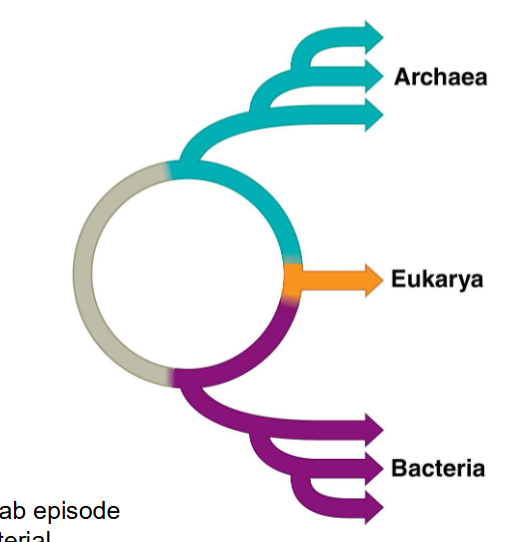
ring of life / fusion hypothesis
eukaryotes formed from a fusion of archaea + bacteria
archaeal genes -→ dna processing, bacterial genes → metabolism
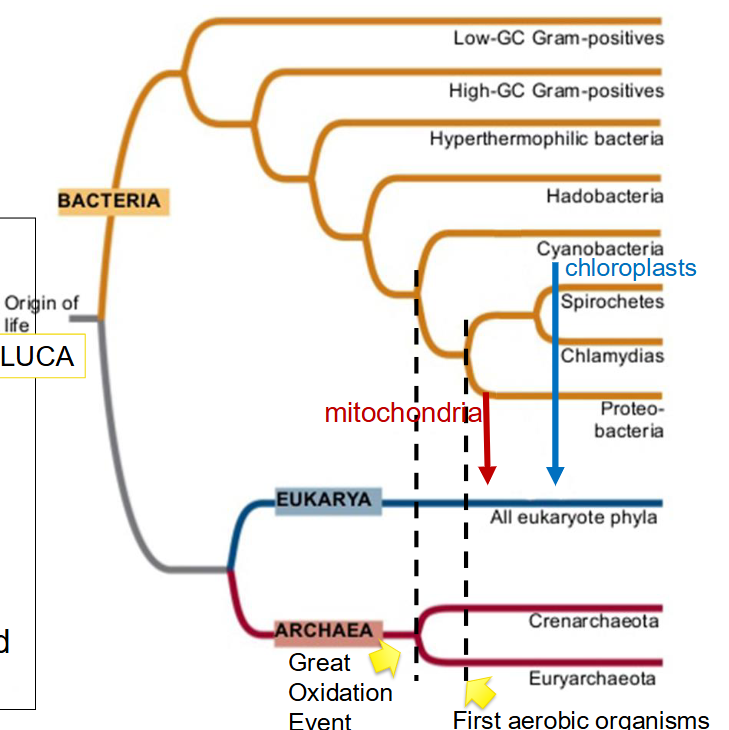
woese’s tree of life
eukaryotes are a seperate + ancient lineage, with a long independent evolution
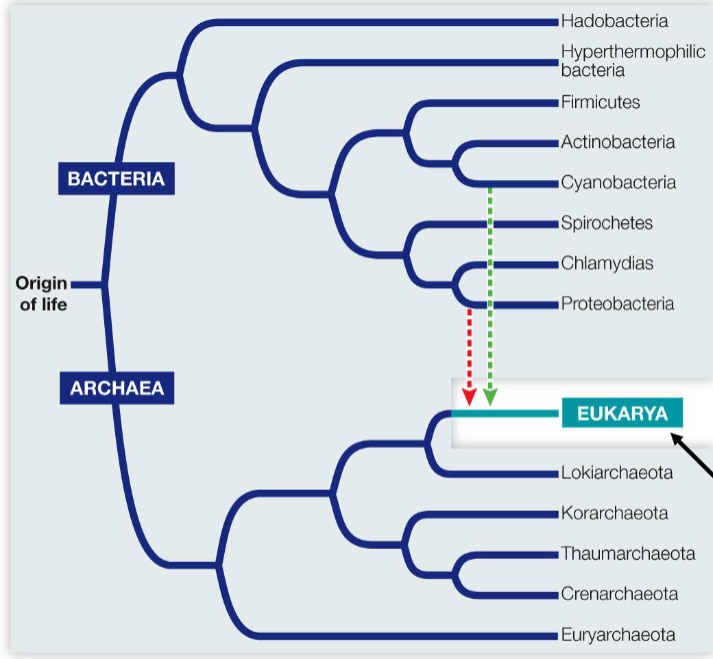
loki’s tree of life
eukaryotes evolved within archaea, implies the eukaryotes are more recent
endosymbiosis theory
eukaryotic cells evolved from prokaryotic organisms when one cell engulfed another, creating the mitochondria + chloroplasts
evidence for endosymbiosis theory :
mitochondria + chloroplasts have their own circular dna
microchondria + chloroplasts produce their own ribosomes
mitochondria + chloroplasts can divide via binary fission
did mitochondria or chloroplast evolve first?
mitochondria
mitochondria ancestor
alpha protobacteria
aerobic → high atp production
chloroplast ancestor
cyanobacteria
introduced oxygenic photosynthesis into eukaryotes