Macroeconomics definitions
 Call Kai
 Learn
Learn Practice Test
 Spaced Repetition
 Match
Match Flashcards
 Knowt Play
1/81

There's no tags or description
Looks like no tags are added yet.
Name | Mastery | Learn | Test | Matching | Spaced | Call with Kai | Chat |
|---|
No analytics yet
Send a link to your students to track their progress
82 Terms
6 economic macro objectives
Low and stable inflation
Low unemployment
Sustained economic growth
Balance betqeen imports and exports
Equitable distribution of income
Environmental sustainability
Inflation
An increase in the average price level over a period of time
Deflation
A sustained reduction in the average price level over a period of time
Disinflation
A fall in the rate of inflation from one time period to the next
‘Real‘
When prices are put into real terms, so inflation is taken into account.
‘Nominal‘
The money value of an economic variable, before it has been adjusted to inflation
Unemployment
People of working age who are willing and able to work, are actively seeking work at current wage rates and are currently not working.
Labour force
People of working age who are either employed or seeking employment in a country
Structural unemployment
Unemployment caused by a change in the demand for skills as the nature of the economy changes, so there is a mismatch between the skills of the unemployed and available jobs.
Three types of structural unemployment
Geographical
Sectorial
Technological
Geographical unemployment
There is work but not within commuting distance
Sectorial unemployment
When there is mismatch between the skills of labour force and the available jobs.
Techonlogical unemployment
When techonolical advancements reduce workforce and replace jobs.
Example of geographical unemployment
Post war, North tends to be at full empoyment whereas the South has suffered unemployment
Less job opportunities in Delemont compared to Basel
Example of sectorial unemployment
1973 deindustrialization leads to skilled workers unemployment, as they ned to retrain and adapt.
Example of techonological unemployment
Printers or bank cashiers
Frictional unemployment
Short term unemployment as a result of people in between jobs
Seasonal unemployment
Unemployment in industries where labour demand is lower at certain times of the year
Natural rate of unemployment
The unemployment that remains when equilibrium real output if at full employment
Cyclical unemployment
Unemployment which results when there is insufficient demand, so in recessions.
GDP
Gross Domestic Product is the value of all final goods and services produced in a country at a given time
GNI
Gross National Income is the market value of all goods and services produced by the labour and capital supplied by the residents of the country in a given time period.
GDP formula
GDP = C + I + G + X - M
GNI formula
GNI = GDP + net income from abroad
NNP
Net National Product is the market value of all products produced by the labour and capital supplied by the residents of the country without depriciation of capital good
NNP formula
NNP = GNI - depriciation
GVA
GDP minus indirect taxes, so at true value produced
GVA formula
GVA = GDP - indirect taxes
GDP deflator
It’s a measure of inflation, used to deflate GDP to real prices
Recession
Two consecutive quarters of falling ouput in the economy of a country
Boom
The peak of a business cycle, right before a recession
Recovery
It’s an increase in the GDP from a recessionary level to match the level of ouput produced before the recession.
Trend rate of growth
It measures the economic growth in relation to GDP from one period to another adjusted to inflation
Aggregate Demand
It’s the total demand for a nation’s goods and services from all sectors of an economy.
Aggregate demand formula
AD = C + I + G + X - M
Interest rates
The cost of borrowing money. It’s the percentage of money paid by borrowers for the use of money.
Forward indicators
Indicators that predict inflation in the future.
Leakages
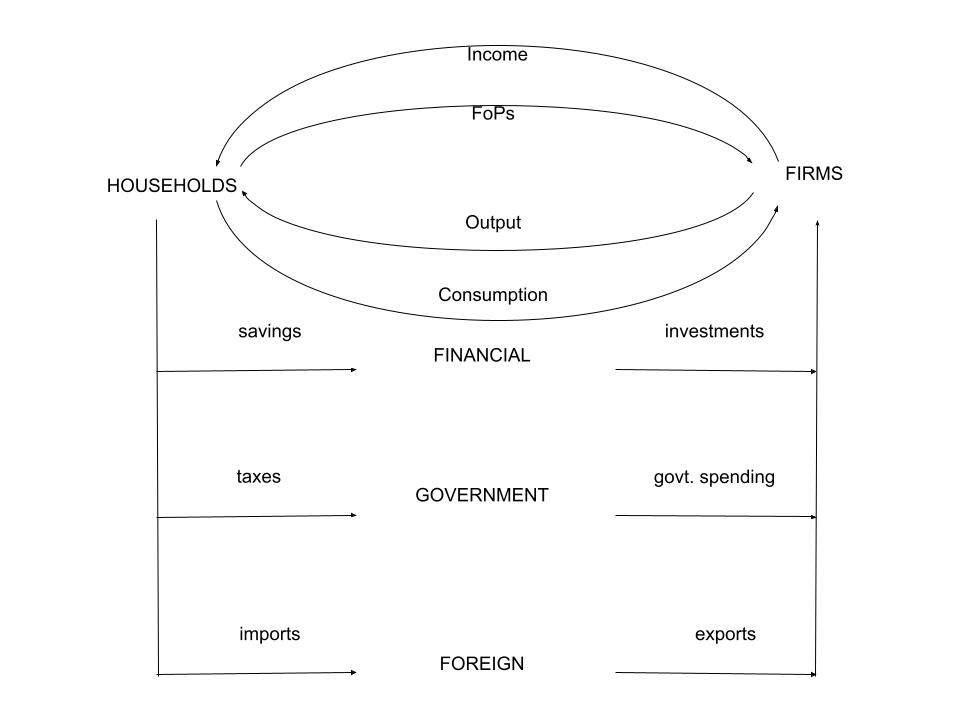
Money that doesn’t re-enter the economy in terms of circular flow.
Full employment
Where increasing output beyond this point only results in inflation.
‘Sticky downards‘
Keynesian concept that prices are slow to fall in recessions because households do not easily accept lower factors of incomes
Monetary policy
A set of official policies governing intrest rates and money supply which are used by the central bank to affect AD.
Fiscal policy
A set of discretionary government policies relating to taxation rates and governemnt spending which are used to affect AD.
Time lags
The time it takes for a monetary policy to take effect. 6-18 months
Target inflation
2%
Disposable income
The remaining income of households after income tax has been collected
Discretionary income
Amount of income after income tax and spending on necessities that househlds can choose to spend how they want.
Supply side policies
Government policies that increase the amount of supply that is capable of being produced in the long run.
Morgtages
Loans secured against properties.
Interventionist supply side policies
When the government intervenes to create a shift in supply
Example of interventionist supply side policies
Worker training, education, investment in new technologies
Automatic stabilizers
Income taxes and welfare spending used to regulate fluctuations in real GDP.
CPI
Consumer Price Index measures the average prices of an economy and expresses them as an index number.
Financial crowding out
Economic theory arguing that rising public sector spending drives down private sector spending.
Hot money
Cash that foreign investors invest in short term to search for highest interest rates possible
Substitute effect
When the price of a good increases, consumers will switch to substitutes
Wealth effect
Rising wealth has a positive impact on consumer spending
Income effects
Increase in the price of a good decreases the consumer’s discretionary income, so spending decreases.
Price effect
Impact that an event has on the price of a good.
Money illusion
The belief that money has a fixed value
Productivity
The ration between the ouput volume and the volume of inputs
Deficit
When expenditures exceed revenue
Debt
The amount of money owed by a person, firm or government to a lender
Surplus
The oversupply of a good
CPI inflation
The sustained increase in CPI over time
Demand-pull inflation
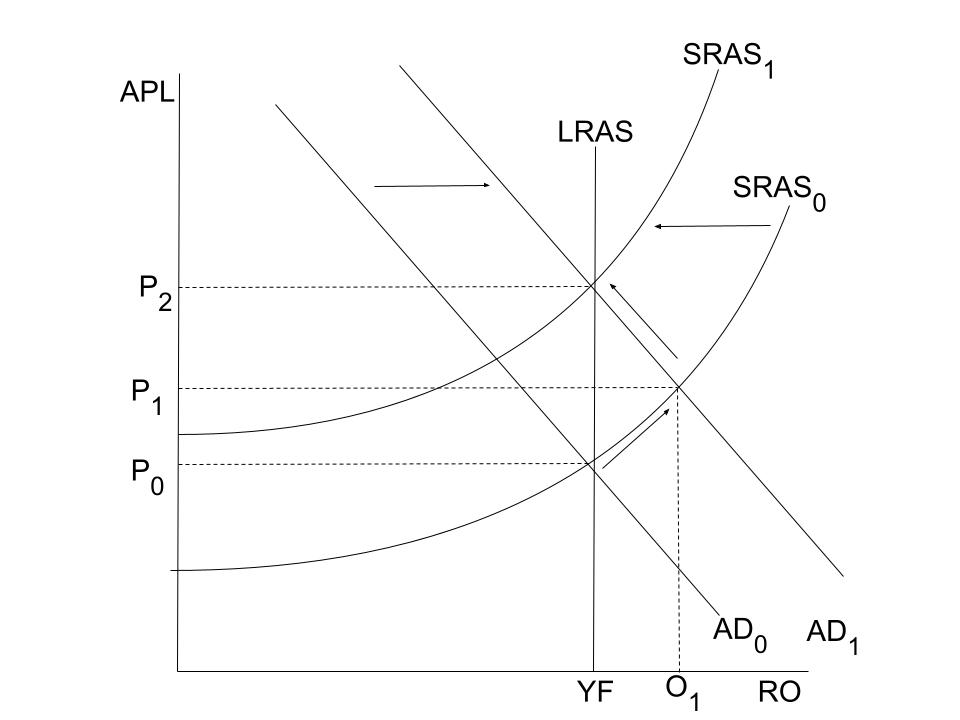
When there is a sustained increase in prices caused by a an excess of aggregate demand over aggregate supply. (When AD shifts right)
Cost-push inflation
When there is a sustained price increase because production costs increase. (Supply shifts to the left)
Inflationary gap
When eq. RO > YF, causing inflationary pressure
Deflationary gap
When eq. RO < FY, causing deflationary pressure
Trough
The turning point in an economy between a recession and a recovery.
Market forward indicators
Reduction in unemployment
Rise in overtime working
Rise in wages
Firms forward indicators
Purchasing Managers index
Inventory levels
Stock levels
Households forward indicators
Consumer Confidence Survey
House prices
Stock markets
5 sector model
Inflationary gap
Deflationary gap
Interest rate RWE
US 2024 5.5%
Fiscal policy RWE
2009 “Car scrappage scheme“ in Germany and UK. Gave 1000/2000£ to help purchase new car
2008 USA govt gives $152 billion in tax cuts to poor & middle income countries.