Nuclear: The Back End
 Call Kai
 Learn
Learn Practice Test
 Spaced Repetition
 Match
Match Flashcards
 Knowt Play
1/22

There's no tags or description
Looks like no tags are added yet.
Name | Mastery | Learn | Test | Matching | Spaced | Call with Kai |
|---|
No analytics yet
Send a link to your students to track their progress
23 Terms
The nuclear fuel cycle of UO2 can be split into 9 stages. What are they?
mining
conversion
enrichment
deconversion and fuel fabrication
power generation
storage
reprocessing
containment
disposal
at low Z what will Z~N give?
a stable nucleus
the more protons a nucleus has, the more they will repel, and the more neutrons are required for stability.
The type of decay that occurs depends on the N/Z
ratio. Name the types and when they will happen.
Nuclei with too many neutrons decay by β decay (electron emission) or neutron emission.
Nuclei with too many protons decay by β+ decay (positron emission) or proton decay.
Heavy nuclei decay through alpha emission or even spontaneous fission.
What is the rate of disintegration (transformation) or decay of radioactive
material measured in?
Measured in becquerels, where 1 Bq is equal to 1 decay per second (or Curies where 1 Curie is equal to the activity of 1 g of radium-226, equivalent to 3.7E10 Bq).
What is radioactive waste?
Material that emits radioactive particles: α,β, γ, n, μ, π, ν…
With activity per unit mass (Bq/g) above a threshold value depending on the radionuclide and regulatory body.
Classifications of waste

High level waste
temperature may rise significantly as a result of their radioactivity
wet or dry storage before being recycled/reprocessed
packaged and directly disposed in canisters (intermediate storage)
Intermediate level waste
exceeding upper boundary of LLW, but which do not require heating to be taken into account for disposal
packaged and disposed (intermediate storage)
Low level waste
radioactive content not exceeding 4 Gigabecquerels per tonne of alpha activity or 12 Gigabecquerels per tonne of beta/gamma activity.
contains a subcategory Very low level waste
recycled (metals), incinerated, packaged and directly disposed
What are the transport options for radioactive waste?
Rail
Road
Sea
Air
What has to be considered when transporting HLW?
Good at shielding radiation.
Good at heat transfer.
Protective in the event of dropping/crash.
Normal transport: free drop (height is mass dependent, but usually 0.3 - 1.2 m), stacking or compression, penetration (6 kg bar dropped 1 m).
Accident conditions: free drop 9 m, puncture test, thermal test (800 deg fire for 60 mins), impact test (90 m/s), immersion test (200 m for 1 hour).
Cask design challenge: shielding vs. heat transfer.
lead and steel used for shielding
cooling fins dissipate heat
What are the basic principles of transport security?
Don’t transport it unless you need to!
Avoid areas of known conflict / disaster.
Reduce total amount of time in transport.
Reduce total number of transports.
Vary timings of transports.
Information is ‘need to know.’
Understanding the threat.
Protective security measures.
Armed escort and advanced weaponry.
Packages and ballistic testing.
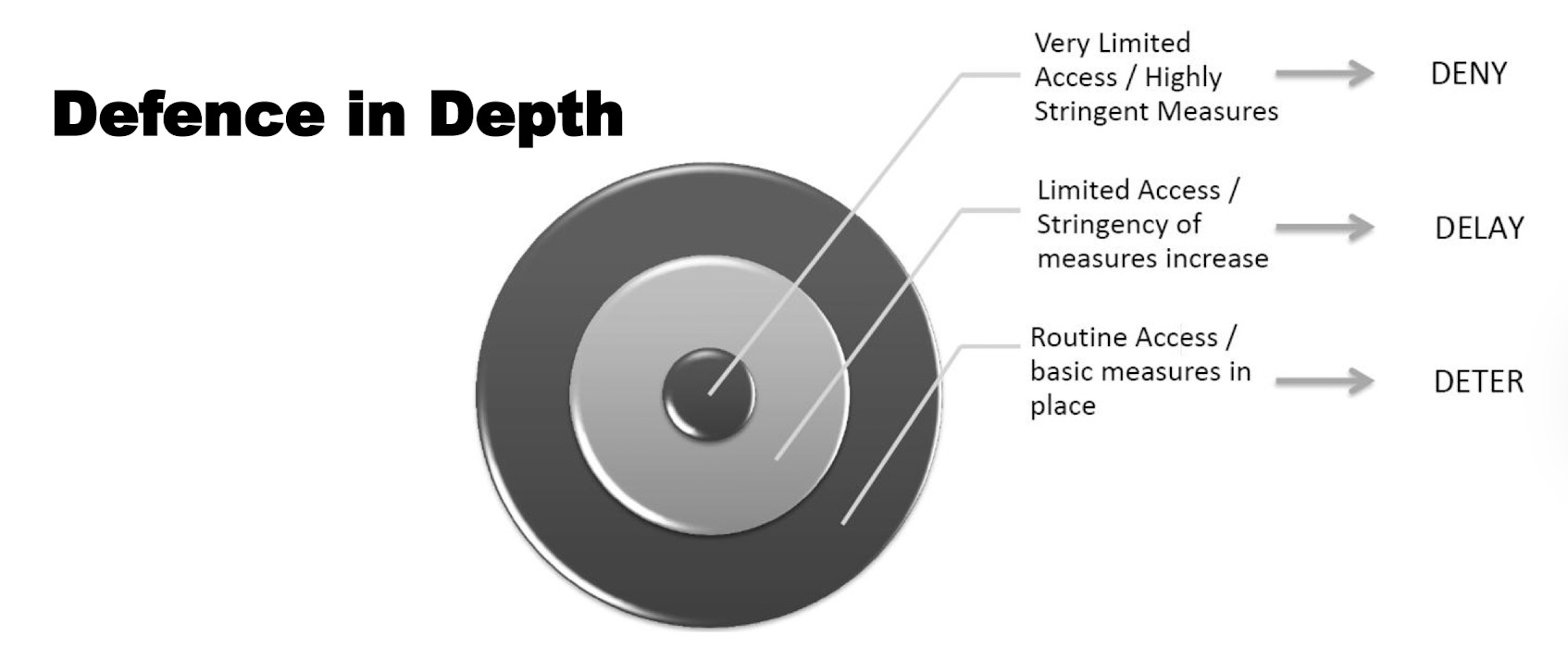
What is defence in depth?
A strategy that leverages multiple security measures. Point is that if one line is compromised then additional layers exist.
What types of fission products from UO2 fuel cycle?
fission gasses
metallic precipitates
oxide precipitates
dissolved as oxides
Aside from fission products, how else can radioactive material be produced?
Spent fuel, cladding and other surrounding structures can absorb neutrons and create radioactive materials.
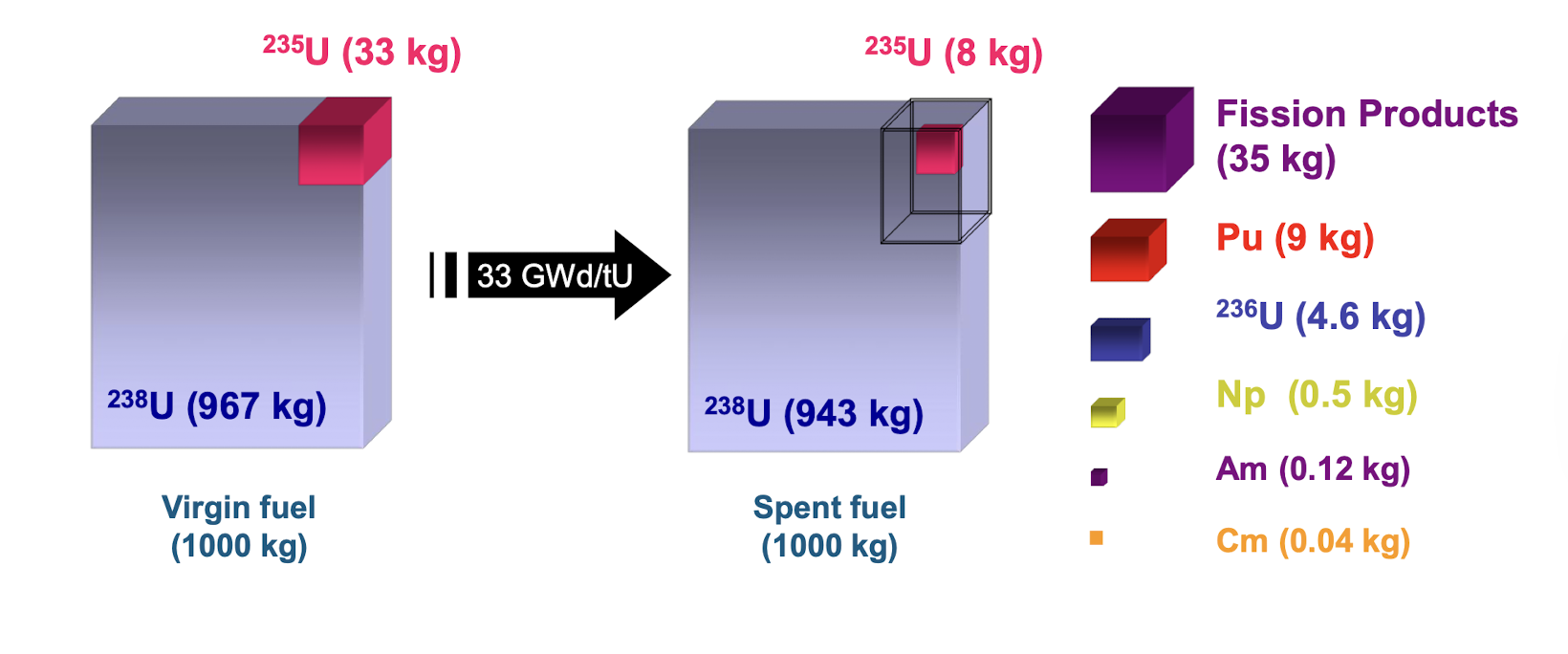
Spent fuel composition
How is nuclear waste initially cooled?
Fuel rods are left in underwater storage ponds at the reactor site for 5-8 years.
Interim storage
Can be:
left on site
transported to interim storage
transported to reprocessing facility
Options are dry or wet.
Dry:
In metal casks or vaults (indoors)
metal canisters or concrete modules (outdoors)
Wet:
active cooling (force heat transfer)
passive cooling (uses natural convection)
What is a magnox pond?
An open-air cooling pond for magnox spent fuel. The magnox cladding corroded due to the decades spent in water. This has created a large volume of radioactive sludge that now requires complex robotic retrieval and stabilisation.
WHat is the difference between virgin fuel and spent fuel?
virgin is low activity (alpha) and spent is high activity (gamma/neutron)
virgin is only uranium (U238 and U235) while spent contains ~95% uranium, ~1% plutonium and ~4% fission products
virgin is cold while spent generates decay heat that requires active/passive cooling
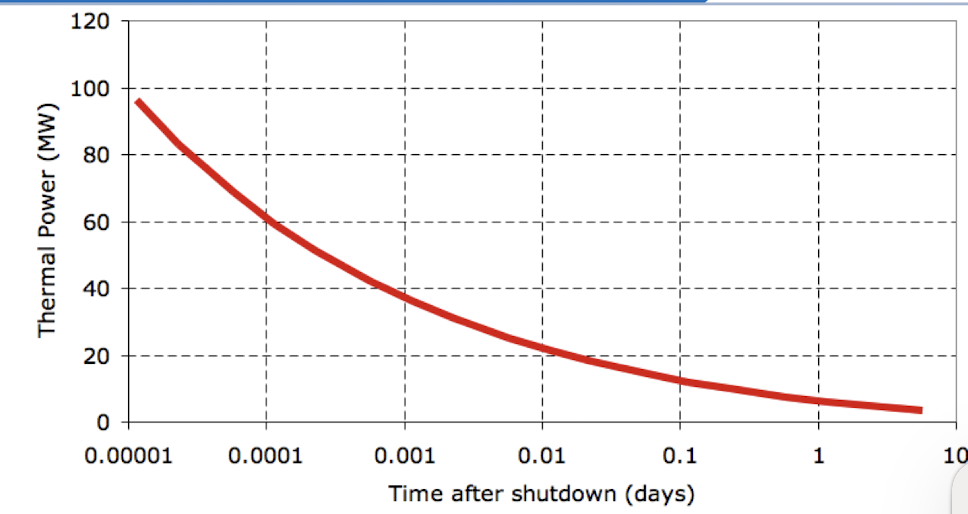
What is decay heat?
Heat released by radioactive materials after a reactor has been shut down or fuel has been removed from the core.
Advantages and disadvantages of reprocessing spent fuel
Advantages:
save natural resources (96% is recyclable - plutonium and uranium used as fuel, fission products stored in glass canisters, metallic structure stored as compacted waste)
reduce waste (mass, volume and toxicity)
Disadvantages:
economic cost - elaborate process and subsequent waste processing is expensive
security risk - plutonium production
PUREX process steps
Plutonium Uranium Recovery by EXtraction - PUREX
Shearing - mechanical decladding.
Dissolution and Clarification - spent fuel is leached with hot concentrated nitric acid leaving behind the undissolved cladding material for disposal. Fuel solution is clarified and acidity is adjusted.
1st Extraction - separate Pu/U from fission products and miron actinides by countercurrent solvent extraction process.
Purification and Conversion - U is stripped using nitric acid to remove all Pu then heated in a furnace to make UO3 and then reduced to UO2. Pu is purified then extracted, precipitated, filtered and calcined (burned in furce) into PuO2.
What waste is produced during fuel reprocessing?
Gaseous waste - nitric oxide
Solid waste - cladding hulls and end pieces
Aqueous waste - nitric acid
Organic waste - solvents
What are the containment measures for HLW, ILW, LLW?
HLW - encased in one or more containers then buried, multi-barrier waste forms.
ILW
Compacted waste - stainless steel
Containment - encapsulated in cement/grout/bitumen-immobilisation, multi-barrier waste forms.
LLW - compacted into steel drums.