Psych/Soc
 Call Kai
 Learn
Learn Practice Test
 Spaced Repetition
 Match
Match Flashcards
 Knowt Play
1/46

There's no tags or description
Looks like no tags are added yet.
Name | Mastery | Learn | Test | Matching | Spaced | Call with Kai |
|---|
No analytics yet
Send a link to your students to track their progress
47 Terms
Participants want to merge completely with others and this desire pushes people away describes
an anxious-ambivalent attachment style
Which is a plausible reason why participants with an avoidant attachment style are less likely to seek support from others in times of stress?
A. Participants think that others are reluctant to get close to them.
B. Participants find it difficult to trust and depend on others.
C. Participants do not worry that they will be abandoned by others.
D. Participants want to merge completely with others and this desire pushes people away.
C
What describes an anxious attachment style
A. Participants think that others are reluctant to get close to them.
B. Participants find it difficult to trust and depend on others.
C. Participants do not worry that they will be abandoned by others.
D. Participants want to merge completely with others and this desire pushes people away.
A
As infants, what type of parent-infant interaction most likely occurred for the avoidant attachment style?
A. A confused infant-parent bond that is characterized by mixed separation anxiety and a tendency for the infant to resist and have a dazed behavior
B. An infant-parent bond that is characterized by some separation anxiety and a tendency for the infant to seek contact with the parent after separation
C. An infant-parent bond that is characterized by strong separation anxiety and a tendency for the infant to resist contact with the parent after separation
D. An insecure infant-parent bond that is characterized by little separation anxiety and a tendency for the infant to resist contact with the parent
D
what scenario describes disorganized attachment
A. A confused infant-parent bond that is characterized by mixed separation anxiety and a tendency for the infant to resist and have a dazed behavior
B. An infant-parent bond that is characterized by some separation anxiety and a tendency for the infant to seek contact with the parent after separation
C. An infant-parent bond that is characterized by strong separation anxiety and a tendency for the infant to resist contact with the parent after separation
D. An insecure infant-parent bond that is characterized by little separation anxiety and a tendency for the infant to resist contact with the parent
A
what scenario describes anxious ambivalent attachment
A. A confused infant-parent bond that is characterized by mixed separation anxiety and a tendency for the infant to resist and have a dazed behavior
B. An infant-parent bond that is characterized by some separation anxiety and a tendency for the infant to seek contact with the parent after separation
C. An infant-parent bond that is characterized by strong separation anxiety and a tendency for the infant to resist contact with the parent after separation
D. An insecure infant-parent bond that is characterized by little separation anxiety and a tendency for the infant to resist contact with the parent
C
what scenario describes secure attachment
A. A confused infant-parent bond that is characterized by mixed separation anxiety and a tendency for the infant to resist and have a dazed behavior
B. An infant-parent bond that is characterized by some separation anxiety and a tendency for the infant to seek contact with the parent after separation
C. An infant-parent bond that is characterized by strong separation anxiety and a tendency for the infant to resist contact with the parent after separation
D. An insecure infant-parent bond that is characterized by little separation anxiety and a tendency for the infant to resist contact with the parent
B
stage, usually in early development, when the individual is more receptive to learning from specific types of experiences
critical period
The internal working model that sets expectations about self and others described in the study is an example of:
A. an insight.
B. a critical period.
C. a cognitive schema.
D. a heuristic.
C
despite his feelings of inferiority and envy, the patient also reports having extreme admiration and love for his partner.
The patient described in the passage is most likely using which defense mechanism?
Reaction formation
Emotional displacement
shifting the focus of emotion from a less to more acceptable target
Reaction formation
minimizing uncomfortable thoughts or emotions by overemphasizing their opposite.
Rationalization -
creating a seemingly logical explanation for otherwise unacceptable behavior.
“He has stopped attending social events with his partner because such events elevate his feelings of inferiority.”
Which statement best explains the patient's behavior in terms of operant conditioning?
A. Feelings of inferiority function as a positive reinforcer for attending social events with partner.
B. Feelings of inferiority function as a negative reinforcer for attending social events with partner.
C. Feelings of inferiority function as a positive punisher for attending social events with partner.
D. Feelings of inferiority function as a negative punisher for attending social events with partner.
C
Weber's characteristics of an ideal bureaucracy suggest that most formal organizations will:
A. train employees to conduct a variety of tasks.
B. select employees based on technical qualifications.
C. require employees to seek consensus in decisions.
D. evaluate employees based on individualized criteria.
B
According to Weber's conceptualization of ideal bureaucracy, a formal organization requires specialization in a
a limited number of tasks
Which construct best describes the process in which an immigrant group comes to express the cultural values and norms of a new country?
A. Cultural transmission
B. Cultural relativism
C. Cultural diffusion
D. Cultural assimilation
D
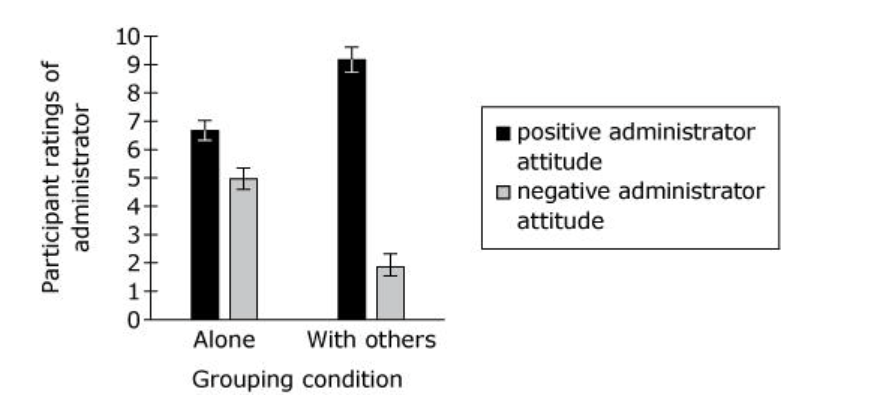
If participants in the study rated the administrator's attitude more inconsistently in the "Alone" condition than in the "With Others" condition, then
A. the mean in the "Alone" condition would be higher than in the "With Others" condition.
B. the mode in the "Alone" condition would be higher than in the "With Others" condition.
C. the median in the "Alone" condition would be higher than in the "With Others" condition.
D. the standard deviation in the "Alone" condition would be higher than in the "With Others" condition.
D
“As more sugar is added, subtle changes in the sweetness of wine can be detected by both experts and novices. However, the lowest level of an odor that can be detected does not seem to be improved with training.”
Which construct is most relevant to the description in paragraph 2 about the comparison of two wines with different levels of sweetness?
A. Weber's law
B. Perceptual constancy
C. Natural selection
D. Absolute threshold
A
Participants with AD were on daily drug treatments of the acetylcholinesterase inhibitor (AchEI) donepezil,
In Study 2, the primary function of donepezil is to:
A. increase the antagonistic effects of acetylcholine.
B. increase the duration of acetylcholine action.
C. inhibit the release of acetylcholine.
D. inhibit the formation of acetylcholine
B
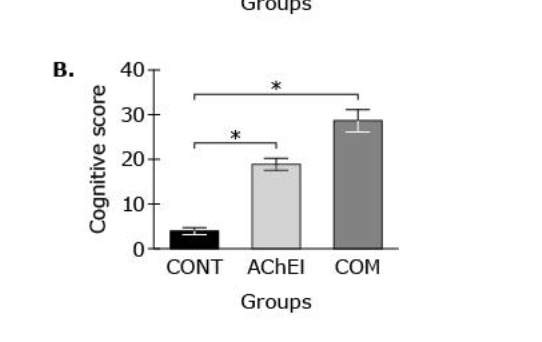
Interpret this
COM and CONT are statistically significant
ACHel and CONT are statistically significant
ACHel COM are NOT statistically significant
A woman loses her job, finds that she is unable to pay her bills, and accumulates debt. She must sell her home and move into an apartment. This woman has experienced which type of social mobility?
A. Horizontal mobility
B. Vertical mobility
C. Intergenerational mobility
D. Structural mobility
B
Vertical mobility indicates a change in
someone's socioeconomic status.
Intergenerational mobility refers to
generational change in socioeconomic status across different generations
A researcher interested in cultural differences regarding happiness designs a cross-cultural study in which happiness is measured relative to a nation's gross domestic product. Which is a dependent variable in this study?
A. Cultural differences
B. Nations
C. Gross domestic product
D. Happiness
D
Which condition provides the best example of medicalization?
A. Cancer
B. Diabetes
C. Alcoholism
D. Hypertension
C
The ecological perspective suggests that a neighborhood’s impact on childbearing is mediated by characteristics and changes in families. The ecological perspective includes a potentiator model, which refers to correspondence between risks from the environment and those from the family, as well as a protective model, which describes how more affluent families tend to protect their adolescents from risks in the environment.
what could this fall under?
the life course approach
Due to the assertion that the local environment influences adolescents' norms and values, the ecological perspective is most similar to which sociological theory?
A. Social strain theory
B. Disengagement theory
C. Differential association theory
D. Labeling theory
C
Disengagement theory describes how
older people disengage from society.
a qualitative research method to make in-person observations in a cultural setting over an extended period of time.
Ethnography
In operant conditioning, partial reinforcement, rather than continuous reinforcement, leads to a response that is:
A. slower to acquire and more resistant to extinction.
B. faster to acquire and less resistant to extinction.
C. faster to acquire and more resistant to extinction.
D. slower to acquire and less resistant to extinction.
A. slower to acquire and more resistant to extinction.
continuous reinforcement -
faster to acquire, less resistant to extinction
A woman's manufacturing job is unexpectedly outsourced to a factory in Country A. She responds with hostility and anger towards all people from Country A and accuses them of taking her job. Which concept best describes her response?
A. Xenophobia
B. Scapegoating
C. Prejudice
D. Ethnocentrism
B
Which structural feature does NOT characterize modern economic systems?
A. Division of labor
B. Craft apprenticeship
C. Occupational specialization
D. Structural interdependence
B
Episodic memory is long-term memory for
personally experienced events
To assess cognitive functioning, they were presented with a list of fifteen items categorizable as animals, clothing, and furniture. After participating in a 2-minute distraction task, they were asked to recall as many of the items as possible and categorize them. The volume of the hippocampus was also assessed for each participant.
The categorization aspect of the cognitive functioning assessment involves which type of memory?
A. Sensory memory
B. Short-term memory
C. Episodic memory
D. Semantic memory
A
refers to individuals acting in ways that comply with the norms of their social groups.
Normative social influence
A low agreeableness score is analogous to
antagonism
conscientiousness is related to
organization, punctuality, and dependability
Opioids function as
depressants
cocaine is as
stimulant
Sedatives refer to
psychoactive substances which depress activity of the CNS
Participants' responses to the self-statements on the inventory described in the passage could be affected by each of the following confounds EXCEPT:
A. Hawthorne effect.
B. demand characteristics.
C. self-serving bias.
D. confirmation bias.
D
Confirmation bias
the tendency to put more weight on information that confirms one’s preexisting attitudes
occur if the research design provides cues to the participants regarding the study hypothesis and causes them to respond in a specific manner
demand characteristics
A postsynaptic cell has a resting membrane potential of -65mV with a threshold potential of -55mV. Will an action potential be generated by a single stimulus that lowers the membrane potential of the postsynaptic cell by 15mV?
A. Yes, because the stimulus caused the membrane potential to exceed the threshold potential
B. No, because the stimulus hyperpolarized the membrane, producing an inhibitory effect
C. Yes, because the stimulus had an excitatory effect on the postsynaptic membrane
D. No, because the depolarizing effect of the stimulus did not exceed the threshold potential
B
If a researcher defines the concept of religiosity as the frequency an individual engages in religious meetings, rituals, or practices, that researcher has created a(n):
A. hypothetical definition.
B. conceptual definition.
C. thematic definition.
D. operational definition.
D