biology exam 4 (FINAL)
 Call Kai
 Learn
Learn Practice Test
 Spaced Repetition
 Match
Match Flashcards
 Knowt Play
1/181

Earn XP
Description and Tags
Unit 1: Animal Reproduction and Development & Meiosis. Unit 2: Mechanism of Transcription and Translation. Unit 3: Macroevolution. Unit 4: All lectures in Unit 4 (from Lecture 17 to 21).
Name | Mastery | Learn | Test | Matching | Spaced | Call with Kai |
|---|
No analytics yet
Send a link to your students to track their progress
182 Terms
what is ecology?
the scientific study of interactions between organisms and their environment.
Biogeography
the scientific study of the distribution of species and ecosystems in geographic space and throughout geological time.
what does biogeography seek to understand?
it seems to understand not only where organisms live but also why they are present (or absent) in specific regions.
organism
individuals
population
a group of individuals of the same species living in a particular geographic area.
community
an assemblage of all the population of organisms living close enough together for potential interaction.
ecosystem
the community of organisms in an area and the physical factors with which they interact
landscape ecology
focuses on the exchanges of energy, materials, and organisms across multiple ecosystems.
A ________ (or seascape) is a mosaic of connected ecosystems.
landscape
Global ecology is concerned with the ____________.
biosphere
Climate
is the prevailing long-term weather conditions found in an area.
Weather
consists of the specific short-term atmospheric conditions of temperature, preciptation, sunlight, and wind.
Global climate pattern are largely determined by:
the input of radiant energy from the sun.
the planet’s movement in space
most climatic variations are due to the uneven heating of Earth’s surface.
climate influences the distribution of terrestrial communities:
variation in the speed of Earth’s rotation at different latitudes results in the major wind patterns.
In the tropics, Earth’s rapidly moving surface deflects vertically circulating air, making the trade winds blow from east to west.
In temperate zones, the slower-moving surface produces the westerlies, winds that blow from west to east.
what do prevailing winds (pink) result from?
result from the combined effects of rising and falling air masses (blue/brown) and Earth’s rotation (gray).
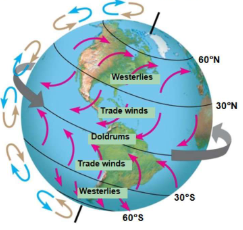
regional effects on climate
landforms can also affect local climate. For example, air temperature declines about 6 degree Celsius with every 1,000-m increase in elevation.
raising air release moisture on the windward side of a peak and creates a “rain shadow” as it absorbs moisture on the leeward side causing a desert.
What are Biomes?
major life zones characterized by vegetation type (terrestrial biomes) or physical environment (aquatic biomes).
Climate
Climate is very important in determining why terrestrial biomes are found in certain areas (latitudes).
Terrestrial ecosystems are grouped into nine major types of biomes, distinguished primarily by their predominant vegetation.
What is biogeography?
The study of the geographic distribution of species and ecosystems across space and time.
What factors influenced the formation of major biogeographic regions?
Plate tectonics, continental drift, isolation, and speciation.
What is the Columbian Exchange and why is it important?
It was the transfer of species between the Americas and the Old World due to human activity, reshaping ecosystems, agriculture, and disease patterns.
What does island biogeography theory predict about species richness?
Species richness depends on island size and distance from the mainland.
How does island size affect species richness?
Larger islands support more species.
How does distance from the mainland affect species richness?
Closer islands have more species due to higher immigration rates.
What should you be able to do with graphs related to island biogeography?
Interpret how area, distance, and isolation affect biodiversity and species richness.
What are the levels of ecological organization (in order)?
Organism → Population → Community → Ecosystem → Landscape → Biosphere
What are the main abiotic factors influencing terrestrial biomes?
Solar energy, temperature, water, nutrients, oxygen, wind, and fire.
What is climate?
Long-term patterns of temperature and precipitation in a region.
What determines global climate patterns?
Solar energy, Earth’s movement, and latitude.
Why does uneven heating of Earth matter?
It creates wind patterns that influence biome distribution.
What are two regional effects on climate?
Ocean currents and rain shadows.
What is a rain shadow?
A dry region formed on the leeward side of mountains.
Why are deserts commonly found around 30° latitude?
Descending dry air reabsorbs moisture, creating arid conditions.
What are the trade winds?
Winds that blow east to west.
What are the westerlies?
Winds that blow west to east.
How do prevailing winds affect climate?
They shape weather patterns and influence precipitation.
What primarily defines terrestrial biomes?
Temperature, precipitation, and disturbance (like fire).
How are biomes often categorized?
By dominant vegetation.
What are the two main types of aquatic biomes?
Marine and freshwater.
What should you understand about aquatic biomes?
Their broad features and environmental characteristics.
Speciation
The process by which new species form.
Immigration (ecology)
Movement of species into a new area.
Isolation (geographic)
Physical separation of populations leading to divergence.
Disturbance regime
Recurring environmental events (e.g., fire, storms) that shape ecosystems.
Inorganic nutrients
Essential nonliving chemical elements required by organisms (e.g., nitrogen, phosphorus)
Oxygen availability
Amount of oxygen accessible for organisms, especially important in aquatic systems.
Wind patterns
Large-scale movement of air that influences climate and weather.
What is a population?
A group of individuals of the same species living in the same area.
What are the key characteristics used to describe populations?
Density, dispersion patterns, and survivorship curves.
What does population ecology study?
Changes in population size and the factors that regulate populations over time.
What is the exponential growth equation?
G = rN
What does each variable represent in exponential growth?
G = population growth rate
r = per capita rate of increase
N = population size
What type of curve represents exponential growth?
A J-shaped curve.
What does a J-shaped curve indicate about environmental limits?
Resources are abundant and limiting factors are minimal.
What is the logistic growth equation?
G = rN(K−N/K)
What does K represent in the logistic model?
Carrying capacity—the maximum population size the environment can support.
What happens to growth rate as population size approaches K?
Growth slows down.
What type of curve represents logistic growth?
An S-shaped curve.
What does an S-shaped curve indicate about environmental limits?
Resources become limited, slowing population growth.
What is intraspecific competition?
Competition between individuals of the same species for resources.
What are density-dependent factors?
Factors that have a stronger effect as population density increases (e.g., competition, disease).
What are density-independent factors?
Factors that affect populations regardless of density (e.g., weather, natural disasters).
What are “boom and bust” cycles?
Rapid population increases followed by sudden declines.
Population density
Number of individuals per unit area.
Dispersion patterns
How individuals are spaced within a population (clumped, uniform, random).
Survivorship curve
Graph showing the number of individuals surviving at each age.
What is a community in ecology?
All the populations of different species living and interacting in the same area.
How does species composition affect a community?
It determines how the community functions, including interactions, energy flow, and stability.
What is competition in ecology?
An interaction where organisms compete for the same limited resources.
How can species interactions be classified?
Based on whether they are positive (+), negative (−), or neutral (0) for each organism.
What are examples of interaction types based on effects?
(+/+) both benefit
(−/−) both harmed
(+/−) one benefits, one harmed
(+/0) one benefits, one unaffected
What is a niche?
The role a species plays in its environment, including resource use and interactions.
What does it mean when niches overlap?
Species compete for similar resources.
What is symmetric vs. asymmetric competition?
Symmetric: species compete equally
Asymmetric: one species is a stronger competitor.
What is the difference between a fundamental niche and a realized niche?
Fundamental: full potential range without competition.
Realized: actual range with competition present.
What is competitive exclusion?
One species outcompetes and eliminates another from a shared niche.
What is niche partitioning?
Species divide resources to reduce competition.
What is character displacement?
Evolutionary changes in species traits to reduce competition.
What are the main trophic levels in a food web?
Producers → Primary → Secondary → Tertiary → Quaternary consumers.
What is a producer?
An organism that makes its own food (usually via photosynthesis).
What is the difference between primary and higher-level consumers?
Primary consumers eat producers; higher-level consumers eat other consumers.
What is a top-down effect?
Predators control the structure of the ecosystem.
What is a bottom-up effect?
Resource availability (like nutrients) controls the ecosystem.
What is species richness?
The number of different species in a community.
What is species diversity?
A combination of species richness and how evenly individuals are distributed.
What characterizes highly diverse communities?
High richness and even distribution of species.
What is a keystone species?
A species that has a disproportionately large effect on its community.
Why are keystone species important?
Their removal can drastically alter or collapse the community.
What is primary succession?
Community development starting from bare, lifeless areas.
What is secondary succession?
Community recovery after a disturbance where soil remains.
What is an invasive species?
A non-native species that spreads and disrupts ecosystems.
What effects can invasive species have?
They outcompete native species and alter ecosystem balance.
Species composition
The identity and variety of species in a community.
Food web
A network of feeding relationships in an ecosystem.
Evenness
How equally individuals are distributed among species
Disturbance
An event that disrupts a community (e.g., fire, storm).
How does the first law of thermodynamics apply to ecosystems?
Energy cannot be created or destroyed, only transferred or transformed.
How does energy move through an ecosystem?
In one direction—from producers to higher trophic levels.
How does the law of conservation of mass apply to ecosystems?
Matter (chemicals) is recycled within the ecosystem.
What is primary production?
The process by which autotrophs convert energy (usually sunlight) into chemical energy.