7.1 Utility
 Call Kai
 Learn
Learn Practice Test
 Spaced Repetition
 Match
Match Flashcards
 Knowt Play
1/21

There's no tags or description
Looks like no tags are added yet.
Name | Mastery | Learn | Test | Matching | Spaced | Call with Kai |
|---|
No analytics yet
Send a link to your students to track their progress
22 Terms
What is utility and how is it measured
A measure of the satisfaction or benefit a consumer gains from consuming a good or service.
It is subjective and cannot be measured directly but economists assume it can be measured in 'utils' for theory.
What is total Utility (TU)
The overall satisfaction gained from consuming a given quantity of a good or service over a given time period.
What is Marginal Utility (MU) and how is it used
The additional satisfaction gained from consuming one more unit of a good.
It can be used to explain how an individual's demand curve is derived.
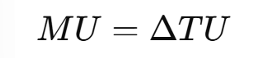
Formula for Marginal Utility
MU = change in total utility resulting from the consumption of one additional unit.
What is the relationship between TU and MU
Total utility increases while marginal utility is positive and is maximised when marginal utility equals zero.
What is the Law of Diminishing Marginal Utility
As more units of a good are consumed, the marginal utility derived from each additional unit falls, ceteris paribus.
As consumption increases, the satisfaction from consumption decreases.
How do consumers use utility
Consumers link an item's utility with the actual price at the point of sale.
Utility may be used to consider how consumers rank their purchases in relation to the satisfaction that is gained from their consumption.
What is the reason for Diminishing Marginal Utility
As consumption increases, wants become increasingly satisfied and each extra unit is less urgently needed.
What is Negative Marginal Utility
Occurs when consumption of an additional unit reduces total utility.
What is the Equi-marginal Principle and how is it used
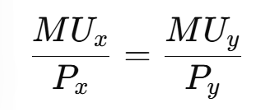
Utility is maximised when the marginal utility per dollar spent on each good is equal.
Consumers maximise their utility where their marginal valuation for each product consumed is the same.
It is used to determine whether or not consumer equilibrium is being achieved.
Equi-marginal Formula
What does the Equi-marginal Principle assume (3)
Consumers have limited incomes
Consumers will always behave in a rational manner
Consumers seek to maximise their utility
How does a consumer reach Utility Maximisation
A consumer maximises total utility when marginal utility per unit of currency is equal across all goods meaning their marginal valuation for each product consumed is the same.
What is the Consumer Decision Rule
A consumer will continue to consume a good as long as marginal utility is greater than or equal to price.
What is the Utility-Maximising Quantity
The quantity where marginal utility equals price.
How is the Demand Curve derived
An individual demand curve can be derived from the marginal utility curve, as consumers buy additional units only while marginal utility is at least equal to price.
Why does the Demand Curve Slope Downwards (Utility Theory)
Because marginal utility diminishes as consumption increases, consumers are only willing to buy additional units at lower prices.
What are the 5 Key Assumptions of Utility Theory
Utility can be measured and compared using hypothetical units called utils.
2. Consumers are fully rational meaning: consumers are assumed to allocate income in a way that maximises total utility.
3. Consumers have perfect information
4. Preferences are consistent
5. Marginal Utility is independent of other's consumption
What are the 5 Key Limitations of Utility Theory
Utility Cannot Be Measured Objectively - Utility is subjective and cannot be directly observed or measured.
2. Consumers Are Not Always Rational - consumers may be influenced by habits, advertising, impulse buying, or social pressure.
3. Perfect Information Assumption - Utility theory assumes consumers have full knowledge of prices and marginal utilities, which is unrealistic.
4. Independent Preferences - Utility theory assumes consumption decisions are not influenced by social influences such as status goods or peer pressure, which is often untrue.
5. Therefore Too simplistic - replaced with indifference curve analysis
Overall Evaluation of Utility Theory
Marginal utility theory is useful in explaining consumer behaviour but has limited explanatory power in real-life consumer behaviour.
COMMON MISTAKES TO AVOID 🚫
❌ Confusing TU and MU
❌ Saying TU diminishes (it doesn’t — MU does)
❌ Forgetting MU/P in equi-marginal principle
❌ No evaluation in essay questions
❌ Saying demand is derived from TU (it’s MU)
Quick summary (memorise this)
• TU = total satisfaction
• MU = extra satisfaction from one more unit
• MU diminishes as consumption rises
• Utility maximised when MU/P is equal
• Demand curve = MU curve
• Theory is unrealistic but useful