CH. 6 | Microbial Growth
 Call Kai
 Learn
Learn Practice Test
 Spaced Repetition
 Match
Match Flashcards
 Knowt Play
1/17

There's no tags or description
Looks like no tags are added yet.
Name | Mastery | Learn | Test | Matching | Spaced | Call with Kai |
|---|
No analytics yet
Send a link to your students to track their progress
18 Terms
6 - 1 Classify microbes into five groups on the basis of preferred temperature range.
Microorganisms are classified by their preferred temperature range. The five primary groups are:
Psychrophiles – cold-loving; can grow at 0°C, optimum ~15°C. Found in ocean depths and polar regions. Rarely cause food spoilage problems.
Psychrotrophs – also grow at 0°C but have a higher optimum (20–30°C); cannot grow above ~40°C. More common and are the main culprits in low-temperature food spoilage (refrigerator temps).
Mesophiles – optimum 25–40°C; most common type of microbe. Most pathogens fall here (optimum ~37°C, body temperature).
Thermophiles – heat-loving; optimum 50–60°C. Found in hot springs, compost piles. Endospores can survive normal canning heat treatment.
Hyperthermophiles (Extreme thermophiles) – optimum 80°C or higher; mostly Archaea, found near volcanic hot springs. Record growth temp ~121°C at deep-sea hydrothermal vents.
6 - 2 Identify how and why the pH of culture media is controlled.
Most bacteria grow best at a near-neutral pH (6.5–7.5); very few grow below pH 4.
Acidophiles are exceptions — tolerant of high acidity (some survive at pH 1).
Molds and yeasts tolerate a wider pH range, with an optimum around pH 5–6.
In lab culture, bacteria produce acids that can inhibit their own growth, so chemical buffers (especially phosphate salts) are added to maintain proper pH.
Phosphate salts are ideal buffers because they are nontoxic and also supply phosphorus, an essential nutrient.
Acidic foods (sauerkraut, pickles, cheese) resist spoilage because low pH inhibits most bacterial growth.
6 - 3 Explain the importance of osmotic pressure to microbial growth.
Microbes get nutrients from surrounding water; they are 80–90% water and require it for growth.
High osmotic pressure (hypertonic environment) pulls water out of the cell → causes plasmolysis (shrinkage of cytoplasm) → inhibits growth.
This principle is used to preserve foods: salted fish, honey, sweetened condensed milk all use high salt/sugar to draw water out of any microbial cells.
Extreme (obligate) halophiles actually require high salt (~30%) — found in places like the Dead Sea.
Facultative halophiles don't require high salt but can tolerate up to 2% (some up to 15%).
Low osmotic pressure (hypotonic) causes water to rush into the cell — can lyse cells with weak walls.
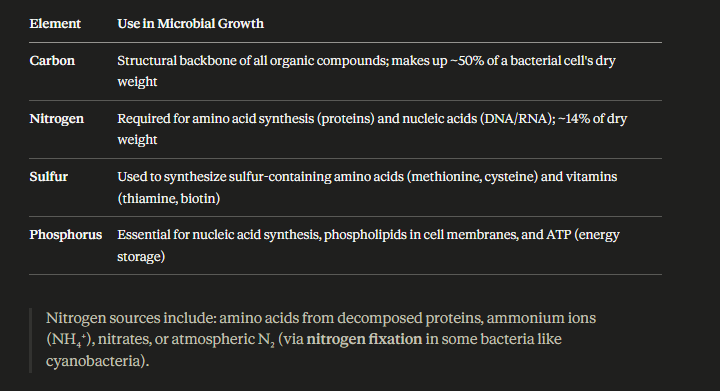
6 - 4 Name a use for each of the four elements (carbon, nitrogen, sulfur, and phosphorus) needed in large amounts for microbial growth.
6 - 5 Explain how microbes are classified on the basis of oxygen requirements.
There are five groups based on how microbes respond to oxygen (O₂):
Obligate Aerobes – require oxygen; grow only where O₂ is present.
Facultative Anaerobes – prefer oxygen but can survive without it (switch to fermentation or anaerobic respiration). Example: E. coli, most yeasts.
Obligate Anaerobes – cannot use oxygen; it is actually toxic to them. Example: Clostridium (causes tetanus and botulism).
Aerotolerant Anaerobes – cannot use oxygen but can tolerate it. Example: lactobacilli (used in acidic fermented foods like pickles and cheese).
Microaerophiles – require oxygen but only at low concentrations; damaged by normal atmospheric O₂ levels.
6 - 6 Identify ways in which aerobes avoid damage by toxic forms of oxygen.
Oxygen produces toxic byproducts that cells must neutralize:
Singlet oxygen (¹O₂) — highly reactive, boosted-energy form of O₂.
Superoxide radicals (O₂⁻) — formed during normal aerobic respiration; extremely unstable and destructive.
Peroxide anion (O₂²⁻) / Hydrogen peroxide (H₂O₂) — toxic; used as an antimicrobial agent.
6 - 7 Describe the formation of biofilms and their potential for causing infection.
Biofilm
A thin, slimy layer encasing bacteria that adheres to a surface
Can consist of a single species or multiple species of microorganisms, and can form on many surfaces
Rocks in ponds, teeth (dental plaque), medical catheters, heart valves, etc
Aggregation of microbes
Benefits Biofilms Provide to Bacteria
Within a biofilm, bacteria gain significant advantages:
Shared nutrients among community members
Protection from desiccation, antibiotics, and the immune system
Genetic exchange — close proximity facilitates conjugation (DNA transfer between cells)
Potential for Causing Infection
Biofilms are a major concern in human health:
Microbes in biofilms are approximately 1,000 times more resistant to microbicides (disinfectants/antibiotics) than free-living bacteria
The CDC estimates ~70% of human bacterial infections involve biofilms
Most healthcare-associated infections are linked to biofilms on medical devices, including catheters, mechanical heart valves, and other indwelling devices
6 - 8 Distinguish chemically defined and complex media.
Chemically defined media
The exact chemical composition is known
Complex media
The chemical composition varies from batch to batch
Nutrient broth
Nutrient agar
6 - 10 Justify the use of each of the following: anaerobic techniques, living host cells, and candle jars.
Anaerobic Techniques
Used to grow obligate anaerobes, which are killed by oxygen.
Oxygen must be chemically removed from the growth environment using reducing media (sodium thioglycolate), sealed jars with oxygen-removing packets, or systems like OxyPlate™ (uses the enzyme oxyrase to convert oxygen into water).
Without these techniques, obligate anaerobes cannot survive long enough to be cultured, studied, or identified — making them essential for diagnosing infections
Living Host Cells
Used for obligate intracellular pathogens (viruses, rickettsias, chlamydias) that cannot grow on artificial media — they can only reproduce inside a living host cell.
Methods include embryonated eggs, tissue cultures, and lab animals.
Since these organisms have no independent metabolism and cannot synthesize their own ATP or proteins outside a host cell, no artificial medium can substitute for a living host
Candle Jars
Used for microaerophiles and capnophiles that need low oxygen and elevated CO₂.
A lit candle in a sealed jar consumes O₂ and produces CO₂.
Modern chemical gas packets are now more commonly used as they provide more precise gas concentrations.
Candle jars and their modern equivalents are necessary because microaerophiles and capnophiles cannot grow under normal atmospheric conditions — they need a carefully controlled gas environment to survive and be cultivated.
6 - 11 Differentiate biosafety levels 1, 2, 3, and 4
BSL-1 — Lowest risk. Used for non-hazardous microorganisms that pose little to no threat (e.g., basic teaching labs). Standard lab practices, no special containment needed.
BSL-2 — Moderate risk. Used for organisms that present a moderate infection risk. Work is done on open benchtops with gloves, lab coats, and eye/face protection when needed.
BSL-3 — High risk. Used for highly infectious airborne pathogens (e.g., tuberculosis). Requires biological safety cabinets, negative air pressure in the lab, and air filters to prevent pathogen release.
BSL-4 — Extreme risk. Used for the most dangerous pathogens with no known cure (e.g., Ebolavirus). Full "space suits" with air supply, sealed negative-pressure environment, HEPA-filtered intake and exhaust air (exhaust filtered twice), and all waste rendered noninfectious before leaving. Only 4 such labs exist in the U.S.
6 - 12 Define Pure Culture
A culture containing only one type of microorganism
To study a single organism without interference from others
6 - 13 Describe how pure cultures can be isolated by using the streak plate method
A sterile inoculating loop is dipped into a mixed culture (containing multiple types of microbes)
The loop is streaked in a pattern across the surface of a nutrient medium plate
With each streak, fewer and fewer bacteria are deposited on the loop
By the end of the pattern, cells are spread far enough apart to grow into isolated individual colonies
A single isolated colony is then picked up and transferred to a nutrient medium, producing a pure culture of one bacterium type
6 - 14 Explain how microorganisms are preserved by deep-freezing and lyophilization (freeze-drying)
Deep-Freezing
A pure culture is placed in a suspending liquid and quickly frozen at −50°C to −95°C.
The culture can be thawed and grown again even years later. Best for long-term storage that exceeds the capabilities of refrigeration.
Lyophilization (Freeze-Drying)
The microbe suspension is quickly frozen at −54°C to −72°C
A high vacuum is applied, causing the ice to convert directly to vapor (sublimation) — removing all water
The container is sealed under vacuum, leaving a dry, powdery residue of surviving microbes
Main Takeaway
Refrigeration only works short-term. Deep-freezing and lyophilization preserve microbes long-term by either keeping them frozen or removing all water — both methods halt metabolic activity without killing the organisms.
6 - 15 Describe bacterial growth, including binary fission
Bacterial Growth
An increase in bacterial numbers, not in the size of individual cells
Binary Fission (most common method):
Cell elongates and DNA is replicated
Plasma membrane constricts inward and a new wall begins to form
A cross-wall forms, completely separating the two DNA copies
The two cells separate into identical daughter cells
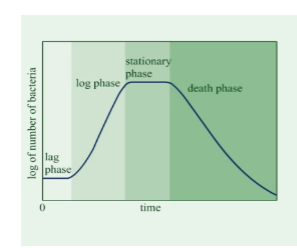
6 - 16 Compare the phases of microbial growth, and describe their relation to generation time
Lag Phase
Little to no cell division occurs
Cells are metabolically active — synthesizing enzymes and molecules to prepare for growth
Duration varies: can last 1 hour to several days
Log Phase
Cells divide rapidly and at a constant rate
Generation time is at its minimum and most consistent
Population doubles at regular intervals → plotted as a straight line on a logarithmic graph
Cells are most metabolically active — important for industrial microbiology
Stationary Phase
Growth slows as the population reaches the environment's carrying capacity
Rate of new cell growth = rate of cell death → population stabilizes
Caused by: nutrient depletion, waste accumulation, and lack of space
Death Phase
Deaths exceed new cell formation
Population steadily declines, sometimes until nearly or completely extinct
Speed of decline varies by species
6 - 17 Explain four direct methods of measuring cell growth
..
6 - 18 Differentiate direct and indirect methods of measuring cell growth
..
6 - 19 Explain three indirect methods of measuring cell growth
..