Bio 152 - Energy Flow & Ecosystems
 Call Kai
 Learn
Learn Practice Test
 Spaced Repetition
 Match
Match Flashcards
 Knowt Play
1/29

There's no tags or description
Looks like no tags are added yet.
Name | Mastery | Learn | Test | Matching | Spaced | Call with Kai |
|---|
No analytics yet
Send a link to your students to track their progress
30 Terms
What is an ecosystem?
An ecosystem is all the species that live in an area together with all the components of their physical environment.
temperature
nutrients
environment
What is gross primary productivity (GPP)?
GPP is the total amount of chemical energy produced in an area over a specific time. (GPP = NPP + R)
*This is energy used for cellular respiration by primary producer
What is net primary productivity (NPP)?
NPP is the energy not used for cellular respiration and is available for reproduction and growth, calculated as NPP = GPP - R.
*This is energy used for reproduction and growth
What does biomass represent in an ecosystem?
Biomass refers to the total amount of chemical energy stored in organic material within an ecosystem.
what is an energy flow model show?
it shows how energy moves from autotrophs through other organisms in the form of biomass
energy lost at each step
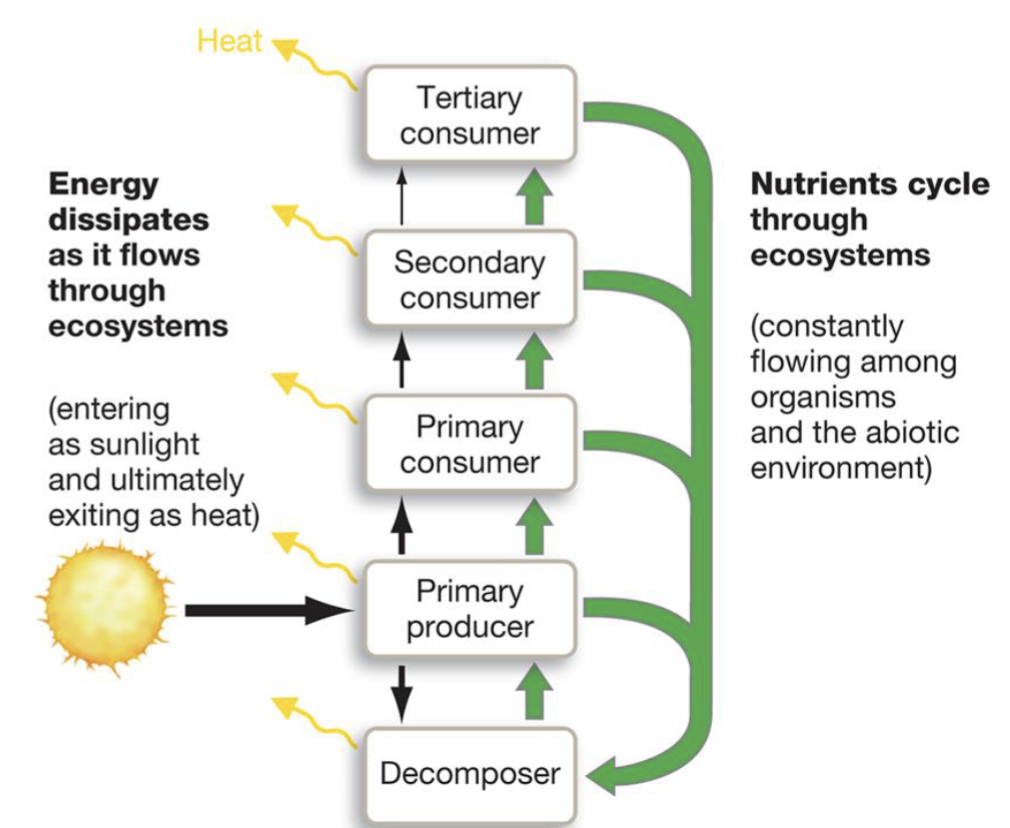
What is a food chain?
A food chain describes the species that occupy each trophic level in a particular ecosystem.
What is a food web?
A food web summarizes energy flows and trophic intersections that occur in ecosystems.
what is productivity?
units of biomass produced per unit of area each year
what is efficiency?
a fraction of biomass that is transferred from one trophic level to the next
10% of biomass is transferred to next trophic level
What is biomagnification?
Biomagnification refers to the increase in concentration of certain molecules at higher levels in a food chain, often involving heavy metals and persistent organic pollutants (POPs).
these do not breakdown in the environment and are difficult to digest
How does productivity vary between terrestrial and marine systems?
Productivity is generally higher in terrestrial systems than in marine systems, influenced by factors such as light availability and environmental conditions.
what is the biogeochemical cycle?
a path that an element takes as it moves form abiotic systems through organismsH and back again
How does decomposition rate control cycles?
abiotic conditions
quality of the detritus as a nutrient source
abundance and diversity of detritivores present
What is the global water cycle?
The global water cycle is the movement of water through different systems, including evaporation, precipitation, and groundwater movement.
what is an aquifer?
it is layers of porous rocks, sand, or gravel saturated w/ water
what is a water table?
it is the upper limit of the underground layer of soil that is saturated w/ stored water
what are the human influences on the water cycle?
depletion of groundwater
mining freshwater from aquifers
changes in global weather patterns due to climate change
Where is most of the Earth’s nitrogen?
in the atmosphere
must be reduced to ammonium nitrate for plant use
what human impact effects nitrogen
fossil fuels - they increase nitrogen which lead to acid rain, depletion of ozone, and climate change
what is the difference between weather and climate?
weather refers to short-term conditions at a specific place and time and climate refers to a long-term average pattern of a region
what is global climate change?
it is the sum of all changes in local temp and precipitation patterns that result from global warming
What is the greenhouse effect?
The greenhouse effect is the trapping of heat between the atmosphere and Earth's surface due to greenhouse gases like CO2 and methane.
What are some possible responses of organisms to climate change?
Possible responses include range shifts, phenology shifts, adaptation, and extinction.
what does it mean for an organism to range shift in response to change?
Suitable habitat moves toward the poles or toward higher altitudes
Changes in species interactions and mismatches between species and resources
what does it mean for an organism to phenology shift in response to change?
Phenology: timing of seasonal events
Seasonal cues shift -> organisms shift their biological activities to match the season
Disruption in species.
What does it mean for an organism to adapt in response to a change?
Change in allele frequencies that favor phenotypes that are best suited to changing conditions
Sexually reproducing species better able to respond
What does it mean for an organism to extinct in response to a change?
Species unable to adapt to rapidly changing or climate envelope is lost so species has no where to live
What is biodiversity?
Biodiversity is the variety of life in the world or a particular habitat or ecosystem, encompassing genetic, species, and ecosystem diversity.
What is the effect of NPP on land?
Temperatures can increase photosynthesis
Drought reduces/ decreases growth
What is the effect of aquatic NPP?
Higher temperatures= lower NPP
Stratification= less nutrient mixing = less photosynthesis