D1.2
 Call Kai
 Learn
Learn Practice Test
 Spaced Repetition
 Match
Match Flashcards
 Knowt Play
1/45

There's no tags or description
Looks like no tags are added yet.
Name | Mastery | Learn | Test | Matching | Spaced | Call with Kai |
|---|
No analytics yet
Send a link to your students to track their progress
46 Terms
Define and summarize transcription
Def: process where genetic information encoded in DNA is copied into RNA
produces mRNA
occurs in nucleus (eukaryotes) or cytoplasm (prokaryotes)
Mainly uses RNA polymerase
What are the 3 steps in transcription
Initiation
RNA polymerase binds to DNA at the beginning of a gene (at promoter region, regulated by transcription factors)
Separates DNA strands by breaking H-bonds
Elongation
RNA polymerase builds mRNA on a DNA strand (the template/antisense strand)
It moves along DNA reading one base at a time and adding free RNA nucleotides
Termination
a terminator sequence in DNA is reached and mRNA is released
RNA polymerase detaches from DNA, so both strands come together
What is the sense vs. antisense strand?
Sense strand = coding strand
Antisense strand = template strand
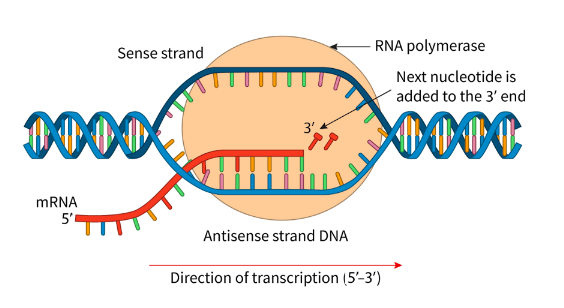
How is the complementary base pairing rule seen in transcription?
Allows the correct RNA nucleotide to be placed by RNA polymerase
It temporarily forms H-bonds
How is transcription related for gene expression?
Transcription enables cells to switch on or off genes, depending on the products that are needed
Define gene expression
the process where genetic info encoded in genes are used to synthesize proteins
Define translation and summarize it
Def: the code from mRNA is read by ribosome and used to synthesize polypeptides
Occurs in cytoplasm and in ribosomes
Describe the 3 components in translation
mRNA
brings code from DNA
Ribosomes
site of translation
brings mRNA and tRNA in correct orientation
has large subunit (where 2 tRNA binds) and small subunit (mRNA binds)
TRNA
single stranded RNA that folds to create clover shape
has double-stranded regions and 3 hairpin loops
each tRNA has a specific AA attached
when it recognizes and binds to code on mRNA on ribosome, tRNA transfers the appropriate AA to make polypeptide
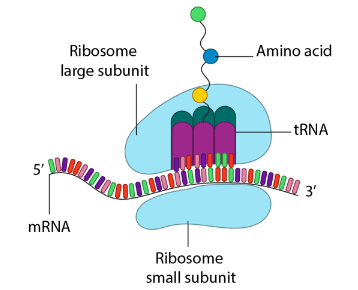
What enables correct AAs to be put int he correct sequence to produce a functional polypeptide?
The complementary base pairing rule
codons are on mRNA, whereas anticodons are on tRNA
they are complementary to each other
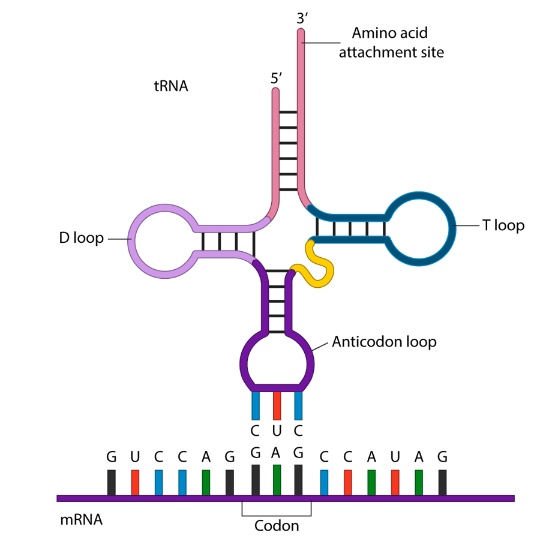
What does the degeneracy of the genetic code mean?
It means redundancy
means that some AA are coded for by more than 1 codon
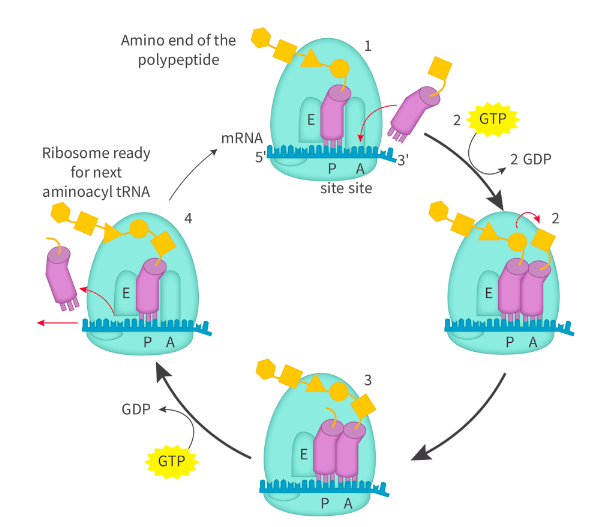
What are the 3 general steps in translation? Explain the process of elongation
initiation, elongation, termination
Begins with a new tRNA binding at the A site
tRNA has a specific AA that matches the second codon on mRNA
the large ribosomal subunit catalyzes a reaction to make a peptide bond between the new AA and the AA held by previous tRNA in P site
Ribosome translates along mRNA, one codon at a time
the tRNA that was in P site moves to E site and exits
tRNA in A site moves to P site, making A site available
essentially, it allows the formation of a polypeptide chain
since the ribosomal subunits hold mRNA and tRNA together so AA can be connected by peptide bonds
What is a point mutation and what are its different types?
A single nucleotide is changed
deletion, addition, substitution
can occur during replication and transcription
What types of mutations are most dangerous/significant? why?
deletion and insertion
because it causes a frameshift mutation, where all codons are altered
What effect would a substitution mutation have?
Depends
due to degeneracy of genetic code, it might produce the exact same AA (silent mutation) —> usually if the third base is altered
If the first or second base is altered, it will likely lead to different AA
What is an example of a disease related to a point mutation?
Sickle cell anaemia
Changes a gene producing haemoglobin —> dramatically changes the shape of haemoglobin
Which direction does mRNA move through a ribosome?
5’ to 3’ direction
Where can control be exerted in gene expression?
The initiation of transcription
The promoter (region of code on DNA before a gene) allows transcription factors to bind
The binding of the correct transcription factors and orientation allows RNA polymerase to bind and begin transcribing DNA into RNA
What happens if transcription factors are missing or can’t bind?
Transcription won’t take place, the gene can’t be expressed
List 4 noncoding regions of DNA and its purpose
Regulators of gene expression (promoters)
Introns: noncoding DNA sequences in eukaryotic genes that are transcribed into RNA but removed during post-transcriptional processing
Telomeres: repetitive sequences protecting end of chromosomes
ensures DNA is replicated correctly
each time cell division occurs, small amounts of DNA are lost from telomeres
Genes to make rRNA and tRNA
What are introns vs. exons?
Introns: non-coding genes but has controlling sequences to regulate gene transcription
Exons: DNA sequences that code for polypeptides
found in eukaryotic genes
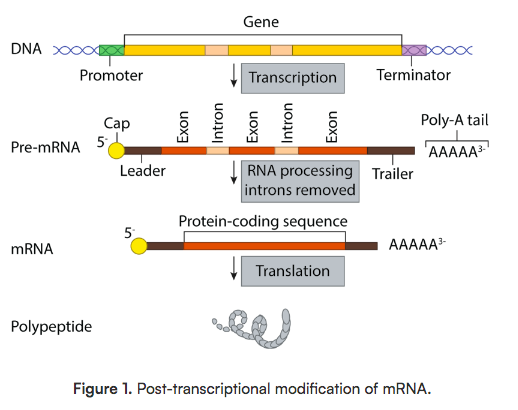
What are the 3 steps in modifying RNA for translation?
transcription
Adding a 5’ cap and a poly-A tail (protects mRNA from degradation)
Splicing (removing introns and joining exons to make mature mRNA) using spliceosomes
What is alternative splicing? Give an example
when a gene is spliced in multiple ways by combining different exons and omitting others
to create different proteins
ex. in a foetus, troponin T gene is sliced in one way to be more sensitive to low blood pH —> after birth, its spliced in a different way and loses these properties
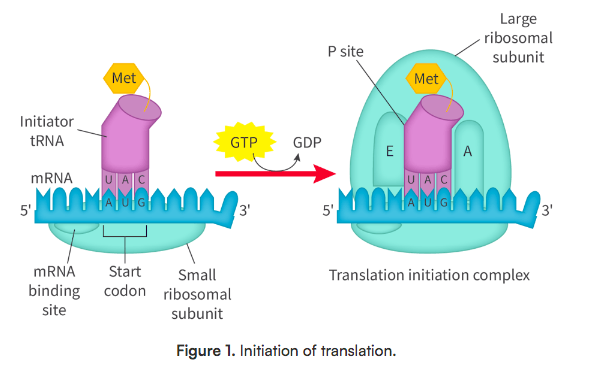
Describe the initiation stage of translation
Mature mRNA (5’ terminal) binds to small ribosomal subunit on the binding site
Ribosome moves along mRNA until finds AUG
the anticodon of initiator tRNA (methionine) binds to codon on mRNA
large ribosomal subunit joins to finish the translation complex
translation starts
Where are polypeptides modified to become functional?
Carried by vesicles to the Golgi apparatus
Describe the post-translational modification of insulin
the direct product from translating insulin gene is pre-proinsulin. It has 4 sections (a signal peptide, A chain, B chain, C-peptide)
Pre-proinsulin enters the rough ER, where the signal peptide is removed. Now, its called proinsulin.
Disulfide bridges form between A and B chain
Proinsulin is packaged into vesicles that move to the Golgi apparatus
C-peptide is removed and mature insulin remains
Define the proteome
the total of all proteins made and used by the body
What do proteasomes do? what are they?
They are protein complexes
helps recycle and hydrolyse proteins to reuse amino acids
Allows cells to maintain a supply of amino acids and getting rid of non functional ones
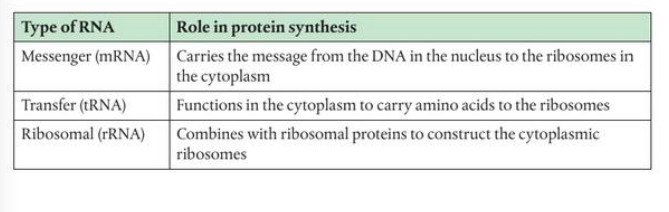
Describe the 3 major types of RNA in translation
All are single stranded and are transcribed from a gene
Note: subunits of ribosomes are made of rRNA molecules and proteins
How does mRNA get out of the cytoplasm for translation?
Moves out through nuclear pores
List the general 9 steps in translation
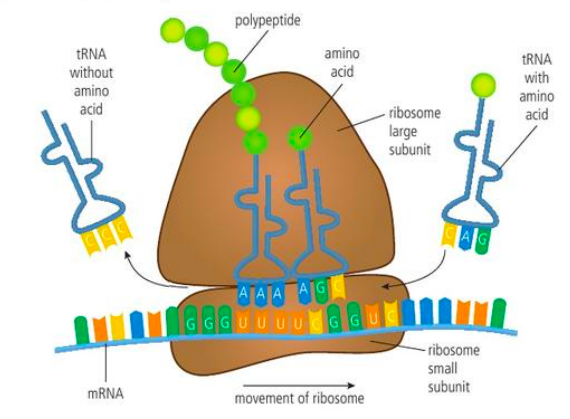
mRNA binds with small ribosomal subunit
tRNA molecule with a specific AA attaches to the large subunit of the ribosome (P site). it combines with mRNA through complementary base pairing
A second tRNA with AA follows the first tRNA, base pairs with mRNA, and attaches to large subunit (A site). Two tRNAs can bind simultaneously to large subunit
An enzyme catalyzes a reaction between the 2 AA, forming a peptide bond
The first tRNA breaks free of its AA, detaches (move to E site), and floats into the cytoplasm (where it can get a new AA)
ribosome moves down mRNA molecule
the second tRNA is in the position that the first tRNA occupied
a third tRNA floats and is in the next sequence of bases on mRNA
Another peptide forms. continues until polypeptide is assembled
Describe the codons on tRNA
they are in the middle loop
they determine which one of the 20 AA is attached
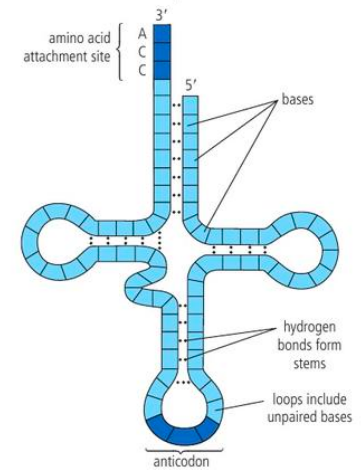
Which direction is transcription written? What about translation?
Its assembled 5’ to 3’
the 5’ ends of free RNA nucleotides are added to the 3’ end of the RNA molecule being synthesized
in translation, mRNA is read in 5’ to 3’
What determines which DNA strand will be the template strand?
The promoter region
What are 2 regions needed for transcription?
promoter (binding site for RNA polymerase)
terminator
How does initiation of transcription differ in bacterial vs. eukaryotic cells
bacterial
after RNA polymerase attached to promoter region
eukaryotic
transcription factors bind to the promoter region of a gene first then attract RNA polymerase to initiate transcription
DNA opens and a transcription bubble forms
What are transcription factors?
proteins that play a role in regulating transcription process
can attach directly to promoter or away from it
determines which genes are active in cells
allow attachment of RNA polymerase to promoter region so transcription begin (eukaryote)
More transcription factors can come later
Can transcription factors activate and prevent transcription?
Yes
What is involved to make a functional mRNA
The first RNA formed is called pre-mRNA, which has exons and introns
to make a functional mRNA, introns are removed through splicing
during splicing, introns are removed, exons might be “rearranged” and a cap and polyA tail is added
what are spliceosomes?
small nuclear RNAs and proteins
help remove introns from primary mRNA
Describe the 3 sites on ribosomes. Where does decoding of mRNA occur?
in the space between the 2 subunits of ribosome
there are 3 sites for binding of tRNA and other sites for mRNA
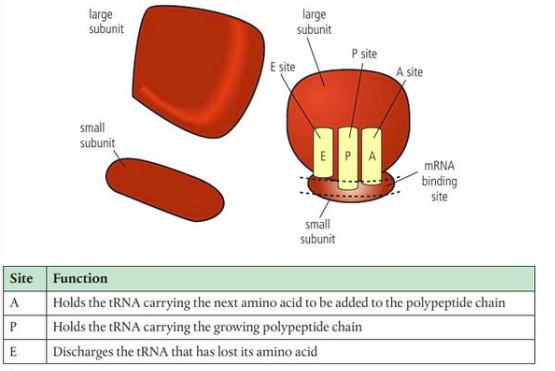
What are the 5 steps in initiation in translation?
Initiation complex forms. involves an initiator tRNA pairing with mRNA start codon. Small ribosome subunit attaches to 5’ terminal of mRNA
the large subunit of ribosome is added
when complete ribosome formed, initiator tRNA is bound to P site and A site is empty
tRNA carrying the next AA enters ribosome A site.
after initiation, translation proceeds with elongation and termination
Where is the start codon found
At the 5’ end of all mRNA
How do eukaryotic cells mark the unneeded or damaged proteins
Use a chemical called ubiquitin
List the functions of ribosomes in translation
translation: process of reading mRNA to form AA/peptides/proteins
small subunit attaches to mRNA
large subunit attaches to tRNA
ribosomes move 1 codon at a time, in 5’ to 3’, to read mRNA
catalyzes formation of peptide bonds
differentiate transcription vs translation
b. transcription produces RNA AND translation produces polypeptide/protein
c. RNA polymerase used in only in transcription and ribosomes only in translation
d. transcription in the nucleus «of eukaryotes» and translation in the cytoplasm
e. tRNA needed for translation but not transcription
f. nucleotides linked in transcription and amino acids in translation
OR
sugar-phosphate/phosphodiester bonds in transcription and peptide bonds in translation
what are tandem repeats for DNA profiling
Tandem repeats are short, repeating DNA sequences found in non-coding regions. The number of repeats varies widely between individuals and is inherited. In DNA profiling, these repeat regions are amplified and separated by gel electrophoresis or similar techniques. Each person has a distinct pattern of repeat lengths, making them useful for identity testing, paternity analysis, and forensic matching.