SEPARATION OF POWERS (4)
 Call Kai
 Learn
Learn Practice Test
 Spaced Repetition
 Match
Match Flashcards
 Knowt Play
1/61

There's no tags or description
Looks like no tags are added yet.
Name | Mastery | Learn | Test | Matching | Spaced | Call with Kai |
|---|
No analytics yet
Send a link to your students to track their progress
62 Terms
The idea of separation of powers
Separation of powers is a constitutional principle about how to stop power being abused. It asks: who should make the law, who should enforce it, and who should interpret it—and should those powers ever be in the same hands?
At its core, it says: don’t let one person or body control everything.
Montesquieu and the origin of the doctrine
The modern doctrine is usually traced to Montesquieu, in De l’Esprit des Lois (The Spirit of the Laws, 1748).
He wrote:
“Political liberty is to be found only when there is no abuse of power. But constant experience shows us that every man invested with power is liable to abuse it, and to carry his authority as far as it will go . . . To prevent this abuse, it is necessary from the nature of things that one power should be a check on another . . . when the legislative and executive powers are united in the same person or body . .. there can be no liberty . . . Again, there is no liberty if the judicial power is not separated from the legislature and the executive . . . There would be an end of everything if the same person or body, whether of the nobles or of the people, were to exercise all three powers.”
From this, you can pull out several key ideas:
Power tends to be abused: anyone given power will push it as far as it will go.
Liberty requires limits on power: to protect freedom, power must be controlled.
Control comes from structure: “one power should be a check on another”.
No liberty if powers are fused:
If legislative and executive powers are united → no liberty.
If judicial power is not separate from both → no liberty.
Totalitarian danger: if one person or body exercises all three powers, “there would be an end of everything”.
Montesquieu was reacting to absolute or totalitarian regimes—systems where one ruler or group controlled law‑making, enforcement, and adjudication.
The three branches of government
Montesquieu’s doctrine divides state power into three organs:
Legislature
Function: makes laws.
Example: Parliament, Congress.
Executive
Function: enforces and administers laws; conducts government.
Example: Prime Minister and Cabinet; President and administration.
Judiciary
Function: interprets and applies laws; resolves disputes.
Example: Courts and judges.
In a pure separation of powers model:
Each branch has its own distinct function.
Each branch is institutionally separate.
Each branch can check and balance the others.
Purpose of separation of powers
The doctrine is not just about neat organisation—it has a normative purpose:
Prevent tyranny:
No single person or body should be able to:make the law,
enforce the law,
and judge disputes under the law.
Protect liberty:
By dividing power, you reduce the risk of arbitrary government.Create checks and balances:
Each branch can limit the others:Legislature checks executive (e.g. scrutiny, impeachment, budget control).
Executive checks legislature (e.g. veto, agenda‑setting).
Judiciary checks both (e.g. judicial review, constitutional review).
The US model: “strict” separation of powers
The United States is the clearest example of a constitutionalised, strict separation of powers. Montesquieu’s ideas were hugely influential on the framers of the US Constitution.
Constitutional allocation of powers
Legislative power
Vested in Congress (Article I of the US Constitution).
Congress = House of Representatives + Senate.
Executive power
Vested in the President (Article II).
President is both Head of State and Head of Government.
Judicial power
Vested in the Supreme Court and inferior courts (Article III).
ers turned into a constitutional structure.
Strict separation in practice
No overlap in personnel:
Members of Congress cannot simultaneously be members of the executive.
Judges are separate from both.
Checks and balances:
President can veto legislation.
Congress can override vetoes and control funding.
Senate confirms key appointments and treaties.
Courts can strike down laws and executive actions as unconstitutional.
Marbury v Madison (1803)
Case: Marbury v Madison 1 Cranch 103 (1803).
Significance:
Established the principle of judicial review in the US.
Supreme Court held it could declare Acts of Congress unconstitutional.
Constitutional impact:
Cemented the judiciary as a co‑equal branch with power to check the legislature and executive.
Gave real effect to the idea of a supreme written constitution.
This is separation of power
The UK model: flexible separation of powers
The UK does not follow a strict separation of powers. Instead, it has a flexible, overlapping model, shaped by history and an uncodified constitution.
Overlaps in personnel
Executive and Legislature:
The government (Prime Minister and Cabinet) is drawn from Parliament, mainly the House of Commons.
Ministers are usually MPs or peers.
This is a fusion of executive and legislative personnel.
Judiciary and Legislature (historically):
Until the Constitutional Reform Act 2005, the Law Lords sat in the House of Lords as both judges and legislators.
The Lord Chancellor historically had roles in all three branches (executive minister, head of judiciary, presiding officer in the Lords).
Reforms (especially the creation of the UK Supreme Court in 2009) have moved the UK closer to separation of powers in the judicial sphere, but the fusion between executive and legislature remains central.
Overlaps in functions
Executive dominates legislative agenda:
Government controls most parliamentary time.
Most legislation is government‑initiated.
Judiciary interprets and develops law:
Courts interpret statutes and develop common law, which can have quasi‑legislative effects.
Yet there are still checks and balances
Even without strict separation, the UK has mechanisms to control power:
Parliament scrutinises the executive (questions, committees, votes of no confidence).
Courts review the legality of executive action (judicial review).
Human Rights Act 1998 allows courts to issue declarations of incompatibility.
Political accountability through elections.
So, the UK model is not a pure separation of powers, but a balance of powers with significant overlap.
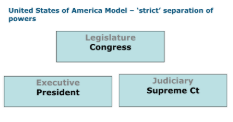
Comparing USA and UK
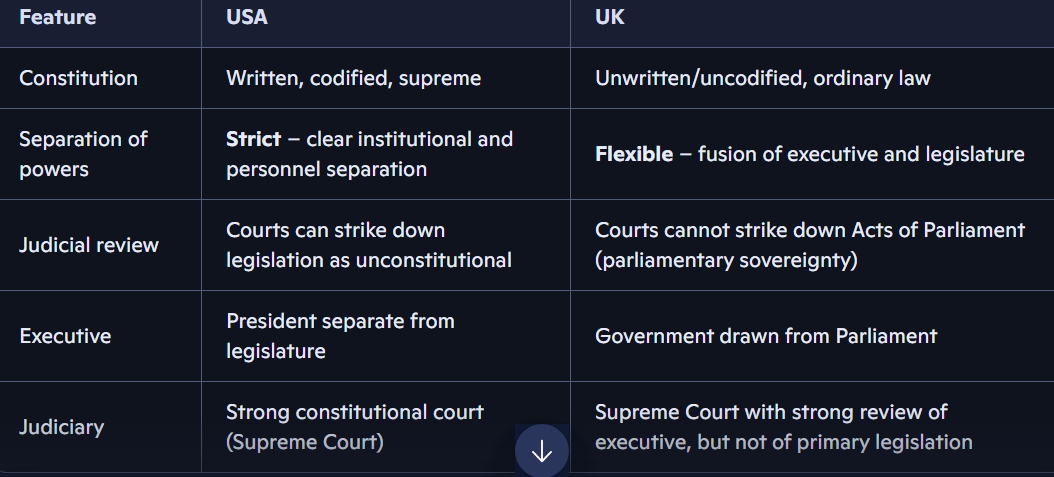
Traditional UK Model - overlapping powers diagram
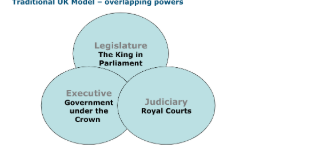
United States of America Model - ‘Strict’ Separation of Powers diagram
The traditional UK model: overlapping powers
The classic UK constitutional set‑up is often described like this:
Legislative power: The Crown in Parliament
King/Queen + House of Commons + House of Lords.
Executive power: Government under the Crown
Prime Minister, Cabinet, ministers, civil service.
Judicial power: Royal Courts
Courts and judges acting in the name of the Crown.
On paper, you can map these onto Montesquieu’s three branches. In practice, the UK model is not one of strict separation, but of overlapping powers, shaped by history and an uncodified constitution.
Wade’s “standard” of separation of powers
Professor H.W.R. Wade set out what a strict separation of powers would require. He said that to “properly observe” the doctrine, three conditions must be met:
2.1 No overlaps in personnel
2.2 No overlaps in functions
2.3 No interference with functions
No overlaps in personnel
Rule 1: No person or body should form part of more than one of the three organs of government.
The same individuals should not sit in more than one branch.
Example of strict compliance: a judge should not also be an MP or minister.
No overlaps in functions
Rule 2: One organ of government should not exercise the functions of either of the other two organs.
Each branch should perform only its own role:
Legislature → makes law.
Executive → implements law.
Judiciary → interprets and applies law.
No crossover in duties.
No interference with functions
Rule 3: One organ of government should not interfere with or control the functions of the other two.
Each branch should be institutionally and functionally independent.
No branch should be able to dominate or direct another.
If these three conditions were satisfied, you would have a pure separation of powers.
The UK reality: overlaps everywhere
Wade’s standard is useful precisely because the UK fails it on all three counts. The UK model is characterised by overlaps in personnel, overlaps in functions, and mutual interference—explained largely by the historical evolution of the constitution.
Overlaps in personnel
A. Legislature and Executive
By constitutional convention, all government ministers must be members of Parliament (Commons or Lords).
This means:
Ministers sit in the executive and the legislature at the same time.
The Prime Minister is both:
Head of the executive, and
An MP in the House of Commons.
Example:
Rishi Sunak is:
Prime Minister (executive), and
MP for Richmond (Yorks) (legislature).
So, the executive is embedded within the legislature—this is the classic fusion of powers in a parliamentary system.
Judiciary and Legislature (pre‑2005)
Before the Constitutional Reform Act 2005:
The Law Lords (Lords of Appeal in Ordinary) sat in the House of Lords.
They were:
Senior judges (judiciary), and
Members of the upper chamber of Parliament (legislature).
This meant they:
Made law (as part of Parliament), and
Interpreted law (as judges).
The 2005 Act created the UK Supreme Court (operational from 2009), moving the Law Lords out of the legislature and into a separate court—bringing the UK closer to separation of powers in the judicial sphere, but not fully.
Overlaps in functions
A. Delegated legislation – executive making law
Parliament often passes enabling Acts that give ministers power to make delegated legislation (e.g. statutory instruments).
In practice:
The executive drafts and makes large volumes of detailed rules.
These rules have legal force, just like Acts of Parliament (subject to limits and procedures).
This is a legislative function being exercised by the executive.
Judge‑made law – judiciary developing law
Courts develop the common law through precedent.
This can involve:
Creating new principles,
Extending or restricting existing rules,
Sometimes effectively creating new offences or liabilities.
This gives the judiciary a quasi‑legislative role.
Key examples:
Shaw v DPP [1962]
The House of Lords upheld a conviction for “conspiracy to corrupt public morals” despite no clear statutory offence.
Seen as the court creating a new common law offence.
R v R [1992]
The House of Lords held that a husband can be guilty of raping his wife, rejecting the old common law fiction of marital consent.
A major development of the criminal law by the judiciary.
R v Brown [1993]
The House of Lords upheld convictions for consensual sadomasochistic acts, drawing lines about consent and harm.
Again, the courts shaped the scope of criminal liability.
These cases show that judges do more than “apply” law—they shape it.
Overlaps in interference and control
A. Legislature and Executive
The House of Commons can remove the government through a vote of no confidence.
If the government loses such a vote:
Conventionally, the Prime Minister must resign or seek a general election.
This is the legislature controlling the executive.
Legislature and Judiciary
Judges can only be removed by Parliament:
Senior judges (e.g. High Court, Court of Appeal, Supreme Court) enjoy security of tenure.
They can only be removed following an address by both Houses of Parliament to the monarch.
Historically, there was also the mechanism of impeachment (rarely used now), where Parliament could put individuals (including ministers or judges) on trial.
This gives Parliament a constitutional check over the judiciary, even though in practice it is used sparingly to protect judicial independence.
Judicial independence: the real core of UK separation of powers
Because of all these overlaps, Wade famously concluded:
“In many constitutions separation of powers has meant an unhampered executive. In England, it means little more than an independent judiciary.”
In other words:
The UK does not have a strict separation of powers.
The executive dominates the legislature (especially with a strong majority).
The real protection against abuse of power lies in an independent judiciary.
The judiciary as “guardians of the constitution”
Even without a codified constitution, UK courts play a crucial constitutional role:
Ensure government acts according to law
Through judicial review, courts can:
quash unlawful decisions,
declare actions ultra vires,
interpret statutes in line with rights and principles.
Act as influential advisors
Judicial decisions shape constitutional principles (rule of law, fairness, proportionality, legitimate expectations).
Key cases
M v Home Office [1994] 1 AC 377 (HL)
Facts:
The Home Secretary ignored a court order to return an asylum seeker to the UK.
Held:
The court held that the Crown (through ministers) can be held in contempt of court.
Even a minister is not above the law.
Constitutional significance:
Reinforces the rule of law.
Shows courts can enforce their orders against the executive.
R v Lord Chancellor, ex parte Witham [1998] QB 575
Facts:
The Lord Chancellor increased court fees, effectively preventing some people from accessing the courts.
Held:
The Divisional Court held that there is a constitutional right of access to the courts.
The Lord Chancellor could not use delegated powers to undermine this fundamental right.
Constitutional significance:
Recognises access to justice as a constitutional principle.
Shows courts protecting individuals against executive overreach.
JUDICIAL INDEPENDENCE AND THE RULE OF LAW
Judicial independence is a core constitutional principle. It ensures that judges can decide cases fairly, impartially, and without interference from the executive or legislature. Without judicial independence, the rule of law collapses, because the government could manipulate court outcomes.
Judicial independence has legal, institutional, and practical foundations.
1. Legal Basis of Judicial Independence
A. Act of Settlement 1700
This is one of the earliest constitutional statutes protecting judicial independence.
It established:
Security of tenure for senior judges
Judges hold office “during good behaviour” and can only be removed by the monarch following an address of both Houses of Parliament.
Protection from arbitrary dismissal by the Crown.
This prevents the executive from removing judges who make decisions it dislikes.
Constitutional Reform Act 2005
The CRA 2005 modernised and strengthened judicial independence.
Key reforms:
Removed the Law Lords from the House of Lords and created the UK Supreme Court (operational from 2009).
Reformed the role of the Lord Chancellor, removing their judicial functions.
Established a statutory duty on ministers to uphold judicial independence.
This Act is one of the most significant constitutional reforms in modern UK history.
Key Elements of Judicial Independence
A. Appointment
B. Immunity
C. Open Courts
D. Political Independence
E. Contempt of Court
F. Duty of Ministers (CRA 2005, s.3)
G. Lay Participation (Juries and Magistrates)
Appointment
Judges are appointed through an independent Judicial Appointments Commission (JAC) (post‑2005).
Reduces political influence in judicial selection.
Immunity
Judges have immunity from civil liability for acts done in their judicial capacity.
Prevents litigants from suing judges for decisions they dislike.
Open Courts
Justice must be publicly administered.
Ensures transparency and public confidence.
Exceptions exist (e.g. national security), but open justice is the default.
Political Independence
Judges must not be influenced by political pressure.
They do not sit in Parliament or engage in party politics.
Ministers must not criticise judges personally.
Contempt of Court
Disobeying a court order is civil contempt.
Ensures compliance with judicial decisions, even by government ministers
Duty of Ministers (CRA 2005, s.3)
The Lord Chancellor and all ministers must “uphold the continued independence of the judiciary”.
This is a legal obligation, not just a convention.
Lay Participation (Juries and Magistrates)
Laypersons help ensure justice is not controlled by the state.
Juries act as a democratic safeguard against executive power.
Case Law: Judicial Independence in ActionM v Home Office [1994] 1 AC 377 (HL)
Facts:
The Home Secretary ignored a court order to return an asylum seeker to the UK.
Held:
The Home Secretary (and therefore the Crown) can be held in contempt of court.
Even ministers must obey court orders.
Constitutional significance:
Reinforces the rule of law: no one, not even the executive, is above the law.
Shows courts can enforce their authority against government.
The Constitutional Reform Act 2005 and Separation of Powers
A. Background
In 2003, the government announced reforms to strengthen separation of powers and judicial independence. These reforms became the Constitutional Reform Act 2005.
The Act was controversial, especially regarding:
the abolition of the Lord Chancellor’s judicial role,
the creation of a new Supreme Court,
the independence of judicial appointments.
Why was change needed?
1. Historical anomalies
Before 2005:
The Lord Chancellor was:
a Cabinet minister (executive),
Speaker of the House of Lords (legislature),
head of the judiciary (judicial).
The Law Lords sat in the House of Lords, acting as both legislators and judges.
This violated all three of Wade’s separation‑of‑powers criteria.
European Convention on Human Rights concerns
McGonnell v UK (2000) 30 EHRR 289
A judge who had previously acted in a legislative capacity was involved in a case.
The ECtHR held this breached Article 6 (right to a fair trial).
Highlighted the UK’s structural overlap between judiciary and legislature.
This case accelerated the push for reform.
Key Provisions of the Constitutional Reform Act 2005
Section 1 – The Rule of Law
Section 2 – Reform of the Lord Chancellor
Section 3 – Guarantee of Judicial Independence
Section 7 – Lord Chief Justice
Section 23 – Creation of the Supreme Court
Section 1 – The Rule of Law
The Act formally recognises the rule of law as a constitutional principle.
Symbolically important: Parliament acknowledges that government must act within legal limits.
Section 2 – Reform of the Lord Chancellor
The Lord Chancellor’s judicial role is removed.
They no longer sit as a judge.
Their role becomes primarily political and administrative.
Section 3 – Guarantee of Judicial Independence
Ministers (including the Lord Chancellor) must not seek to influence judicial decisions.
They must protect judicial independence.
Section 7 – Lord Chief Justice
Becomes Head of the Judiciary in England and Wales.
Takes over many former responsibilities of the Lord Chancellor.
Section 23 – Creation of the Supreme Court
Establishes the UK Supreme Court as a separate institution.
Removes the Law Lords from the House of Lords.
Strengthens institutional separation between judiciary and legislature.
Operational from 1 October 2009.
Post‑2009 UK Model
After the CRA 2005 came fully into force:
The UK moved closer to a separation of powers model.
The judiciary is now institutionally independent.
The Lord Chancellor no longer straddles all three branches.
The Supreme Court is separate from Parliament.
However:
The executive and legislature remain fused (ministers are MPs).
The UK still does not have a strict separation of powers like the USA.
CONSTITUTIONAL REFORM ACT 2005 – KEY SECTIONS AND CONCLUSIONS
The Constitutional Reform Act 2005 (CRA 2005) is one of the most significant constitutional reforms in modern UK history. Its purpose was to strengthen the separation of powers, modernise the judiciary, and ensure compliance with Article 6 ECHR (right to a fair trial).
The Act responded to long‑standing criticisms that the UK’s constitutional structure blurred the boundaries between the executive, legislature, and judiciary.
Key Sections of the CRA 2005
Section 1 – The Rule of Law
Symbolically recognises the rule of law as a constitutional principle.
Parliament acknowledges that government must act within legal limits.
Section 2 – Reform of the Lord Chancellor
The Lord Chancellor’s traditional role is retained in name, but radically reformed.
The LC is no longer:
Head of the judiciary,
A judge,
Speaker of the House of Lords.
Section 3 – Guarantee of Judicial Independence
Places a statutory duty on:
The Lord Chancellor, and
All other ministers
to uphold the continued independence of the judiciary.
Ministers must not seek to influence judicial decisions.
Section 7 – Lord Chief Justice
The Lord Chief Justice becomes:
Head of the Judiciary of England and Wales,
Responsible for judicial training, discipline, and welfare.
Section 23 – Creation of the Supreme Court
Establishes the Supreme Court of the United Kingdom.
Removes the Law Lords from the House of Lords.
Creates a separate, independent apex court, operational from 1 October 2009.
Parts 4 and 5 + Schedules 12–15 – Judicial Appointments Commission (JAC)
Creates the Judicial Appointments Commission (launched April 2006).
Independent body responsible for selecting candidates for judicial office.
Aims:
Embedded independence,
Transparency,
Increased diversity in the judiciary.
The Former Role of the Lord Chancellor (Pre‑2005)
The Lord Chancellor was one of the most unusual and constitutionally problematic offices in the world.
A 1400‑year‑old office
Historically, the Lord Chancellor was:
A senior Cabinet minister (executive)
Head of the judiciary (judicial)
Speaker of the House of Lords (legislature)
A judge in the Appellate Committee of the House of Lords
Holder of royal duties
Mentioned in over 5,000 statutes
This meant the LC sat at the apex of all three branches of government—a direct violation of Montesquieu’s separation of powers.
The Current Role of the Lord Chancellor (Post‑CRA 2005)
The office still exists, but its functions are transformed.
Now the Lord Chancellor:
Is no longer a judge
Is no longer head of the judiciary
Is no longer Speaker of the House of Lords
Is a political minister, usually also the Secretary of State for Justice
Has a statutory duty to protect judicial independence (s.3 CRA 2005)
Head of the Judiciary
Now the Lady Chief Justice (currently Dame Sue Carr).
Current Lord Chancellor
David Lammy MP (as of 2026)
Holds a political role, not a judicial one.
Why Were These Reforms Necessary?
A. To strengthen separation of powers
The UK’s historical constitution created overlaps between branches.
The CRA 2005 aimed to modernise and clarify institutional boundaries.
B. To protect judicial independence
Judges were concerned that the Lord Chancellor’s political role compromised judicial neutrality.
C. To comply with the European Convention on Human Rights
McGonnell v UK (2000) 30 EHRR 289
A judge who had previously acted in a legislative capacity was involved in a case.
ECtHR held this breached Article 6 (right to a fair trial).
Highlighted the UK’s structural overlap between judiciary and legislature.
This case accelerated the push for reform.
D. To remove constitutional anomalies
Law Lords acting as both legislators and judges.
Lord Chancellor straddling all three branches.
The Supreme Court of the United Kingdom
A. What changed?
The Law Lords were removed from the House of Lords.
A new, separate Supreme Court was created.
Opened 1 October 2009.
B. “Supreme in name, not in nature”
Unlike the US Supreme Court, the UK Supreme Court:
Cannot strike down Acts of Parliament
Operates under parliamentary sovereignty
Is the final court of appeal, not a constitutional court
C. Why this matters
Strengthens institutional independence.
Enhances public confidence in judicial impartiality.
Judicial Appointments Commission (JAC)
A. Purpose
To ensure transparent, independent, and merit‑based judicial appointments.
B. Key features
Independent from government.
Reduces political influence in judicial selection.
Promotes diversity in the judiciary.
Operational since April 2006.
C. Constitutional significance
Reinforces judicial independence.
Helps maintain public trust in the judiciary.
Were the Reforms Necessary? Do They Strengthen Separation of Powers?
Arguments that the reforms strengthen separation of powers
Removed the Lord Chancellor’s judicial role → clearer institutional boundaries.
Created an independent Supreme Court → separation of judiciary from legislature.
Introduced the JAC → reduced political influence in appointments.
Statutory protection of judicial independence → stronger rule of law.
Arguments that the reforms were controversial
Judges feared losing the Lord Chancellor as a protective buffer between judiciary and executive.
Some argued the reforms were rushed (initially announced without consultation).
Others believed the old system worked well due to convention and trust.
Were they necessary?
Most scholars agree:
Yes, because the old system violated modern expectations of judicial independence.
Yes, because of ECHR requirements (McGonnell).
Yes, because public confidence required clearer separation.
Post‑2009 UK Model
After the CRA 2005 came fully into force:
The UK moved closer to a separation of powers model.
The judiciary is now institutionally independent.
The Lord Chancellor is a political minister, not a judge.
The Supreme Court is separate from Parliament.
Judicial appointments are independent and transparent.
But:
The executive and legislature remain fused (ministers are MPs).
The UK still does not have a strict separation of powers like the USA.