MAME Exam 3
 Call Kai
 Learn
Learn Practice Test
 Spaced Repetition
 Match
Match Flashcards
 Knowt Play
1/91

There's no tags or description
Looks like no tags are added yet.
Name | Mastery | Learn | Test | Matching | Spaced | Call with Kai |
|---|
No analytics yet
Send a link to your students to track their progress
92 Terms
prochlorococcus
0.5-0.7 um
picophytoplankton
0.2-3 micron
what are the two major types of photoautotrophy?
Chlorophyll-based chlorophototrophy and Rhodopsin-based retinalophototrophy
Chemoorganotrophs (also known as "heterotrophs" are
organisms that obtain their energy from the oxidation of organic material; use organic carbon for biomass synthesis and energy production
zoo
animal like
phyto
plant like
If algal blooms happen in response to light, then why does fertilizer runoff play such a big part in red tide HABs? If light were the limiting factor, then why would more fertilizer increase growth?
Blooms can only be sustained as long as inorganic nutrient inputs into the system are constant and high, light availability is good, and predation/viral lysis phytoplankton death does not exceed phyto growth rates
Due to microbial growth being limited by carbon, nitrogen, andphosphorus, would chemicals containing inorganic forms ofcarbon, nitrogen, and phosphorus aid microbial growth?
No, addition of NO3, PO4 &, and NH4 would only directly enhance growth of photoautotrophs (cyanobacteria and diatoms, for instance) and Basically yes, since enhancement of photoautotroph growth leads to a soon-to-follow increase of heterotrophic microbe growth
phototrophy
involves light capture by chlorophyll, usually coupled to splitting of H2S or H2O or organic molecules
light-driven primary production
process by which organisms use light energy to synthesize organic compounds from inorganic CO2 and H2O
2H2O + light-->4H + 4e- + O2, this refers to_______
oxygenic photosynthesis
CO2+H2O+nutrients+light-->biomass + O2 refers to ______
oxygenic photosynthesis
heterotrophy
the opposite of primary production, including light-driven primary production and chemolithoautotrophy
Water (H2O) is the molecule that is "split" for obtaining electrons during ____________
oxygenic photosynthesis
Phototrophic microbes have a greater diversity of accessory _______ than seen in higher plants on land
pigments
Rubisco, a very important enzyme that can make up ~50% of total cellural protein, is responsible for _______
fixing carbon dioxide
Light of different wavelengths penetrates seawater to varyingdepths: red light is absorbed quickly, while blue-green lightpenetrates the deepest. How does this influence the ecologicalniches of cyanobacteria and eukaryotic phytoplankton in theocean?
Cyanobacteria, such as Prochlorococcus and Synechococcus, thrive indeeper waters because accessory pigments (e.g., phycobiliproteins) allowthem to absorb green and blue wavelengths that penetrate further.
Coccoid cyanobacteria such as Prochlorococcusand Synechococcus are far more abundantglobally than eukaryotic phytoplankton. Whichfactor best explains this?
Cyanobacteria have accessory pigments that allowthem to utilize blue-green light, enabling them tothrive throughout the deeper photic zone whereeukaryotic phytoplankton cannot compete
rates of O2 production
measures how fast oxygenic photosynthesis happens
what is the trace element that is uniquely important to this centric diatom?
Si
what is the trace element that is uniquely important to the coccolithophorids like Emiliana huxleyi?
Ca
What is the biological pump?
the sinking of organisms and detritus from the surface layer to deep waters and sediments, moving carbon away from the surface
Coccolithophorids
produce calcium carbonate (CaCO3) shells that sink to the deep ocean
CO2+2H2A+light-->CH2O+2A+H2), what type of photosynthesis is this?
anoxygenic photosynthesis
Although anoxygenic photosynthesis does not contribute much to global primary production (____%), it is a significant source of organic carbon production in some environments.
1%
Are all algal blooms toxin-producing?
No, only some types of prokaryotic phytoplankton and some types of eukaryotic phytoplankton produce toxins
diatoms
primary players in coastal regions
microbial loop
A dissolved organic material (DOM) based pathway consisting of : primary production->DOM->microbes->grazers
labile
easily degraded or used by microbes
refractory
hard to degrade compounds made by large plants
106CO2 + 16HNO3 +H3PO4 +122H2) <-> (CH2O)106 (NH3)16 H3PO4 + 138O2, where the reverse reaction refers to......
mineralization
"Chitinase" is a generic term for a type of enzyme that can ______ chitin
hydrolyze
an aminopeptidase is a ______
exopeptidase and ectoenzyme
a bacterium or fungus
the big circle in the drawing refers to......
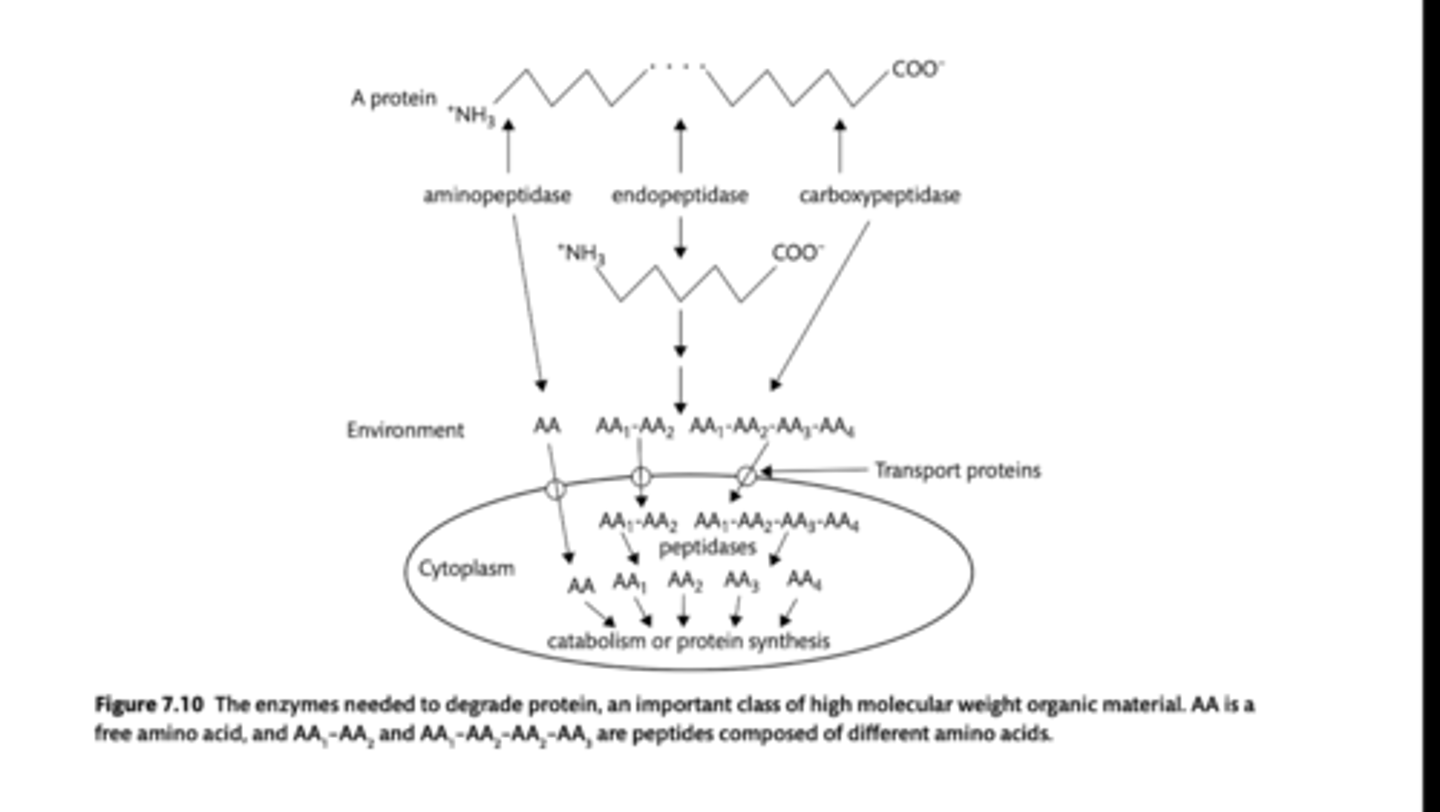
monomers of protein are ______
amino acids
monomers of nucleic acids are ______
nucleotides
monomers of polysaccharides are ______
simple sugars
Scientists are able to collect microbial DNA andRNA at a location in the ocean just before andjust after an oil spill. Note, oil spills arecomprised of aromatic hydrocarboncompounds. The scientists use the nucleic acidsto study microbial community responses to theoil spill. How could using one or both of thesedatasets help evaluate functional gene diversityand metabolic redundancy among marinebacteria, and what would be the mostinformative interpretation?
You can examine both metagenomics (DNA) andmetatranscriptomics (RNA) from before and afterthe spill to determine two things: One, you candetermine if the metabolic capability (DNA) waspresent in a variety of taxa in the ocean before thespill. And two, you can determine from the DNA andthe RNA after the spill if bacteria with genesencoding hydrocarbon-degrading enzymes arepresent and actively being expressed after the spill.
In aquatic habitats, the biomass of_______ is very low compared to that ofbacteria, with a few exceptions. Forinstance, ______ are only prevalent incertain niche aquatic habitats such as inmicrobial communities associated withsemi-submerged rocks at the shoreline.Fig 1.8Panel A =aquatic habitatsPanel B = soils
fungi
In heterotrophic metabolism, OM molecules taken up by the cell can be used for both catabolism and/or anabolism. Anabolism is
using aquired OM for new biomass production
In the oceans, heterotrophicbacteria excrete a variety of__________ to start the processof degradation (performhydrolysis) on the variety of high-molecular-weight (HMW) organicmatter, where HMW OM can bepolysaccharides, polypeptides orproteins, lignin, DNA and RNA.
ectoenzymes
To measure rates of heterotrophic respiration,you can estimate it by measuring changes inoxygen concentration by incubation for adefined period of time in the __________
dark
Microbes that perform _________ require oxygen for growth, can use lightenergy to augment energy from heterotrophy, but do not produce oxygenduring phototrophy and do not have Rubisco
aerobic anoxygenic photosynthesis
If you have a strain of bacteria that have the PR geneand want to prove that possession of (and assumingexpression of) the pR gene confers some advantagesome advantage through phototrophy, how could youdo this expt
Perform a mutation of just the pR gene and grow the wild-type (un-mutated) strain in one flask and grow the mutant in another flask. Stop feeding new OM (e.g., glucose) and see which one dies first. Incubate all flasks in the light but also grow the mutant in two different flasks, one in light and one in dark. See which flask dies first.
anabolism
making new biogrowth
exoprotease
cleaves from end of molecule
ectoenzymes
pushed outside cell
Ribosomes (made up of ribosomal proteins and rRNAmolecules) are used directly in which cellular process?
Translation
Enzymes (e.g. ectoenzymes that are put outside of the cell to breakdown HMW OM into monomers) are made in which process?
Translation
rRNA molecules (which become part of the ribosomes) are made inwhich process?
Transcription
Per-cell number of ribosomes are one of the mostimportant indicators of "active" growth. WHY?
Ribosomes are directly used for the translation of all genes, including genes encoding enzymes for the extracellular breakdown and uptake of OM. Ribosomes are directly used for the translation of genes such as those responsible for making more lipids for the membrane, so that a septum is formed between two daughter cells.
Speculate why the wide variations in the C:P ratio is so important in thecontext of the "growth rate hypothesis" as described in Chapter 2
The per-cell ribosome numbers increase with increased growth rates; and sinceribosomes contain rRNA, the P from all those ribosomal nucleic acids will greatlyincrease or decrease with changing growth rates.
When measuring activity states,which one is a better measure of howquickly cells are "growing" (makingnew biomass and getting ready todouble)?
rate of uptake*of radioactively-labeled amino acid like 3H-Leu
How do you do autoradiography?
Add a radioactive tracer molecule to a living body or to a collection of living cells, let them take up the radioactive molecule and incorporate it into biomass. Lay the body over a piece of X-ray paper and expose the emulsion for a period of time. Then develop the X-ray paper
See Figures 8.4 & 8.5, both showingways to grow bacteria in pure culture.Figure 8.4 shows a batch culture(simple flask), while 8.5 shows achemostat bioreactor, where there isconstant input of new media andremoval of old media containingwastes. During stationary phase of abatch culture, cell numbers (cells permL) do not change. Why?
Resource limitation and waste buildup
Each dot on Fig 8.7 can give you theBP:PP ratio (which are both closelytied to growth rate). This ratio canvary greatly, with values ~0.1 in theoligotrophic open oceans, andperhaps as high as ~0.5 in estuariesand near-shore.Overall (on average), the linesuggests that the BP:PP ratio is:
0.1 : 1
See Fig. 8.7. The data summarized in this figureis likely the most important overview of howsecondary production rates are related toprimary production rates in global oceans andfreshwater ecosystems. Which statement belowis best supported by the data in the figure,what is described in the text, and what youlearned from previous chapters (Ch 1-7)?
The slope of the line in Fig. 8.7 is <1 because a large portion of OM created by primary production is exported to depth or consumed by grazers before it enters the DOM or POM pool, where bacteria can directly utilize it.
Growth rates of heterotrophic bacteria innature are ______ than growth rates ofbacteria grown in the lab in rich media
slower
Growth rates of heterotrophic bacteria ineutrophic environments (with lots of input ofOM from terrestrial sources, such as in lakes orestuaries) are ______ than growth rates ofbacteria growing in the oligotrophic openocean away from land.
faster
Two major bottom-up factors affect the success and hence growth rates of heterotrophic bacteria. In Chapter 8 alone, a figure (Fig 8.13) and a table show/list a very important factor that controls the growth of the community of heterotrophic bacteria and hence controls bacterial production (secondary production) rates. What is this factor?
Temperature (C)
Although organic matter is a major limiting factor for all heterotrophic bacteria, in the oligotrophic open ocean, inorganic P limitation can also be a problem for heterotrophic bacteria. As described in Chapter 2 (and assessed in Exam I), the growth rate hypothesis says that the per-cell ribosome numbers increase with increased growth rates, and this explains wide variations in the C:P ratio of heterotrophic bacteria biomass. Why is P important to the growth rates of heterotrophic bacteria, and why growth rates in the oligotrophic open ocean are lower where [P] is low?
Since ribosomes contain rRNA, a lot of P is needed for increased growth rates tosupport production of enough ribosomal nucleic acids to perform sufficient translationto increase growth rates
What is theprimary controlling factor for growth of thephotoautotrophic community, given thatassumption of [Chlorophyll] is a good measureof photoautotroph biomass and hencephotoautotroph growth?
light (length of daylight)
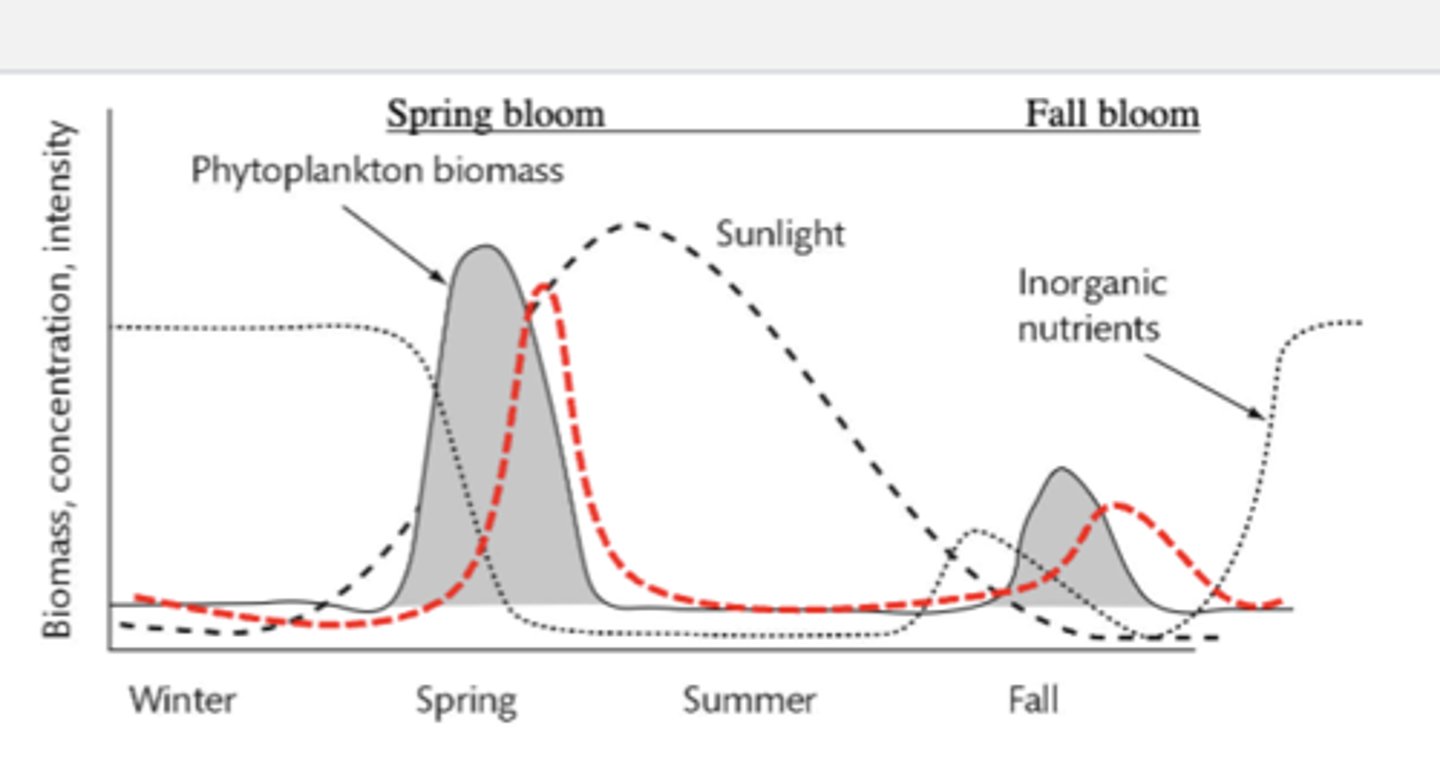
Based on what you know about 1oP and 2oP, which of the below is most likely represented by the red dotted curve drawn in by Dr.Waidner?
chemoorganoheterotrophy
what is "mineralization"
the conversion of organic material back to its inorganic constituents, such as carbon dioxide, ammonium and phosphate
Why is the C:N ratio in phytoplankton (Aquatic,Diatom line) so much lower than the C:N ratio in terrestrial plants (Terrestrial, straw,tree leaves, pine wood)?
Phytoplankton do not make lignin; hence, their macromolecular compositions are enriched in proteins, as opposed to the carbohydrate-rich composition terrestrial plant biomass
______ is the mixture of molecules usedmostly by heterotrophic bacteria in theoceans. Although protists can take upsome of this, protists cannot effectivelycompete effectively with heterotrophicbacteria in its uptake
DOM
In the pool of oceanic DOM, an example of a LMW monomer is _____
amino acid
In the oceans, the turnover time (rate of degradation) of this type of DOM is the FASTEST
labile
When measuring heterotrophic (secondary) production to understand the role of bacteria in oceanic carbon fluxes, why is it important to size-fractionate microbial communities before conducting these measurements?
Size-fractionation separates bacteria from larger heterotrophs, preventing possible overestimation of bacterial production caused by including non-bacterial respiration and DOC uptake
_______ is thought to be the "rate limiting step" in degradation pathways. One piece of evidence to support this statement is that concentrations of polymers are higher than the concentrations of monomers in the natural environment
hydrolysis
A gene encoding a single protein that, along with a retinal molecule, can help heterotrophic bacteria obtain extra energy from light harvesting. The simplified drawing of the transmembrane view of it complexed with retinal is shown in the figure. It is present in many photoheterotrophic bacteria in the SAR11 clade and other groups of bacteria. As the book says, "It may be in as many as half of all bacteria in aquatic environments."What is this protein?
proteorhodospin
Why is measuring bacterial production rates (e.g. uptake rates of 3H-labeled thymidine or 3H-labeled leucine) essential for determining whether the microbial loop functions more as a sink or a link in the biological pump?
Because bacterial production indicates how much organic carbon is converted back to CO₂ through respiration versus how much is transferred up the food web, revealing whether carbon is retained in the food web or respired
See below Fig. 8.7 from the book. From the relationship shown for each data point, we can obtain the BP:PP ratio. This ratio can vary greatly, with values ~0.1 in the oligotrophic open oceans, and perhaps as high as ~0.5 in estuaries and near-shore. Which of the following best explains why the offshore ratio is so low compared to more productive eutrophic ecosystems?
In oligotrophic open oceans, both phytoplankton and bacteria are limited by low-nutrient and organic carbon availability. In the oligotrophic oceans, phytoplankton have low C fixation rates, and they leak or exude minimal dissolved organic carbon(DOC) to support bacterial growth
For growing pure cultures of bacteria, we can grow them in batch culture, or we can grow them in continuous culture in chemostat bioreactors. For an example growth curve of a batch culture, see Figure 8.4, next page. In batch cultures, bacterial growth is predictable: There is a lag phase, followed by a log (exponential) phase, followed by a plateau (stationary phase). During log phase, the number of cells increases _____-fold in each generation.
2
Refer above to part of Table 8.1 shown. The method we need to use to get bacterialproduction or secondary production rates is by _______. This method relies on the uptake ofa radioactively-labeled monomer followed by the incorporation of that monomer into protein
measuring rate of incorporation of leucine into biomass
See Figure 8.9 above. In the oceans, phytoplankton grow ~______ more quickly than heterotrophic bacteria; and in freshwaters, phytoplankton grow ~______ more quickly than heterotrophic bacteria. (Note, ~ means "approximately.")
Oceans, ~10X more quickly; and freshwaters, ~2X more quickly
"Correlation does not necessarily imply causation." That is a key fact to remember when considering co-limitation and interactions between controlling factors limiting oceanic microbial growth. For photoautotrophs, the primary controlling factor is ____; and a secondary, but important, co-limitation is ____
primary is light, and secondary is nitrate
The different growth rates of different groups of bacteria, even within the same ecosystem, is one of the reasons "why the relationship between growth rate and abundance of a taxon is not straightforward. The most abundant bacteria are usually______, which have low but constant growth rates.
oligotrophs
what is the biological pump?
the sinking of organisms and detritus from the surface layer to deep waters and sediments, moving carbon away from the surface
______ is the molecule that is "split" for electrons during oxygenic photosynthesis
H2O
which enzyme is likely the most important enzyme on the planet, being responsible for ~99% of global carbon fixation?
Rubisco
_______ are responsible for approximately 25% of global primary production
Coccoid cyanobacteria
See Figure 6.4 and Eqn 6.7 above. Why is there an apparent inverse correlation between fluxes of carbon dioxide and oxygen in these lakes?
even during an algal bloom, excess organic matter input from nearby terrestrial sources can fuel high respiration from heterotrophic growth
A P. vs. I. curve analysis, as shown in Figure 6.6 below (next page), provides the light-driven rate of photosynthesis (primary production rate), which is indicated by the slope of the line marked by symbol alpha(α). The alpha for both samples is the same, but the maximum value (plateau of each curve) is different for the two samples. Why do the curves plateau
Photoinhibition limits the photosynthetic capacity of all photolithoautotrophic cells, particularly by causing light damage to the photosynthetic complex
There are different ways to estimate the standing stock (biomass) of phytoplankton and/or orphytoplantkton activity (primary production rates) in seawater. One of the three shown below only gives information about standing stock, while the others provide information about rates. Which measurement only provides data for estimating biomass?
Chl a concentrations
Marine organisms responsible for the majority of 1o P in the oceans are ____________
Cyanobacteria (prokaryotes) AND microalgae (eukaryotes)
Two representative genera of the photolithoautotrophic prokaryotes, commonly called"cyanobacteria," are ___
Synechococcus and Prochlorococcus
In seawater, detritus is ______ by heterotrophic bacteria into CO2 and other inorganic constituents
mineralized
Doubling time (generation time) is vastly different between oligotrophic heterotrophic bacteria and copiotrophic heterotrophic bacteria. Which one is likely to be associated with a typical doubling time for a strain of bacteria in the SAR11 clade
2 days
Refer to the graph above. At the time when the average seawater oxygen concentration is highest(~16:00), which of these statements is TRUE?
Primary production rates exceed respiration rates.
See the figure below from the book. This shows the size distribution of respiration and photosynthesis, expressed as a percentage of rates in unfiltered samples. Knowing what you know about distribution of photoautotrophic microbes and size ranges of all types of microbes, then you know that the data are from _________
Near-shore environments, where primary production by cyanobacteria and small eukaryotic phytoplankton is low
To enumerate different groups of bacteria using the 16S rRNA gene, we can design PCR primers unique to each groups' 16S gene sequences. Then the ratio of 16S rRNA molecules to rDNAmolecules (measured by qPCR and RT-qPCR of the DNA and RNA from the seawater,respectively), gives us information about _______ in each group of bacteria. This was shown in Chapter 8 and in additional slides to support the book figure (figures from Campbell et al. 2011)
growth rates