AP Bio Unit 8: Ecology
 Multiple Choice & FRQ
 Call Kai
1/91

Earn XP
Description and Tags
Name | Mastery | Learn | Test | Matching | Spaced | Call with Kai | Chat |
|---|
No analytics yet
Send a link to your students to track their progress
92 Terms
Ecology
The study of interactions between living and nonliving factors in the environment.
Biosphere
All the organisms and environments of the planet.
Ecosystem
Community plus its abiotic environment. Determined by abiotic factors, biotic factors, and factors intrinsic to organisms (adaptations).
Community
Interacting populations of different species in a particular area.
Population
Individuals of the same species that live, interact, and interbreed in a particular area at the same time.
Levels of Ecological Organization
Biosphere, [Biome], Ecosystem, Community, Population, & Organism
Biomes
Groups of ecosystems that have the same climate and dominant communities. Climate is the dominant factor that determines these.
Biogeography
The study of the geographic distribution of living things and the abiotic factors that affect their distribution.
Abiotic Factors
Nonliving things
Biotic Factors
Living things
Biogeochemical Cycles
Pathways that move elements between abiotic and biotic reservoirs and the processes that cycle matter between reservoirs. These pathways are interdependent.
Nutrient Cycling (Biogeochemical Cycles)
Nutrients move between living things and the atmosphere.
Water Cycle (Biogeochemical Cycles)
Abiotic reservoir - surface and atmospheric water
Enter food chain - precipitation and plant uptake
Recycle - transpiration
Return to abiotic - evaporation and runoff
Human impact - pollution; deforestation causes a reduction in transpiration
Key processes - evaporation, condensation, precipitation, and transpiration (water leaving plant stomata
Carbon Cycle (Biogeochemical Cycles)
Abiotic reservoir - CO2 in atmosphere
Enter food chain - photosynthesis = carbon fixation into carbohydrates in Calvin cycle
Return to abiotic - respiration and combustion
Human impact - burning of fossil fuels releases more CO2 into the atmosphere; deforestation reduces # of plants performing photosynthesis
Key processes - photosynthesis, cellular respiration, decomposition, and combustion.
Nitrogen Cycle
Abiotic reservoir - N in atmosphere
Enter food chain - nitrogen fixation by bacteria (nitrogen gases are “fixed’ into ammonia, making it ionized and available to be turned into an organic compound)
Recycle - decomposition and nitrifying bacteria
Return to abiotic - denitrifying bacteria
Human impact - runoff from fertilizer adds nitrogen to bodies of water → eutrophication; insecticides & herbicides can kill bacteria in soil
Ammonification
When plants or animals die (or leave behind waste), decomposers break down the remains and convert the organic nitrogen back into ammonia (NH3), returning it to the soil.
Nitrification
Specific soil bacteria take that ammonia and turn it into nitrites (NO2-) and then into nitrates (NO3-). Nitrates are the form of nitrogen that plants find easiest to absorb during assimilation.
Denitrification
To complete the cycle, denitrifying bacteria in the soil take nitrates and convert them back into nitrogen gas (N2), which is released back into the atmosphere.
Phosphorus Cycle
Abiotic reservoir - rocks, minerals, and soil
Enter food chain - erosion releases soluble phosphate (PO4 3-) that is taken up by plants & incorporated into biological molecules (DNA, RNA, ATP)
Recycle - decomposing bacteria and fungi
Return to abiotic - loss to ocean sediment
Human impact - runoff from fertilizer adds phosphorous to bodies of water → eutrophication
Eutrophication
A body of water becomes overly enriched with minerals and nutrients (N & P), leading to excessive growth of algae and depletion of dissolved oxygen.
5-Step Chain Reaction of Eutrophication
Nutrient Runoff
Algal Bloom
Light Blockage
Decomposition & Oxygen Depletion
Hypoxia & Die-off
Autotrophs
Producers, Captures “free energy” from physical or chemical sources (uses photosynthesis and chemosynthesis)
Chemosynthesis
Uses small inorganic molecules, can occur in anaerobic environments
Heterotrophs
Consumers, Captures energy by consuming organic matter produced by other organisms
Food Chain
Shows the feeding relationship between organisms
Trophic Level
A level in a food chain
Energy Pyramid
Represents the amount of energy at each trophic level in a food chain
10% Rule
Around 10% of an organism’s energy is passed to the next trophic level; the rest is lost to the environment as heat
Net Primary Productivity (NPP)
The measure of how much “new” energy or biomass is actually available to the consumers in an ecosystem.
Calculation: NPP = GPP - RL
Gross Primary Productivity (GPP)
The total energy captured by producers (via photosynthesis or chemosynthesis) per unit area/time.
NPP = GPP - RL
Respiration Loss (RL)
The energy producers use for their own metabolic needs (cellular respiration).
NPP = GPP - RL
Food Web
Shows interconnected food chains in an ecosystem
Endotherms
Generate heat to maintain their body temperature (food required)
Ectotherms
Do not regulate their own body temperature and only eat for energy needs. They may regulate their temperature behaviorally.
Metabolic Rate & Body Mass Relationship
Generally, the smaller the organism, the higher the metabolic rate.
Reproductive Strategies & Energy Availability
Organisms must balance energy cost of reproduction with the need to survive in their environment
→ Asexual Reproduction: low energy cost, high quantity of offspring, zero genetic diversity
→ SexualReproduction: high energy cost, lower quantity of offspring, high genetic diversity
Biodiversity
The variety of life in the world or in a particular habitat or ecosystem. Greater biodiversity means greater stability for an ecosystem (more resources, more food, etc)
Community Structure
Described in terms of species composition and species diversity. These measurements can change over time.
Species Composition
Specific types and relative proportions of species present in a community
Species Diversity
Both the number of species (species richness) and how equally represented each species is in a given area (species evenness)
Species Richness
The number of species
Species Eveness
How equally represented each species is in a given area
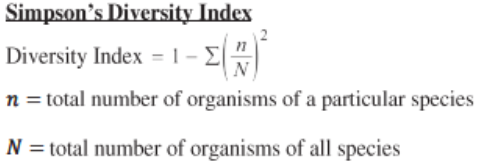
Simpson’s Diversity Index
A way to quantify biodiversity based on the number of species and the population size of each species (0 = no diversity (all the same), 1 = maximum diversity)
Keystone Species
Exerts important regulating effect on other species in community by increasing diversity in the habitat (ex: beavers build dams that transform streams into ponds).
Trophic Cascades
Ecological responses based on the addition or removal of top predators that results in dramatic changes in ecosystem structure and nutrient cycling.
Habitat
Where an organism lives
Niche
An organism’s ecological role in its environment
Symbiosis
Interaction between two organisms living in close association (can be positive, negative, or neutral for each of the organisms).
Mutualism
Both organisms benefit from the interaction.
Commensalism
One organisms benefits and the other is unaffected.
Parasitism
Parasite lives on or within the host causing it harm and benefiting from the host’s resources.
Amensalism
One organism harms another without any benefit to itself.
Competition
When two organisms attempt to occupy the same niche in the same habitat. One species will outcompete the other or they will divide the habitat (niche partitioning)
Resource Partitioning
Reduces competition through microhabitats. This occurs through adaptations, like different feeding times or using different parts of a habitat, allowing various species to coexist.
Coevolution
When two or more species reciprocally affect each other’s evolution (ex: parasite-host, flower-pollinator, predator-prey relationships)
Camouflage
To evade/hide from predators (cryptic coloration)
Defenses
Can be mechanical (ex: spines), or chemical (ex: odors)
Aposematic Coloration
Warning coloration; warns predators that they are undesirable to eat
Demography
The study of factors that affect the growth and decline of populations
Sex Ratio
A factor affecting population growth rate, asks how many males vs. females?
Generation Time
A factor affecting population growth rate, asks at what age do females reproduce?
Age Structure
A factor affecting population growth rate, asks how many females are at their reproductive age?
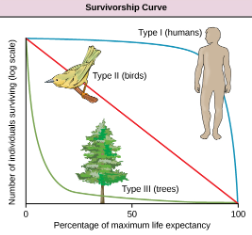
Survivorship Curve
A graphic way to represent population changes in a cohort still alive at each age
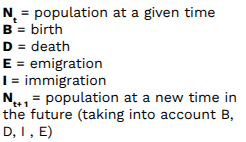
Birth-Death Model
Nt+1 = Nt + B - D
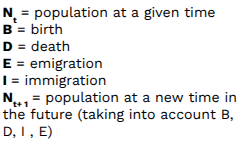
BIDE Model
Nt+1 = Nt + B + I - D - E
Limiting Factors: Density Dependent
Factor’s intensity changes based on how crowded the population is (ex: competition, predators, parasites, pathogens; typically biotic factors)
Limiting Factors: Density Independent
Factor affects the population regardless of its size (ex: sunlight, temperature, rainfall, etc; typically abiotic factors)
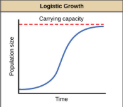
Carrying Capacity (K)
The maximum population size that environment (in an given area) can support without habitat degradation (affected by density-dependent and density-independent factors)
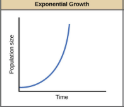
Exponential Growth Model
Occurs when resources are unlimited and limiting factors are absent
Logistic Growth Model
This incorporates density-dependent factors by accounting for carrying capacity
R Selected Reproductive Strategy
Early reproduction, many offspring, little parental care, type III survivorship curve
K Selected Reproductive Strategy
Late reproduction, few offspring, invests a lot in raising offspring, type I survivorship curve
Ecological Disturbances
Events that cause significant changes in an ecosystem, impacting both living organisms and the environment. They are often necessary for community development and survival because they release nutrients, increase biodiversity, increase habitats, and rejuvenate communities.
Invasive Species
Species that are transplanted from a different location and outcompete native species due to a lack of predators and reduce biodiversity
Ecological Succession
A series of progressive changes in the composition of an ecological community over time that often occurs after a disturbance
Pioneer Species
The first to grow or grow back after the disturbance that begins without soil (ex: bacteria, lichens, moss)
Climax Community
Stable community representing the final stage of succession
Secondary Succession
Existing community is cleared, but base soil is still intact (soil contains seeds and spores). Pioneer species of grasses and flowers.
Ecosystem Services
The direct and contributions of ecosystems to human well-being and quality of life.
HIPPCO (Human Impacts on Biodiversity)
Habitat Fragmentation/Loss, Invasive Species, Population Growth, Pollution (Pollutants), Climate Change, Over Exploitation
Adaptation
Genetic variation that is favored by selection that manifests as a trait that provides an advantage; can be structural, physiological, or behavioral
Heterozygote Advantage
Occurs when individuals with the heterozygous genotype (Aa) have greater fitness than both homozygous dominant (AA) and homozygous recessive (aa) individuals. When natural selection maintains both alleles in the population (balancing selection) rather than eliminating the "harmful" recessive one.
Behavioral Adaptions
A specific action or set of actions that an organism engages in to survive and reproduce in its environment. Natural selection favors innate and learned behaviors that increase an individual’s fitness and reproductive success.
Behavior
A response to internal changes (hormones, hunger, etc.) and external cues (temperature, light, etc.) in the environment
Innate Behavior
Inherited (instict), automatic, and consistent behavior (ex: migration patterns in birds)
Learned Behavior
Changes with experience and environment; the ability to learn is inherited but the behavior develops during an animal’s lifetime (ex: primates learning to use tools)
Tropism
A plant’s physiological response to environmental stimuli (phototropism, photoperiodism, gravitropism/geotropism, hydrotropism) and is controlled by a hormone called auxin.
Positive = towards stimulus, negative = away from stimulus
Phototropism
Growth in response to light
Photoperiodism
Blooming in response to light
Gravitropism/Getropism
Growth in response to gravity
Hydrotropism
Growth in response to water
Cooperative Behavior
Increases the fitness of the individual and the survival of the entire population (ex: pack hunting, colony safety)