ACCT 211 Exam 1 - Chapters 1
 Call Kai
 Learn
Learn Practice Test
 Spaced Repetition
 Match
Match Flashcards
 Knowt Play
1/100

There's no tags or description
Looks like no tags are added yet.
Name | Mastery | Learn | Test | Matching | Spaced | Call with Kai |
|---|
No analytics yet
Send a link to your students to track their progress
101 Terms
What are the primary functions of accounting? Select all the correct options.
To increase a company’s profitability
To increase a company’s stock market valuation
To communicate information to decision makers
To measure a company’s activities
To provide information to taxing authorities
To communicate information to decision makers
To measure a company’s activities
To provide information to taxing authorities
Margot starts a new business and contributes $20,000 in cash borrowed from creditors; she also borrows $25,000 from her local bank. She utilizes the cash to purchase supplies for $5,000 and a computer system for $10,000. After these transactions, what is the value of the total claims to the company’s total resources?
$45,000
In financial accounting which of the following are the three types of business activities of a company?
Financing activities, operating activities, investing activities
A(n) ___ is a resource, such as cash, land, or buildings, that is owned by a company.
asset
Financial Accounting
•Accounting information provided to external users
•2 functions: measure business activities of a company and communicate those measurements to decision makers outside of the company (investors, creditors, etc.)
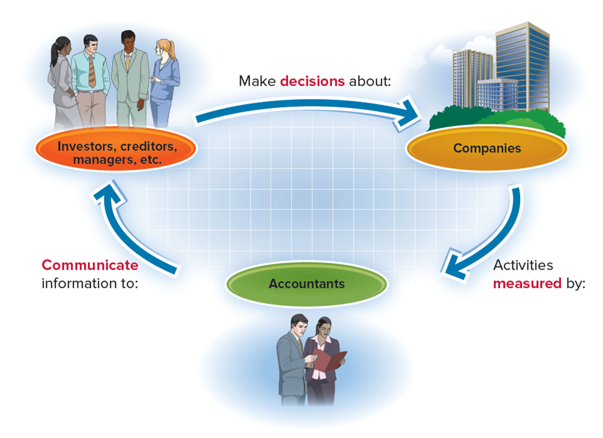
Operating activities / cash flows
•cash transactions involving revenue and expenses
•transactions related to the primary operations of the company (providing products or services to customers and the associated costs of doing so)
•i.e. rent, salaries, utilities, taxes, advertising
Investing activities / cash flows
•(cash) transactions involving the purchase and the sale of investments and long-term assets / expected to benefit company for several years
Financial activities / cash flows
•(cash) transactions company has with lenders and stockholders
Accounting Equation
Assets = Liabilities + Stockholders’ Equity (S.E.)
Assets - Liabilities = Stockholders’ Equity
Assets - Stockholders’ Equity = Liabilities

Asset
•total resources of the company
•will benefit future operations
•i.e. cash, supplies, inventory for sale to customers, buildings, land, investments
Liabilities
amount owed to creditors
Stockholders’ equity (S.E.)
owners’ claims to resources
Revenues
amounts recognized when the company sells products or provides services to customers
Expenses
costs of providing products and services and other business activities during the current period
Net income
•difference between revenues and expenses
•common names → earnings or profit.
Dividends
•cash payments to stockholders (not expenses)
•disrtibution of net income in the statement of S.E.
Net Income Equation
Revenue - Expenses
Measurement role of Accounting
•create a record of the activities of a company
•company must maintain an accurate record of assets, liabilities, S.E., revenue, expenses, and dividends
Corporation
•company that is legally separate from its owners
•stockholders have limited liability (advantage)
Sole proprietorship
business owned by 1 person
Partnership
business owned by 2+ people
The total resources of a company are referred to as:
a) Liabilities
b) Revenues
c) Assets
d) Expenses
c) Assets - resources of company that’ll benefit future operations
The amounts recorded when the company sells products or provides services to customers are referred to as:
a) Liabilities
b) Revenues
c) Assets
d) Expenses
b) Revenues
Financial Statements
•periodic reports published by the company for the purpose of communicating a company’s business activities to those outside the company
•Primary ones: income statement, statement of stockholders’ equity, balance sheet, statement of cash flows
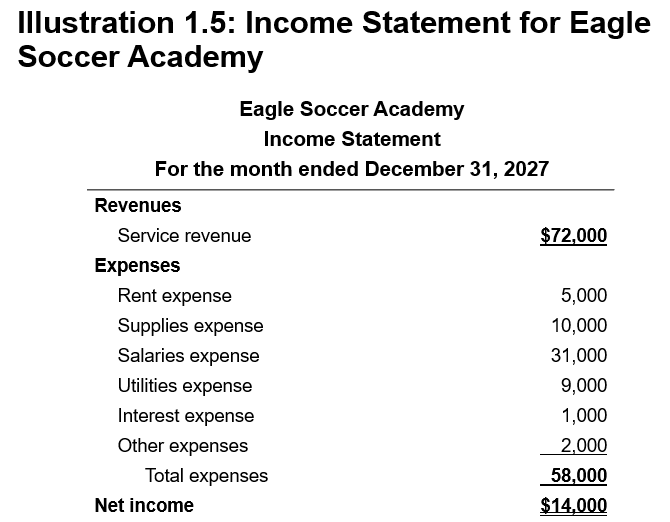
Income Statement
•reports revenues and expenses over an interval of time (current period to assess company’s ability to earn profit from running its operations)
•net income = revenue > expenses
•net loss = revenue < expenses
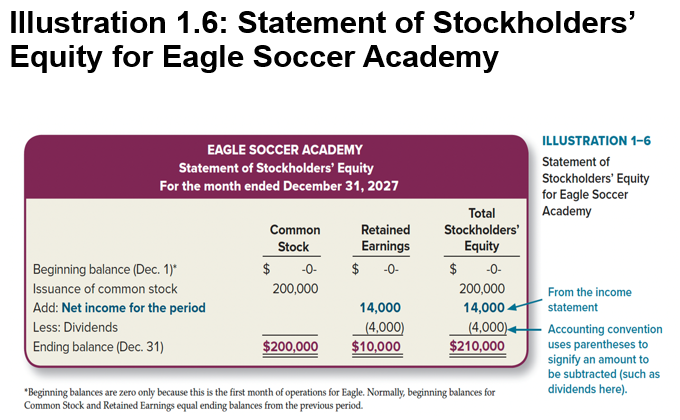
Statement of Stockholders’ Equity
•summarizes changes in stockholders’ equity over interval of time
•S.E. = Common stock (external source) + Retained Earnings (internal source)
•change in common stock and retained earnings each period
•external and internal source determine company’s value
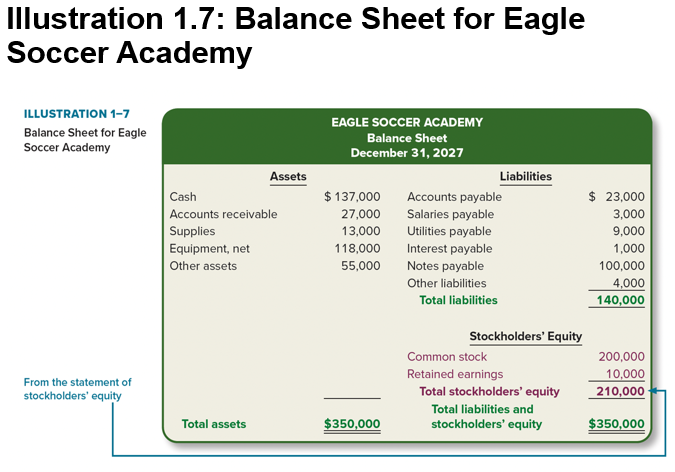
Balance Sheet
•Financial position of the company on a particular day
•Resources = Claims to Resources
•Assets = Liabilities + S.E.
Which of the following accounts would appear in a company’s income statement?
a) Accounts Payable
b) Cash
c) Dividends
d) Rent Expense
d) Rent Expense - income statement reports revenues and expenses, accounts payable (liability) and cash (asset) would be on the balance sheet while dividends would appear in the statement of stockholders’ equity
Which relationship is reflected in the balance sheet?
a) Revenues − Expenses = Net income.
b) Assets = Liabilities + Stockholders’ Equity.
c) Assets − Liabilities = Net Income.
d) Assets = Revenues + Dividends.
b) Assets = Liabilities + Stockholders’ Equity.
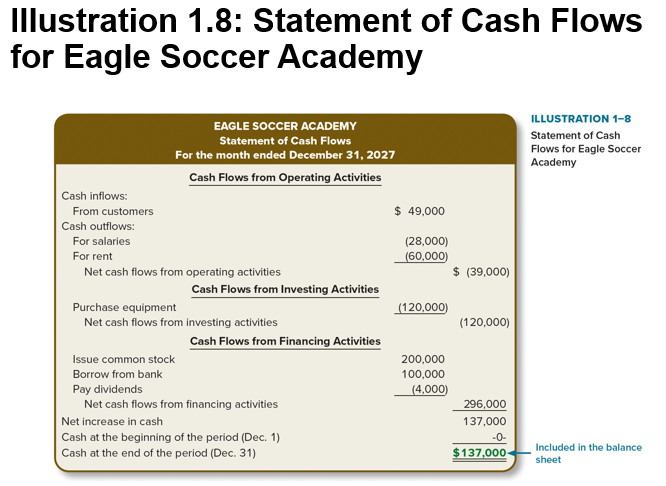
Statement of Cash Flows
•measures activities involving cash receipts and cash payments over an interval of time
•operating, investing, and financing cash flows (Oops I Forgot)
The cash collected from a customer would be recorded as which type of activity in the statement of cash flows?
a) Operating Activity.
b) Business Activity.
c) Investing Activity.
d) Financing Activity.
a) Operating Activity - include revenue and expense transaction (collecting cash is related to revenues)
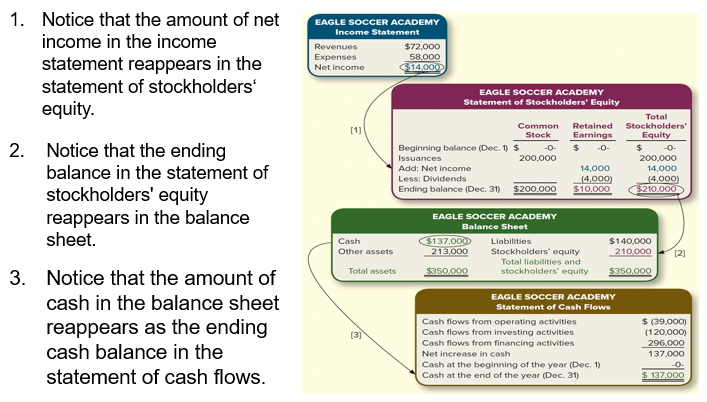
Link among Financial Statements
•net income, S.E., cash
Data Analytics
process of analyzing data to help improve decisions
Which of the following is an alternate form of the accounting equation?
1) Expenses − Dividends = Net Income
2) Assets − Liabilities = Stockholders’ Equity
3) Assets = Liabilities − Stockholders’ Equity
4) Revenues − Expenses = Net Income
2) Assets − Liabilities = Stockholders’ Equity
If stockholders’ equity is $50,000 and liabilities are $78,000, then assets must equal:
$128,000
Expenses are best defined as:
a. Costs of providing products and services.
b. Distributions to stockholders.
c. Amounts owed to creditors.
d. Amounts the owners have invested in the business.
a. Costs of providing products and services.
Which of the following is not one of the four primary financial statements?
a. Income Statement
b. Trial Balance
c. Balance Sheet
d. Statement of Cash Flows
b. Trial Balance
Use the following amounts to calculate net income: Assets, $165,000; Dividends, $9,000; Expenses, $61,000; Liabilities, $74,000; Revenues, $82,000.
$21,000
What are the primary components of stockholders’ equity?
Common Stock and Retained Earnings
Catalina Corporation begins the year with a $195,000 balance in Retained Earnings and a $320,000 balance in Common Stock. During the year, the company generated net income of $46,000, issued additional common stock for $28,000, and paid a dividend of $5,000. What is total stockholders’ equity at the end of the year?
$584,000
The balance sheet:
a) Indicates if a company is profitable.
b) Presents the financial position of a company at a point in time.
c) Shows the net change in cash over a period of time.
d) Reports the difference between revenues and expenses.
b) Presents the financial position of a company at a point in time.
Franklin Corporation has the following account balances at the end of the year. What is stockholders’ equity?
Accounts Payable | $ 17,000 |
|---|---|
Accounts Receivable | $ 23,000 |
Cash | $ 35,000 |
Equipment, net | $ 41,000 |
Notes Payable | $ 29,000 |
Salaries Payable | $ 8,000 |
Supplies | $ 3,000 |
$48,000
The statement of cash flows:
a. Indicates if a company is profitable.
b. Shows the net change in cash over a period of time.
c. Reports the difference between revenues and expenses.
d. Presents the financial position of a company at a point in time.
b. Shows the net change in cash over a period of time.
Net income appears in which two financial statements?
Income Statement and Statement of Stockholders’ Equity
Total stockholders’ equity appears in which two financial statements?
Balance Sheet and Statement of Stockholders’ Equity
The balance in the cash account appears in which two financial statements?
Balance Sheet and Statement of Cash Flows
TRUE OR FALSE: The main functions of financial accounting are to measure business activities and to communicate those measurements to investors and creditors.
True
TRUE OR FALSE: The organization primarily responsible for establishing accounting and reporting standards in the United States is the Financial Accounting Standards Board (FASB).
True
Going concerns assumption
Provides justification for measuring many assets based on their original costs instead of current liquidation values
Monetary unit assumption
A unit of scale of measurement can be used to measure financial statement elements
Periodicity assumption
The economic life of an enterprise can be divided into artificial time periods for financial recording
Economic entity assumption
All economic events with a particular economic entity can be identified
In financial accounting which of the following are the three types of business activities of a company?
Financing activities, operating activities, investing activities
Which of the following items are liabilities?
1) Wages and salaries payable
2) Supplies inventory
3) Cash held in checking account
4) Notes payable
1) Wages and salaries payable
4) Notes payable
The system that maintains records of a company's operations and then communicates that information to decision makers is referred to as ___.
accounting
For a corporation, the owners’ claims to the resources of a company are called:
Stockholders’ equity
Using the accounting equation, stockholders’ claims on the resources of the corporation can be expressed as
Assets - liabilities
TRUE OR FALSE: The fundamental activities of a business are selling activities and marketing activities.
False
The amount recorded as a result of the sale of products or services to customers is called
revenue
Which of the following item(s) is (are) assets?
1) Accounts payable
2) Common stock
3) Inventory
4) Supplies
3) Inventory
4) Supplies
A(n) ___ is a cost of doing business that is necessary to produce ___.
Expense / revenue
Amounts owed to creditors are:
Liabilities
Revenues minus expenses equals:
Net income
Stockholders’ equity is:
1) resources owned by a company
2) owners' claim to resources of the corporation
3) amounts owned by a corporation
2) owners' claim to resources of the corporation
Identify the 3 most common forms of business organization
Corporation, sole proprietorship, partnership
Which of the following are financial statements?
a. statement of corporate responsibility
b. income statement
c. statement of assets
d. balance sheet
e. statement of stockholders’ equity
b. income statement
d. balance sheet
e. statement of stockholders’ equity
Revenues are:
1) Amounts that owners have contributed directly to the business
2) Cash payments that a business has made directly to its owners
3) The amount of cash a company has left after it has paid its obligations
4) Amounts owed to creditors
5) Sales of goods and services to customers
5) Sales of goods and services to customers
An income statement reports: (Select all that apply.)
a. Amounts contributed by stockholders
b. Cash
c. Revenues
d. Net income or loss
e. Expenses
c. Revenues
d. Net income or loss
e. Expenses
Expenses are
a. amounts paid to stockholders for their investment
b. always less than revenues
c. equal to a company's liabilities
d. the costs of doing business that are necessary to produce revenue
d. the costs of doing business that are necessary to produce revenue
An income statement includes which of the following items? (Select all that apply)
a. Expenses
b. Revenues
c. Net income
d. Cash
a. Expenses
b. Revenues
c. Net income
Net income equals:
a. revenues plus expenses
b. revenues minus expenses
c. assets minus liabilities
d. revenues minus expenses minus dividends
b. revenues minus expenses
Which of the following appear on the statement of stockholders' equity?
a. Net income
b. Dividends
c. Cash received during the accounting period
d. Beginning balance of retained earnings
e. Property, plant, and equipment
a. Net income
b. Dividends
d. Beginning balance of retained earnings
Gem Corporation is a new company and obtains financing by issuing common stock to investors for $30,000. During the year, Gem earns $8,000 in net income and pays stockholders a dividend of $5,000. What is the total stockholders' equity at the end of the year?
$33,000
What accounts are stockholders’ equity accounts?
Common stock and retained earnings
The financial statement that summarizes revenues and expenses for a period of time is the ___ statement.
income
The accumulated net income earned since the inception of the corporation and not yet paid to shareholders is referred to as ___ ___.
retained earnings
Which of the following line items appear on an income statement?
- Service revenue
- Supplies expense
- Salaries expense
- Accounts payable
- Supplies inventory
- Cash
- Service revenue
- Supplies expense
- Salaries expense
Quartz Instruments had retained earnings of $145,000 at December 31, 2017. Net income for 2018 was $90,000, and dividends for 2018 were $30,000. What amount of retained earnings should be reported at December 31, 2018?
$205,000
The two sources of stockholders' equity are amounts ______.
- earned by the corporation
- paid in from shareholders
Profits earned by a company that have not been paid to stockholders are called ___ earnings
Retained
Rahls issues stock to investors for $20,000, and has $5,000 of net income in its first year of operations. During Year 2, Rahls earns $10,000 in net income and pays a dividend to stockholders of $4,000. What is the balance in stockholders' equity at the end of year 2?
$31,000
Which of the following financial statements shows a firm's financial position on a particular date?
balance sheet
Which of the following represents the net income earned by a corporation and not yet paid to shareholders?
Retained earnings
Keepers, Inc.'s balance sheet reported retained earnings as $10,000 at December 31, 2017 and $12,000 at the December 31, 2018. The income statement reported net income of $3,000 for the year ended December 31, 2018. Dividends declared for the year ended December 31, 2018 must equal $___.
1000
A balance sheet lists the assets, ___, and stockholders’ equity as of a specific date.
liabilities
Many liabilities are referred to as ___ to indicate that amounts must be paid
payables
Which financial statement presents the financial position of a company on a particular date?
balance sheet
The balance sheet shows that a company's resources equal _____ claims to those resources.
creditors claims plus owners' claim to those resources
Retained earnings formula
Ending RE = beginning RE + net income - dividends
Which of these appears on both the statement of stockholders’ equity and the balance sheet?
Retained earnings
Accounts that include the term "payable" typically are classified as
liabilities
A company owns an economic resource that will provide it with future benefits. This economic resource is:
an asset
which of these would be found on a company's balance sheet?
a. sales revenue
b. notes payable
c. accounts receivable
d. equipment
e. depreciation expense
b. notes payable
c. accounts receivable
d. equipment
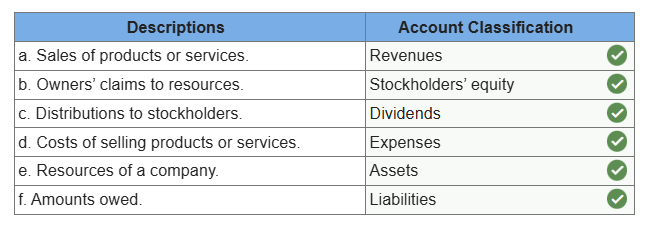
Match the account classification with the description:
a. Sales of products or services. | Revenuesselected answer correct |
b. Owners’ claims to resources. | Stockholders’ equityselected answer correct |
c. Distributions to stockholders. | Dividendsselected answer correct |
d. Costs of selling products or services. | Expensesselected answer correct |
e. Resources of a company. | Assetsselected answer correct |
f. Amounts owed. |
a. Revenues
b. Stockholders’ equity
c. Dividends
d. Expenses
e. Assets
f. Liabilities
Indicate whether each account would be classified in the balance sheet as an asset, liability, or S.E., in the income statement as revenue or expense, or in the statement of stockholders’ equity as a dividend.
Accounts | Related Transactions | Account Classification |
Rent expense | Cost of rent. | Expenseselected answer correct |
Interest revenue | Interest earned on savings account. | Revenueselected answer correct |
Dividends | Cash payments to stockholders. | Dividendselected answer correct |
Land | Land used for operations. | Assetselected answer correct |
Accounts payable | Amounts owed to suppliers. |
Expense
Revenue
Dividend
Asset
Liability
Items | Financial Statements |
a. The change in retained earnings due to net income and dividends. | |
b. Amount of cash received from borrowing money from a local bank. | |
c. Revenue from sales to customers during the year. | |
d. Total amounts owed to workers at the end of the year. |
Select the financial statement to which the item belongs.
a. Statement of stockholders’ equity
b. Statement of cash flows
c. Income statement
d. Balance sheet
Eagle Corporation operates Magnetic Resonance Imaging (MRI) clinics throughout the Northeast. At the end of the current period, the company reports the following amounts: Assets = $34,000; Liabilities = $19,000; Dividends = $1,400; Revenues = $10,800; Expenses = $7,400.
Calculate net income.
Calculate stockholders' equity at the end of the period.
1. $3,400
2. $15,000
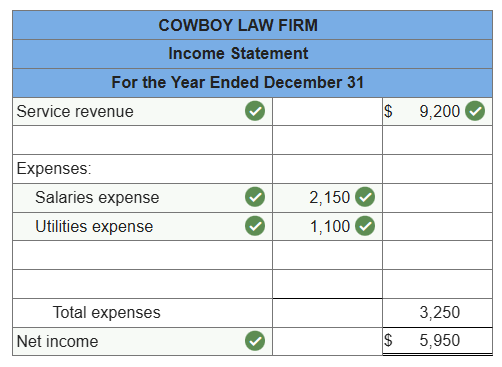
Below are the account balances for Cowboy Law Firm on December 31.
Accounts | Balances |
|---|---|
Cash | $5,300 |
Salaries expense | 2,150 |
Accounts payable | 3,300 |
Retained earnings | 3,850 |
Utilities expense | 1,100 |
Supplies | 13,700 |
Service revenue | 9,200 |
Common stock | 5,900 |
Use only the appropriate accounts to prepare an income statement for the year ended December 31.
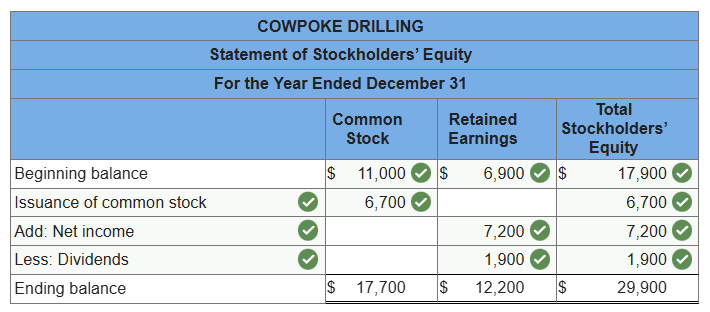
At the beginning of the year (January 1), Cowpoke Drilling has $11,000 of common stock outstanding and retained earnings of $6,900. During the year, Cowpoke reports net income of $7,200 and pays dividends of $1,900. In addition, Cowpoke issues additional common stock for $6,700.
Required:
Prepare the statement of stockholders' equity for the year ended December 31.
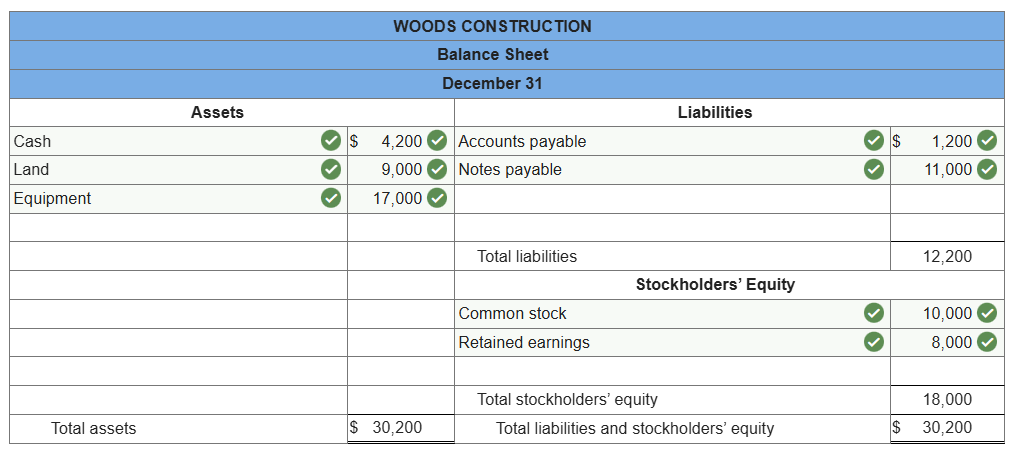
Woods Construction has the following account balances on December 31.
Accounts | Balances |
|---|---|
Equipment | $17,000 |
Accounts payable | 1,200 |
Salaries expense | 24,000 |
Common stock | 10,000 |
Land | 9,000 |
Notes payable | 11,000 |
Service revenue | 30,000 |
Cash | 4,200 |
Retained earnings | ?question mark |
Required:
Use only the appropriate accounts to prepare a balance sheet on December 31.
Retained earnings:
Assets | = | Liabilities | + | Stockholders' Equity |
|---|---|---|---|---|
$30,200 | = | $12,200 | + | ($10,000 + Retained earnings) |
$30,200 | − | $12,200 | − | $10,000 = Retained earnings |
|
|
|
| $8,000 = Retained earnings |