201 Final

0.0(0)
Studied by 0 people
call kaiCall Kai
learnLearn
examPractice Test
spaced repetitionSpaced Repetition
heart puzzleMatch
flashcardsFlashcards
GameKnowt Play
Card Sorting

1/472

encourage image

There's no tags or description

Looks like no tags are added yet.

Last updated 7:06 PM on 4/15/26
Name
Mastery
Learn
Test
Matching
Spaced
Call with Kai

No analytics yet

Send a link to your students to track their progress

473 Terms

1
New cards
"What is autophagy and its main function?"
"Autophagy self eating is a cellular degradation process that delivers intracellular components to lysosomes. It removes defective organelles old proteins aggregates and pathogens maintaining cellular homeostasis."
2
New cards
"What are the key roles of autophagy?"
"1) Cellular cleanup damaged organelles proteins 2) Recycling amino acids lipids sugars 3) Stress response starvation survival 4) Defense against pathogens."
3
New cards
"How does autophagy extend the central dogma?"
"Traditional DNA → RNA → Protein. Expanded DNA → RNA → Protein → Folding → Trafficking → Turnover autophagy. Proteins are continuously replaced ~3 months lifespan."
4
New cards
"Who were the key contributors to autophagy discovery?"
"Keith Porter 1962 first observed autophagy Christian de Duve lysosome discovery Nobel Prize Yoshinori Ohsumi ATG genes yeast work Nobel Prize."
5
New cards
"Why was autophagy difficult to study initially?"
"Basal autophagy is very low and lacked markers. It became observable only under stress e.g. starvation causing a ~30 year delay in mechanistic understanding."
6
New cards

"What are the 4 main steps of autophagy?"

"1) Induction & nucleation near ER omegasome 2) Expansion phagophore growth 3) Maturation autophagosome formation 4) Fusion with lysosome and degradation."
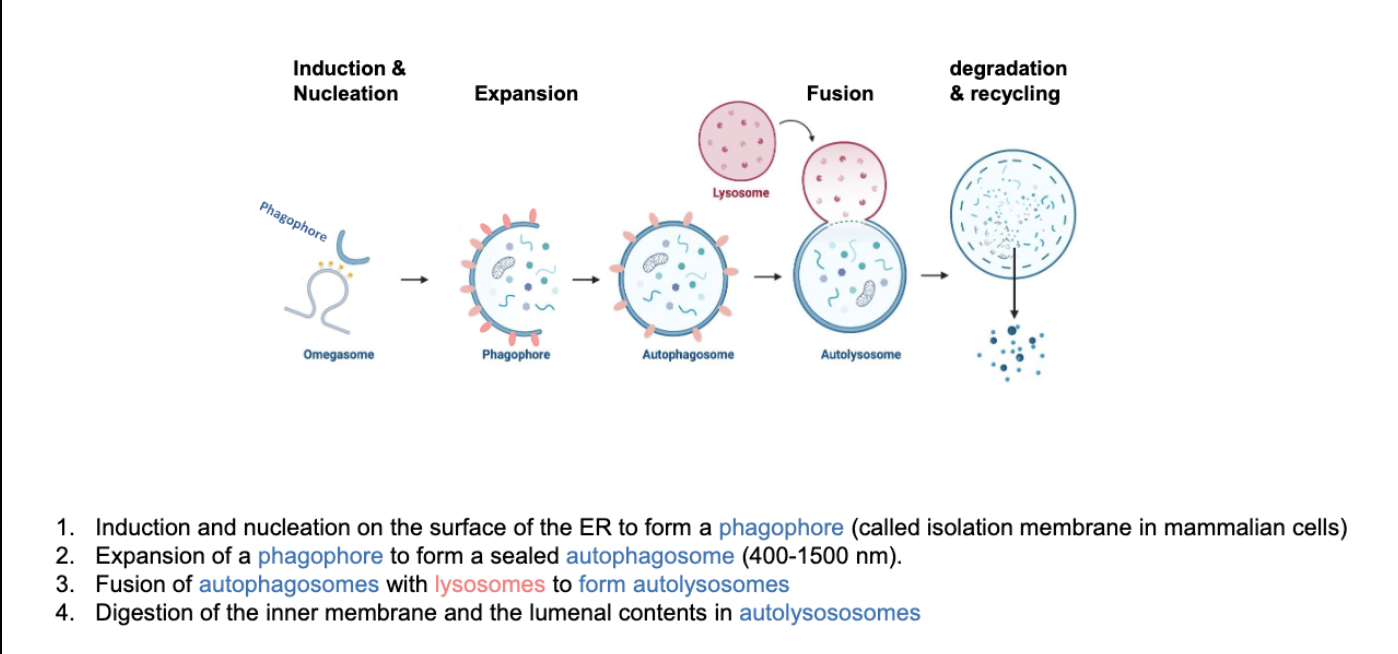
<p>"1) Induction &amp; nucleation near ER omegasome 2) Expansion phagophore growth 3) Maturation autophagosome formation 4) Fusion with lysosome and degradation."</p>
7
New cards

"How is autophagy initiation regulated by ATG1?"

"ATG1 kinase requires ATG13. In nutrient rich conditions ATG13 is phosphorylated, inactive. In starvation, it is dephosphorylated, binds ATG1, and activates autophagy."
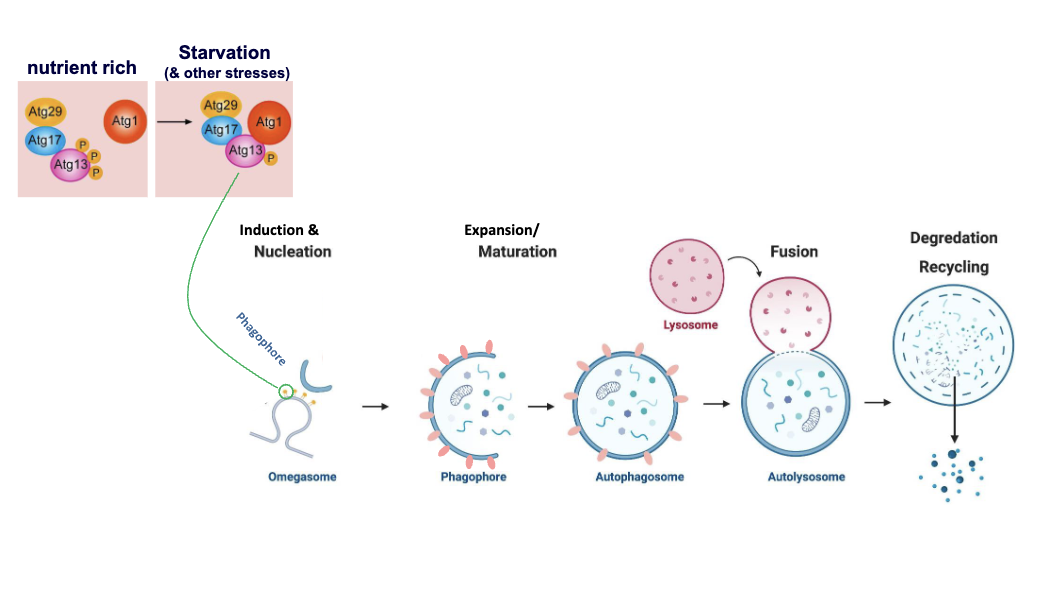
<p>"ATG1 kinase requires ATG13. In nutrient rich conditions ATG13 is phosphorylated, inactive. In starvation, it is dephosphorylated, binds ATG1, and activates autophagy."</p>
8
New cards

"What is the role of ATG8 LC3?"

"Exists as LC3 I, cytosolic, and LC3 II, lipidated. Promotes membrane expansion binds cargo via receptors and serves as a key autophagy marker."
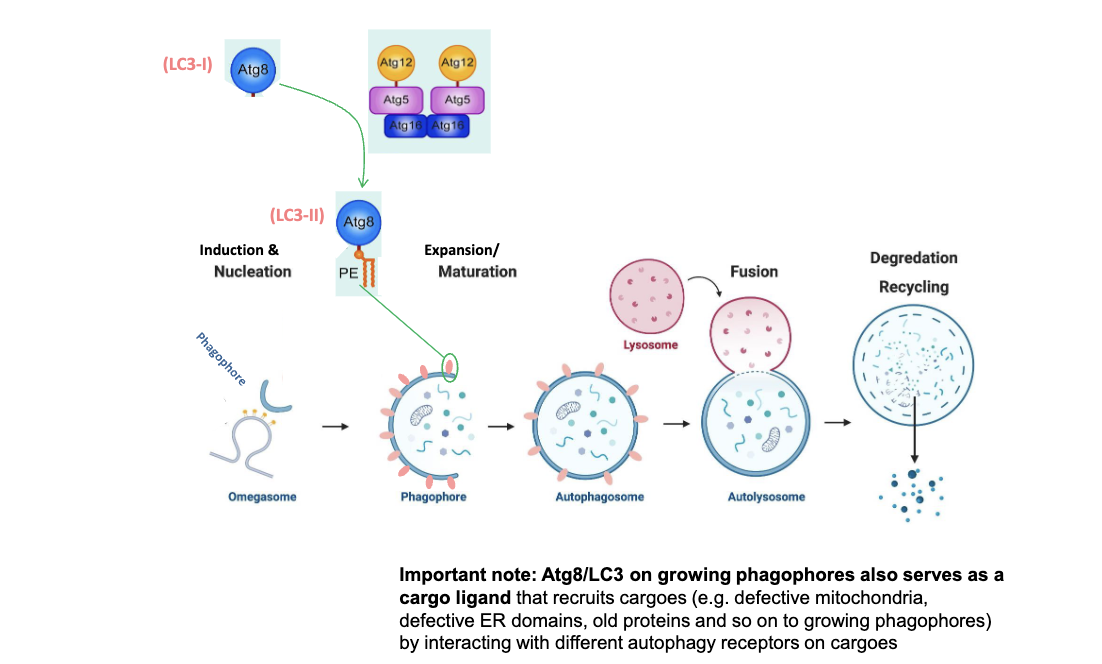
<p>"Exists as LC3 I, cytosolic, and LC3 II, lipidated. Promotes membrane expansion binds cargo via receptors and serves as a key autophagy marker."</p>
9
New cards

"How is ATG8 activated?"

"ATG8 is lipidated with phosphatidylethanolamine PE via ATG12- ATG5 -ATG16 complex, allowing it to attach to autophagosome membranes and drive growth."
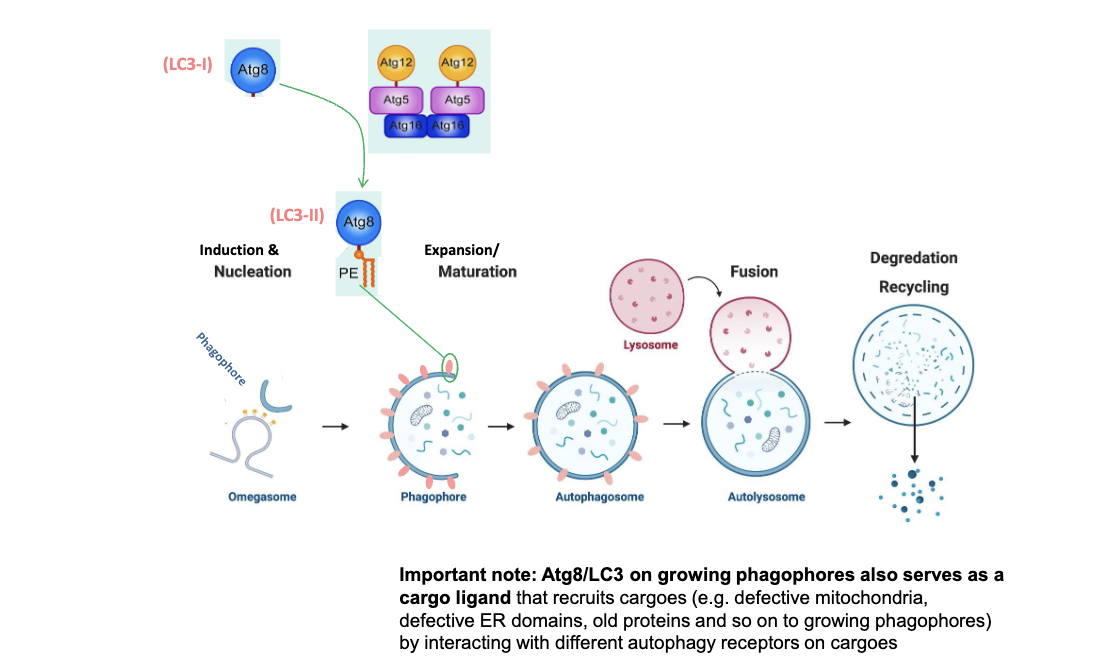
<p>"ATG8 is lipidated with phosphatidylethanolamine PE via ATG12- ATG5 -ATG16 complex, allowing it to attach to autophagosome membranes and drive growth."</p>
10
New cards

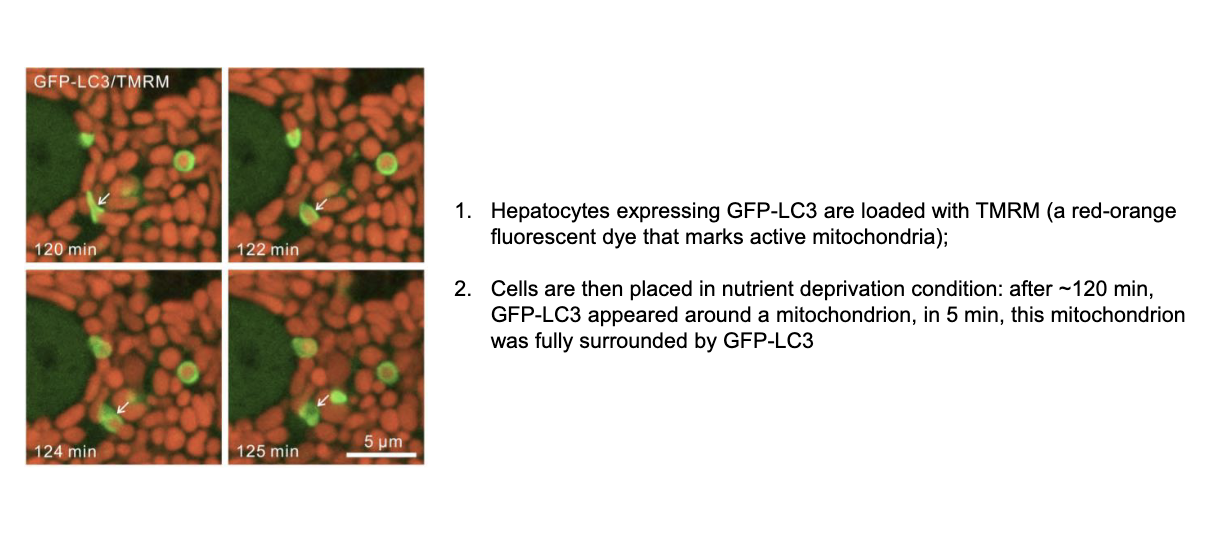
Mitophagy visualized by LC3

knowt flashcard image
11
New cards

"How does mitophagy work?"

"Damaged mitochondria accumulate PINK1 → activates Parkin → ubiquitinates mitochondrial proteins → recruits receptors → LC3 binds → autophagosome forms → degradation."
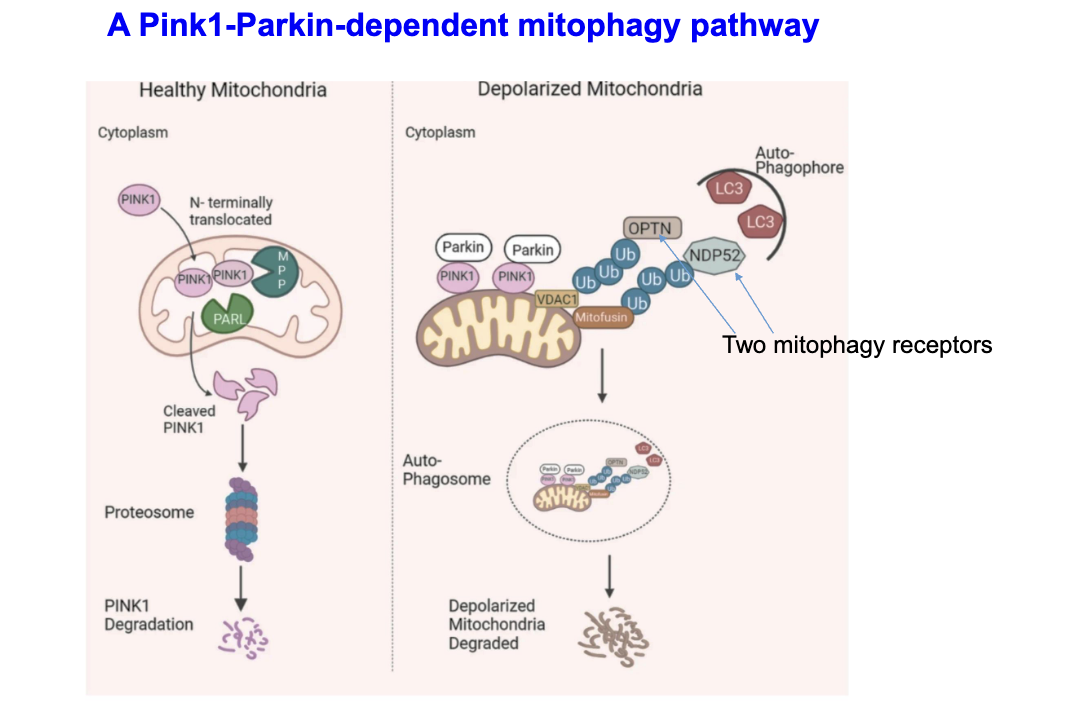
<p>"Damaged mitochondria accumulate PINK1 → activates Parkin → ubiquitinates mitochondrial proteins → recruits receptors → LC3 binds → autophagosome forms → degradation."</p>
12
New cards

"What is required for autophagosome lysosome fusion?"

"Requires Rab GTPases tethering factors ATG14 and SNARE proteins. ATG8 must be removed before fusion occurs."
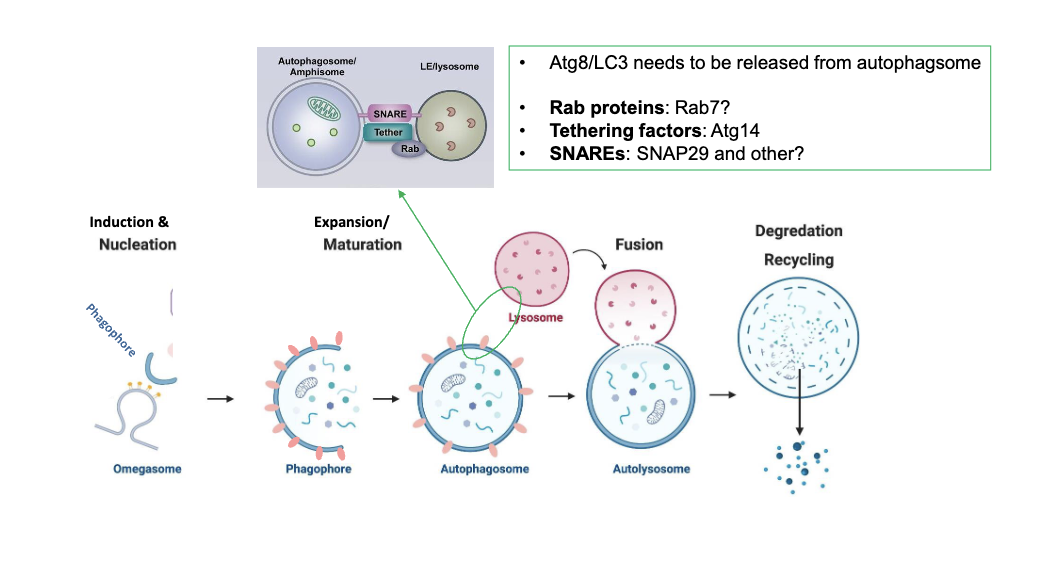
<p>"Requires Rab GTPases tethering factors ATG14 and SNARE proteins. ATG8 must be removed before fusion occurs."</p>
13
New cards
"Why is autophagy important after birth?"
"Newborns experience nutrient deprivation after birth. Autophagy provides internal nutrients. ATG5 knockout mice die within 24 hours showing its necessity."
14
New cards

"How does autophagy defend against viruses?"

"Viral proteins are ubiquitinated, recognized by autophagy receptors, and delivered to lysosomes for degradation. e.g. measles herpes viruses."
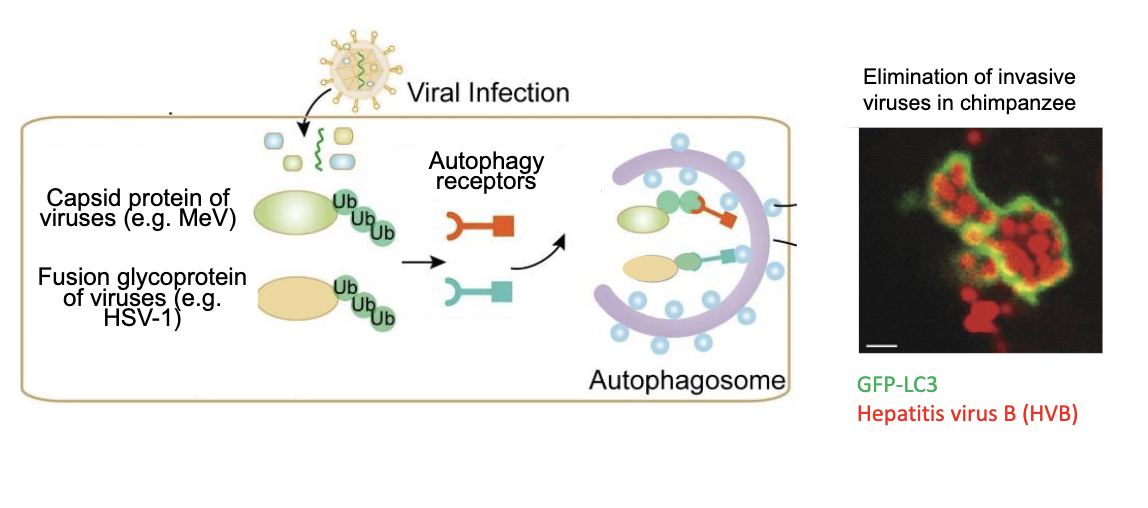
<p>"Viral proteins are ubiquitinated, recognized by autophagy receptors, and delivered to lysosomes for degradation. e.g. measles herpes viruses."</p>
15
New cards

"How does SARS CoV 2 evade autophagy?"

"Escapes endosomes, then uses ORF7a protein to block autophagosome, lysosome fusion, preventing degradation and allowing viral release."
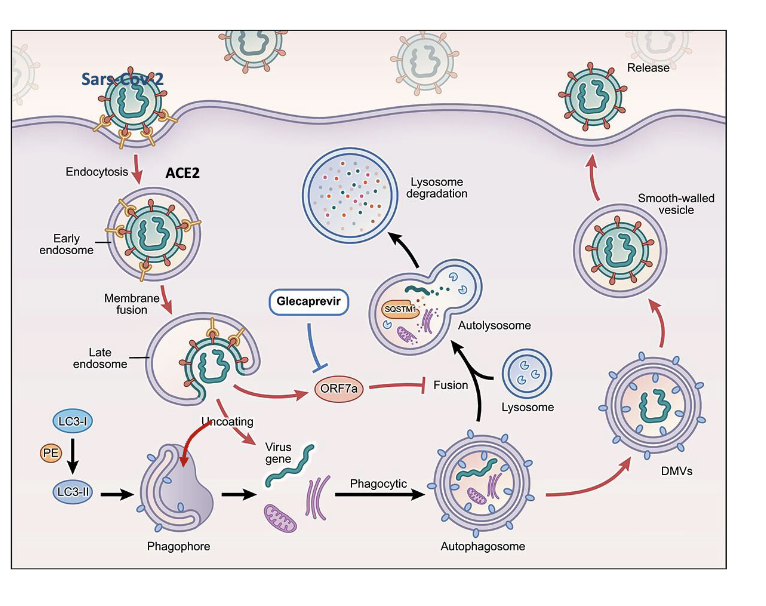
<p>"Escapes endosomes, then uses ORF7a protein to block autophagosome, lysosome fusion, preventing degradation and allowing viral release."</p>
16
New cards
"Why is autophagy essential for life and evolution?"
"Enables constant recycling and renewal of cellular components. Maintains balance between synthesis and degradation distinguishing living systems from machines."
17
New cards
"What are the key takeaways about autophagy?"
"It is a universal recycling system removes damage provides nutrients activated by stress controlled by ATG proteins and essential for survival development and immunity."
18
New cards
"What determines the shape of cells?"
"Cell shape is determined by the cytoskeleton which is an internal network of protein filaments analogous to a skeleton. Different arrangements of cytoskeletal components produce different cell shapes despite identical genomes."
19
New cards
"Why can cells with the same genome have different shapes?"
"Cells express and organize cytoskeletal components differently. The cytoskeleton arrangement determines morphology allowing neurons muscle cells and epithelial cells to have distinct shapes."
20
New cards

"What is the cytoskeleton?"

"The cytoskeleton is a dynamic network of protein polymers that provides structure organization intracellular transport and enables cell motility."
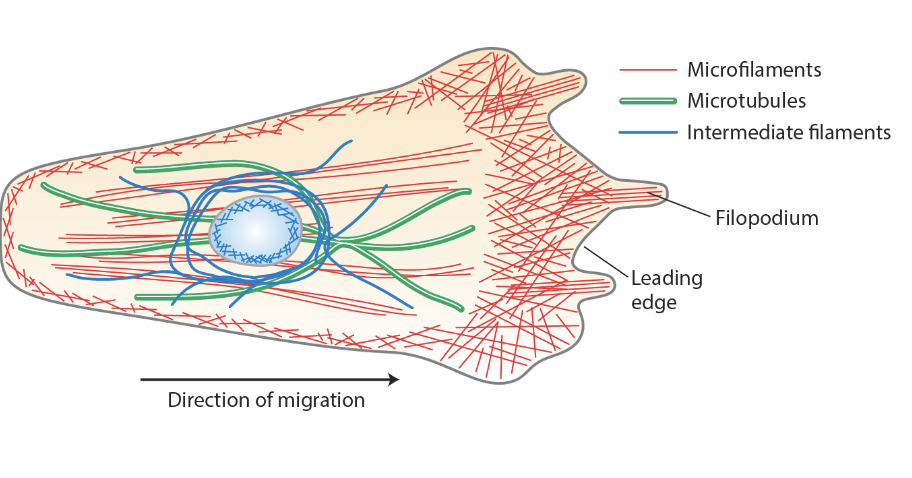
<p>"The cytoskeleton is a dynamic network of protein polymers that provides structure organization intracellular transport and enables cell motility."</p>
21
New cards
"What are the three main components of the cytoskeleton?"
"Microfilaments actin filaments microtubules tubulin polymers and intermediate filaments various proteins. Together they provide structure transport and mechanical support."
22
New cards
"What are the main functions of the cytoskeleton?"
"Maintains cell shape provides structural stability enables intracellular transport organizes cell compartments and drives cell movement and contraction."
23
New cards
"What do all cytoskeletal components have in common?"
"They are polymers made of protein subunits that dynamically assemble and disassemble allowing cells to change shape and move."
24
New cards
"What are microtubules like mechanically?"
"Microtubules are stiff hollow tubes like poles that resist compression and provide structural support and tracks for transport."
25
New cards
"What are actin filaments like mechanically?"
"Actin filaments are flexible like wires with high tensile strength meaning they resist pulling forces but bend easily."
26
New cards
"What are intermediate filaments like mechanically?"
"Intermediate filaments are elastic like ropes meaning they can stretch and return to original length providing mechanical resilience."
27
New cards
"What is a tensegrity structure?"
"A tensegrity structure is stabilized by tension rather than compression. Cytoskeleton uses tension between filaments to maintain cell shape."
28
New cards
"How is the cytoskeleton similar to tensegrity structures?"
"Cells maintain shape through balanced tension between actin microtubules and intermediate filaments rather than rigid compression like buildings."
29
New cards
"What is cell polarity?"
"Cell polarity is the ability of a cell to distinguish different regions such as apical and basolateral domains and localize proteins appropriately."
30
New cards
"How do epithelial cells organize proteins?"
"They separate apical and basolateral domains placing nutrient transporters in the apical region facing the lumen and other proteins in different regions."
31
New cards
"How do cells transport cargo internally?"
"Motor proteins move vesicles along cytoskeletal tracks especially microtubules enabling directed transport inward and outward."
32
New cards
"What is cell motility?"
"Cell motility is the ability of cells to move by reorganizing their cytoskeleton especially actin filaments."
33
New cards
"How do cells move?"
"Cells extend forward using actin polymerization attach to a surface move the cell body forward and release the rear attachment."
34
New cards
"What is the lamellipodium?"
"The lamellipodium is a broad flat actin rich protrusion at the leading edge of a moving cell that pushes the membrane forward."
35
New cards
"What are stress fibers?"
"Stress fibers are bundles of actin filaments that generate contractile forces and help pull the rear of the cell forward."
36
New cards

"What is actin?"

"Actin is a protein that binds ATP and polymerizes into filaments forming a major component of the cytoskeleton."
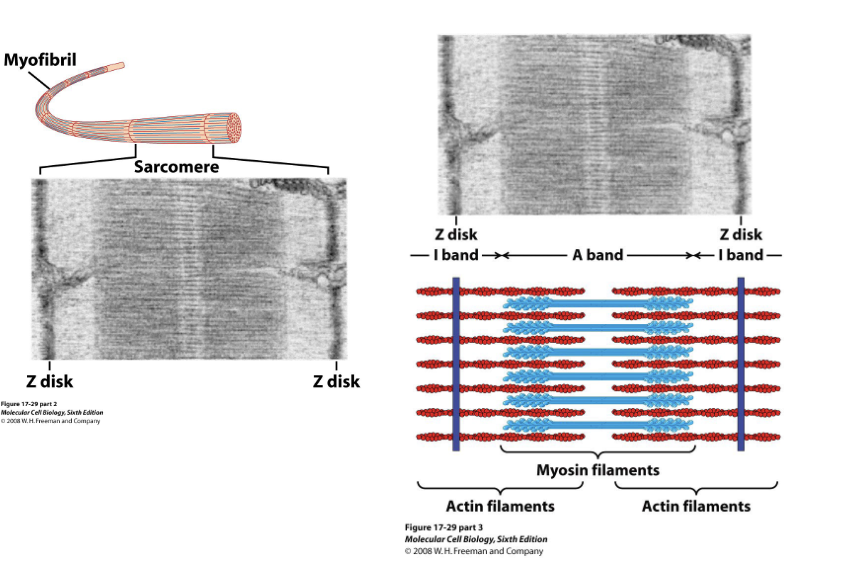
<p>"Actin is a protein that binds ATP and polymerizes into filaments forming a major component of the cytoskeleton."</p>
37
New cards
"What is G actin?"
"G actin is globular actin the monomeric form that diffuses in the cytoplasm before polymerization."
38
New cards
"What is F actin?"
"F actin is filamentous actin a polymer formed by the assembly of actin monomers into long filaments."
39
New cards
"What is actin filament structure?"
"Actin forms a two stranded helical filament composed of repeating actin subunits forming a polar structure."
40
New cards
"What does polarity of actin filament mean?"
"Actin filaments have a plus end and minus end due to asymmetry in subunits which affects growth rates and dynamics."
41
New cards
"What is nucleation in actin polymerization?"
"Nucleation is the formation of an initial stable cluster of actin monomers usually three which is the rate limiting step."
42
New cards
"What is elongation in actin polymerization?"
"Elongation is the rapid addition of actin monomers to filament ends after nucleation forming long polymers."
43
New cards
"What is steady state in actin dynamics?"
"Steady state occurs when the rate of addition of actin equals the rate of loss resulting in constant filament length."
44
New cards
"What is critical concentration?"
"Critical concentration is the actin concentration at which addition and loss rates are equal for a filament end."
45
New cards
"How do plus and minus ends differ in actin?"
"Plus end has lower critical concentration and grows faster while minus end has higher critical concentration and grows slower."
46
New cards
"What is actin treadmilling?"
"Treadmilling is when actin filaments grow at the plus end and shrink at the minus end causing apparent movement of the filament."
47
New cards
"Why is treadmilling important?"
"It allows dynamic rearrangement of actin filaments enabling cell movement and rapid cytoskeletal remodeling."
48
New cards
"How is actin organized in different structures?"
"Actin can form bundles networks rings or branched structures depending on cellular function and regulatory proteins."
49
New cards
"What is the actin cortex?"
"The actin cortex is a cross linked meshwork beneath the plasma membrane providing mechanical support and shape."
50
New cards
"What are microvilli composed of?"
"Microvilli contain parallel bundles of actin filaments that form protrusions increasing surface area for absorption."
51
New cards
"What is a dendritic actin network?"
"A dendritic network is a branched array of actin filaments found in lamellipodia driving cell movement."
52
New cards
"What role does ATP play in actin function?"
"Actin binds and hydrolyzes ATP which provides energy for polymerization and dynamic behavior."
53
New cards
"How do cells control actin organization?"
"Cells use regulatory proteins to nucleate elongate stabilize sever bundle and branch actin filaments."
54
New cards
"What is focal adhesion?"
"Focal adhesion is a protein complex that anchors the cell to a surface acting like a foot during cell movement."
55
New cards
"How does cell movement resemble human movement?"
"Cells extend forward attach pull their body forward and release the rear similar to walking."
56
New cards
"Why is the cytoskeleton dynamic?"
"Because filaments constantly assemble and disassemble allowing rapid changes in shape organization and movement."
57
New cards
Front
Back
58
New cards
"What is a dendritic actin network?"
"A dendritic actin network is a branched tree like structure of actin filaments formed by nucleation of daughter filaments off mother filaments typically at the leading edge of migrating cells."
59
New cards
"Why is actin organization different in different parts of the cell?"
"Cells actively regulate actin filament length number orientation and bundling using regulatory proteins to create structures suited for specific functions."
60
New cards
"What are the three phases of actin polymerization?"
"Nucleation formation of a stable nucleus elongation rapid addition of monomers and steady state where addition equals loss."
61
New cards
"Why is nucleation the slow step in actin polymerization?"
"It requires three actin monomers to collide in the correct orientation simultaneously which is statistically rare."
62
New cards
"What determines steady state in actin filaments?"
"Steady state occurs when the rate of addition of actin subunits equals the rate of loss resulting in constant filament length."
63
New cards
"What is the equation for net actin growth?"
"Net growth equals kon times actin concentration minus koff representing addition minus dissociation."
64
New cards
"Why are on rate constants concentration dependent?"
"More actin monomers in solution increase collision frequency with filament ends leading to higher binding rates."
65
New cards
"Why are off rate constants not concentration dependent?"
"Dissociation depends on thermal motion at the filament end and not on actin concentration in solution."
66
New cards
"What is actin treadmilling?"
"Actin treadmilling occurs when the plus end grows while the minus end shrinks causing the filament to move without changing length."
67
New cards
"How do cells use treadmilling for movement?"
"Cells polymerize actin at the front and depolymerize at the back creating directional movement of the cytoskeleton."
68
New cards
"What are actin regulators?"
"Proteins that control actin dynamics including nucleation elongation severing capping and cross linking."
69
New cards
"What do formins do?"
"Formins promote actin filament elongation by accelerating addition of actin subunits at filament ends."
70
New cards
"What does cofilin do?"
"Cofilin binds ADP actin filaments and severs them by altering filament twist leading to depolymerization."
71
New cards
"What do capping proteins do?"
"Capping proteins bind filament ends to prevent further polymerization stopping growth."
72
New cards
"What is the ARP2 3 complex?"
"A protein complex that nucleates branched actin filaments by mimicking an actin nucleus and forming daughter filaments at 70 degree angles."
73
New cards
"How does ARP2 3 create branches?"
"It binds to the side of a mother filament and nucleates a daughter filament at a precise 70 degree angle."
74
New cards
"Why is the 70 degree branching angle important?"
"It optimizes force generation by allowing efficient insertion of actin monomers during membrane pushing."
75
New cards
"What activates the ARP2 3 complex?"
"WASP family proteins bind actin and ARP2 3 and induce a conformational change enabling nucleation."
76
New cards
"What is WASP protein function?"
"WASP proteins activate ARP2 3 by bringing ARP2 and ARP3 together and delivering actin monomers."
77
New cards
"What is Wiskott Aldrich syndrome?"
"A genetic disorder caused by mutations in WASP leading to impaired actin dynamics and defective immune cell migration."
78
New cards
"What is a lamellipodium?"
"A flat protrusive structure at the leading edge of migrating cells composed of branched actin networks."
79
New cards
"How does the lamellipodium maintain constant thickness?"
"Actin polymerizes at the front while depolymerizing at the back keeping overall thickness stable."
80
New cards
"What is futile actin polymerization?"
"Polymerization of actin filaments that do not contribute to movement wasting cellular resources."
81
New cards
"How do cells prevent futile polymerization?"
"They use capping proteins to stop growth of non productive filaments."
82
New cards
"What is profilin?"
"Profilin is a protein that binds actin monomers promotes ADP to ATP exchange and facilitates recycling."
83
New cards
"How does profilin promote actin polymerization?"
"It converts ADP actin to ATP actin and directs it to the plus end for growth."
84
New cards
"Why does profilin block minus end growth?"
"It binds the surface required for minus end addition preventing actin from binding there."
85
New cards
"What is cofilin mechanism of action?"
"Cofilin binds ADP actin filaments changes their twist and induces mechanical strain leading to severing."
86
New cards
"What is the role of actin severing?"
"Severing increases filament ends and accelerates depolymerization allowing rapid recycling of actin."
87
New cards
"What is thymosin beta four?"
"A protein that sequesters actin monomers preventing polymerization until needed."
88
New cards
"What is cross linking in actin networks?"
"Cross linking proteins bind multiple actin filaments together to form bundles or networks."
89
New cards
"How do fimbrin and alpha actinin differ?"
"Fimbrin creates tight bundles while alpha actinin creates looser bundles allowing other proteins to fit between filaments."
90
New cards
"What is filamin?"
"A flexible actin cross linker that supports diverse filament orientations especially in dynamic networks."
91
New cards
"What is the role of actin in cell movement?"
"Actin polymerization pushes the membrane forward while depolymerization recycles subunits enabling movement."
92
New cards
"How does actin push the membrane?"
"Actin inserts new subunits into gaps created by Brownian motion of the membrane generating force."
93
New cards
"What is Brownian ratchet mechanism?"
"A process where thermal motion creates space for actin insertion preventing membrane retraction and producing forward movement."
94
New cards
"What is Listeria and its relation to actin?"
"Listeria is a bacteria that hijacks host actin to form comet tails that propel it through cells."
95
New cards
"What is a Listeria comet tail?"
"A structure of polymerized actin behind the bacteria that pushes it through the cytoplasm."
96
New cards
"How does Listeria activate actin polymerization?"
"It expresses ActA protein which mimics WASP and activates ARP2 3."
97
New cards
"Why is Listeria useful for studying actin?"
"It provides a model system to study actin based motility and regulation in controlled conditions."
98
New cards
"What is reconstitution of actin motility?"
"An experimental system where purified proteins recreate actin driven movement in vitro."
99
New cards
"Why is capping protein concentration important?"
"Too little causes wasted polymerization too much prevents growth optimal levels allow efficient movement."
100
New cards
"What happens if capping protein is absent?"
"Actin polymerizes in incorrect directions forming disorganized networks reducing movement efficiency."